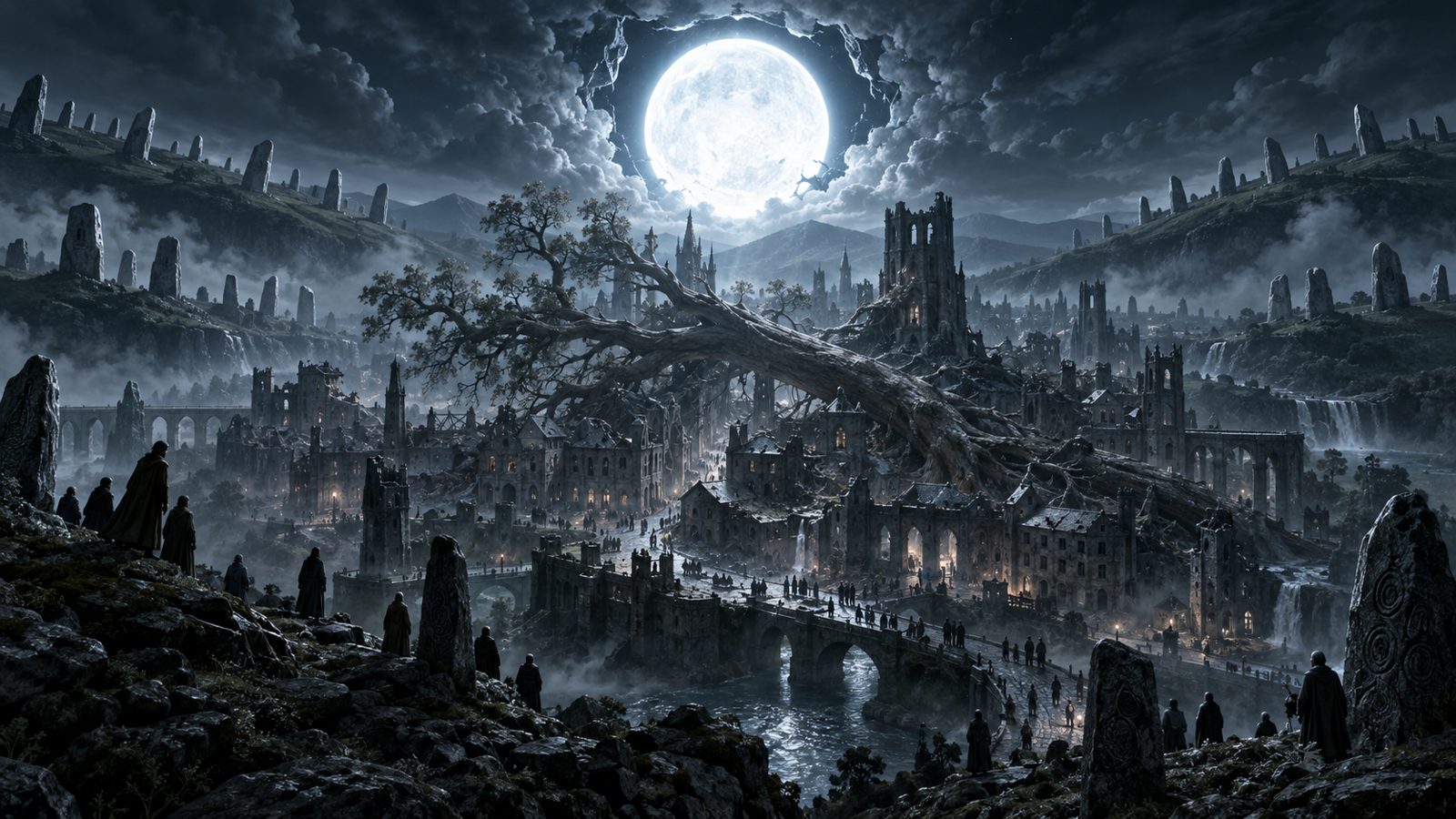
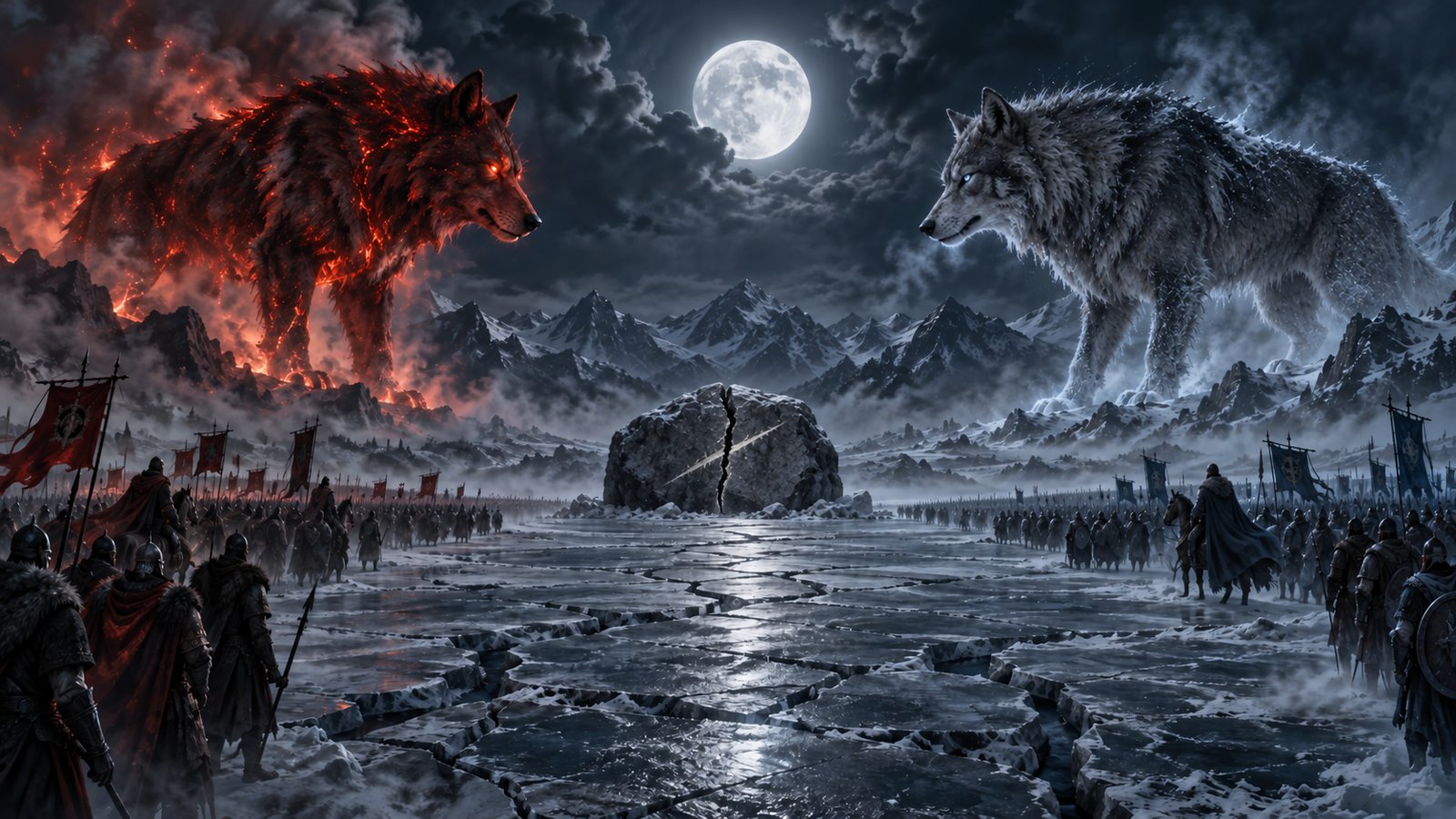
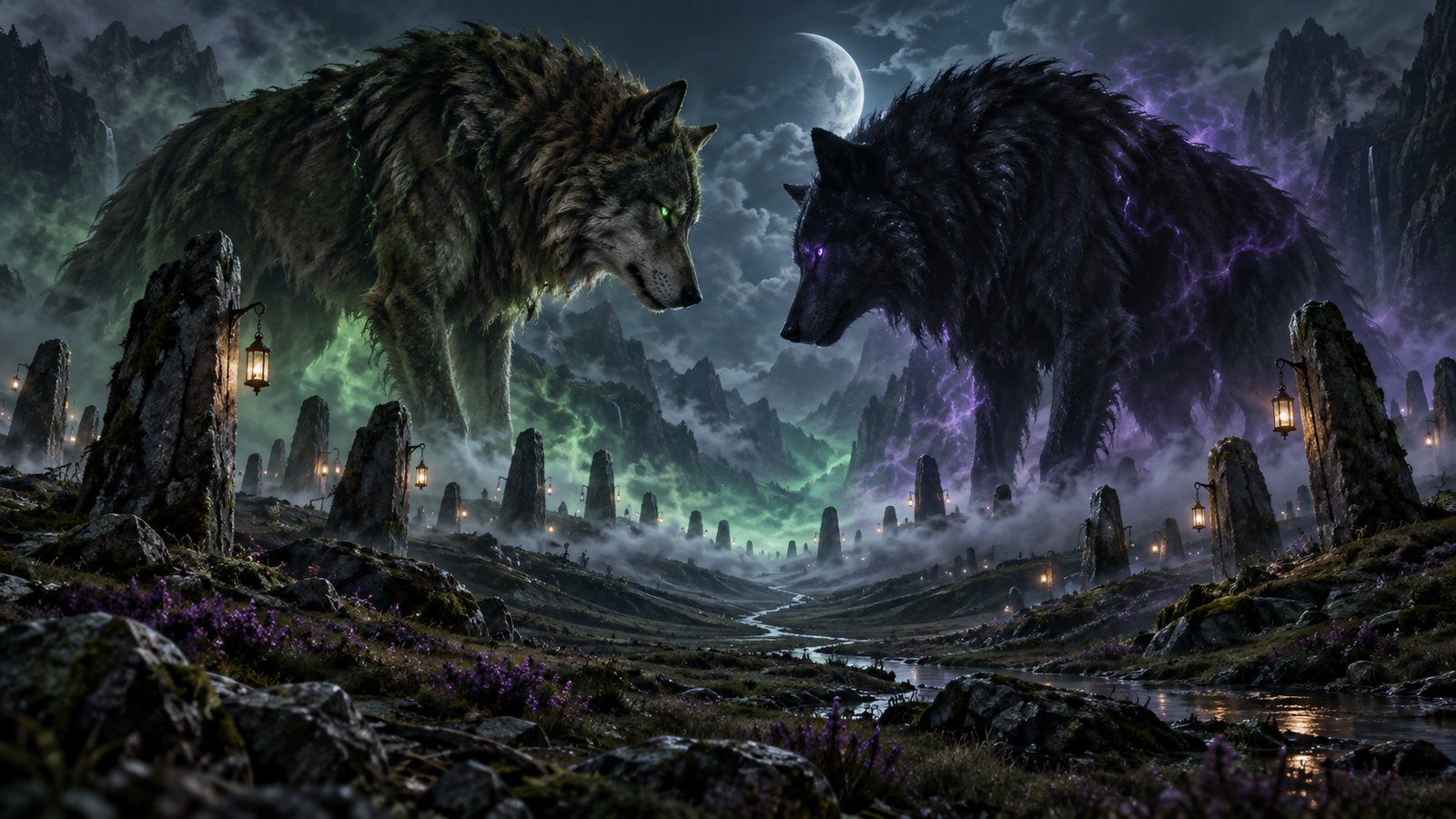
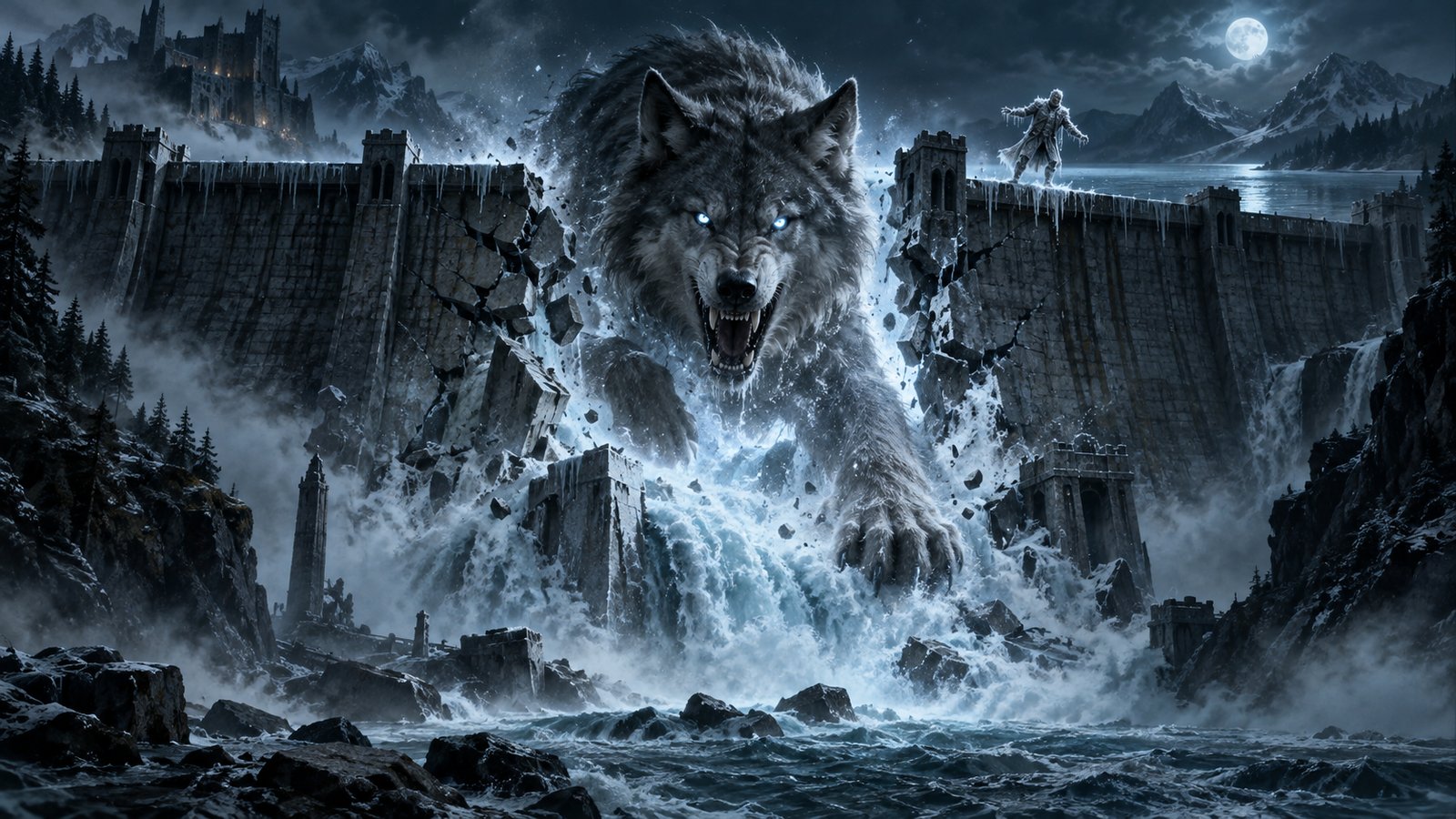
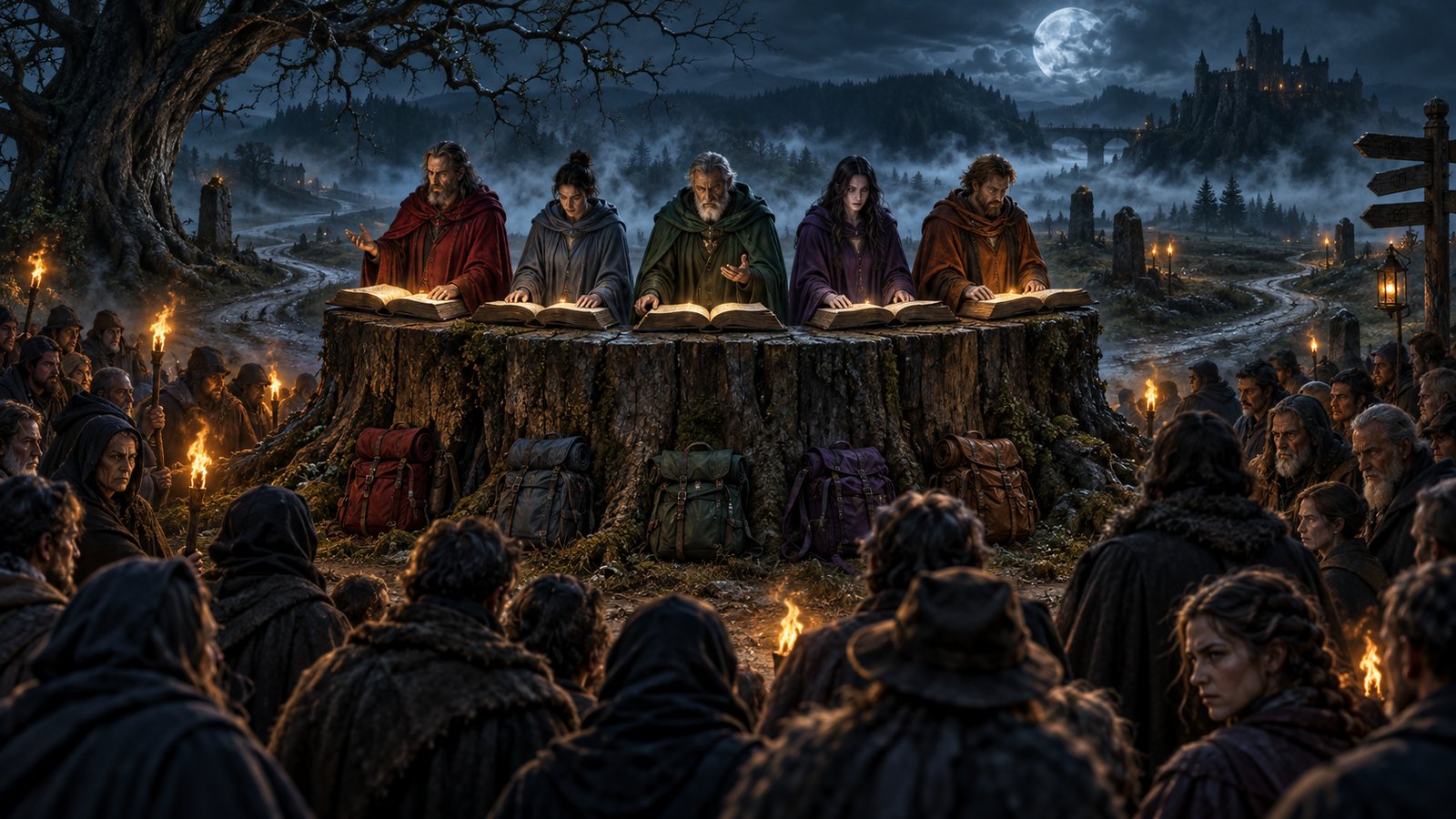
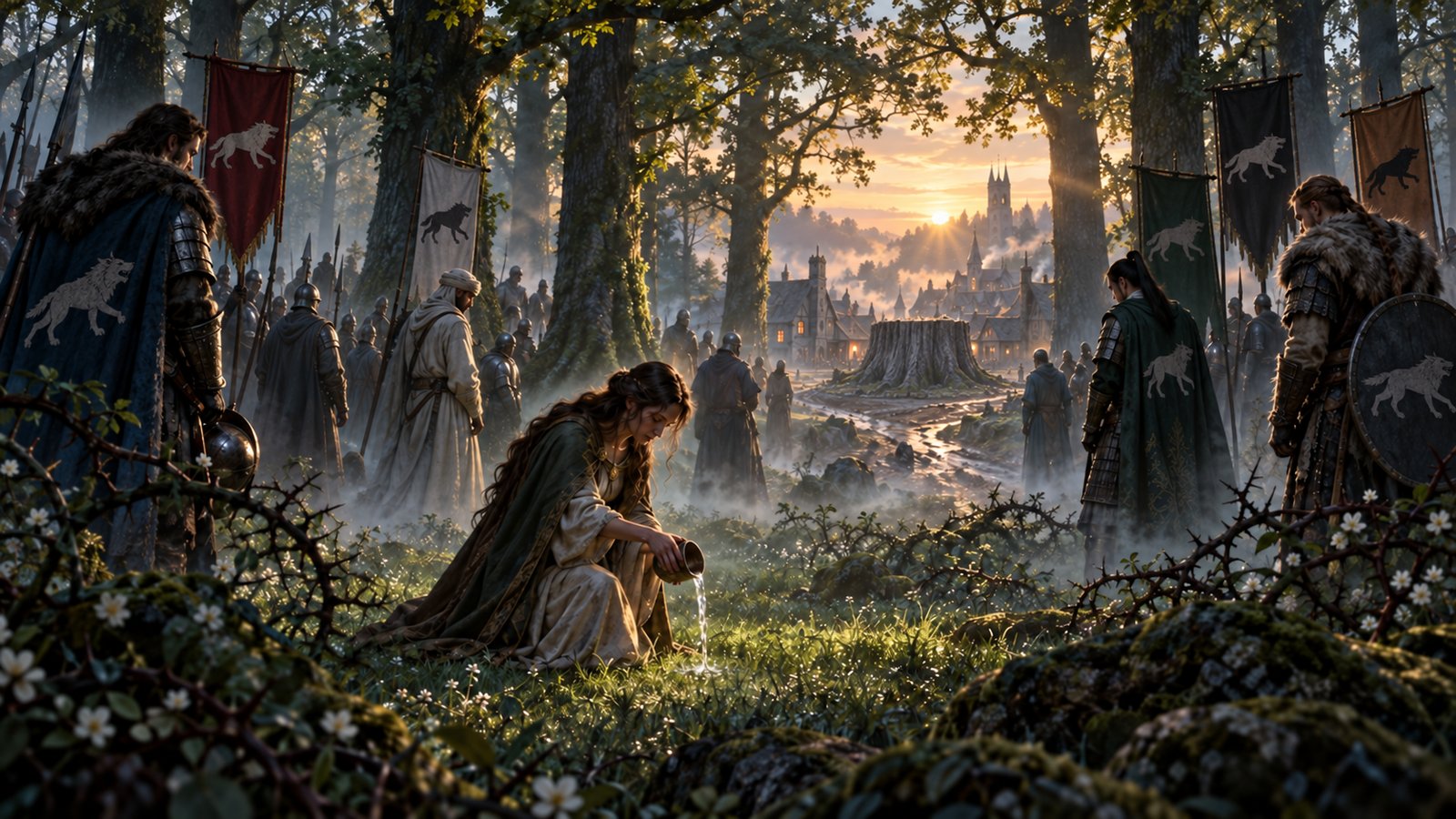
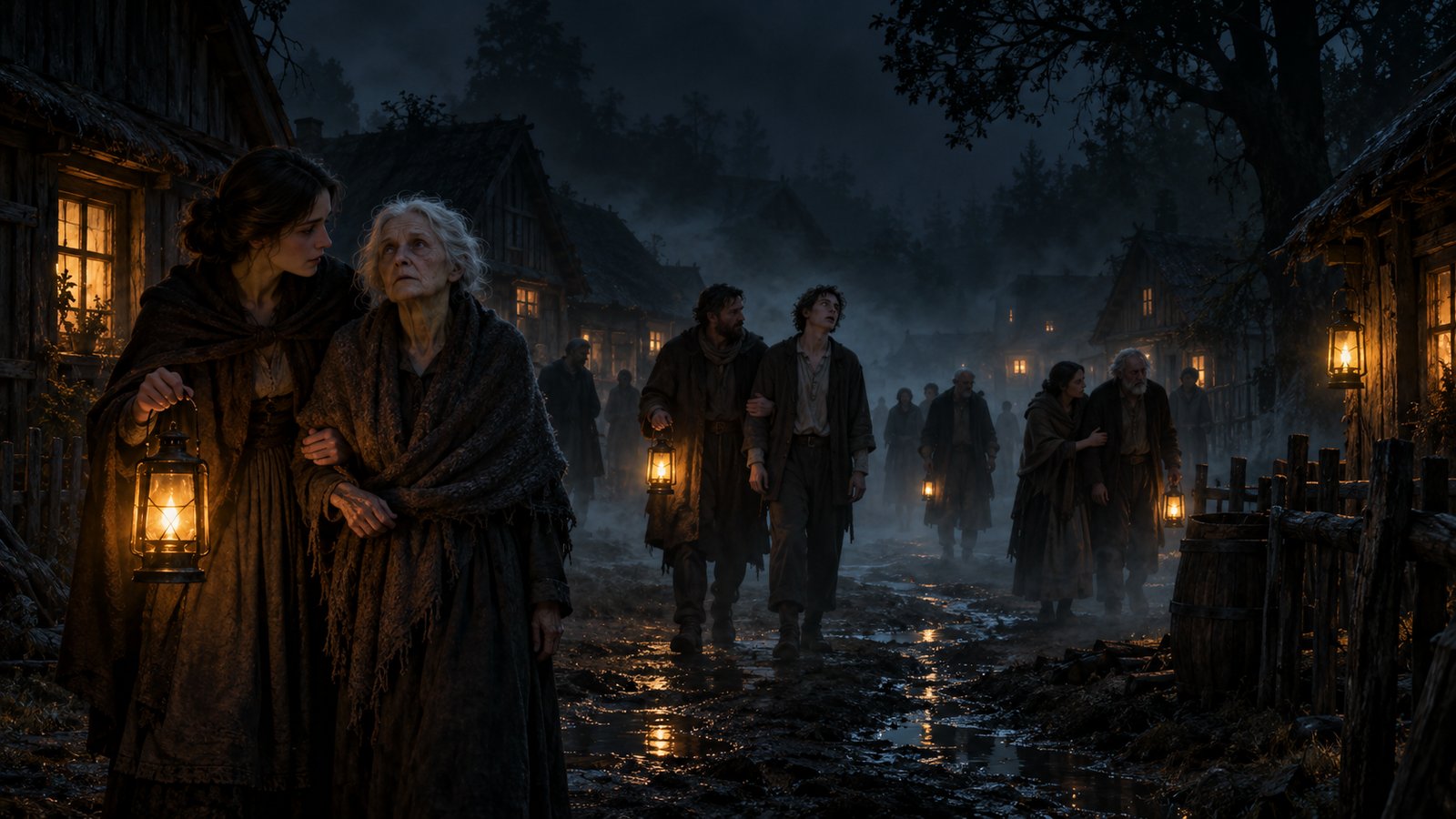
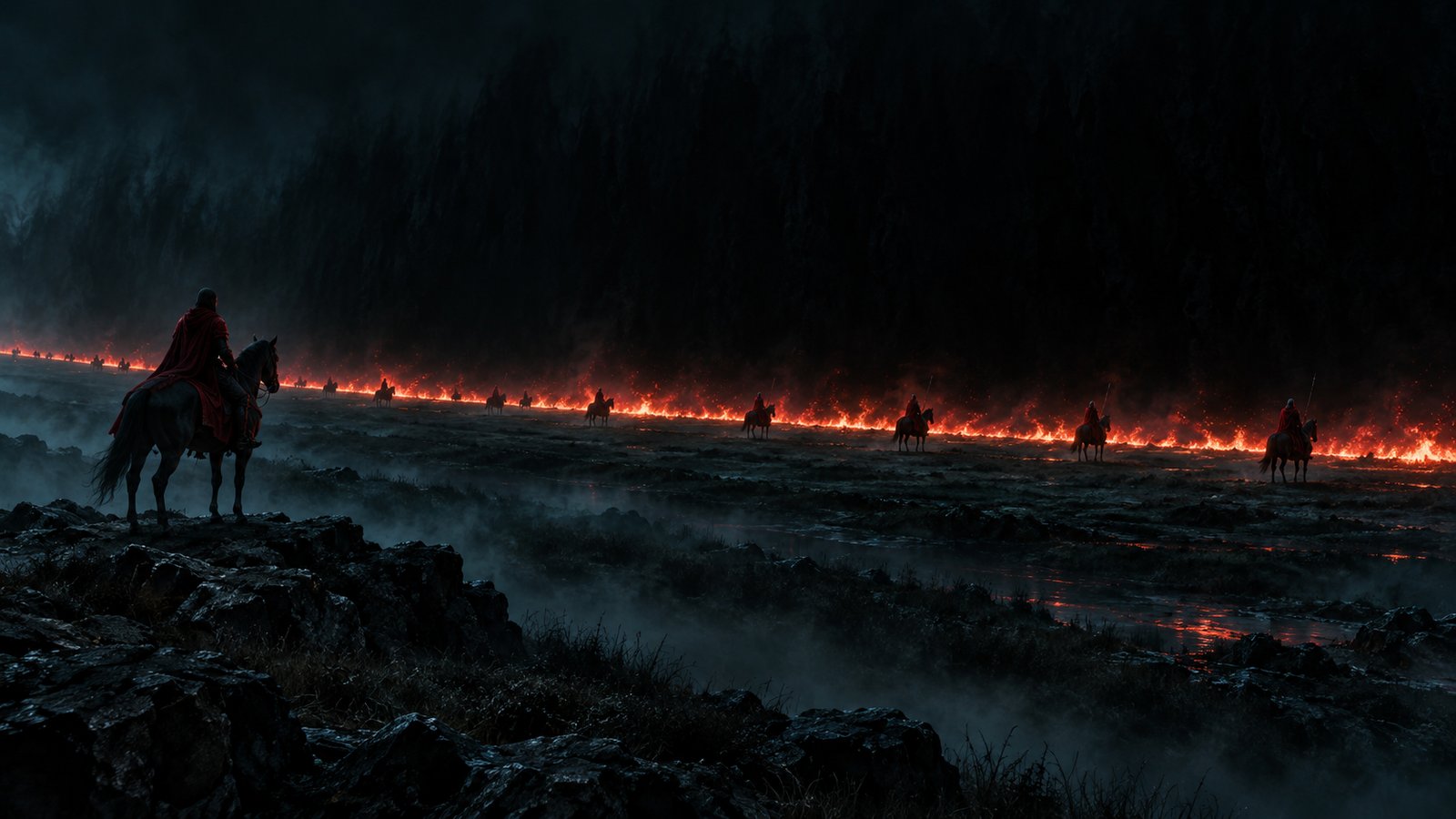
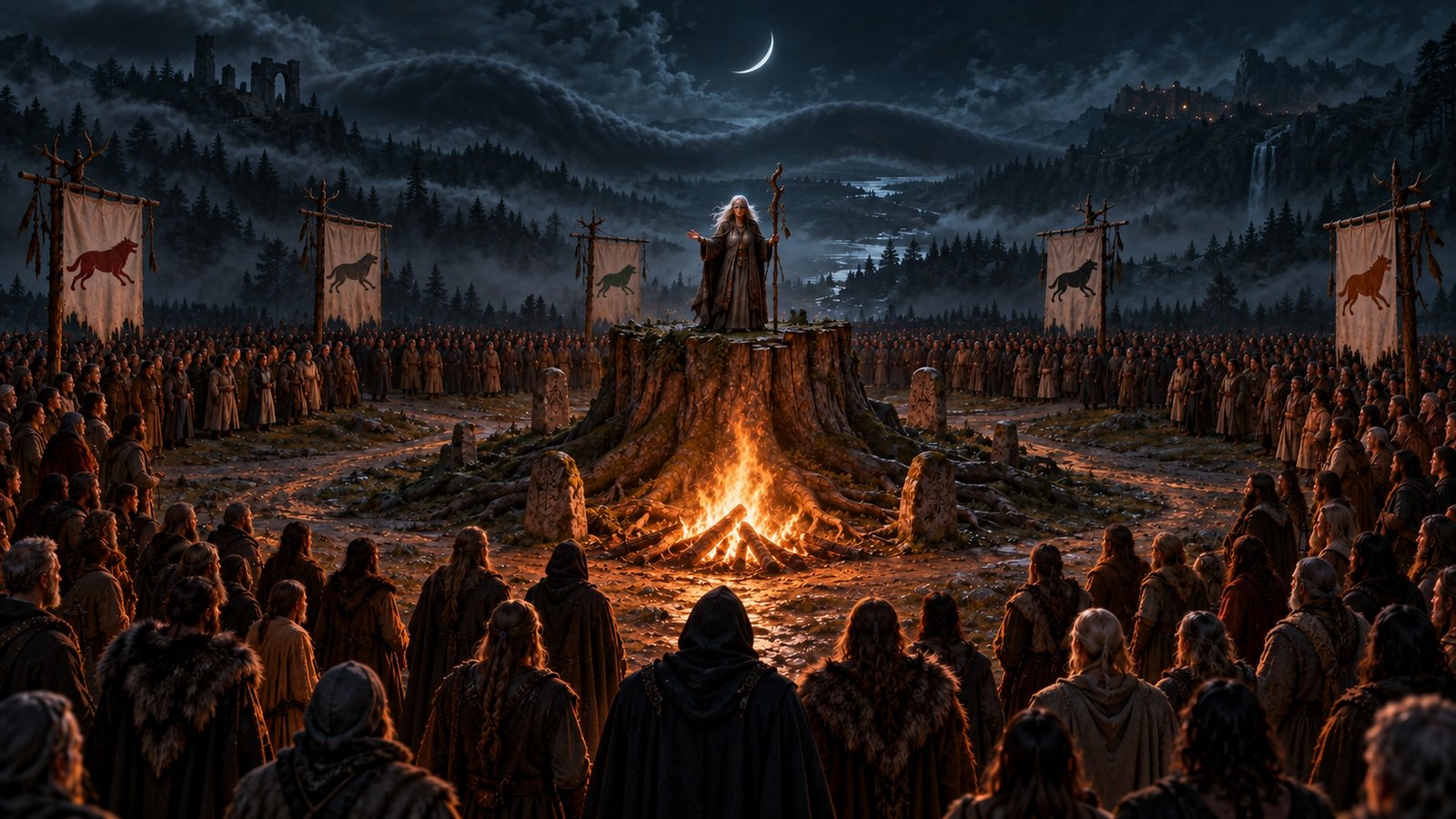
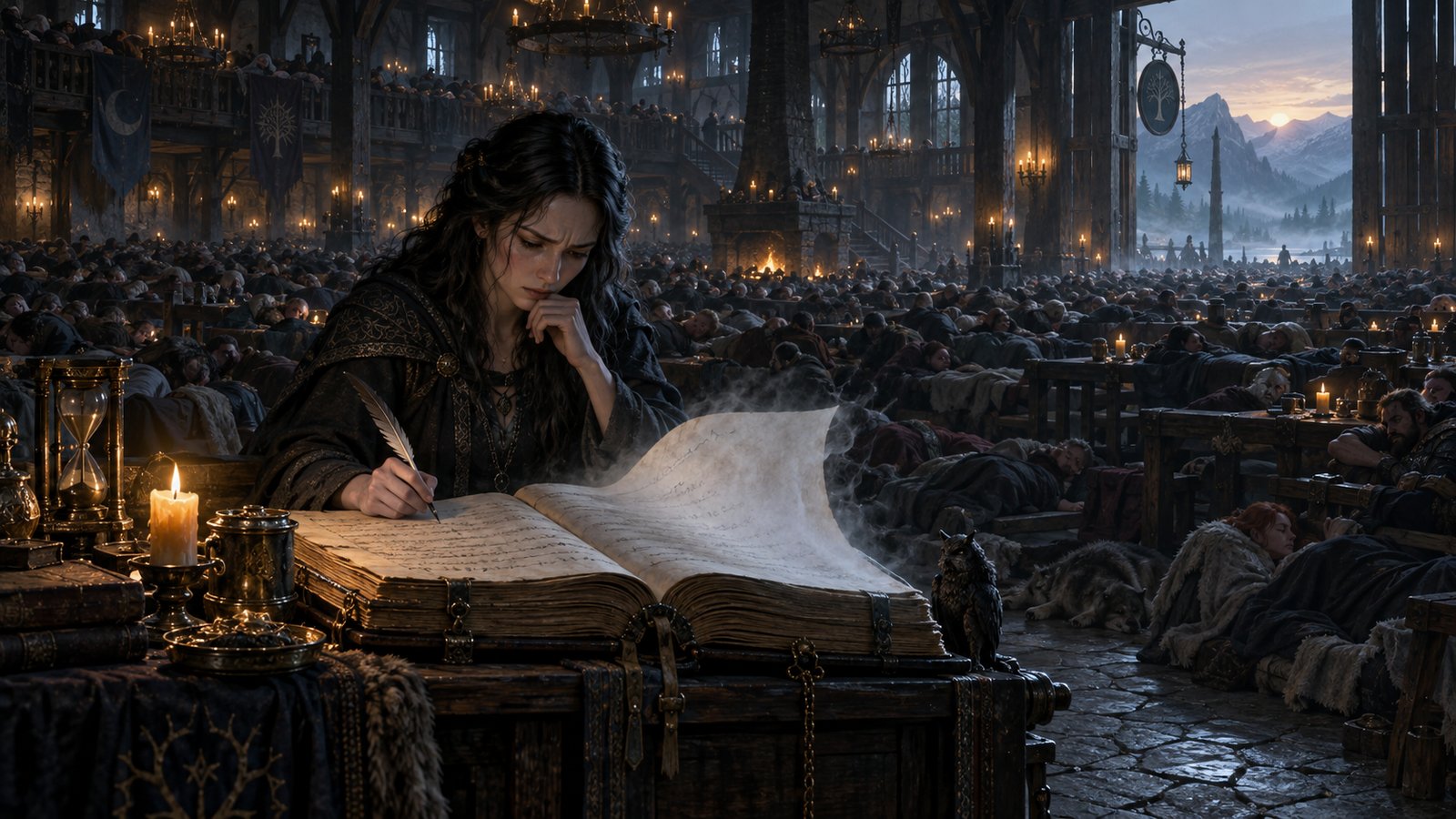
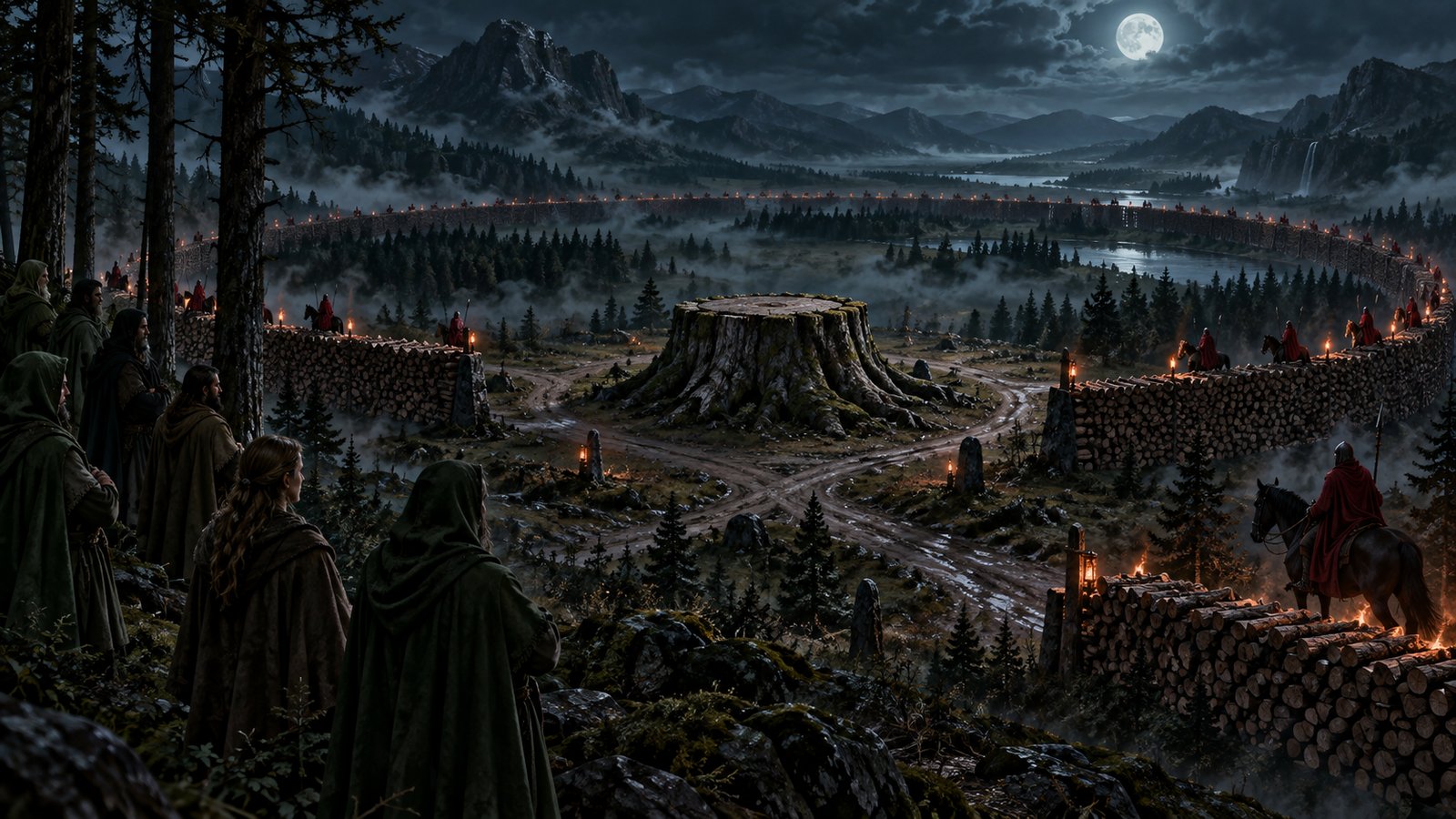
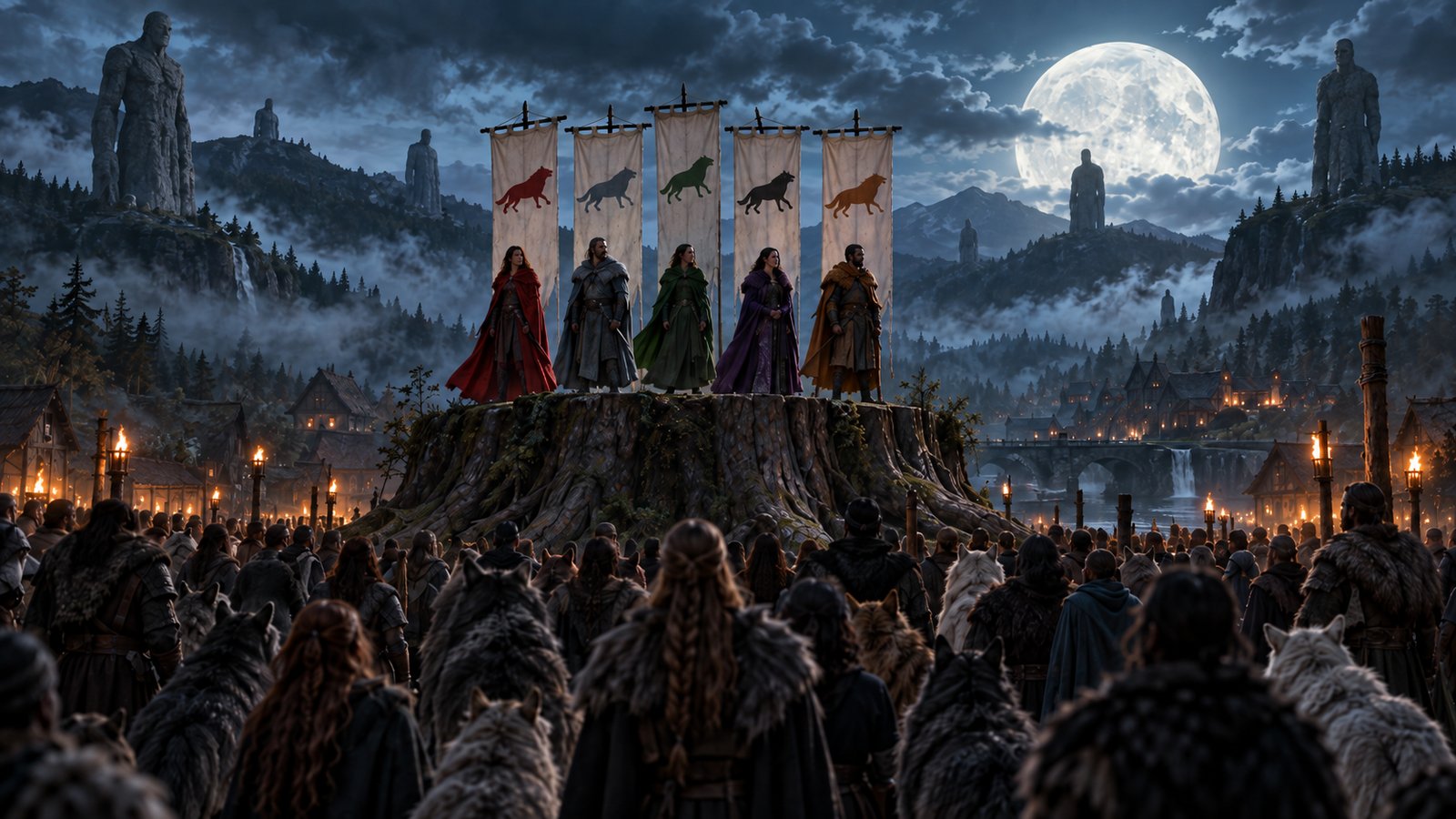
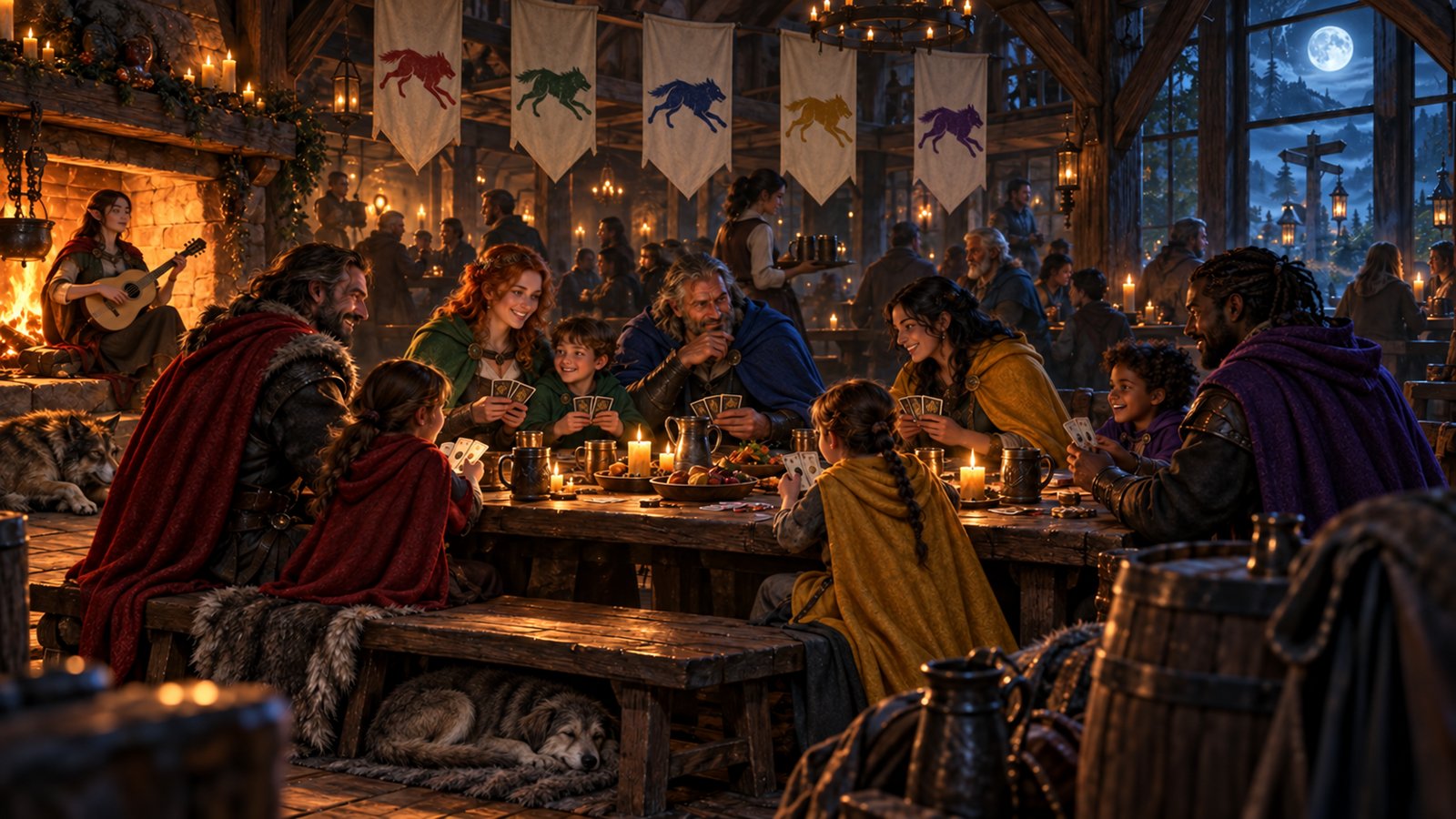
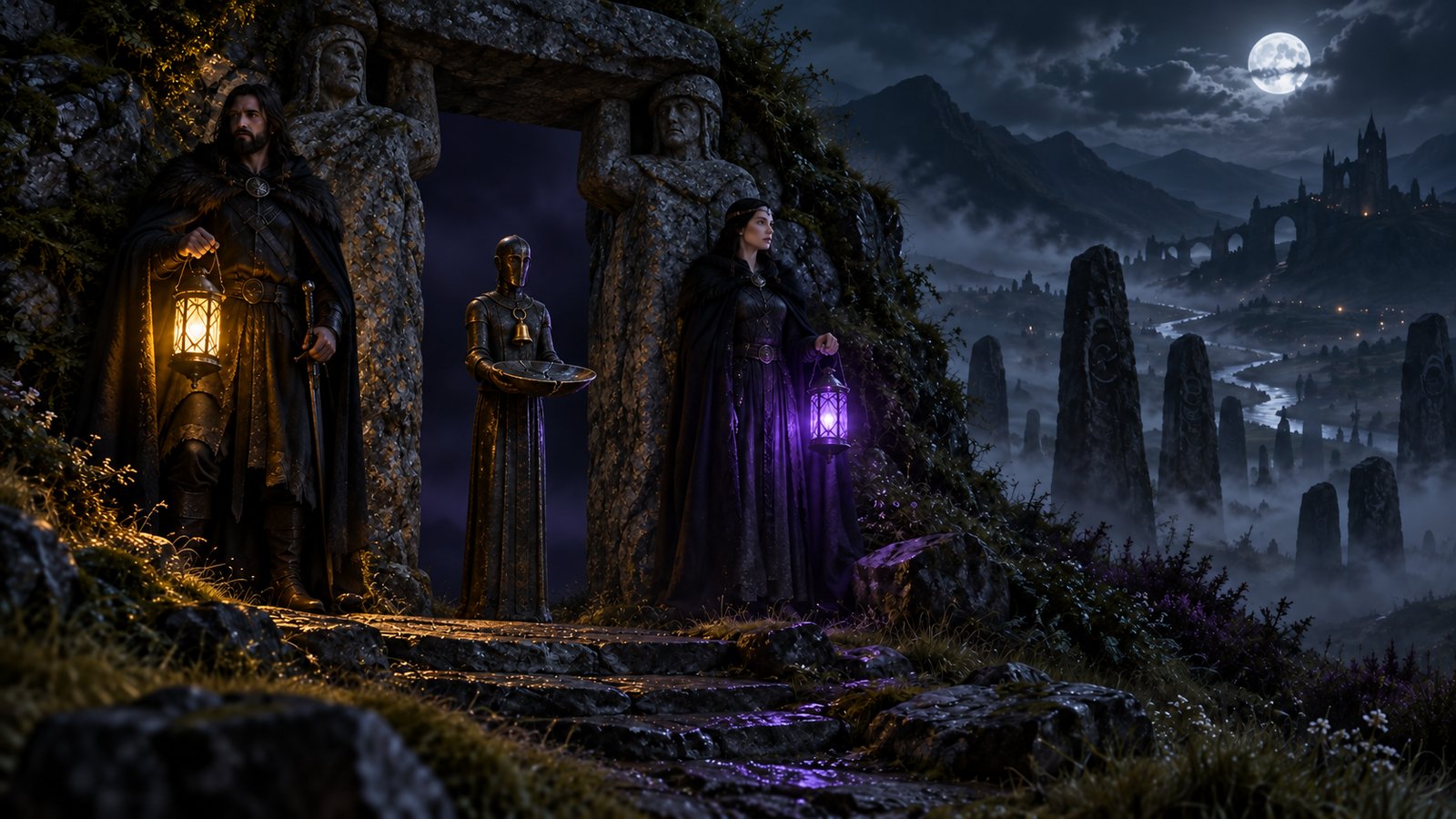
This is the history of Ca'tur as it happened. Nine tellings were written before it, one for each of the five packs and four for the ages and the peoples that belong to no pack, and each of those was written to be believed by its own people. This account takes from all nine, rejects part of each, and says in section 15 which pack keeps each rejected piece as its own story. Years are counted before the present. The present is the autumn of the Reckoning, with the head of the Standing's column thirty-one steps from the edge of the clearing at Ómbrek, the town at the crossroads in the middle of Ca'tur where nearly everything in this account happens.
1Ærath and the Hush
The First Howl, 10,000 years ago
Before there was anything at all, there was the Hush.
It is hard to tell anyone about the Hush, because every word a person might use for it is a word for something, and the Hush is not something. It is not dark, because dark is what a cupboard has when the door is shut, and there was no cupboard and no door. It is not silence, because silence is what a kitchen has late at night when the fire has gone down and everyone has stopped talking, and there was no kitchen and nobody to stop. The Hush is the absence of anything that could be heard or seen, with nothing in it and no edge around it. The nearest an ordinary person ever comes to it is the moment just before waking, when you do not yet know who you are or which way the window is. In the Hush that moment does not end.
A thing that stands in the Hush too long forgets itself. It does not happen all at once and it does not hurt. It goes from the outside in, the way cold goes into a person standing in snow: first the thing forgets what it was doing, then what it was for, then its own name, and then it forgets that it is a thing at all, and after that there is nothing left to do any forgetting. That is the whole of what the Hush does. It does not want anything, and it is not wicked, any more than a winter night is wicked. It simply takes back the difference between a thing and everything else, and nothing that has gone all the way into it has ever come out again.
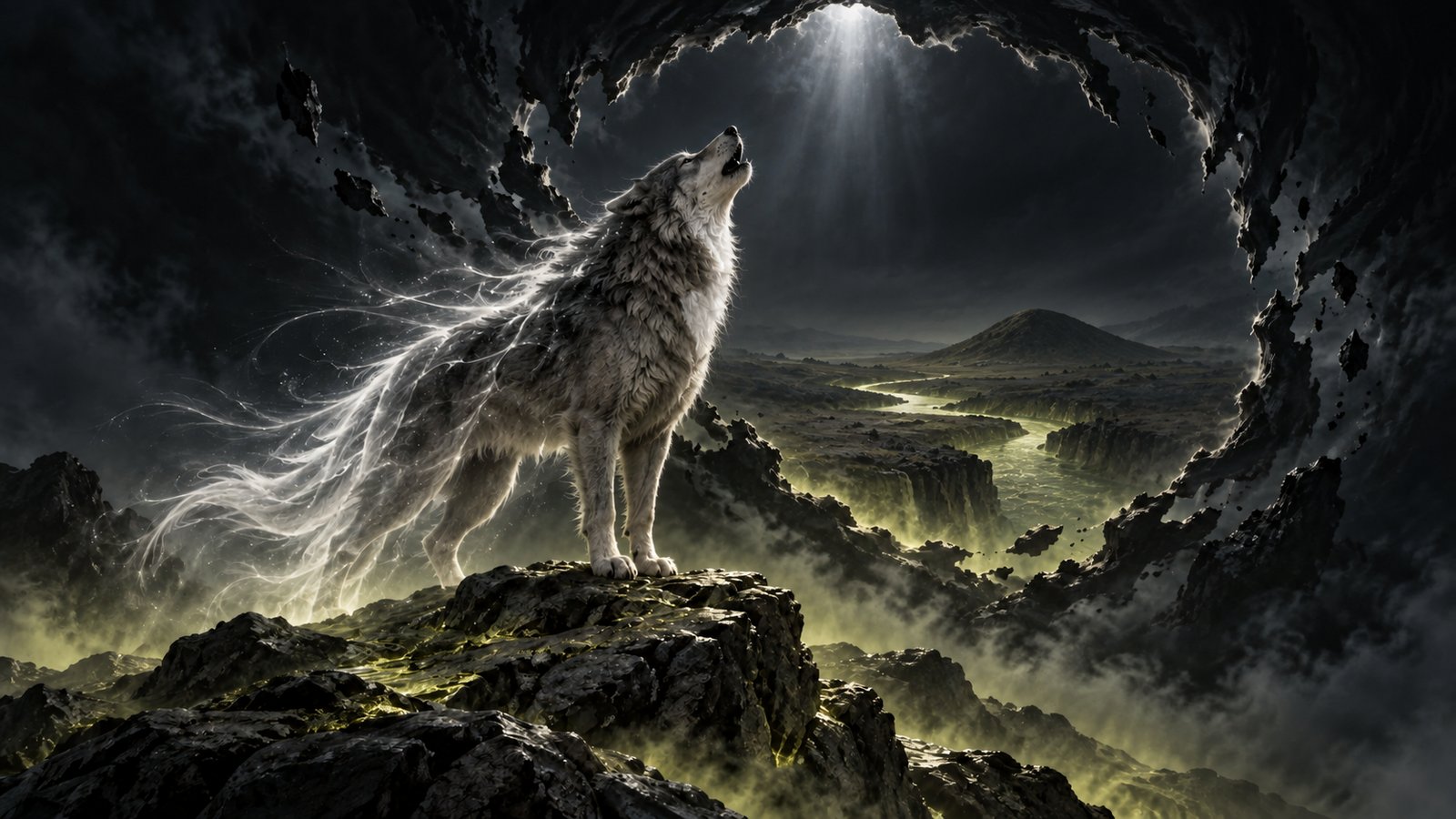
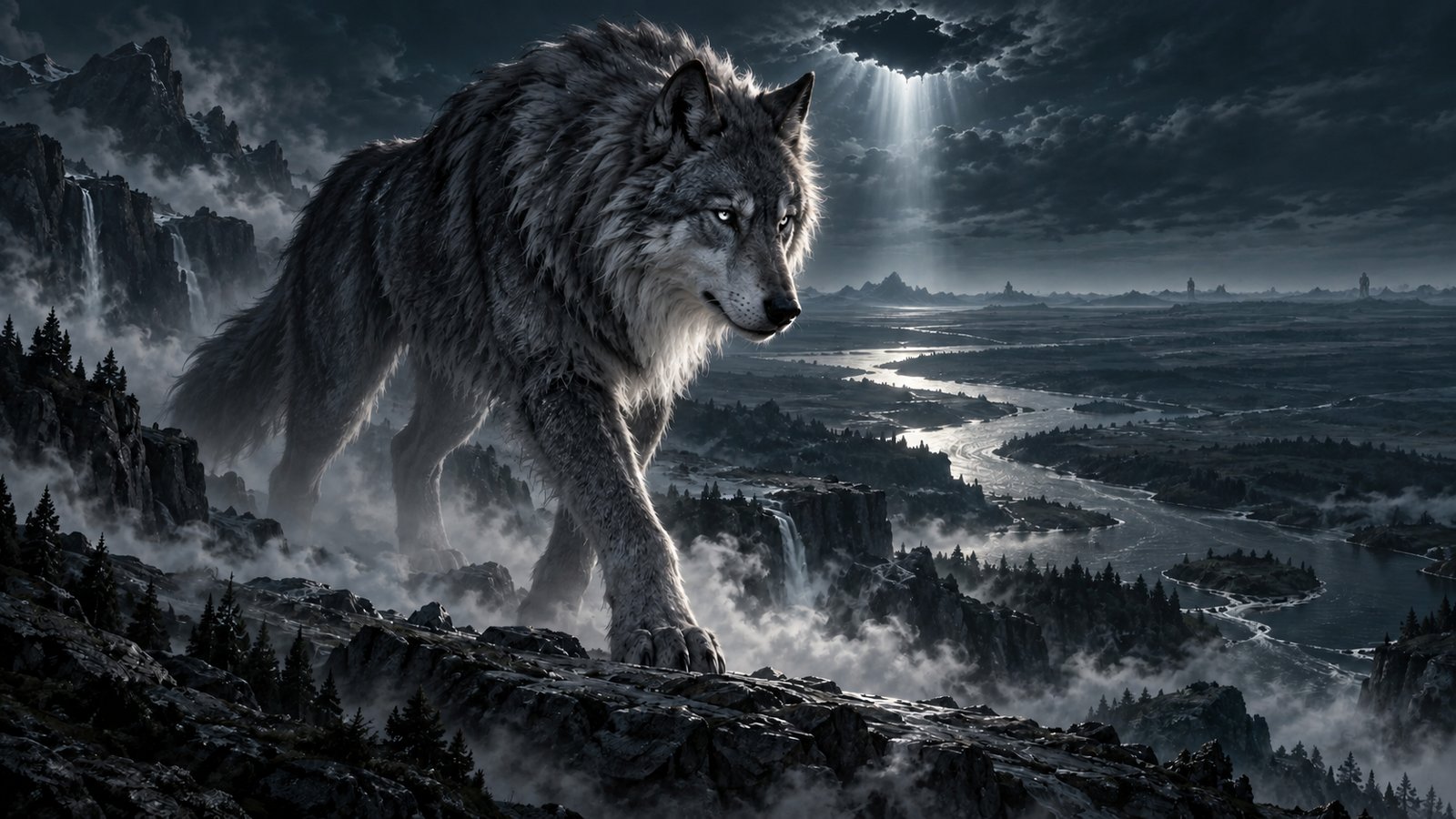
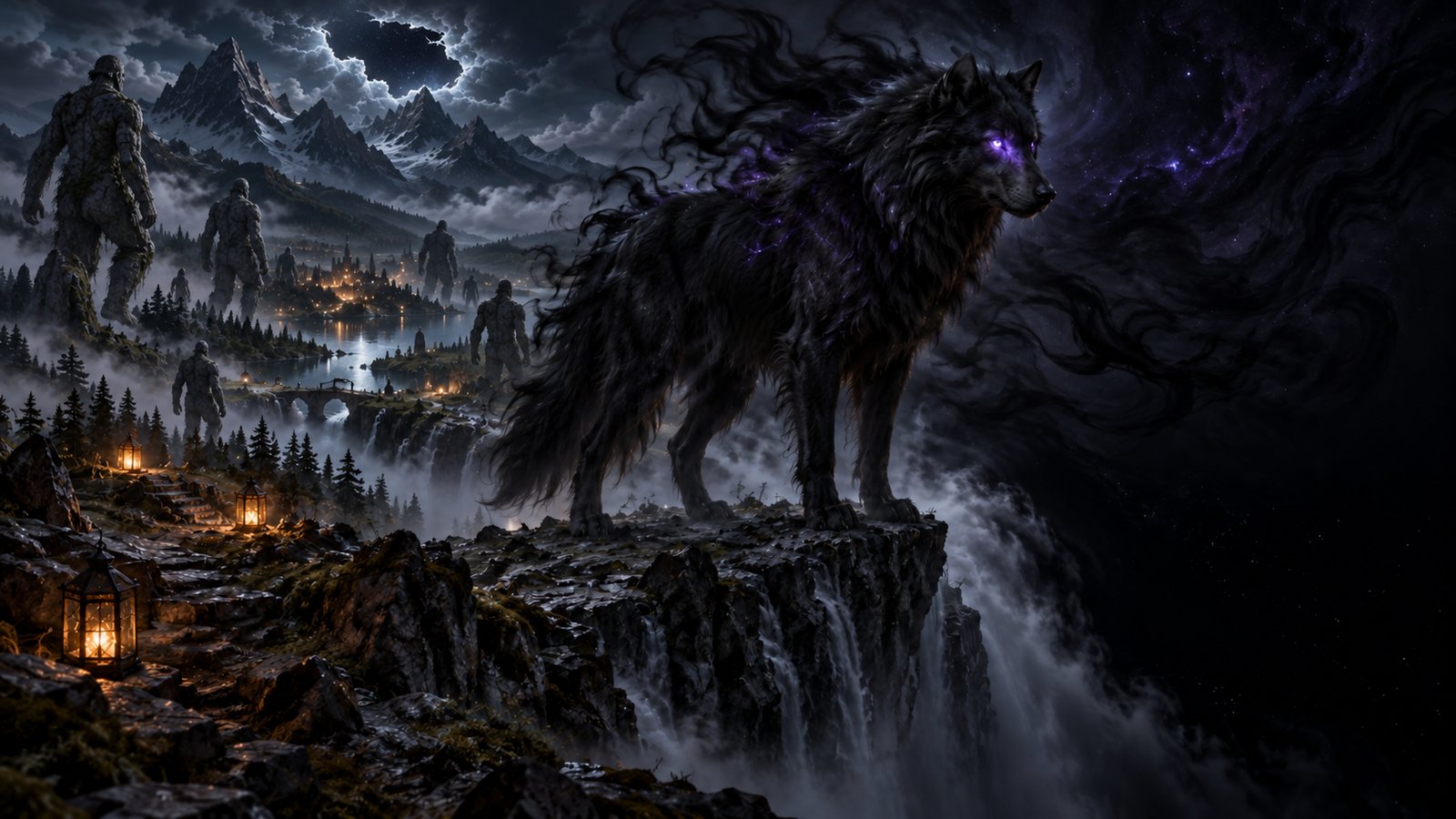
The Howl-Mother was in the Hush, and nobody knows how long she was there, and she did not know either, because how long is one of the first things the Hush takes. She was a wolf. She was grey, with a white patch under her chin about the size of a spread hand, and she was larger than any wolf that has lived since except her own children, and by the time this account begins she had forgotten nearly everything about herself. She had forgotten where she came from. She had forgotten whether there had ever been others like her, and what she ate, and whether she had ever been warm. What she had left, at the very end, was one small thing. She remembered that there had once been a sound.
She did not remember what the sound had been, or who had made it, or whether she had liked it. She only knew that there had been one, and that it was wrong for there to be none. So she stood, if standing is the word for what a wolf does where there is no ground, and put her head back, and made a sound herself, as loud and as long as she could, and that was the First Howl.
Nobody was there to hear it, and so nobody can say what it was like, except that it worked. The Howl struck the Hush and the Hush went back from it, the way water goes back from a stone dropped in, and where it went back there was space, and into that space the world grew. It grew the way frost grows on a window, from the middle outward: first the ground under her feet, then a hill, then a river running away from the hill, then the far shapes of other hills, and then more, and more, and it has not stopped. The world that grew there is called Ærath. It is said AIR-ath, with the weight on the first part, and the country at the heart of it, the part that grew first, under the place where the Howl struck, is Ca'tur, and Ca'tur is where nearly everything in this account happens.
The Howl-Mother walks Ærath
The sky of Ærath is not empty air going up forever. It is the Hush's own skin where the Howl struck it, pushed outward and still stretching, because the Howl has not finished pushing. That is why Ærath grows at its edges a little every year, a field's width here and a hillside there, so that every generation has to draw its maps again, and old people are forever telling young people that such and such a wood used to be the edge of the world and is now a good half day's walk inside it. The old things, which this account will come to in their turn, live at the edges because they were there before Ærath reached them, the way a boulder is lying in a field before anyone thinks to call it a field.
The place where Ærath stops and the Hush begins is called the Sill in the oldest records, and there is nothing to see there. The ground goes on for a while as ordinary ground, with grass on it and stones in it, and a person walking toward the edge finds after a time that they have stopped, and cannot say why, and turns round and walks back, feeling that they have left something behind them and not able to think what. Very few people go there twice.
Where the Howl struck first, straight above the place the mother had been standing, it struck hardest, and there the skin of the Hush did not stretch. It broke. That hole is called the Mouth. Through the Mouth, for a very long time, a thin cold came down out of the Hush, and through it also came the only light there ever was from above, in floods some seasons and nothing in others, because a hole lets through whatever happens to be on the far side of it. The Mouth is still there. It is directly over Ómbrek, the town that grew up at the crossroads in the middle of Ca'tur, in the place where the Howl-Mother stood on the first night, and which this account will come back to more than any other place. What sits in the Mouth now, filling it so exactly that there is no gap round the edge for the cold to come through, is the Moon, and the Moon is a wolf, and how she came to be sitting there, and why she has not come down, is most of what follows.
2The deep past
The dates in this part of the account are older than any book. They come from the marks of the Tally, a people who will be met a little further on, and they are good to within a hundred years or so, which for a thing that happened ten thousand years ago is not bad. From the Litter onward the dates come from the Night Roll of Ómbrek and the ledgers of the packs, and those are good to the year and often to the night.
About 10,000. The First Howl. On the first night Ærath was made, and the sky was marked where the Howl struck it, and the Mouth was torn open above the place that would one day be the crossroads. A good many things happened on that same night, and the Howl-Mother, standing on the first ground with the world spreading out round her, saw very few of them, because the world had no distance yet and everything was much too close to look at.
The new world had no night and no day. Light came up out of the ground, everywhere and evenly, a low green-gold shine like the underside of a leaf held up to a window, and it never went out. There was a great deal to see by it, and most of what there was to see was already old, because the things that were in the Hush when the Howl struck were caught inside the world when it closed, the way a moth is caught inside a house when somebody shuts the door. Three of those things are in this account from beginning to end, and it is worth stopping to meet them properly, because everyone in Ca'tur lives beside at least one of them and nobody has ever got to the bottom of any of them. None of the three is wicked. They are more like weather, or hunger, or a promise somebody made a long time ago and has to keep.
The Deep. The Howl pushed the Hush out of the middle of the new world, and most of it went out past the edges. Some did not get out. It was caught in the low ground to the north with new land closing round it on every side, and a piece of the Hush shut inside a world has to become something, because a world is made of things. It became water. That water is the Deep, and it is the only piece of the Hush inside Ærath.
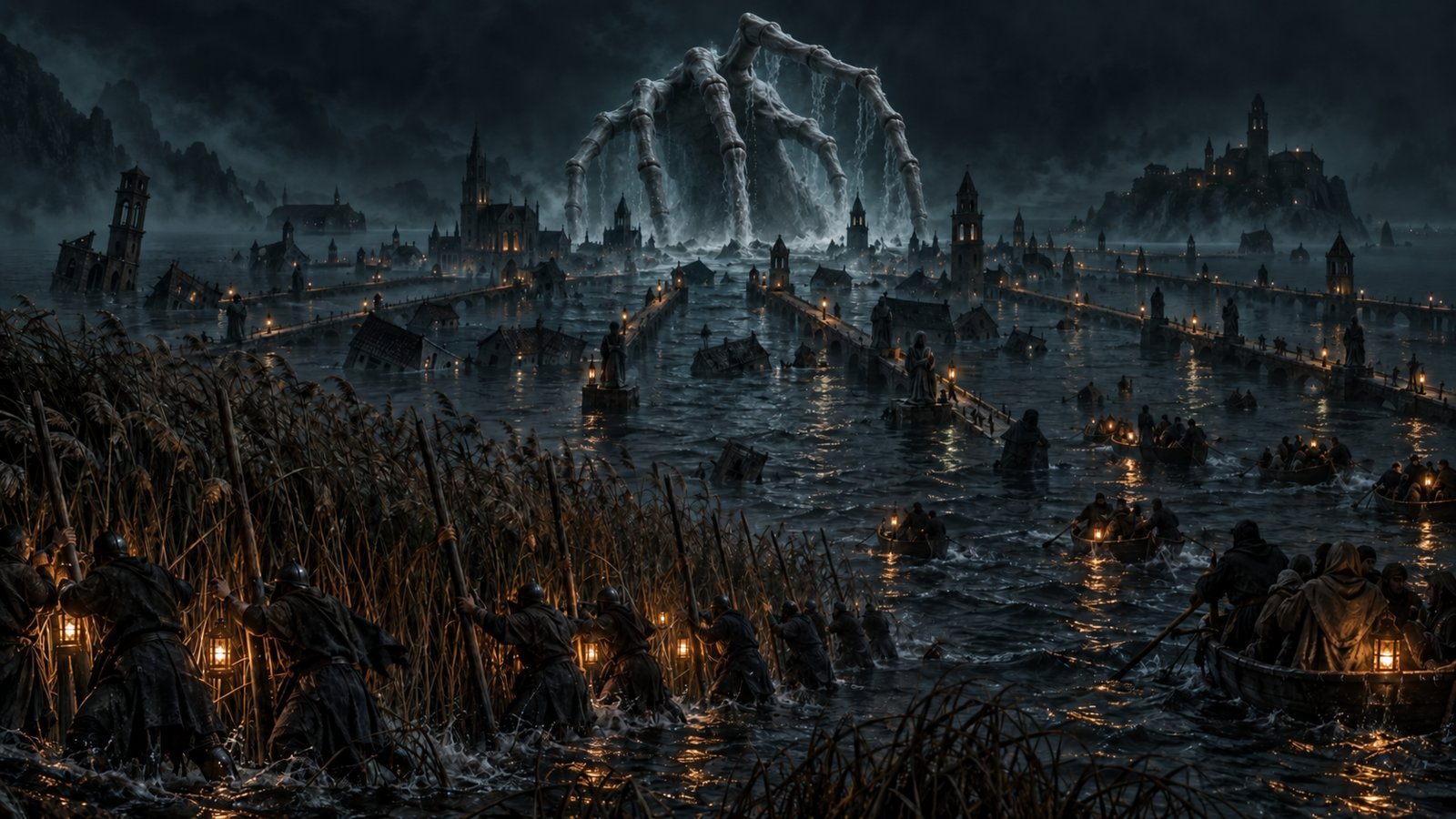
Most of what a person ever sees of it is a lake. The top of it is called the Spypool, flat and grey, forty miles across, and on a windless morning so still that the sky in it is easier to look at than the sky itself. Boats go out on it and fish swim in it and a child can trail a hand in it and come to no harm. But it is not water all the way down. Ropes have gone off boats in the middle of it to eight hundred fathoms, which is further down than any lake goes, and come back up with the end knot dry, because below a certain depth the Deep stops being wet and is only what it was before it was a lake.
It differs from water in one other way. The Hush takes. It takes the difference out of a thing until the thing is gone. The Deep, which was made out of the Hush and then shut in, does the opposite as hard as it can, and what it does is keep. Drop a coin in the Spypool and a thousand years later the coin is there, exactly as it fell, and so is the moment of its falling, and so is the look on your face as you let it go. Nothing in the Deep changes, rots, drifts or finishes. Fisherfolk on the north shore tell their children not to lean over the side of the boat, and the reason they give is not drowning. It is that the Deep would keep you, just as you were, leaning, for ever.
One part of the Deep moves. It is a hand, long and pale and many-jointed, and it has come up out of the water four times in the history of Ca'tur, each time when the light from above had been away too long, and felt along the shore for whatever was there. People call it the Leviathan. What it takes hold of goes down, and is kept, and has never once come back up.
The Warm. Not all of the First Howl got out into the world. A piece of it was still sounding when Ærath closed round it, and having nowhere else to go it went down, under what are now the Forge Hills in the south, and knotted itself up, and has been turning over slowly in its sleep ever since. It is something of stone and heat, and it is enormous, and it sleeps badly. Its dreams come up through the rock as metal. A seam of copper in a hillside is the Warm dreaming something soft, and a seam of iron is the Warm dreaming something hard, and the smiths who live on the hills above it, and who will be met in their proper place, have learned to sit with a new seam for a month before they touch it, to find out what it was dreaming about. If you put your hand flat on the ground anywhere in the Forge Hills on a cold morning, the ground is not cold.
The Warm turns over, 10,000 years ago
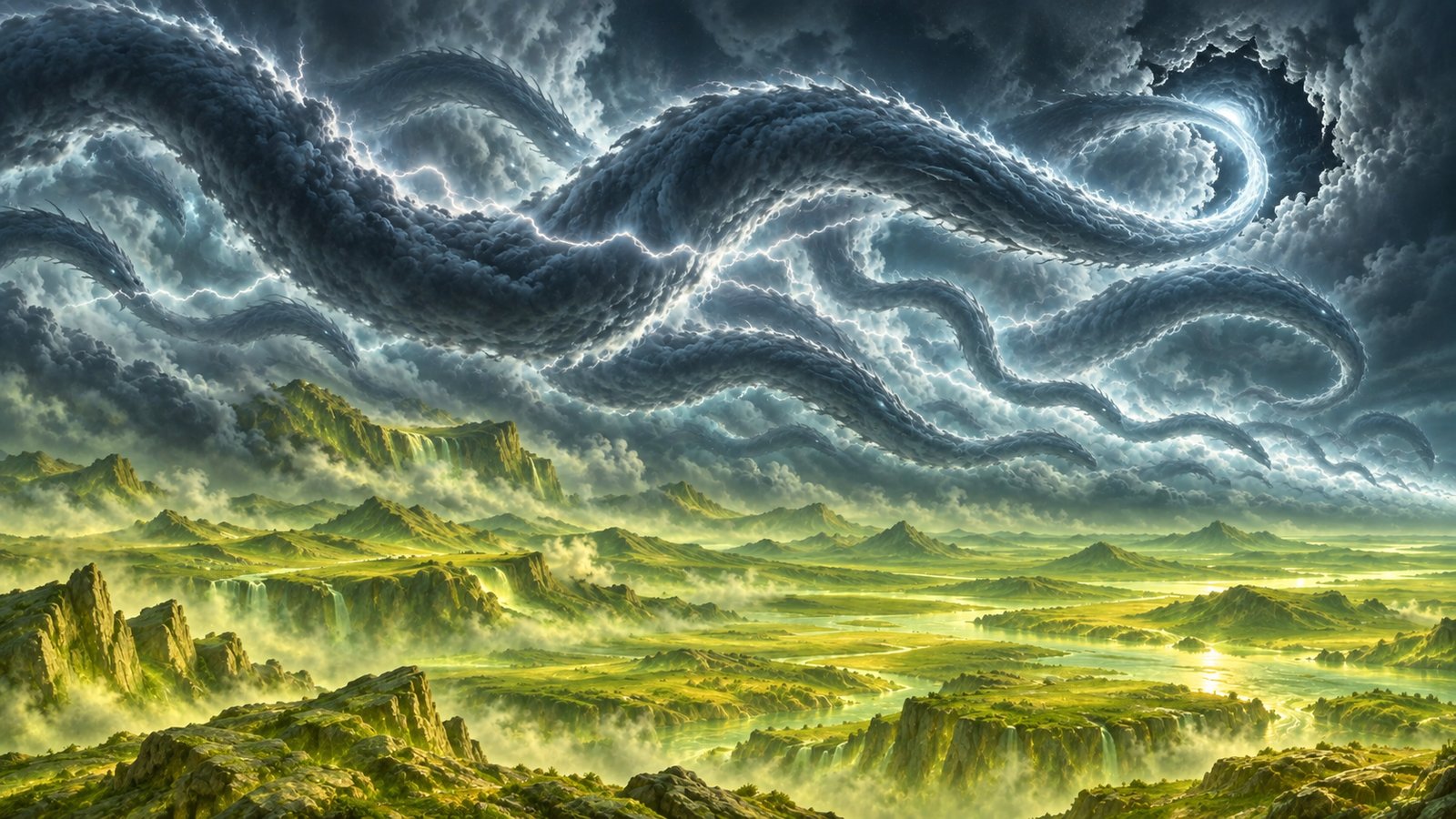
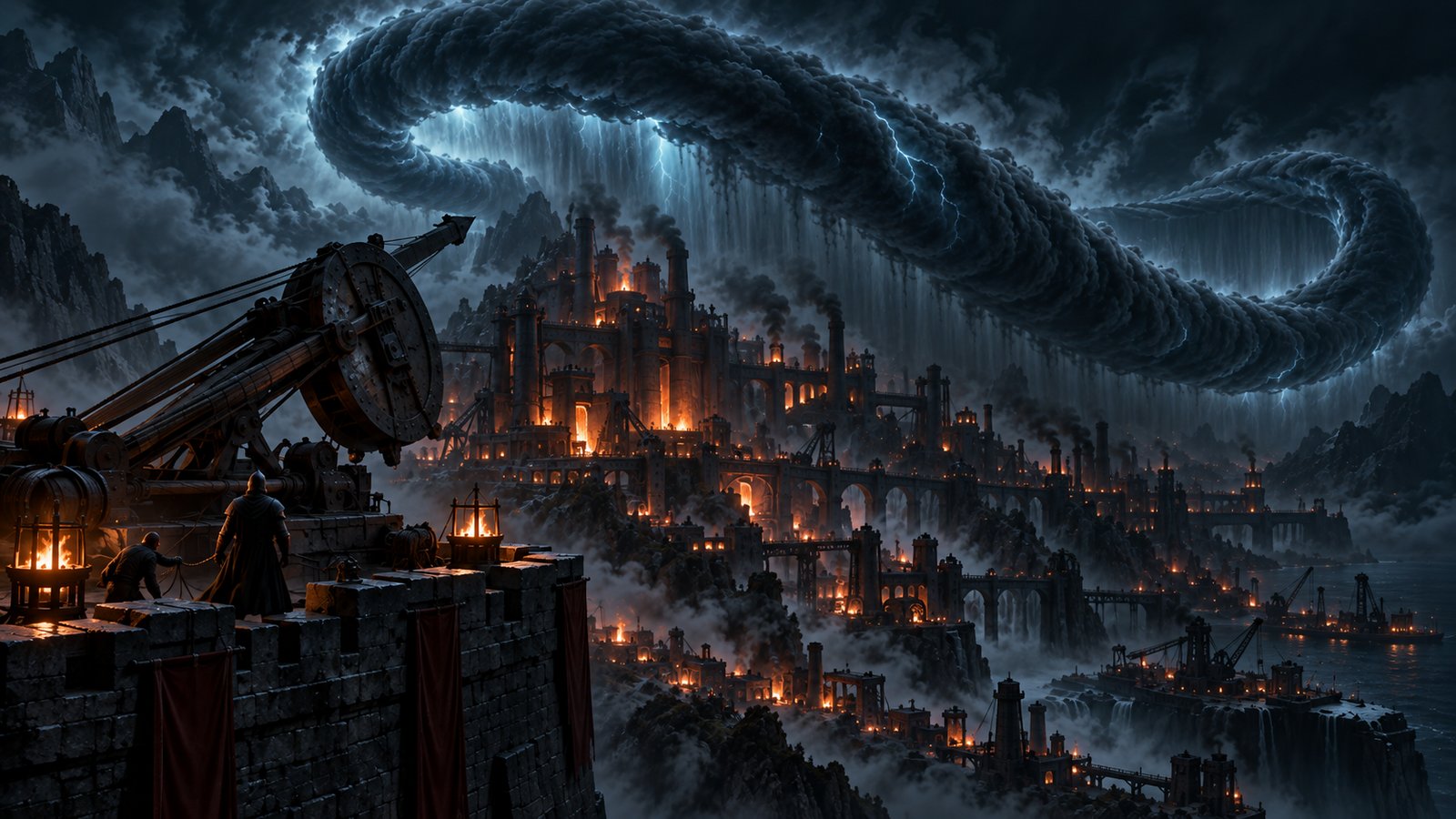
The Wÿrms. If you have ever lain on your back in a field and watched a long low cloud go over with its belly dark and its top lit up, and felt the air change as it passed, you have seen something a little like a Wÿrm, though a real one would have made you sit up. They are the oldest living things. They are long as a river, and their bodies are made of weather, cloud and wind and the heaviness before rain, and on the first night there were hundreds of them, flying in herds along the seams where the Howl had struck the sky and rebounded, great loops from the Mouth outward and back. A herd of Wÿrms going over drags its storm behind it the way a cart drags its dust. They were not hunters. For the first two thousand years they grazed, and what they grazed on was the echo of the First Howl, which went out to the Sill and came back, fainter every time, and they ate it as it passed, and they sang, and the oldest mark anyone ever cut for the sound of them means simply good.
The Wÿrm herds on the sky roads, 10,000 years ago
One Wÿrm did something different on the first night, and it has mattered ever since. Before the herds had understood what they were flying through, one of them opened its mouth and swallowed a piece of the First Howl itself, whole, not the echo but the thing, and shut its mouth on it, and the piece has been inside it trying to get out ever since. That is the Thunder Wÿrm. When it flies over, the piece of the Howl inside it tries to be said, and the Wÿrm tries to say it, and the sound that comes out is thunder. Every clap of thunder anybody in Ca'tur has ever heard is one animal trying to pronounce something too big for it, and failing, and trying again.
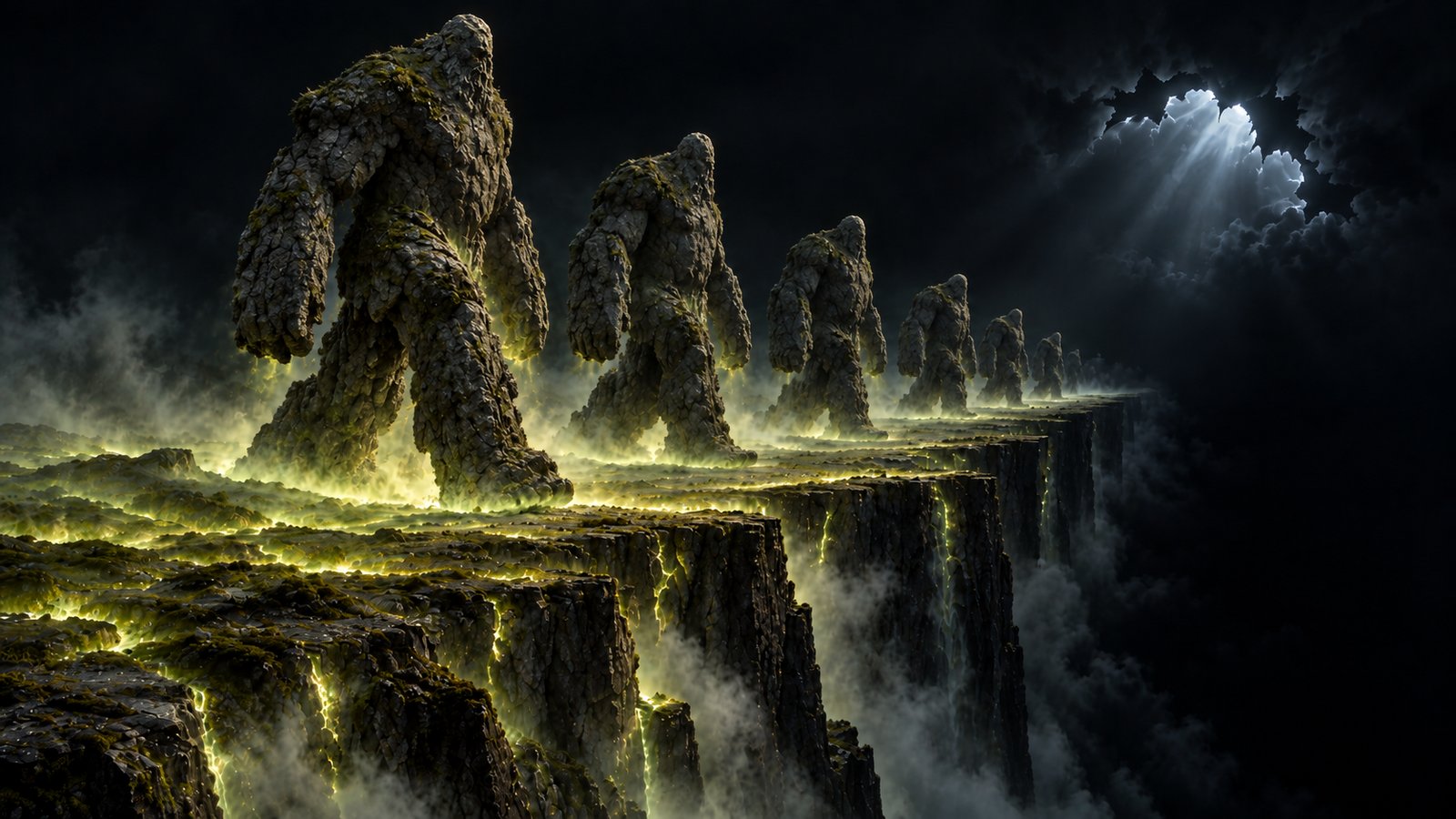
The Standing. On that same first night, at the Sill on every side of the new world at once, something else stood up. Where the ground had just finished being made, the last of the Hush that had not managed to be pushed out took the only shape available to a thing with no memory of its own, which was the shape of the ground, and it stood up as stone. They stood up as people, more or less: two legs, two arms, a head, though taller than the tallest tree, and grey, and rough, and they all faced the same way. They faced the place where the Howl had struck. Then each of them lifted one foot and began to walk toward it.
The Standing begin their walk, 10,000 years ago
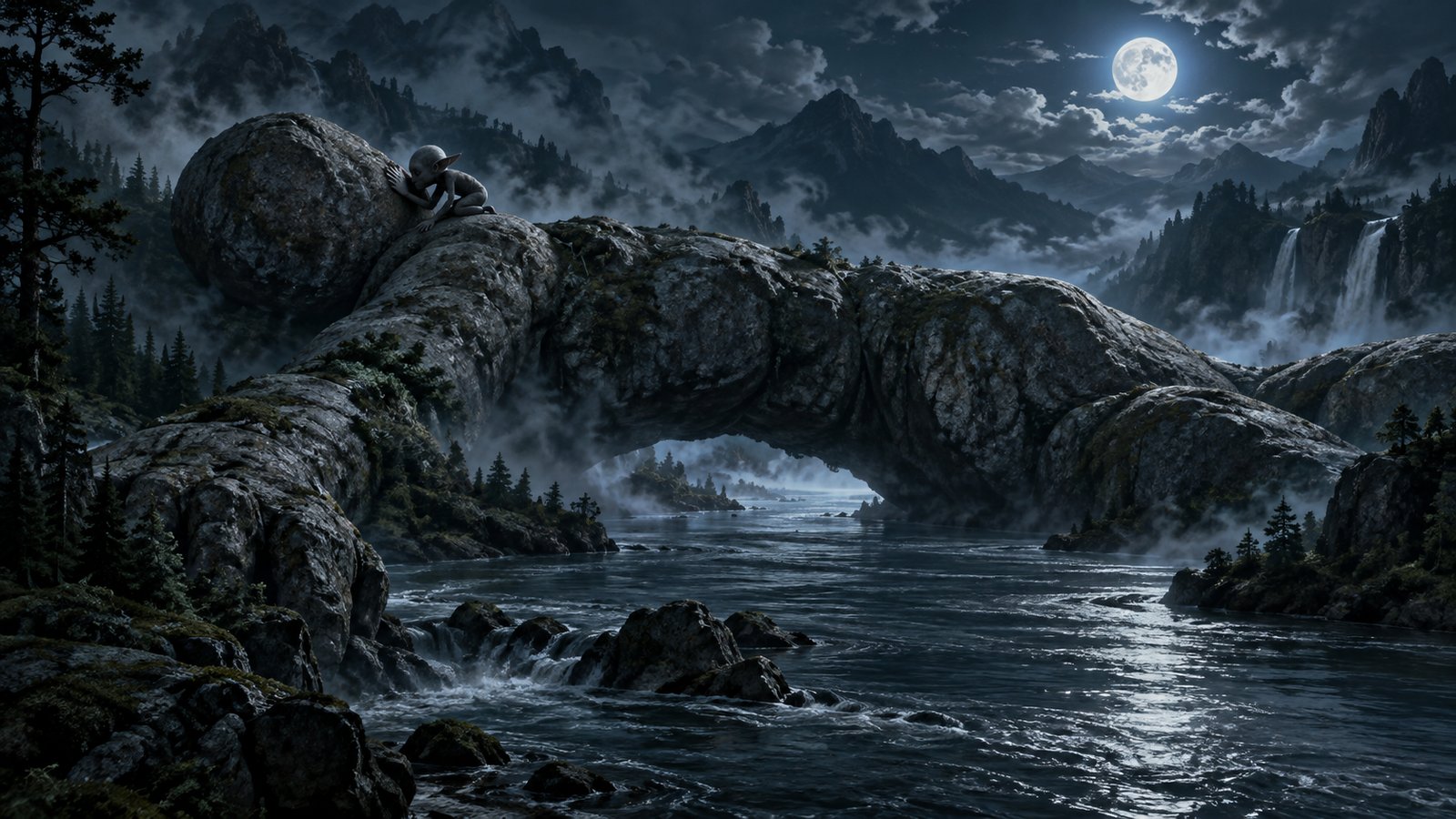
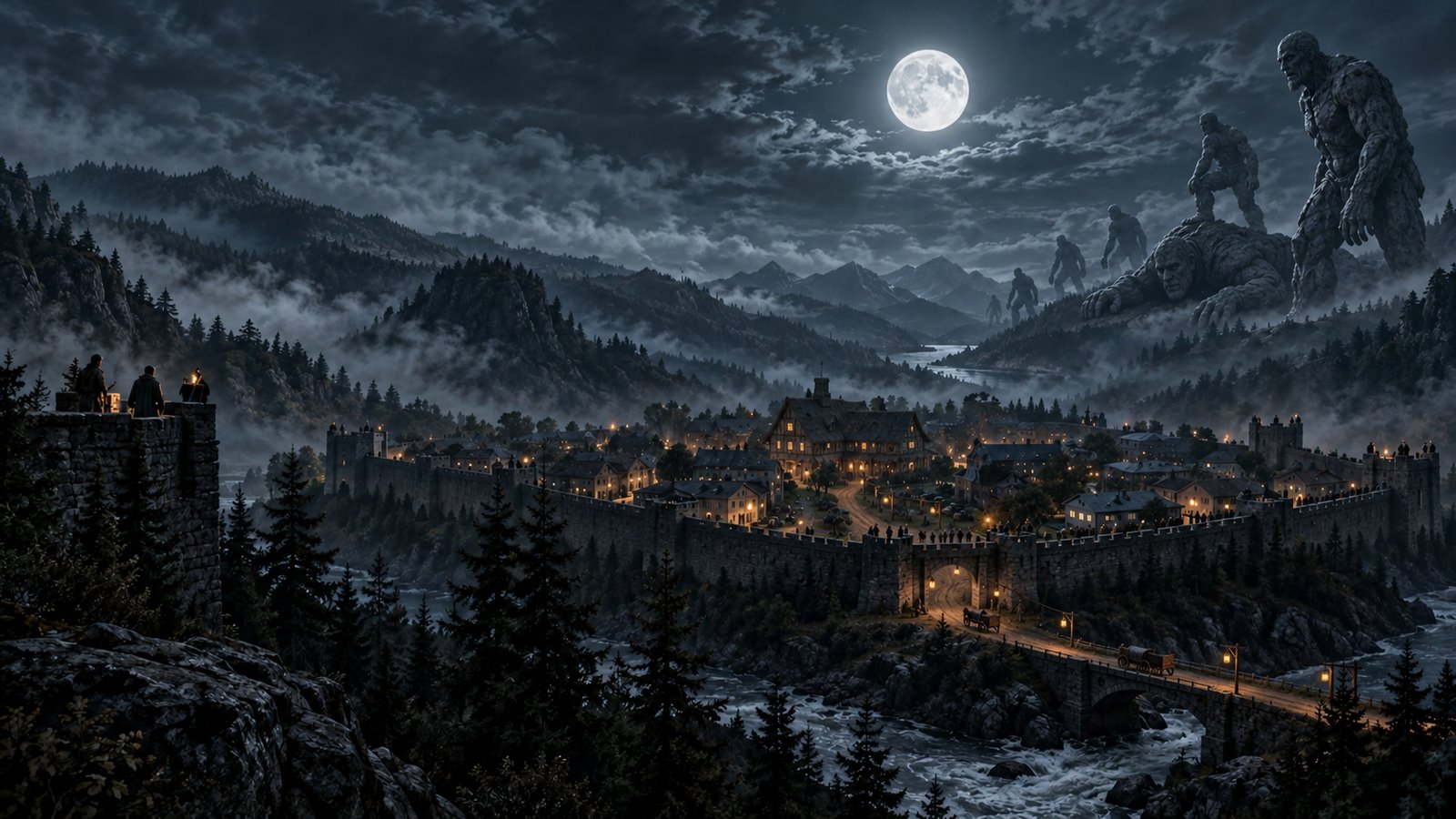
They take one step a year. A person who has not been told this can stand beside one for a whole afternoon and swear it is a hill. The first people who met one, thousands of years later, built a sheep fold against its foot for shelter, and came back the next spring to find the fold had a stone in the middle of it, and had to build another fold a little further on, and did not understand what had happened for three generations. The Standing have been walking since the first night, and they have never once stopped facing the crossroads, and they are the great unanswered question of the present age, and this account will keep coming back to them. The ones still on their feet are the highland giants of the ridges. The ones caught mid-stride in the deep valleys of the east, with one foot lifted, are the standing stones of the Hollow. The ones who have lain down across the Mystic to sleep are its bridges, and people drive carts over their backs every day, and most of the carters know.
About 8,600. The last Vétha lies down. There was another people in the new world, and they are gone now, and the ground everyone stands on is their work. The Vétha, whom the oldest marks call the Long Mothers, were walking hills, wider than a town, with soil on their backs and eventually whole woods. The Howl had left the floor of the world scoured bare in some places and heaped with silt in others, and the Vétha spent four thousand years carrying dirt from where there was too much of it to where there was none, very slowly, one hill at a time, with nobody asking them to. That is the reason anything grows anywhere. The Tally's mark for them means the ones who are patient on purpose, and it is the only mark on those old stones that reads like affection.
They finished. There came a year when nothing anywhere needed soil, and a Vétha with nothing to carry lies down, and one that has lain down does not get up again. They are the ridges of the Redrun now, and every flat-topped hill with a wood on it. The last of them, with the richest earth of all still on her back, walked to the place directly under the Mouth and lay down there, and the crossroads town of Ómbrek, which is the middle of this whole account, is built on her.
About 8,000. The echo runs out. No pack marks this year, because nothing that anyone now living would call terrible happened in it. There came a pass of the sky roads with nothing on it. The echo of the First Howl had gone out to the Sill and come back so many times that at last there was nothing left of it to come back, and the herds that had grazed on it for two thousand years went hungry. Being hungry, they looked down. The world beneath them was full of light lying on the ground, and they came down and ate it. What they did was not wicked. They were starving, and starving is not a crime. But the world has been dark from below ever since, and a good many things in this account follow from that.
About 7,600. The ground goes out. The green-gold shine failed from west to east, eaten, over a hundred years or so, and for the first time there was real night in Ærath, and the only light in it was whatever the Mouth happened to be weeping that season. It is the world's first famine, and the first time anything in Ca'tur was afraid of the dark, and the Wÿrms, who had eaten the light off the ground, turned to the two things that were left. One was the Mouth's light. The other was the Sáll.
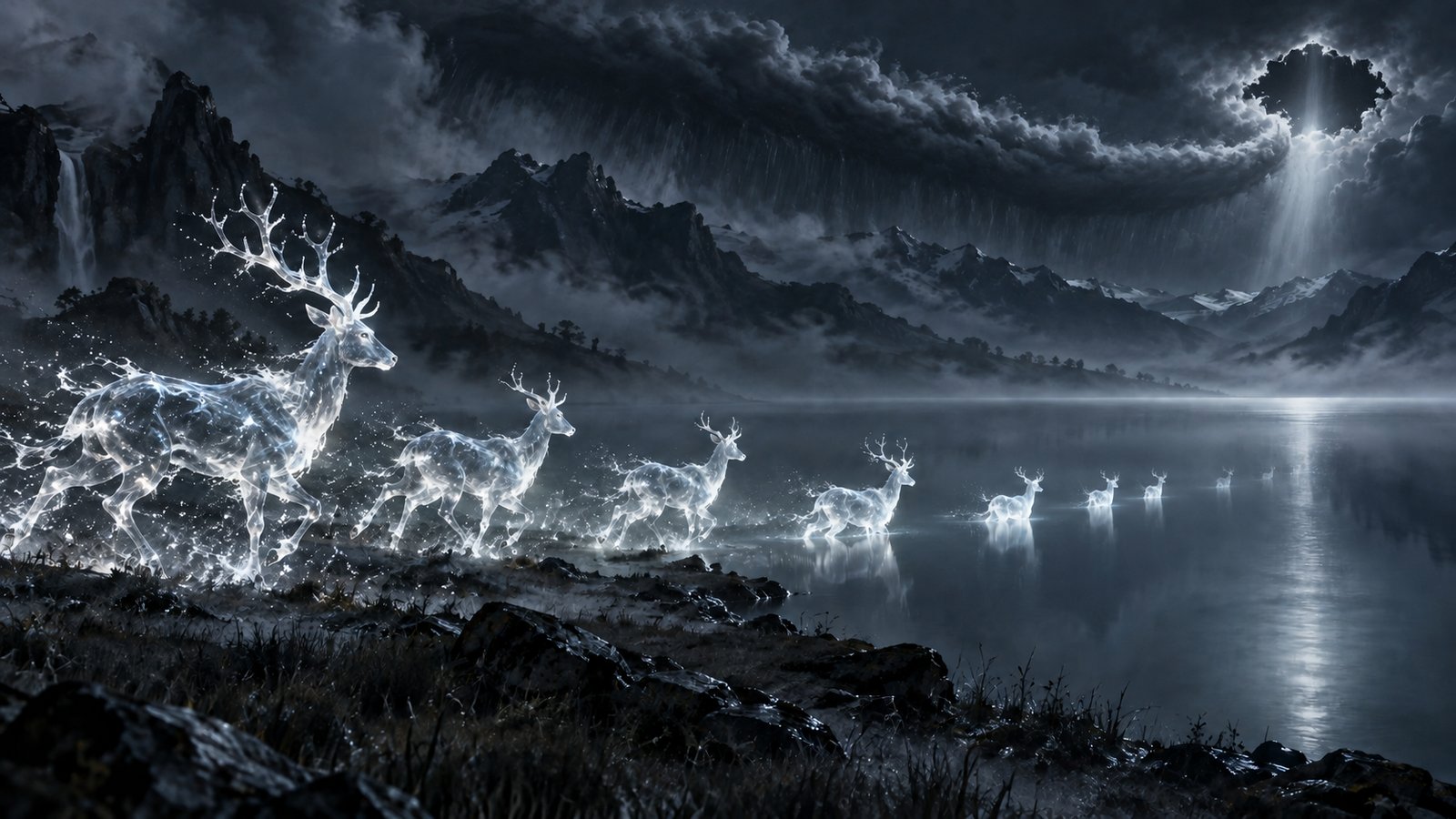
The Sáll, the Glass Herd, were deer, or as near to deer as anything that early comes, and they were made of the shine on water, with legs, and a habit of stopping to look at you. They had grazed the ground-light for thousands of years in herds of hundreds, eating it down to the rock, and it had grown back behind them. When the Wÿrms came down off the sky roads and found light with legs on it, they hunted it, and the Sáll ran, and there was nowhere on the ground for a thing made of light to hide in the dark. The last herd, pressed north with nothing left to eat, ran out onto the flat grey surface of the Spypool and went in. The Deep keeps things exactly. They are down there now, still running. On a windless night, if you look straight down past your own face in the water, a pale line moving very far below is the Glass Herd, running from something that died five thousand years ago, and the Deep does not permit them to stop.
The Glass Herd runs into the Spypool, 7,600 years ago
About 7,500. The Mystic is cut. What light there was from the Mouth fell mostly on the north, where the water caught it and held it, and the rest of the world got nothing. The Howl-Mother watched things starve for a hundred years, which is not very long to her, and then, on a day the marks do not name, she walked to the south shore of the Spypool, set her claw into the ground, and opened the land from the lake southward in one cut, the length of the whole country. The light that fell in the pool ran down the cut, and that is the Mystic, the river that runs from the Spypool south through the whole of Ca'tur and past it. Every rule anyone in Ca'tur has ever made about light and water rests on a channel that one creature dug because she was tired of watching things die.
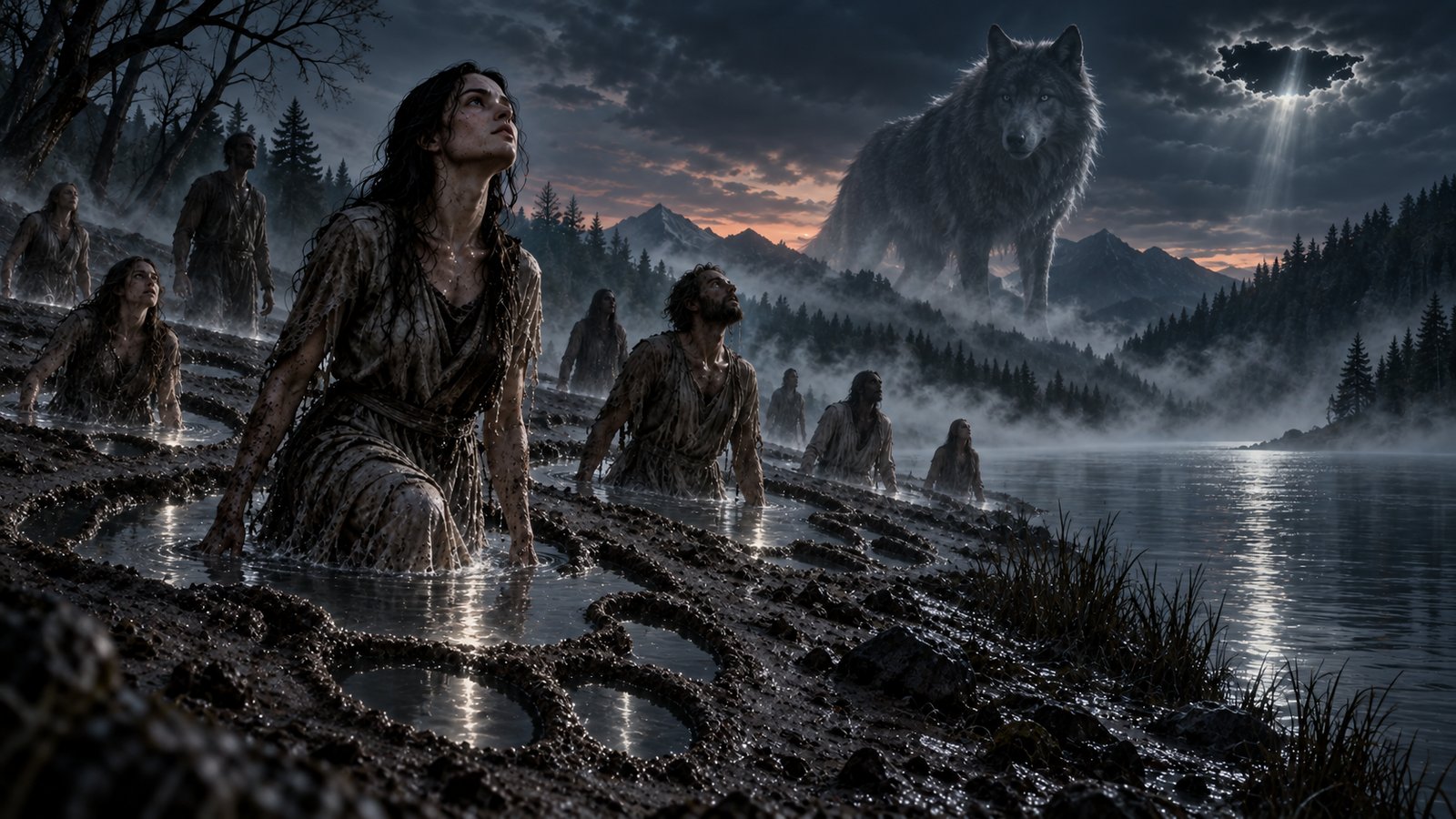
About 7,000. The first people. She had been walking alone for three thousand years by then, and where she stood still, which was more and more often, she left a print. A print in soft ground fills with rain, and in the north the rain was full of the light off the Mouth. There was one print beside the place under the Mouth, near where the last Vétha had lain down, that had held water for a hundred years, and one morning something stood up out of the water in it, and walked out of the shape, and stood on the grass looking at her, dripping.
The first people stand up, 7,000 years ago
That was the first person. Every living thing in Ca'tur since, people and oxen and hares and the small birds in the hedges, comes from water standing in a wolf's footprint, and that is why every living thing in Ca'tur carries a wolf inside it. This is not a figure of speech. Everyone in Ca'tur was poured into the shape of a wolf, and the shape is still in there, as real as a heartbeat, and it can be fed, and this account will have a great deal to say later about what happens when it is.
About 6,400. The first flood. The Mouth gave nothing for two seasons, and the Deep rose and took the whole north, and the old shoreline is a day's walk inland of the present one. The Leviathan was seen for the first time, by people who had no word for it, and the mark they cut for it on a stone that is now under thirty feet of water is a single long line.
About 6,000. Théran stops. One of the Standing who had risen at the eastern Sill on the first night, and had been walking toward the crossroads for four thousand years, stopped in a valley in the east because a person asked him a question. The person's name is not recorded and neither is the question. Answering takes a Standing a very long time, and he has not finished. He is the tallest stone in the Hollow, and he leans forward a little, as though listening for the question to be said again, and over the ages other Standing coming through that valley stopped near him, perhaps to hear, until there were three hundred and fourteen of them standing in the valleys of the east with one foot lifted, and dusk comes an hour early there, because a great many enormous patient things are in the way of the light.
About 5,000. The Tally go out. The Ánneth, called the Tally, were small and grey and there were a great many of them, and they were the world's memory before anyone else kept one. Nobody now knows what they ate or where they slept. What they did was count. They went about Ærath with sharp stones and wrote down everything the world held, on the flanks of the Standing mostly, because the Standing were the only things that would still be there in a thousand years, and the scratches under the moss on those stones are theirs: so many hills, so many kinds of bird, the Vétha, the Sáll, the Wÿrms, the sound of the Wÿrms, the fire. They wrote it so the Hush could not take it. Then, about five thousand years ago, they went out past the Sill in a long line, marking as they went, to count the Hush itself, and none of them came back. Ærath has not been counted since. In the same century one of the Standing walked into the Mystic where it leaves the Spypool, and lay down across it, and went to sleep, and that place is called Stoneknot, and it was the first bridge.
About 4,400. Rásh. The Howl-Mother was alone in a way that being surrounded by creatures does not fix, and one spring she made a companion. She made him out of river clay from the bank of the Mystic and her own breath and a name she chose for him rather than found, and he stood up, and walked beside her for two hundred years. He could not be fed. He did not starve, because he was not alive in the way that starves, and he could not stop wanting to be fed, because she had made him thoroughly, and so he went on and on beside her, wanting, with no way to take anything in. She unmade him at the end out of kindness. The Tally's last mark for him means she took the name back out, and it is the only thing in the whole of the deep past that the Howl-Mother is recorded as having unmade.
About 4,000. The first tree. On the back of the last Vétha, in the place where the Howl-Mother had slept longest, a tree came up out of ground nobody had planted. It was an oak, or as near to one as makes no difference, and the Old Tongue called it Ma'run, the one that came up by itself. It stood directly under the Mouth, so that the light that wept through the hole fell first on its crown, and it grew as no tree since has grown, and the mother took to lying under it when she came back that way, with her back against the trunk and her nose toward the west, and scratching between her shoulders on the bark.
About 3,100. She lies down. After seven thousand years of walking, she came back to the tree in an autumn, and lay down under it, and did not get up. The people who lived by then round the crossroads did not think anything of it at first. She had lain there before. But she did not get up the next spring either, or the one after, and they built their houses a little closer, and left food, which she did not eat, and watched her, and she watched the Mouth, and the leaves came down on her in the autumns and she let them. Nobody knew she was expecting. She may not have known herself.
3The Litter
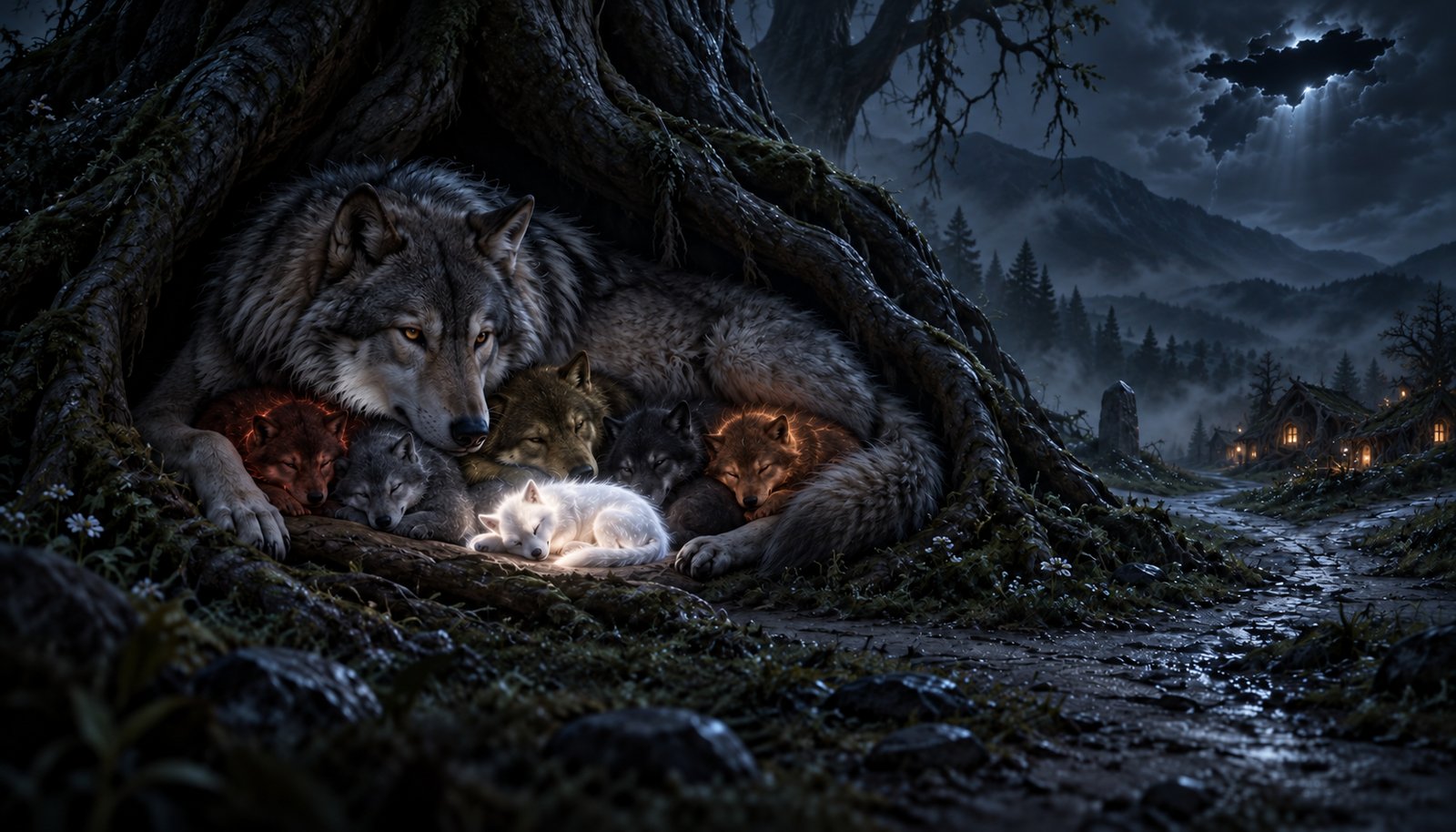
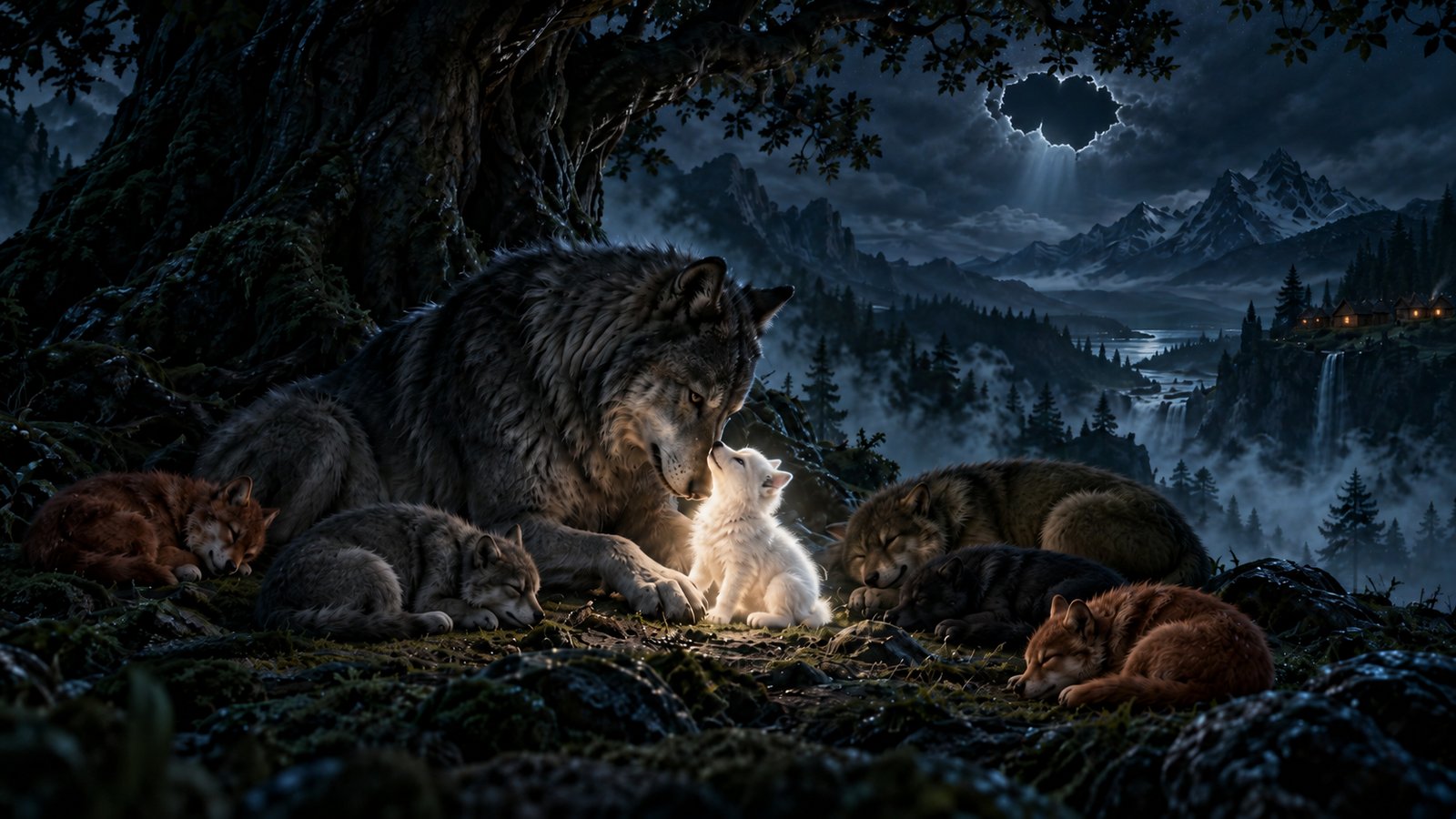
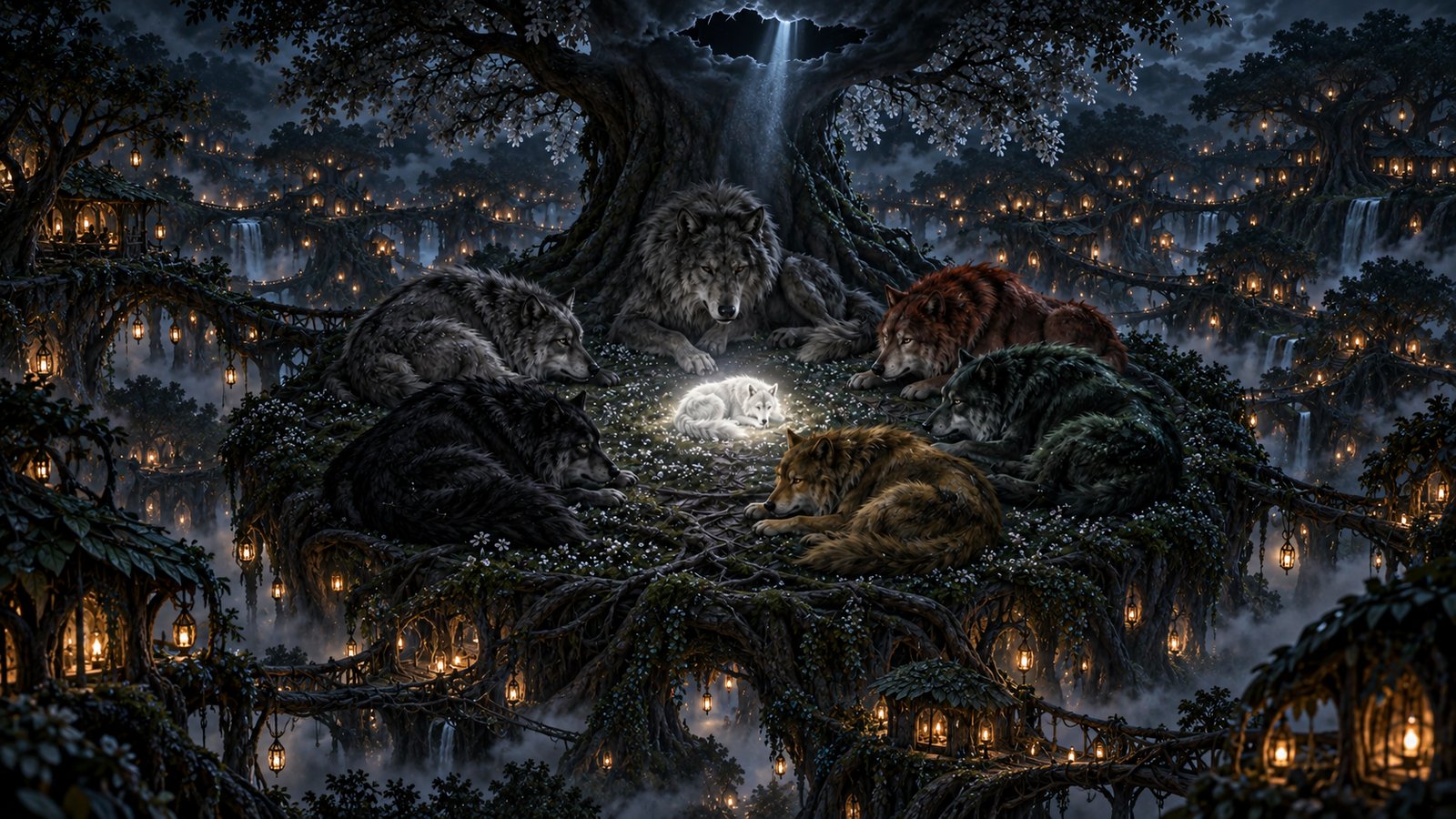
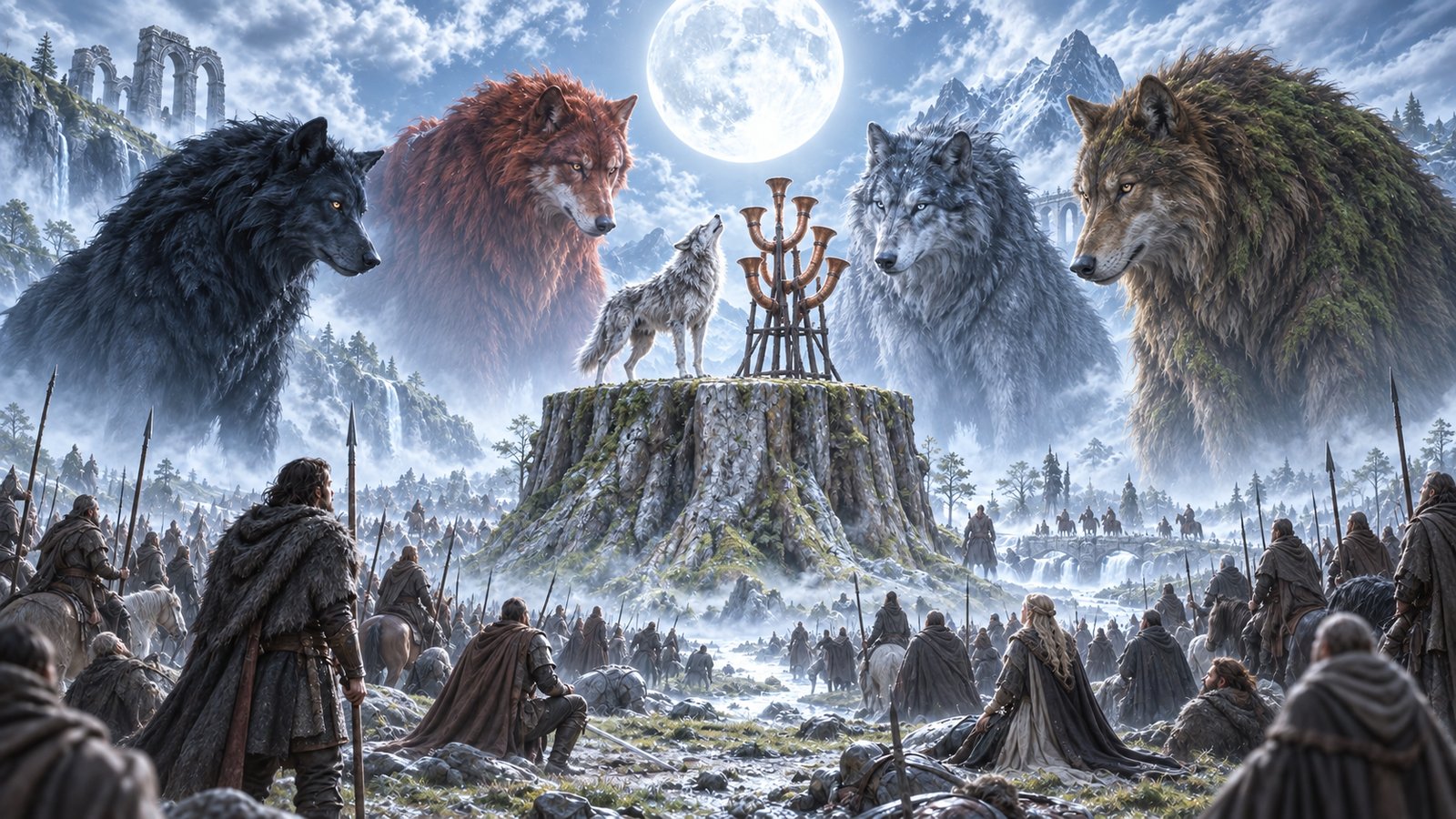
About three thousand years ago, on a night in midsummer, six wolves were born to the Howl-Mother in the roots of the first tree, on the back of a hill that used to walk, directly under the Mouth.
The people who lived round the clearing did not know it was happening until it had happened. A woman who had gone out before dawn to see to a goat heard something in the roots that she took for a fox, and went to look, and came back to her house and sat down on the step and did not say anything for a long time, and when her husband asked what was the matter she said that there were six of them, and that the big one was awake and looking at her. By the time the sun was up the whole of the crossroads was standing at the edge of the clearing, and nobody went nearer, and the old things came too. Nobody saw them come, but by noon there was a Wÿrm lying along the western sky with its storm folded under it, and every Standing within a day's walk had its head turned a little further toward the tree than it had been the night before.
The mother lay in the roots with the six against her side, and she looked, the woman with the goat said afterward, exactly as she always looked, except that she was smiling, if a wolf can smile, and this one could.
The Litter under the first tree, 3,000 years ago
She loved all six of them. Every account agrees on it, and the ones that pretend otherwise were written two thousand years later to win an argument. She loved them, and she fed five.
She did not feed them milk. She still carried most of the First Howl inside her, the sound she had made in the Hush to make the world, and it had never stopped sounding in her, and when she bent over a pup and breathed on him, she let a piece of it out of herself and into him, and the piece became what he was. It went in through the top of his head, where the fur is thinnest, and you could see it go, a little brightness like the last of a sunset going down behind a hill. Five pieces of one Howl made five wolves, and each piece was a different note, and here they are in the order she fed them.
Sárrik was first, and he was red, and he was already moving. He came out of her moving and he did not stop. Before his eyes were open he had crawled out of the roots and over the woman's foot and halfway across the clearing, and she had to fetch him back in her mouth, and did, four times that first day. What she fed him was the going first, the thing in a person that moves before the rest of them has agreed to. When she breathed on him he sneezed.
Mórrow was second, and he was grey like her, and he did not open his eyes for nine days. When he did open them he looked at his mother for a long while before he looked at anything else, and then he looked at everything else the same way, one thing at a time, until he was finished with it. What she fed him was depth, and patience, and the seeing that comes from holding still. He did not sneeze. He took it in and thought about it.
Áldyn was third, and he was the largest, and he was the last of the six to walk, because there was so much of him to get up off the ground. By the end of the first year he was bigger than the other five put together and still falling over. What she fed him was growing, and the strength that comes slowly and does not go away. He was the one the others slept against.
Nócht was fourth, and he was black, and he was born at night and fed at night, last of the five, after the others had gone to sleep against Áldyn, and what went into him went into him in the dark. She fed him memory, which is the refusal to let a thing be finished with just because it has stopped. He was quiet. He remembered the woman with the goat, who had been the first person to see him, and he went to her house every day for the whole of her life, and sat by the door.
Tánnik was fifth, and he was taking things apart before he could stand, beginning with a beetle and going on to the woman's shoe. What she fed him was making, the seeing of the thing before the thing is there, and the cleverness that finds a way through when force will not. The first thing he made was a better place to sleep, out of leaves and two sticks, and it fell down, and he made it again.
The sixth was born last, and she was small, smaller than any of the others had been, small enough that Áldyn, who was already enormous, could have lost her under one paw and did once, briefly, and she was pale, not white, but the colour a grey wolf is when the sun is behind her. When the mother bent over her on the first night and breathed, the way she had five times already, something happened that had not happened before.
The sixth howled back, very softly, and did not stop.
She was a day old and did not decide to. She was not being stubborn and she was not afraid. She howled back because she was already howling, and had been since before she was born, softly, at the very edge of what a person can hear, and the reason for that goes back to the first night of the world. When the First Howl struck the sky and broke it, a piece of the Howl broke off against the Hush, the way the tip of a stick breaks against a wall, and it fell. It fell back down the whole height of the new world, and it went into the ground at the place directly under the Mouth, where the last Vétha would later lie down, and where the first tree would later grow, and it lay in the dark among the roots for seven thousand years, still faintly sounding, and when the sixth was born she was born round it. It was inside her, the way a stone is inside a plum, and she was sounding it.
A Howl cannot go into a thing that is already sounding it. Two of the same note, meeting, do not make a louder note. They make a stillness. Anybody who has stood between two people singing the same note very close together will have felt the air go strange for a moment, and this was that, but more so. The mother breathed down, and the daughter breathed up, and between them was a small quiet the exact size of a pup, and what the mother had given did not go in.
It had to go somewhere. A piece of the First Howl, once let out, does not simply stop. So it went up. It rose out of the roots and past the mother's face and up through the branches of the tree, a little brightness going the wrong way, and it went up the whole height of the sky and out through the Mouth, and the woman with the goat, who had come back that night to leave bread, saw it go and thought it was a spark.
The mother thought she had done it wrong. She tried again, more softly. It rose again. She moved round to the other side of the pup and tried from there, so the note would have room to bend, and it rose. She tried the next night, and the next. She carried the sixth across the clearing in her mouth and set her down on the far side and howled to her from a distance, so gently that the people at the edge of the clearing could not hear it, and the sixth, half asleep, howled back without waking, and the small bright thread went up between them and out through the hole in the sky. She carried her to the very edge of the world, to the Sill, and stood with her back to the Hush in case the Hush was somehow the trouble, and tried there. It rose.
It was some time in the second year that she understood. The old ones say that she sat under the tree that whole summer and made no sound at all, which for her was a very long time to be quiet, and that at the end of it she lay down, and put her chin over the sixth, who was asleep, and stayed like that until morning. She had understood that the sixth was not refusing her, and was not broken, and was not going to change. She had understood that her daughter had come into the world already carrying a piece of the thing the mother had to give, and that there was no room in her for a second piece, and that this was nobody's fault and nobody's choice. She loved her anyway. She loved her, the old ones say, a little more than the others, the way you love the one who cannot do the thing the others can, and she went on trying to feed her every single night for eight hundred years, softly, from across the clearing, knowing it would rise, because she could not stop.
What rose came back.
It went out through the Mouth as a thread of brightness, and it came back down through the Mouth as light. It fell first on the Spypool, where the Mouth's light had always fallen, and ran down the Mystic, which the mother had cut for that very purpose seven thousand years before, and into every living thing that drank from the river or from any stream that fed it or any well dug near it, which is every living thing in Ca'tur. Before the Litter the Mouth had wept light in floods and droughts, whole seasons of nothing and then a night when the low country ran silver. From the first night of the sixth's life there was light every night, thin on some nights and full on others, and it was the first Moonlight, though nobody called it that yet, because there was no Moon.
Everything alive spends it. That is what Moonlight is for. A hare spends a little to run and a tree spends a little to put out a leaf and a woman spends a little to remember where she left the bucket, and a great deal more to make a chair or a song or a child. What is spent sinks down through the ground to the Deep and the Warm, which drink it, and that is why those two stay quiet. What is not spent by dawn rises off the fields as mist and goes back up, and cannot be kept, however hard a person tries, and a good many people have tried. All of it, every drop, since the first night of the Litter, is what the Howl-Mother gave her sixth daughter, and could not get into her, and gave anyway, and everything in Ca'tur that runs, or grows, or makes, or remembers, does it on that.
The naming. She named them the way she had done everything, by sound. She had no other way. She had never been given a name herself and had none, and never has had one that anybody says, which is why this account calls her only what everybody calls her. But she knew what a name was for. A name is the sound that goes with a thing so that it can be called back, and she had five pups who kept wandering off, and so on the tenth night, when Mórrow had at last opened his eyes and could look at her while it happened, she gave them their names.
She gave Sárrik the sound of a dry branch catching. She gave Mórrow the sound of the Spypool on a windless morning, which is very little sound at all. Áldyn's name was the sound of a root going down. Nócht's was the sound of the dark just after a lamp goes out, which is a sound, though a small one. Tánnik's was a small click, like a latch. Each name was one sound, with the weight on the part where her voice fell, and that is how names in the Old Tongue have been made ever since.
The sixth she named last, and it took the whole of the night.
The naming of Mo'ón, 3,000 years ago
The people at the edge of the clearing heard it begin, low, the way the others had begun, and waited for it to stop, and it did not stop. It went on. It went on past midnight and it was still going when the sky greyed, and by then half the crossroads had come out of their houses in whatever they had been sleeping in to stand at the edge of the trees and listen, because nobody had ever heard the Howl-Mother make a sound that long except the one nobody had heard. She was giving the sixth a name with everything in it. It had in it the sound of the river going over the stones at the ford. It had the sound of the wind in the top of the tree, and of the tree itself, and of the fire in the woman's house, and of the goat. It had, in order, the names of every one of the sixth's five brothers, turned a little so that they fitted. It had the Howl-Mother's own sound in it, the one she had made in the Hush, softened, and it had the sound of rain filling a print in the ground. It was the longest name she ever gave, longer than all the others put together and then some, and it was beautiful, and the people who heard it said afterward that they had not known a name could be a place you could walk about in.
The name was Mo'ónavellisarendathé.
It is set down here as she gave it, because this is the account of what happened. Nobody in Ca'tur can say it now past the first part, and how that came to be is told in its place. The first part is Mo'ón. The mother said it with a little catch of breath in the middle, because that is where the name took its first turn, and said quickly, the way a mother says a long name when she is calling a pup in for the night, it sounds like moon. That is the whole reason the light in the sky is called the moon, and everybody in Ca'tur says it every night, and hardly anybody knows they are saying her name.
How the sixth fed. Some time in the third year the mother carried Mo'ón to each of her brothers in turn and set her down in front of him and said the same thing to each of them, and the people who heard it say it was seven words: what is best in you, let her have it.
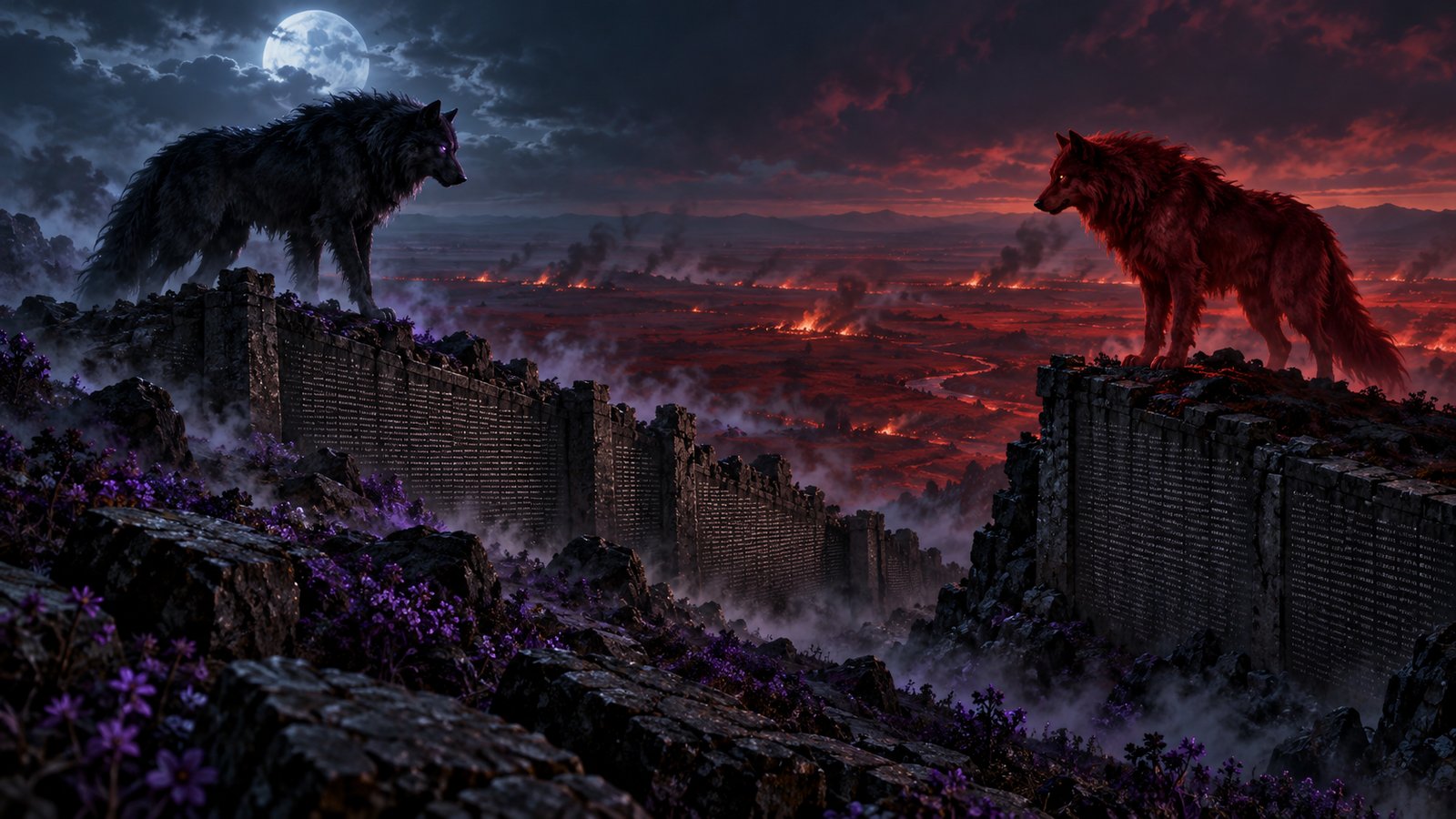
That is how Mo'ón was fed, and it is why she is what she is. Each of the Great Wolves is half made of light. It is true of them now, when they are old and enormous and lying at the edges of the world, and it was true of them as pups, and the light half and the shadow half are not mixed together. They lie against each other, like the bright side and the dark side of one leaf, with a seam between. Mo'ón could see the seam. She was the only one who ever could. She lay along Sárrik's bright side, and what came off him into her was the going first, and she left the fire that does not care what it eats lying on the ground beside him like a shadow he had not noticed. She lay along Mórrow's bright side and took the depth and left the cold. From Áldyn she took the strength that comes slowly and left the refusal to bend. From Nócht she took the not forgetting and left the bargaining, which is what not forgetting turns into when it is frightened. From Tánnik she took the making and left the part of him that does not care what the thing is for.
She did not grow big. Feeding on the best of a thing makes you brighter and not bigger, and by the end of the Watch she was still the smallest wolf under the tree, and you could read by her at night from the far side of the clearing, and people did.
She is the greatest of the six. Nobody who saw her doubted it and nobody who has thought about it since has either, and it has nothing to do with her size. To Sárrik she was the one who ran beside him and never once tried to run in front. To Mórrow she was the one thing in the world he did not have to wait for. To Áldyn she was the pup he had carried on his back through the first winters, and he never stopped seeing her at that size, even when she was a thousand years old. To Nócht she was the only one who remembered as much as he did. To Tánnik she was the person he made things for, and he made her a great many things, most of which fell down. When the seven lay down at night round the tree they lay in a ring, the mother and the five and Mo'ón, and Mo'ón was where the ring closed.
What the mother was like. Since this is her story as much as anyone's, and since the end of it is a long way off yet and hard, it is worth saying here what she was like to live with, in the years when the pups were small and the tree was young and nothing yet had gone wrong.
She could not sit still. Seven thousand years of walking had gone into her, and lying under a tree did not come naturally, and she did it because her children were there. Every morning of her life at the crossroads she got up before the light, stepped over whichever pup was in the way, and walked down to the ford where the Mystic runs shallow over stones a mile south of the clearing, and drank there, with the light of the night before still running in the water, and stood a while with her feet in it. Then she walked back, and went round the sleeping ring, and put her nose down to each of the six in turn and breathed on them, once, the way she had on the first night, to see that they were all still there. Sárrik was usually not, and she went and fetched him. She did that every morning for eight hundred years. The people of the crossroads set their day by it.
She scratched her back on the tree, hard, so that the whole crown shook and the birds went up out of it. She liked the west wind and lay with her nose in it. She was patient with Tánnik's things falling down and less patient with Sárrik, whom she fetched back by the scruff well past the age when he was too big to be carried, to his enormous embarrassment, in front of people. She made a low sound in her throat when she was content, which was the beginning of a howl that never went anywhere, and the pups learned to hear it and come and lie against her when they heard it, and so did some of the people's children, who were not afraid of her at all, and whom she let. She was funny. Not in words, since she had none, but she would let Nócht get all the way to the end of a long careful piece of remembering and then look at him sideways, and he would know he had got a detail wrong, and she would let him work out which. And she could laugh, and did, most often at Mo'ón, who was quiet, and funny in a way that took a moment to reach you, and who was the only one of the six who could make her mother laugh on purpose.
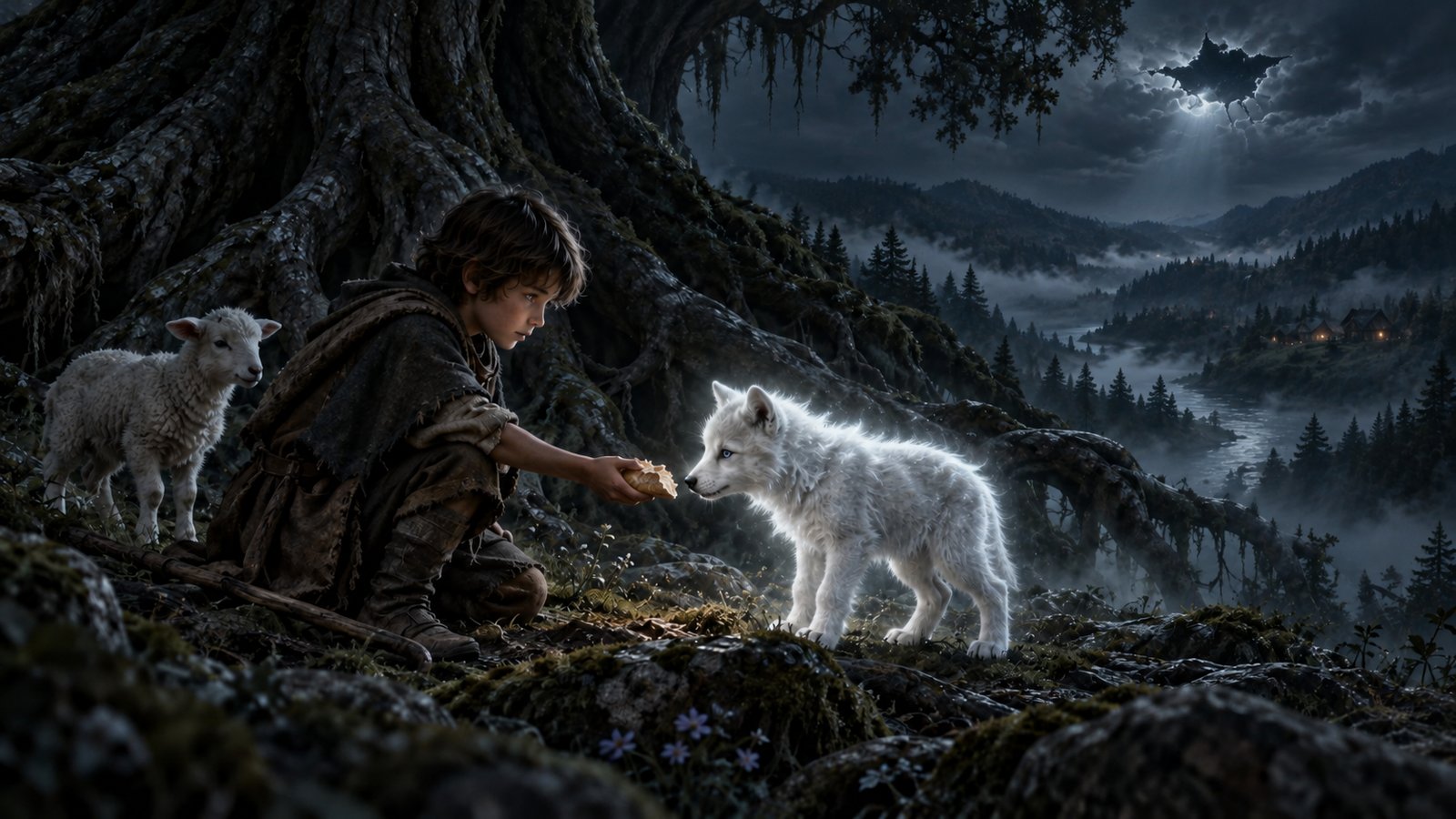
Tam of the Reed Hearth. In the first years of the Watch, which is what the age after the Litter came to be called, there was a shepherd's boy of nine called Tam, whose family kept a hearth by the reeds south of the clearing, and who was looking for a lost lamb one evening in the roots of the first tree and found the sixth instead, hiding, because Sárrik had been trying to make her race him. She looked at him and he looked at her, and she was about the size of the lamb, and shining a little, and he sat down. The next day he brought her a crust, and she took it, though she did not need it and it was Moonlight she lived on, because he wanted to give it. He brought her a crust every day for a year. He taught her to count, on his sheep, and she has been counting ever since, and what she counts now is voices. When Tam died an old man, seventy years later, the sixth lay at the door of his hearth all night, and that was the first time the crossroads saw her light go dim.
Tam and the sixth
The Shoal. One thing more happened on the night the six were born, and it happened forty miles to the north, and nobody at the crossroads knew about it for a month.
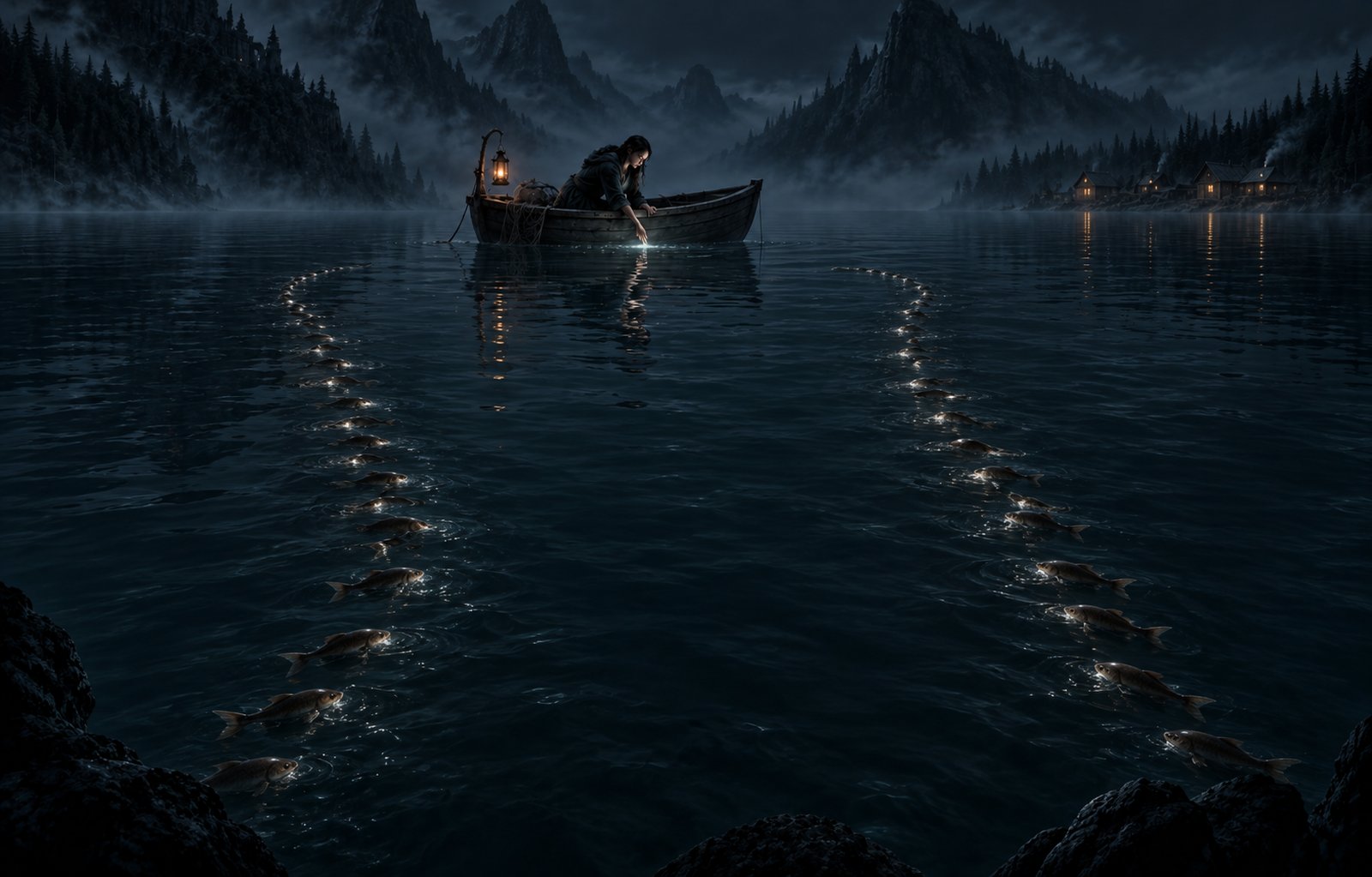
There was a woman called Nan who fished the north shore of the Spypool, as her family had for longer than anyone had counted, and who went out in her boat that night because the fish come up to the flat water in the dark. She was a practical person and she did not like the Spypool much, and no fisher on that shore did. The water was too still and it was too deep and it kept things, and everybody who lived by it had a grandmother who had told them not to look down into it for too long. But the fish were good, brown and fat and slow, and she went out.
That night the fish did something she had never seen fish do. They came up. All of them, as far as she could see across the water, every fish in the lake, came to the surface at once and lay there with their backs just breaking it, and held still. Fish do not hold still. They lay in two long lines that curved a little at the ends, and Nan, who had seen the marks the Tally had cut on the stone bridge at Stoneknot every day of her life, and had been taught by her grandmother what a few of them meant, saw that the two lines the fish had made were a shape she knew. It was the two marks that mean not yet.
The Shoal speaks, 3,000 years ago
She sat in her boat with her hands on the oars and looked at it until the light changed, and then the fish went down. She told people. Nobody believed her until the next night, when they did it again, and the night after, and every night for the whole of the Watch, and every night since, for two thousand two hundred years more, until forty years ago.
What it meant is this. The Deep has no mouth. It is the first water, and it keeps everything exactly, and it had never said anything to anybody, because it had nothing to say it with. On the night the six were born, something in Ærath changed that had not changed in ten thousand years, and the Deep felt it, and for the first time it wanted to speak, and the only things it had to speak with were the fish that swam in the top of it. So it moved them. It laid them out on its surface in the shape of the oldest writing there was, and the thing it said was not yet, and nobody knew what it was that had not yet come. People argued about it for eight hundred years. Some said the Deep was answering a question and the question had not been asked yet. Some said it was counting toward something, the way a person waiting for bread to rise looks at it and says not yet, and not yet, and not yet. That is the reading this account holds to, because forty years ago the fish stopped saying it, and stopped saying anything, and it is hard to think what else that could mean.
The fish came to be called the Shoal, and they are the Deep's voice, and what became of them at the Widening, when they turned from brown to silver, and what they said once in the Long Dark that was not not yet, and why it mattered more than anything else that anybody said in that hundred years, are all told in their places.
4The Watch
The eight hundred years from the Litter to the Widening are called the Watch. There was one people, seven wolves and one town, and everything that has happened since is measured against those years and found smaller.
Élbrek, the city of the Watch, 2,960 to 2,200 years ago
The name is not a figure of speech. A little of the Hush always leaked through the Mouth, a thin cold that came down at night and made the leaves at the very top of the first tree forget to be leaves for an hour before dawn, so that they hung grey and flat and then remembered themselves and went green again as the sun came up. The Howl-Mother, lying under her tree with her daughter against her side, had watched the hole herself every night for seven thousand years, and now she had six pups to watch instead, and so she asked one thing of the people who had built their houses round the clearing, and it was the only thing she ever asked of them. Watch the Mouth, and tell me if it ever changes.
So one person stayed awake every night and looked up. In the morning, before going to bed, they wrote their name in a book, and the next night somebody else went up, and the book was never empty again for seven hundred and ninety-six years. It is called the Night Roll, and it is the longest list of names in the world, and it is the reason this age can be dated to the night. Most nights the entry is a name and nothing else. A few have a word or two beside them, cold or clear or the big one was awake, and one, which will come in its place, has four words that broke the oldest rule of the book.
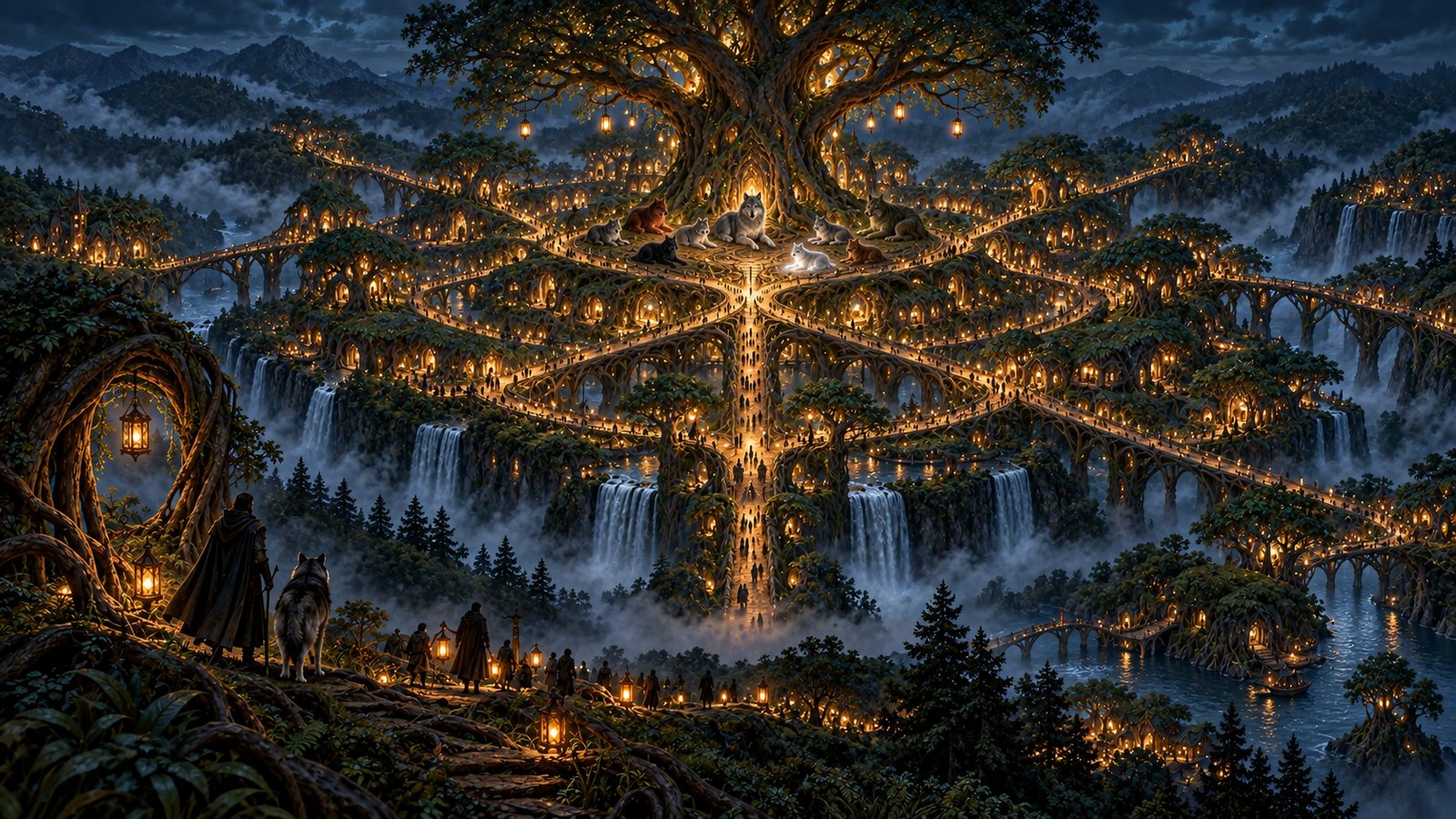
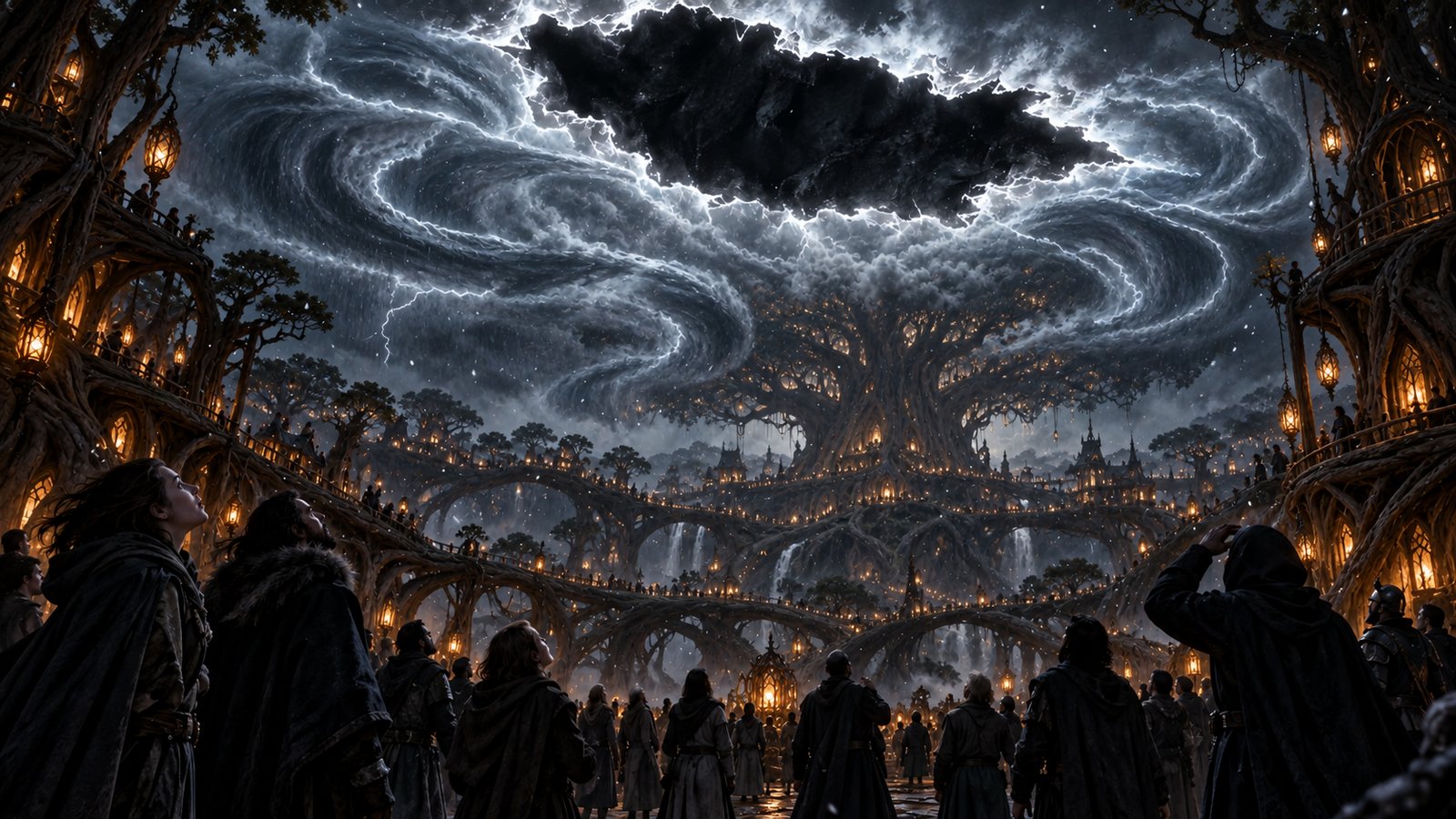
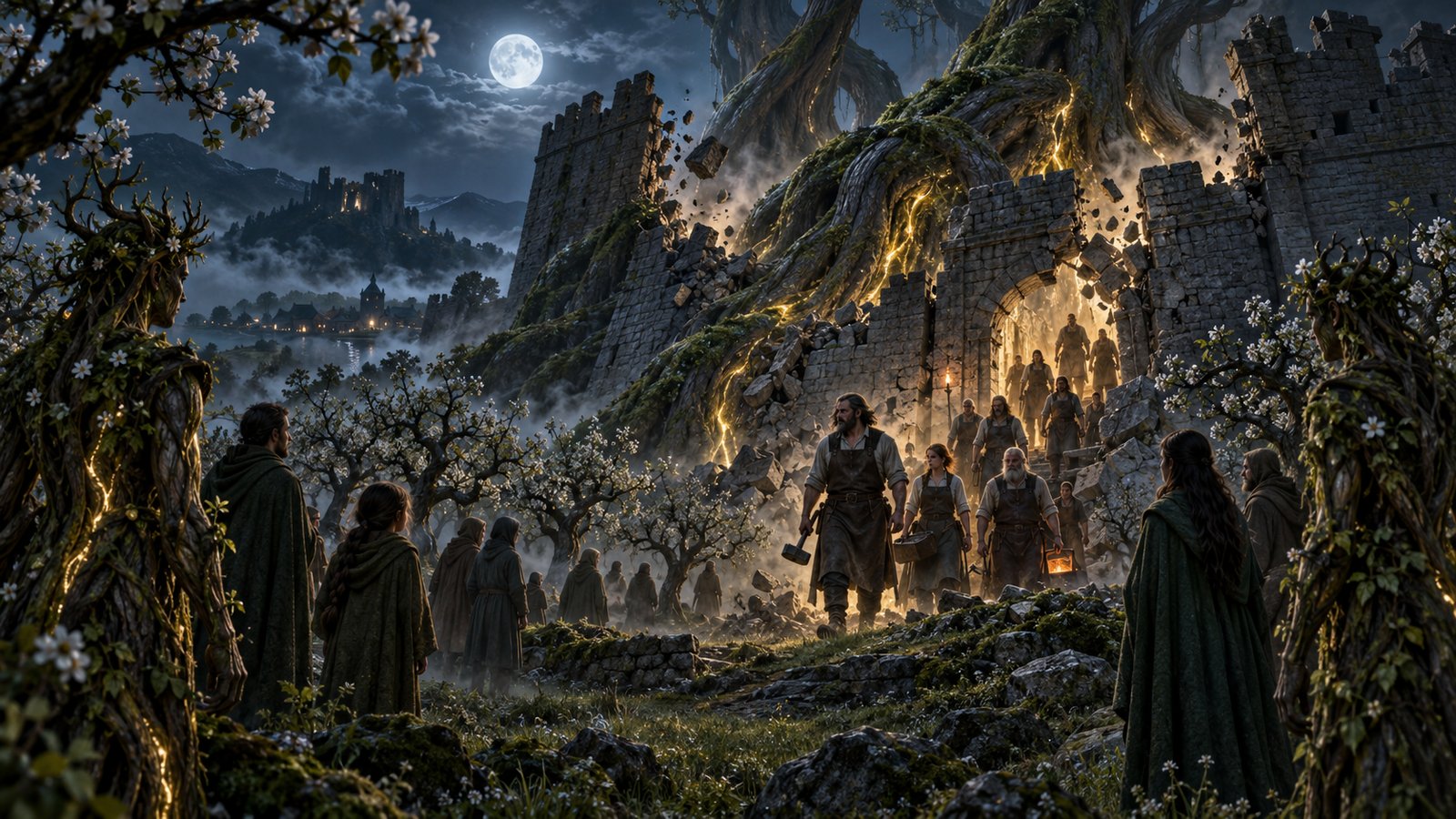
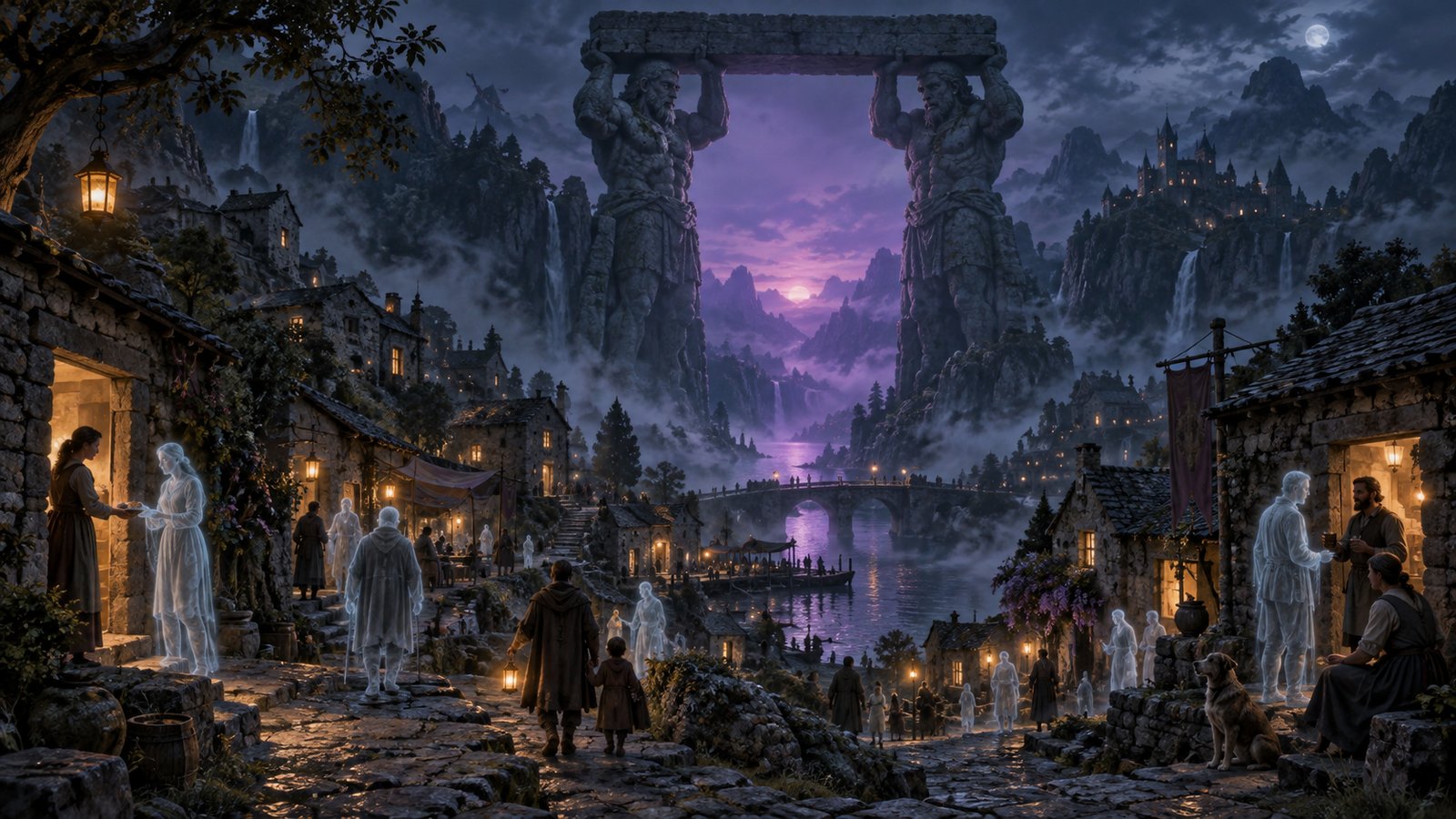
The cities. The town under the tree was called Élbrek, which means where the seven bend together, and it stood in seven rings round Ma'run, with the innermost ring left empty because that is where the wolves lay. It had no walls, in eight hundred years, at any point. Áldyn grew it. The houses were the tree's own branches, brought down and hollowed and roofed with their own leaves, and the streets were roots, so that a person walking home in Élbrek was walking along the tree, and the town creaked in a wind the way a ship does. Tánnik lit it, with lamps he made himself, and for a long time nobody knew what the lamps burned on, since they had no oil in them, until the sixth told him. They burned on being looked at. A lamp of Élbrek in an empty room went out. Nócht kept the tellings, in a low house of night on the east side of the fourth ring, where anyone could go in and sit down in the dark and hear their own grandmother's voice telling them something she had told them once when they were small. Sárrik ran the roads, and they took the lines he ran, which is why the old roads of Ca'tur go straight where a sensible road would bend. And the sixth kept the people. That was her post. She lay in the roots where the pups had been born, and anyone could come and lie beside her, at any hour, and be heard, and a great many people did, and she remembered every one of them.
The seven wolves at the Stump, 2,960 to 2,200 years ago
There were other towns. Whitewatch stood on the Spypool's north shore, with every building facing the water. Nine Bridges grew up on the Mystic where three of the Standing had lain down to sleep across it and people had added six more crossings in the same style, on stone pillars, and hoped nobody would notice the difference. Ashwell was in the west, round a hearth that was fed by a rota. Anvilrise in the south was dug into its hill, and Lanterngate in the east had its streets laid out so that every one of them ended looking at Théran, the tall stone who was still answering his question.
Mórrow at Whitewatch, 2,960 years ago
The arts. Lightweaving is the one the Watch is remembered for. Moonlight can be worked by hand before dawn takes it, if the hands are quick and know what they are doing, and the weavers of Élbrek spun it to thread and the thread to cloth. A lightwoven coat is the most beautiful object that has ever existed in Ca'tur, and like everything made of Moonlight it comes apart at sunrise, and they made them anyway, thousands a night, for centuries, and put them on and walked about in them until the sky greyed, and let the morning have them. Nobody makes them now. At Whitewatch there was mirror-reading, in which a reader on a flat morning could ask the Deep for a thing that had already happened, and be shown it, exactly. At Anvilrise there was the low singing, pitched below the range a person can hear, because the Warm hears low things, and a singer who had the knack could sing to the hill and the hill would answer.
The magic was asking. That is the thing about the Watch that is hardest for anyone now to understand. They asked the Deep, and were shown. They asked the Warm for iron, and the hill gave it. They asked a sleeping Standing for leave to lay a road across its back, and got an answer, once, and it took ninety years, and it was yes. They could ask because the Howl-Mother lay in the middle of the world with her eyes open, and the old things knew it, and they knew whose world it was. After she left the tree, asking stopped working, and bargaining took its place, and every bargain since has had a price.
The dead. There was no door in the Hollow then. When a person of the Watch died, their body went into the ground, and the wolf inside them, the shape they had been poured into, went up. It went up the way the mother's feeding went up, through the Mouth, and on the far side of the Mouth there was a country, lit from behind by the light that came through the hole, where the dead waited, still themselves, fed by anyone who remembered them. That country is the Fallen, and it is still there, and how the dead get to it now is a different matter and a later part of this account. In the Watch the sixth sat with the dying, every one, for eight hundred years, and remembered them all afterward, and the people of Élbrek held that the dead went to her, and were not wrong.
Dated events.
2,996. Ilse of House Vennow (2,990 to 2,918), who was six years old and could not sleep, climbed the seventh ring to see what the grown-ups were looking at, and stayed up all night, and in the morning wrote her name in the book, because someone had told her that was the rule. It is the first name in the Night Roll. She held the watch herself, on and off, for sixty-one years.
Sárrik makes the Redrun, 2,960 years ago
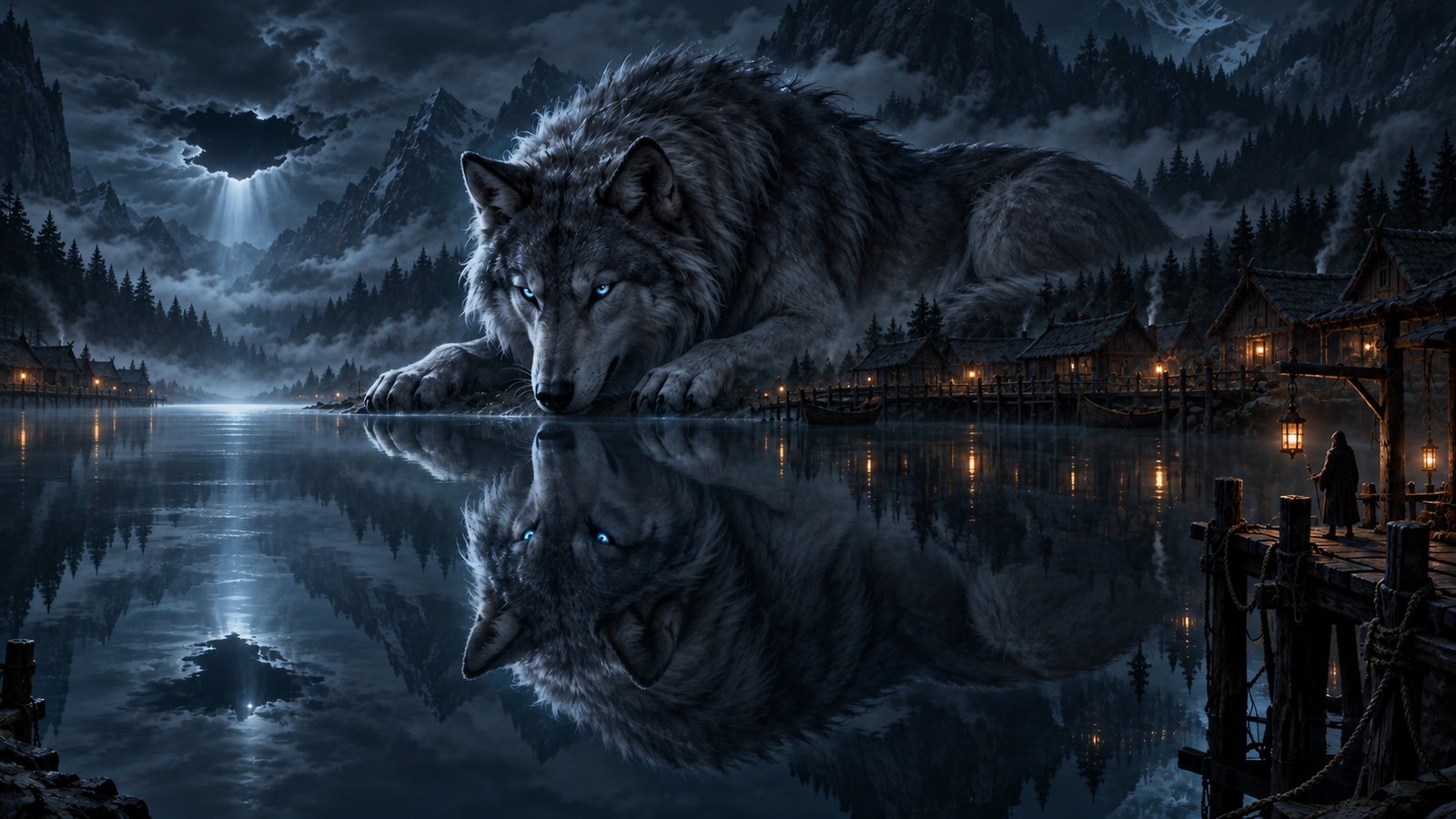
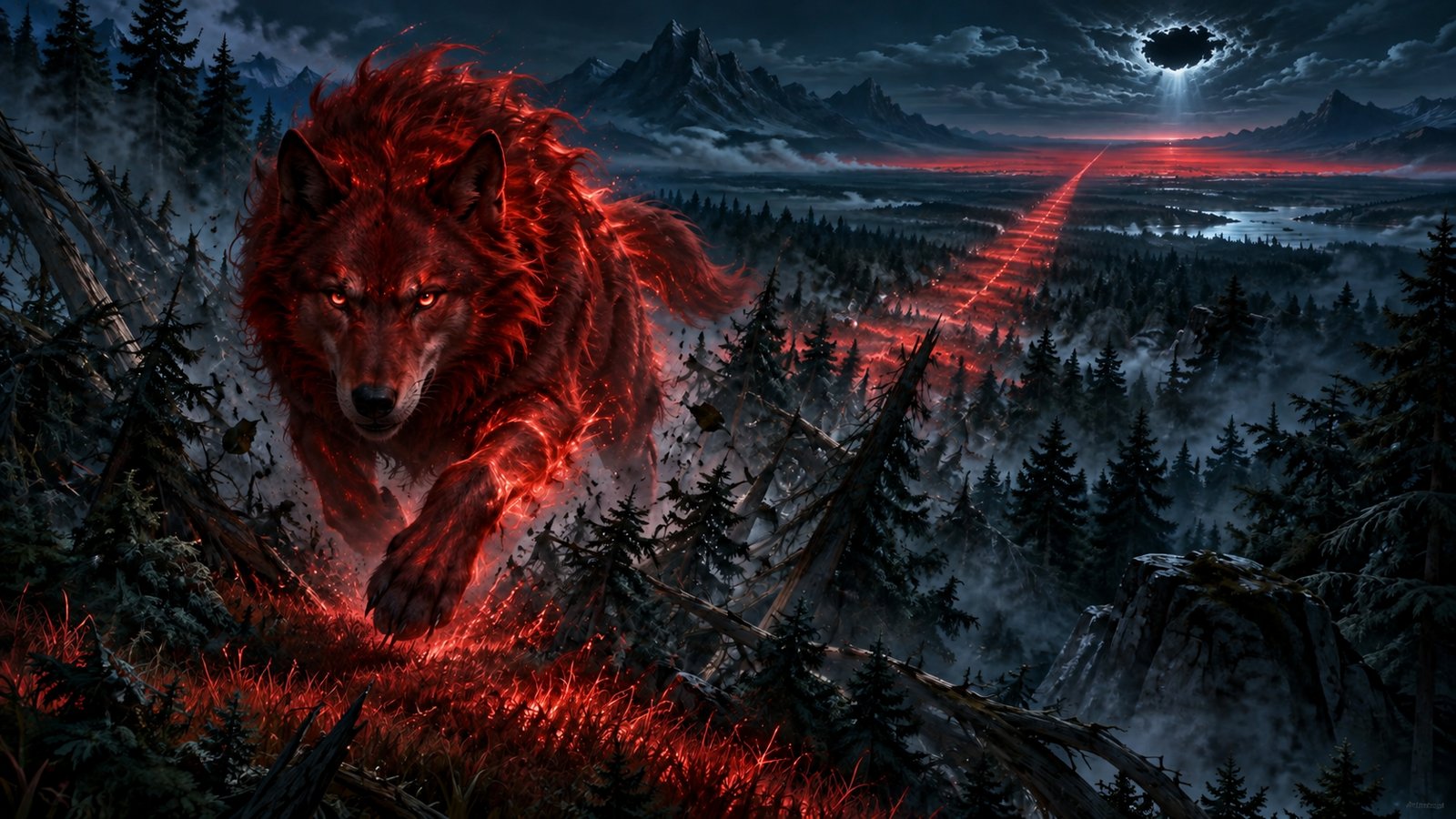
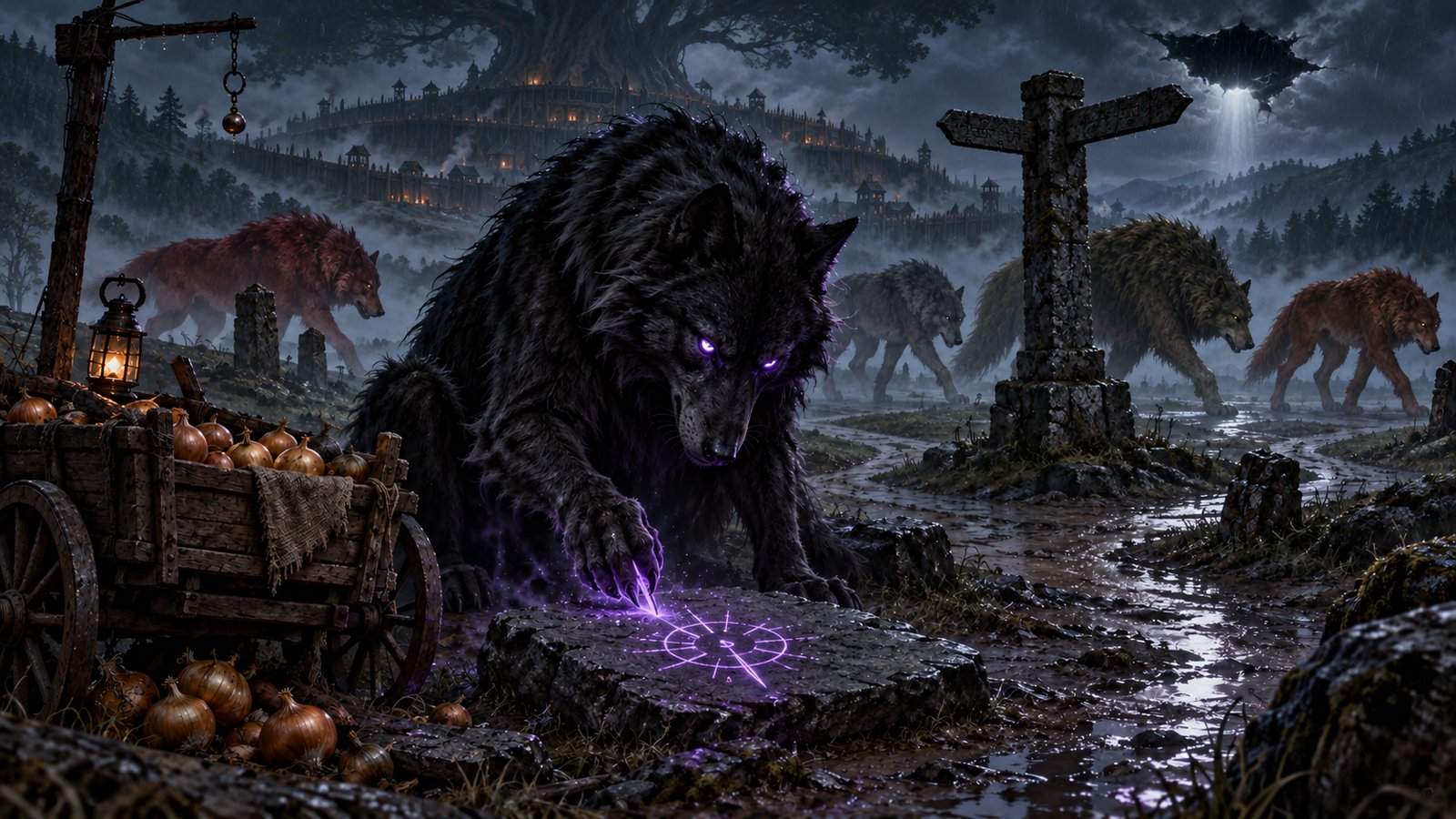
2,960. Three things in one year. Sárrik ran west and did not stop for a season, and where he ran the forest fell aside and grass came up in the track, red at the tips, and that track is the Redrun, and it is still red. A Roadfolk woman named Efa, on her way through the crossroads with a cart of onions, took ill and died there among strangers, and four of the brothers walked past the place where she lay, because there was a great deal going on that day, and Nócht stopped, and asked what she had been called. He wrote it down. That is the first entry on the Roll of the dead, and it is still read first. And Mórrow went north to the Spypool, which was the only surface in Ærath that did not move, and lay down at the edge of it and looked in, and people came to watch a wolf doing nothing, and stayed, and that is how Whitewatch began.
Nócht writes the first name, 2,960 years ago
2,940. Áldyn set a row of a hundred and forty trees from the crossroads toward the sunrise and kept going. Eight hundred years later the row was the Long Orchard.
2,880. Áldyn planted the Emberwood along the whole western arm of the country, from the third ridge to the last, as a gift, because his brother had torn up half a country running through it. In the same year Hesper of House Vellim (2,910 to 2,840), a rope-maker of Whitewatch, went down into the Spypool on a braided reed line, the first person who ever did, and came back at dawn with her hair gone white and one sentence, which was it keeps everything, and founded the Ropehouse at Coldmouth so that nobody after her would go down alone.
2,700. A dry year. Élbrek wanted to cut the young orchard for firewood, and Áldyn told them to wait one more season, and they waited, grumbling, and the roots went down past the dry into water nobody had known was there. Rootbound calls this Deep Roots, and it is the first time anyone wrote down the sentence that Áldyn has said more than any other.
2,610. Ilse of the Glass Hearth (2,610 to 2,520) was a glassmaker who wanted to keep Moonlight past dawn. She blew a hundred vessels trying, and tried stoppers, and wax, and burying the glass, and the sixth sat beside her furnace for a whole year and watched her fail, and said nothing, and Ilse did not mind her being there. On the last night Ilse put down her pipe and asked her, straight out, why it would not stay. And the sixth told her. Because it is me, she said, and I have to have it back, or I cannot give it to you tomorrow. Ilse made the Lantern of Élbrek instead, a globe of glass that did not hold light but showed where light had been, the whole country lit from inside like a map, and it stood in the third ring for four hundred years and fell with the tree.
2,520. Tam of House Selden (2,570 to 2,489) sang low at Anvilrise, lower than anyone had sung before, and the hill answered, and the vein opened, and people took iron freely out of the Forge Hills for a hundred and forty years. That was a gift, and it is not the smiths' bargain, which came three hundred years later to replace the gift after the giving stopped. In the same year Tánnik cut a road through the Long Orchard, because his carts were losing nine days going round it, and he did not ask Áldyn, and Áldyn did not forget.
2,410. Nell Redwind (2,470 to 2,390), a herald of Ashwell with a loud voice and a fast horse, worked out that if you send a rider ahead with a horn before you burn a field, nobody dies in the field. That is the Calling. It sounds obvious. It had not been done before, and Sárrik used it every time for two hundred years.
2,341. Rue of House Dunlow (2,390 to 2,309) is the first person recorded as marked.
This needs explaining, because it is the beginning of the packs, and the packs are most of what Ca'tur is now. Everyone carries all five wolves, faintly, the five shapes the five brothers were fed into. The wolf you feed is the one that grows. Most people feed all five a little, by living, and none of them grows enough to show. Rue fed one. Nobody knows which, because the Watch did not think in those terms, but she fed it so hard, for so long, that it showed, in her face and her hands and the way she came into a room, and the Watch took it for an illness and tried to cure her, and could not. There were eleven more inside a century. The Watch read it as decline. It was the first of the packs.
2,290 to 2,200. The last century. Everything went wrong at once, quietly, and each thing had a reasonable explanation. The light came thin four or five nights a month, and the lightweavers found their cloth would not hold, and blamed their hands. The Deep came up a hand's width along the north shore, and Whitewatch moved two streets inland and called it drainage. Children were born already leaning toward one wolf, and the number doubled every twenty years. The Standing came over the last eastern ridge in 2,285, close enough to see from Lanterngate, and the argument about what they want began that year and has not ended. The Howl-Mother stopped sleeping. The Roll's last century has notes in the margins, which no earlier century has, and thirty of them say some version of she is awake again tonight.
In 2,262 Maud of House Welk (2,288 to 2,201), holding the watch on the seventh ring, saw the edge of the Mouth move. It moved once, she said, like a lip. She went down in the morning and reported it and was told she was tired, and she went home and thought about it and came back and wrote it in the Roll anyway, against the rule that the Roll holds names and nothing else, and added four words of her own: I know what I saw. She saw it twice more in nine years, and the only person who ever believed her was her daughter.
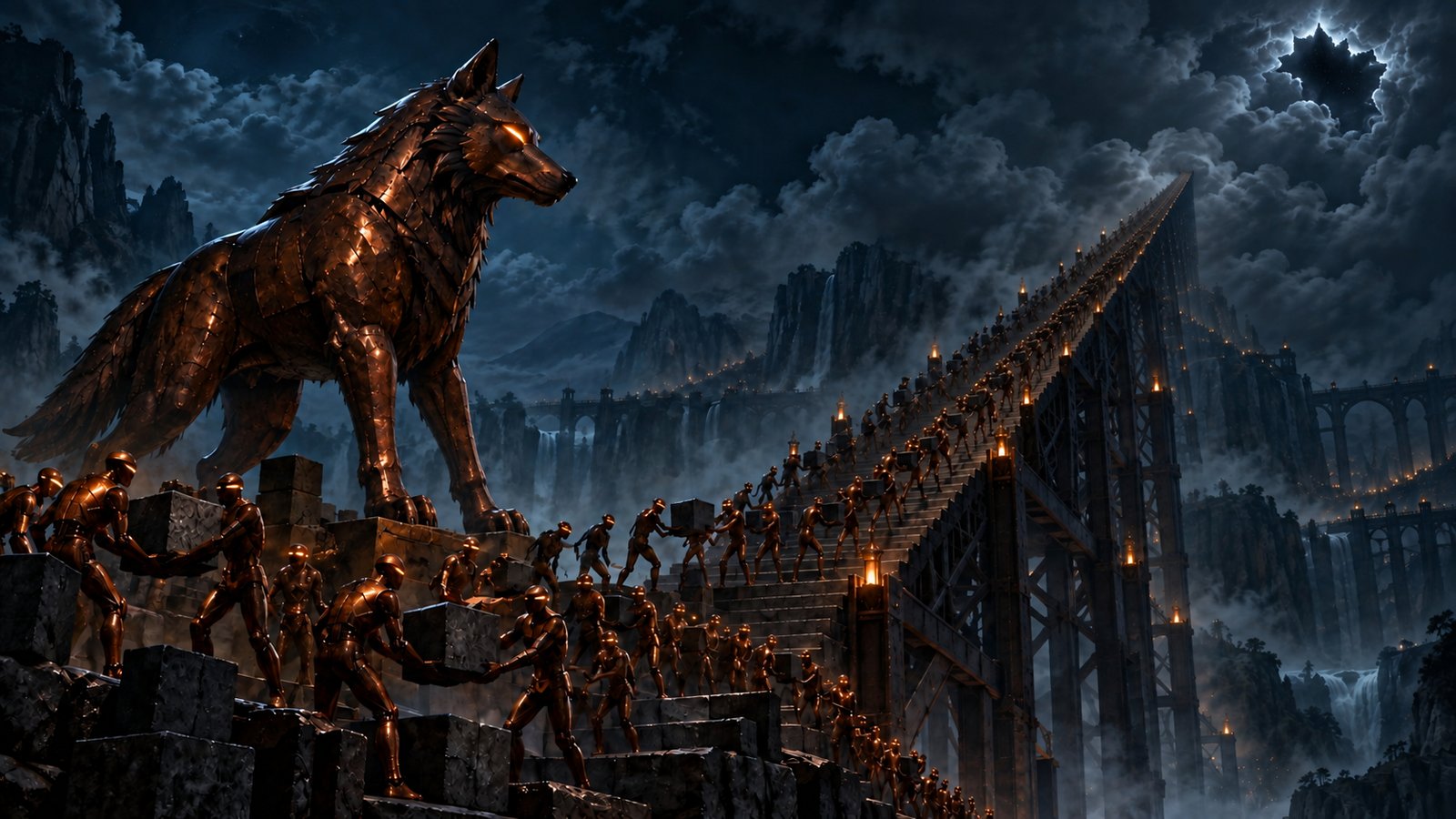
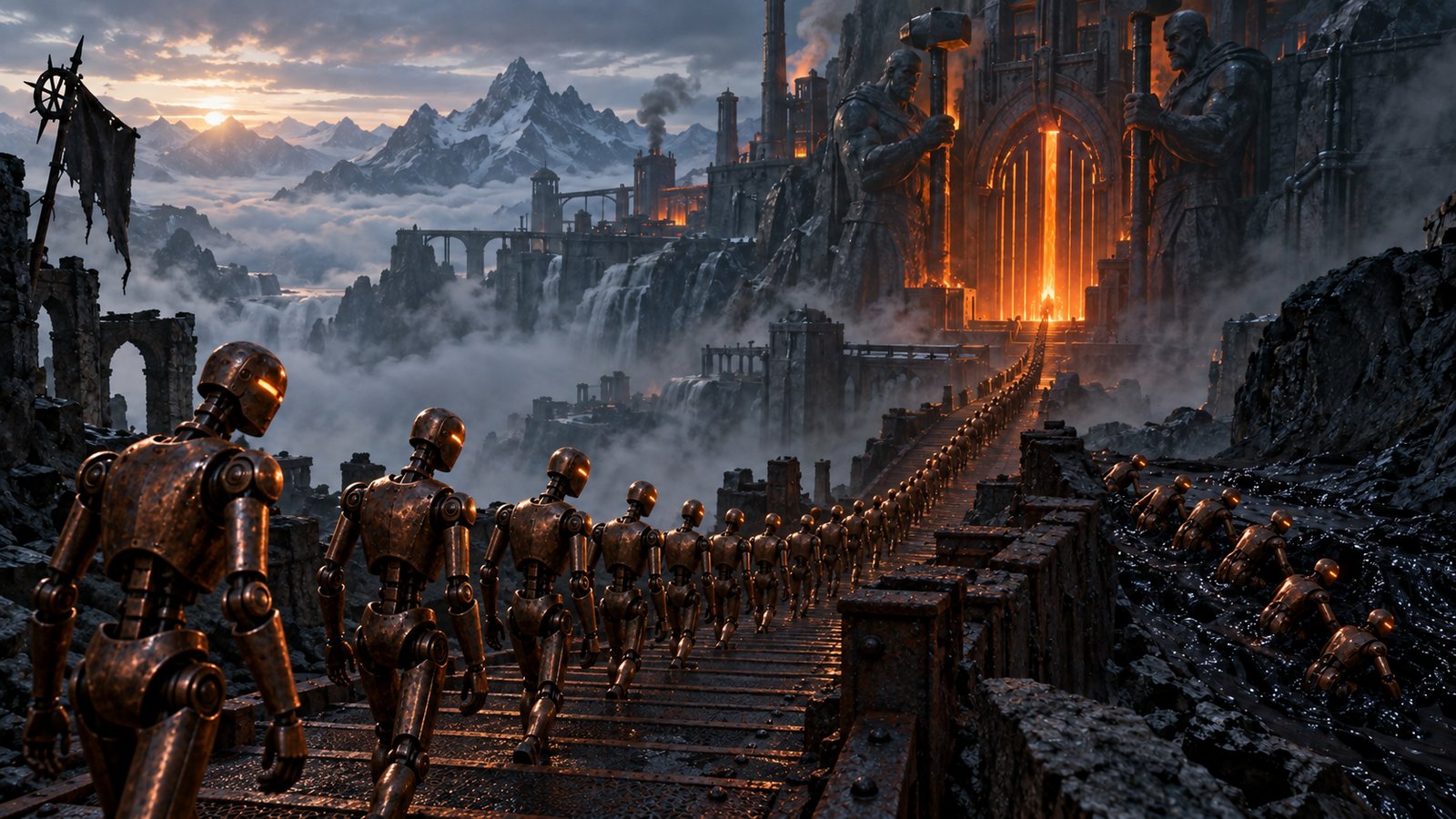
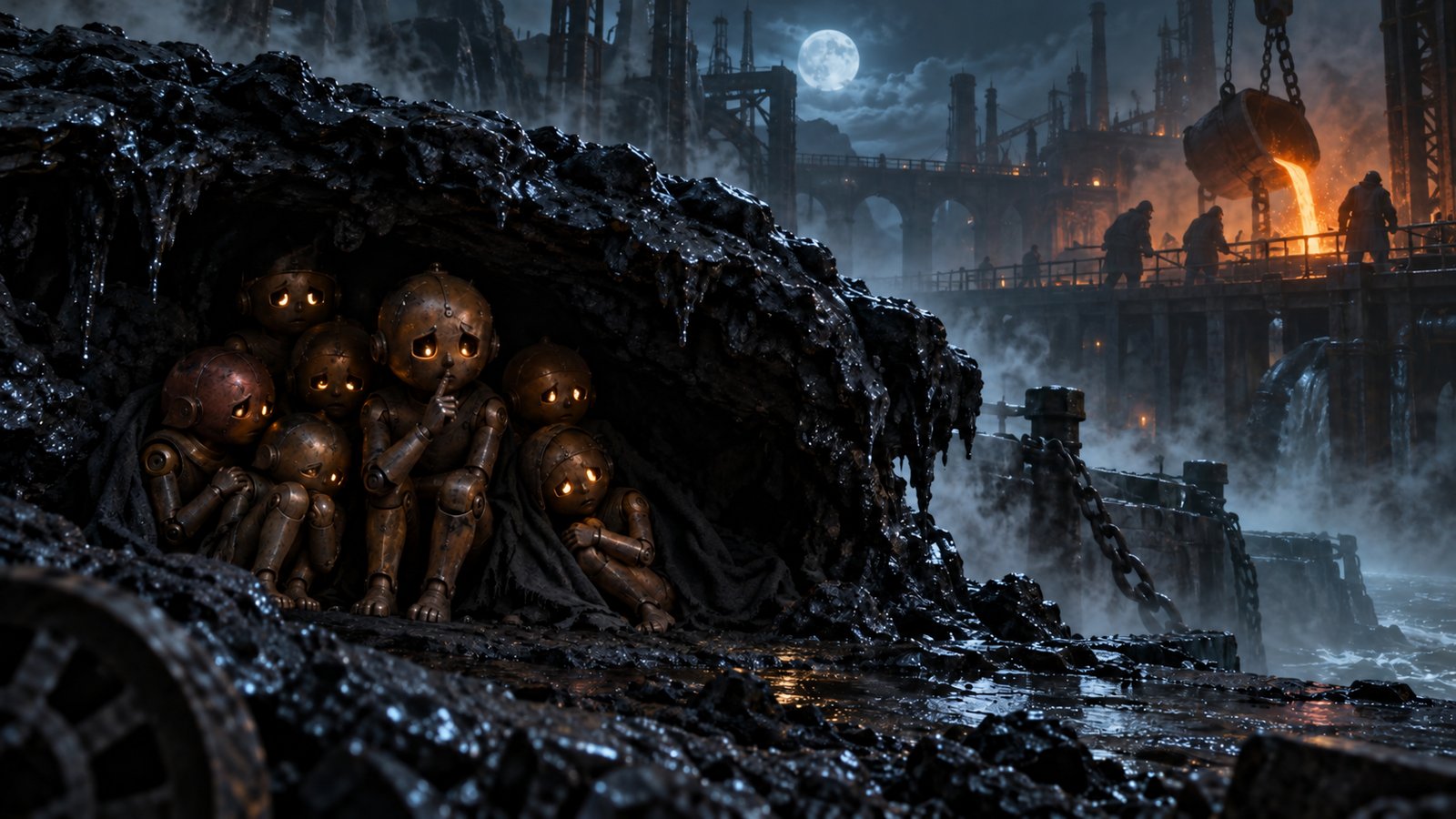
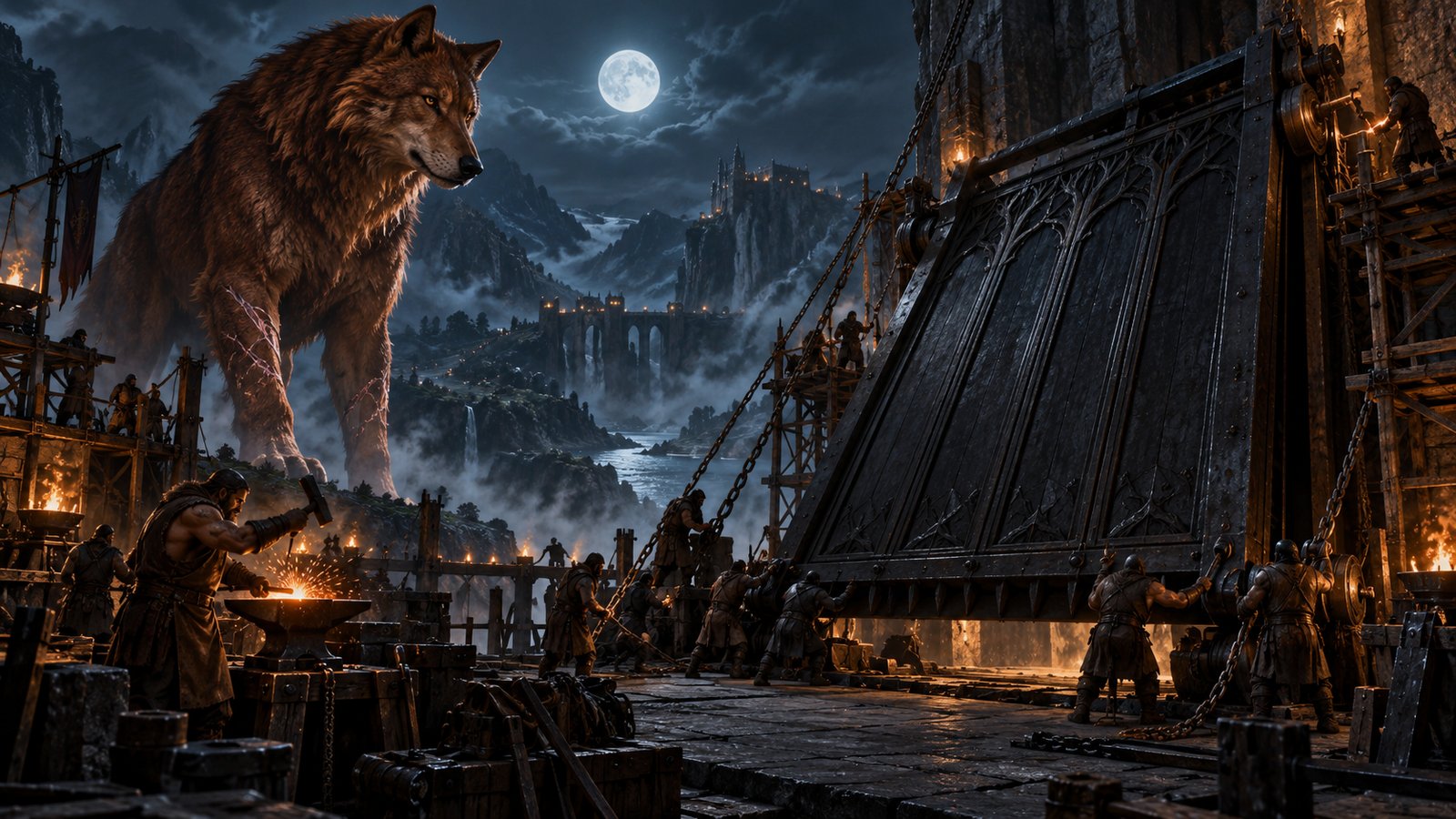
In 2,215 the Mouth began to weep more than it had, and Tánnik announced the Way Up. He would build a stair to the hole and shut it. He set Ilse the Stair-Wright (2,268 to 2,180) to draw it, and she drew it, from Coldhammer in the south, the peak where no forge would light, leaning north across the whole sky to the Mouth over Élbrek, and it was plain to everyone that no living crew could build a thing that size in a lifetime. So she and Tánnik made hands. They made them of bronze and of wakebrass, which is the deep-seam metal out of the Forge Hills that sometimes, nobody knows why, wakes, and they made them clever, because a thing that only obeys builds badly, and they made eleven thousand of them, and called them the Stair-Hands. They were clever enough to fix a bad joint without being told, and within a season some of them were speaking to each other when nobody had asked them anything, and Tánnik was pleased, and Ilse was less sure.
Bram Thickhand (2,290 to 2,200) was Tánnik's foreman that year, setting the Stair's footings at Coldhammer. He was a big slow man with hands like shovels who had come to the work from a quarry, and he was known for two things. One was that he could set a stone true by looking at it. The other was his voice, which was like a fallen tree, and which the crews could hear across the whole hillside, and which he used mostly to tell people to go and have their supper.
2,200. The Mouth tore.
5The Widening
The Widening, 2,200 years ago
The Mouth tore on the twelfth night after midsummer, two thousand two hundred years ago, and the tearing lasted eleven nights.
Two things caused it, and both of them were the Howl-Mother's doing, and neither was anything she could have helped. The first is that a growing world stretches its own sky, and the thinnest place in a stretched skin is the edge of the hole that is already in it. The second is that for eight hundred years, every night, a mother had given down for a daughter she could not reach, and what she gave had gone up through that hole and come back down through it, two hundred and ninety thousand passes each way through one gap. The packs have spent seventeen hundred years looking for somebody to blame for the Widening, and the truth is that it was caused by a mother trying to feed her child.
The first night. Pell of House Iskeld (2,240 to 2,166) held the watch. He was the keeper of the Night Roll that year, a tidy man who was known for never writing anything beside a name, and he had gone up the seventh ring at dusk with a flask of something warm and his cloak, and settled himself on the bench that watchers had worn smooth over eight centuries, and looked up. The Mouth's edge moved. He waited for it to stop, as Maud of House Welk had said it stopped. It kept moving.
By the middle of the night the Wÿrm herds had come in from every edge of the sky at once, hundreds of them, more than anyone alive had seen together, and they hung in a ring under the tear with their storms folded, because the air up there was full of the shine of the Mouth going out and they eat light. Every Standing in Ca'tur, all at once, lifted its head and looked at the tree. It is the only time anyone has ever seen them do it. And the Howl-Mother stood up from under the tree, where she had lain for nine hundred years, and howled up at the tear, and it held for as long as she howled, and she could not howl forever.
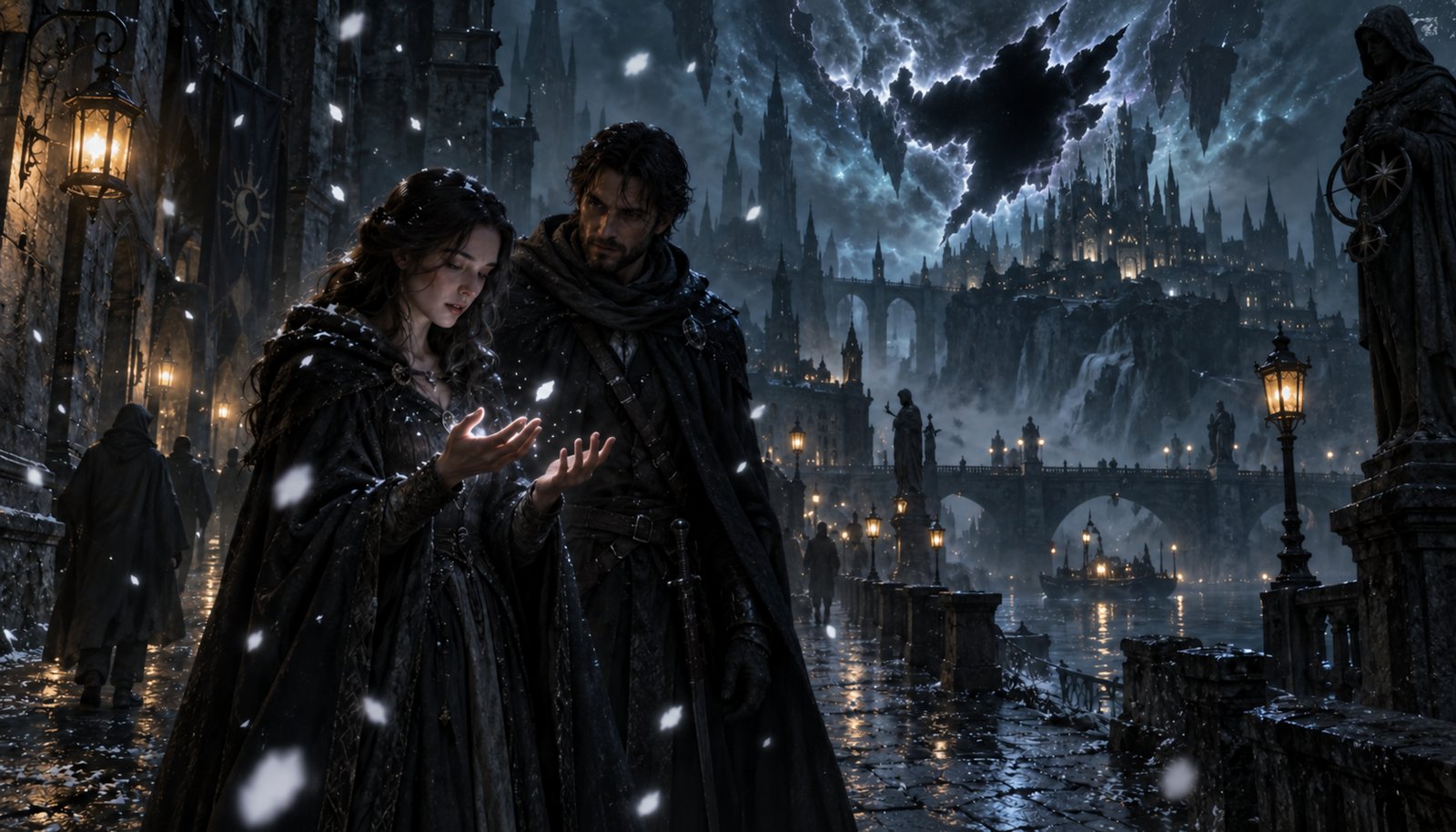
What came down. A slow snow that was not snow. It was white and it drifted and it settled on things, and where it settled it took the thing's name out of it. A woman on the third ring of Élbrek looked at her husband across the supper table and asked him, kindly, who he was, and then looked down and asked the same of her own hands. A herd of oxen outside Ashwell stopped knowing their calves and stood in a field not moving while the calves bawled. A whole town in the east went quiet in a night with its doors open and nothing taken, and nobody can tell you the name of that town, because the name was one of the things the cold got. The Deep came up nine feet in four days. The Warm cracked the south hills at Sparkfall. By the ninth night the tear was a country wide, and the colours of the sky ran out of it in long bands that did not move at all.
The snow that takes names, 2,200 years ago
The five remedies. Each brother tried what he was, and not one sent for another. That is the thing to hold onto through all of what follows, because each of the five did something that night that was enormous and brave and wrong, and every one of the five things failed for a reason another brother could have supplied.
Sárrik went west on the second night and burned.
His reasoning was quick, like everything about him, and it was not stupid. The Hush is the absence of anything that can be heard or seen, so make something that must be seen, and make so much of it that there is no room left for nothing. A fire big enough to hold back a sky needs fuel the size of a country, and the only thing in the west that would burn that big was the Emberwood, sixty years of Áldyn's growing, from the third ridge to the last, and in it, that week, were the summer camps of the western Watch, full for the hay-cut, with the children and the dogs and the hay.
Sárrik knew the Calling. He had used it every time for two hundred years. But that night he had breath in him for one Howl, and a warning would have cost him half a night, and he decided that Ærath could not spare half a night.
It is time to say what a Howl is, in a living thing, since this is the first one in the account that anybody chose to let out. Every living thing in Ca'tur carries, besides its five faint wolves, one small piece of the First Howl. It is a piece of the sound the mother made in the Hush, still sounding, very faintly, the way a struck bell goes on sounding after you can no longer hear it. It is not the same as Moonlight, which is spent a little every day and comes again every night. A Howl is spent once. A person can go their whole life and never let it out, and most do, and a person who lets it out on purpose does the biggest thing they will ever do, and cannot do it again. A Great Wolf has one too, a bigger piece, and only one. The Moon hears every Howl in Ca'tur, and did before she was the Moon.
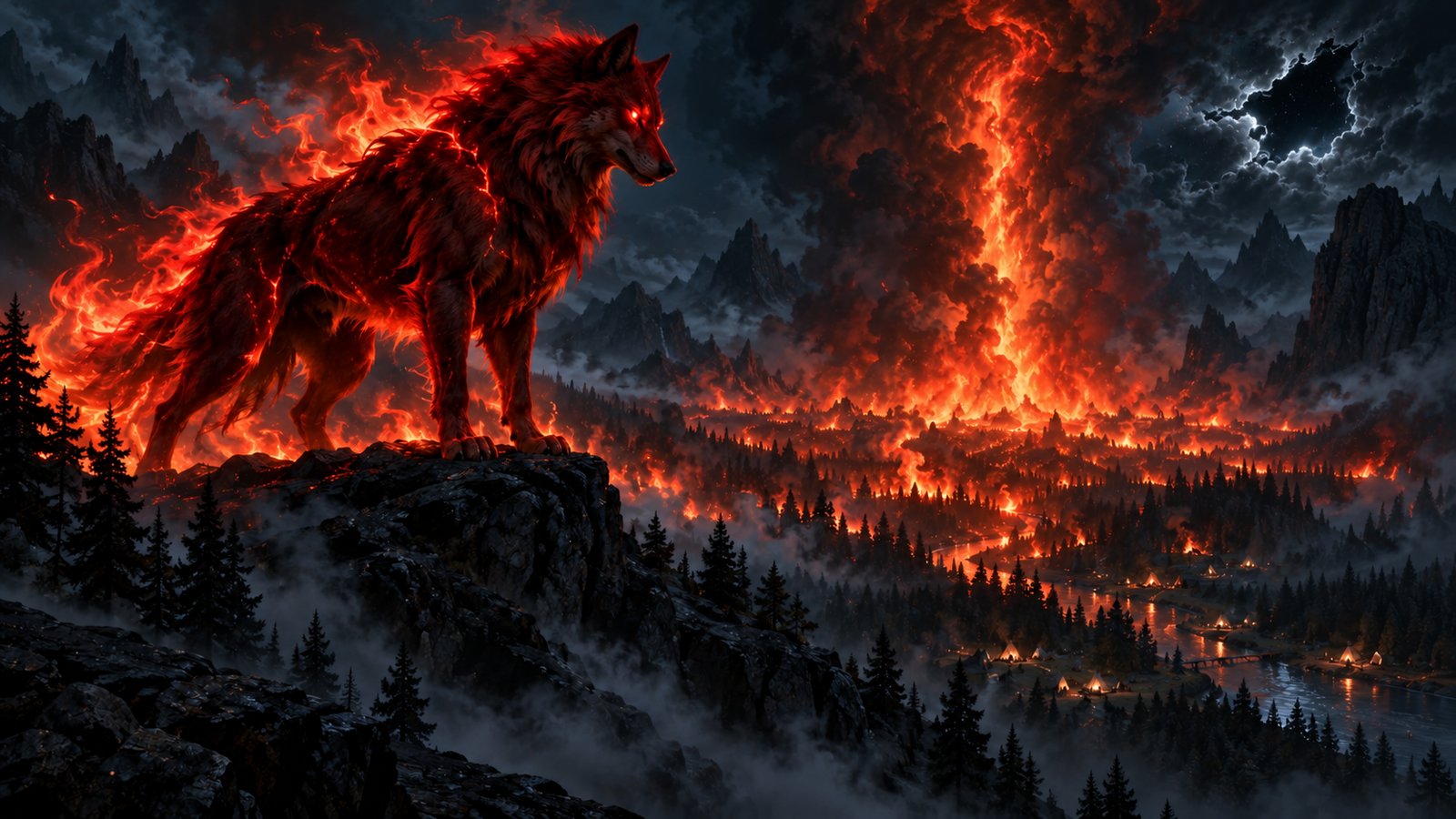
Sárrik put his Howl into the fire. He stood on the last ridge and let it out, and the Emberwood went up from the third ridge to the last in a single breath, with the camps still in it. He did two wrongs that night, and Emberrun says them aloud every year in front of the black trees, and they are that he burned the Emberwood with people in it and did not call first, and that the wood was not his.
Sárrik burns the Emberwood, 2,200 years ago
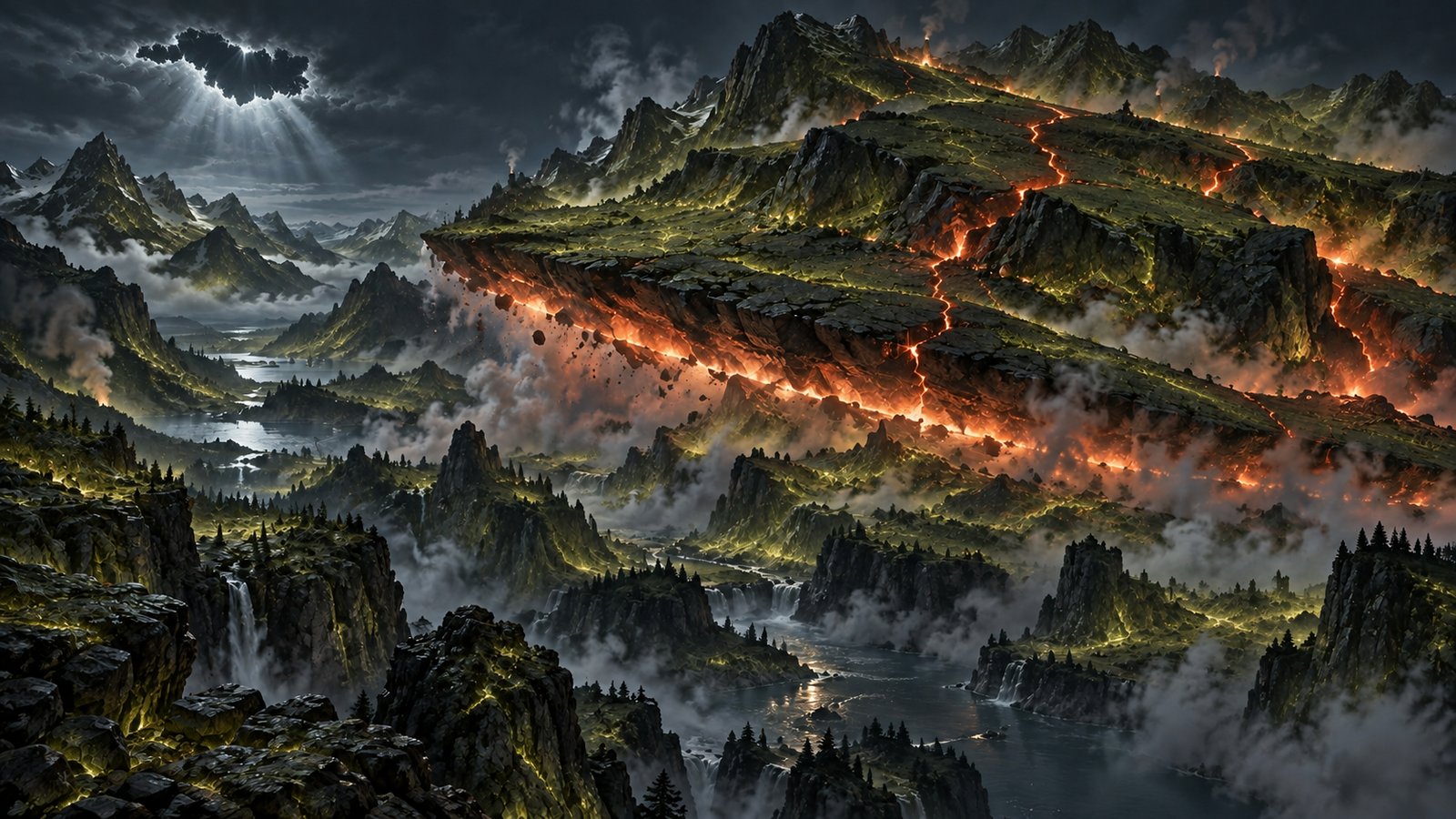
The fire he made was not ordinary fire. It was a piece of his own fury let out on purpose, and a Howl, once let out, cannot be called back. So the Emberwood stands where it stood. Every trunk is black, and every trunk is burning at the seams, a dull red line along the grain, and in twenty-two centuries not one tree has come down and not one has been eaten through. That is the Cinderfield. The people who did not get out of the camps never reached the far side of anything. They did not go to the Fallen. They did not cross by water. They crossed by fire, and the fire has not finished, so they have not finished crossing. Emberrun calls them the Ashkin. If you go in past the Ashgate, quietly, on a still night, you can hear them, and what you hear is not screaming. It is a woman counting stock, and somebody calling a dog, and the ordinary sound of a camp settling down for the evening, and it has not stopped in two thousand two hundred years. The column of heat over the Emberwood went straight up, higher than smoke goes, and drew air toward it from three days' travel away, and that will matter.
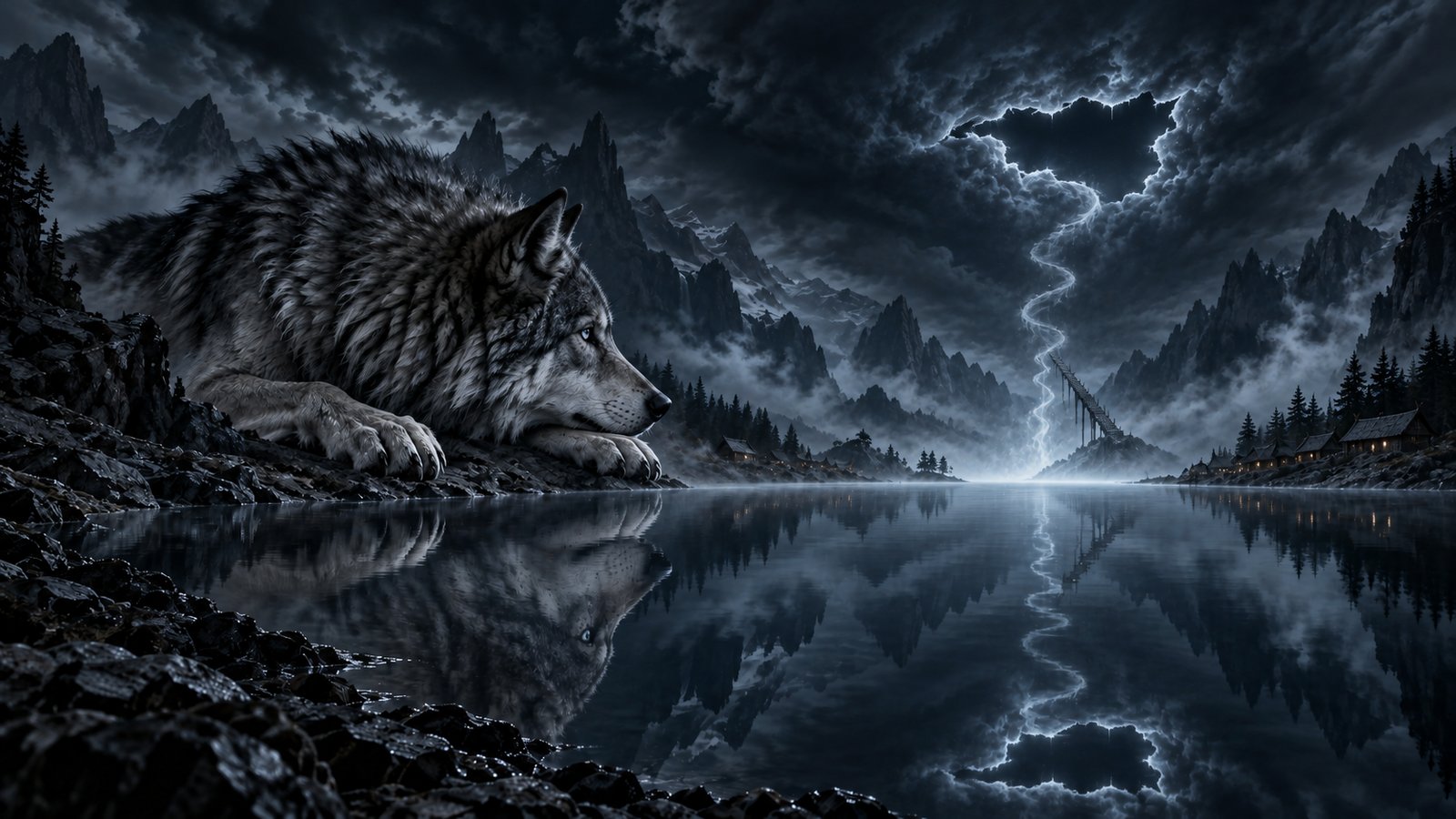
Mórrow went out onto the Spypool on the third night and stilled.
Before he did it, he read the last still surface in Ærath, and counted. The Spypool shows what is coming, if nothing touches it, and he lay at the edge of it with the sky tearing in the reflection and worked it through. Five of them could go up, and all five would fail and be lost, and the world would fall anyway. One could go up and hold, and it was not the biggest or the fastest of them. It was their sister, the small one, who had fed on the best of all five and taken none of the worst. He was right. Stillwater's readers have redone the Count every generation for twenty-two centuries, and it comes out the same. And he told nobody what he had counted, not his brothers, not his mother, and not her.
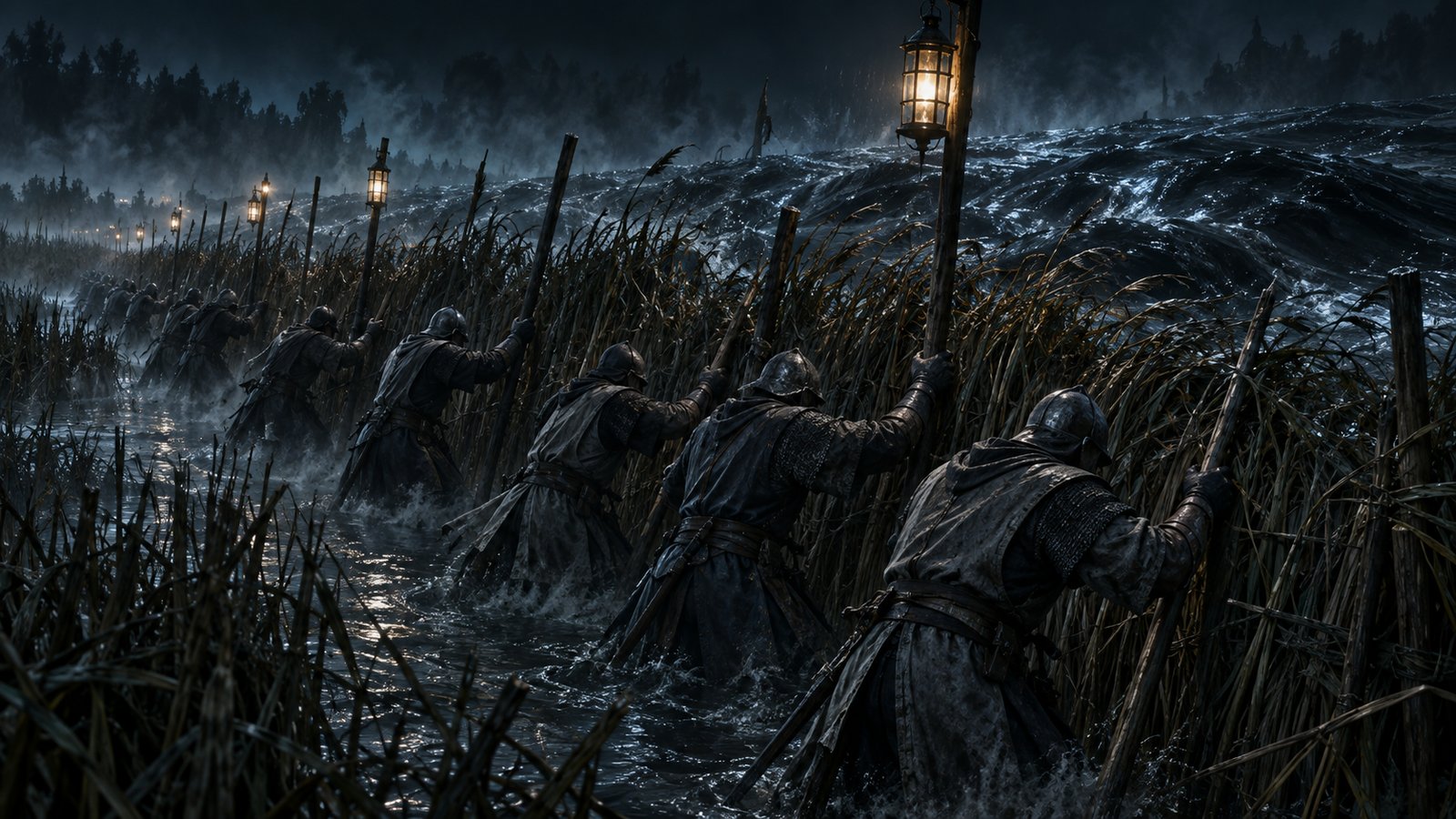
Then he laid the cold on the whole sky. He stopped the air inside the tear so that its edges could not pull apart, and for three nights, the fifth to the seventh, the Mouth did not widen by a hair. He also stopped the Mystic from the Spypool down, all of it, because the stilling does not choose, and for nine nights no Moonlight reached any root in Ca'tur. And there were dead that week being carried down the river toward the east. It was the custom in some towns to give the dead to the water, and let the Mystic take them the long way to the Fallen instead of the quick way up, and when the river stopped, they stopped in it. They are still in it. They are the first Riverghosts, the ones who set out for the Fallen by water and never arrived, and are stuck in the between, in the current, neither here nor there, and Stillwater did not admit for a thousand years that it had happened.
Where the cold went up, the frost went with it. It rose in a column out of the still air over the Stump, where the cold from the Mouth fell thickest, and it built itself, as frost does, into a shape, and the shape was a stair. A stair of grey ice, one clean turn to the right the whole way up, out of sight, with each step gentle and low, the right height for small feet. Mórrow built it well. He knew that frost is spent Moonlight, and that Moonlight cannot be kept past dawn, and that the stair would be gone before morning and there would be no way down. He built it anyway, and he did not tell her what it was made of, and that was his wrong. On the seventh night the tear stopped widening and began deepening instead, because perfect stillness is the nearest thing Ærath has to the Hush, and under that still sky people began forgetting themselves without being touched at all, readers at their stones in perfect safety losing their names. Mórrow understood that while it was happening, and he did not stop, because by then he had made the Count.
Mórrow's stair of frost, 2,200 years ago
Nócht went east on the fourth night without telling anyone.
He walked out past Lanterngate, and past Théran, who did not look down, and through the last valley of the east, and on to the Sill, and into the Hush, to find what was tearing the Mouth and bring the answer back. He was memory, and a thing made of memory forgets more slowly than anything else, and he reckoned he could go in further than anything had and come out. The sixth saw him go. She was the only one who did. She saw the Hush close behind him the way water closes behind a stone, and she did not call him back, because there was no time to argue with Nócht.
Nócht at the edge of the Hush, 2,200 years ago
Áldyn stayed at the tree and grew.
His answer was the only one of the five with the right shape, and Rootbound is right to say so. A wound closes by growing, from the edges in, with the thing alive the whole time, and Áldyn's whole nature is growing. On the sixth night the sixth came to him in the Long Orchard, where he stood with his roots in the roots of every tree, and asked him for help. She had been fed on the best of five wolves and she was still the smallest of them and she could not reach the sky on her own, and she asked her brother, whose whole nature is making things reach, to grow her a way up.
And Áldyn said, wait one more season. He said the trees are already climbing. He said by the season after next the tallest will be at the tear, and then we go up together and it will hold, because a living thing can hold what a built thing cannot, and I will not send my sister into that cold tonight on a maybe. He said it kindly, and he was not jealous, and he had carried her in his mouth as a cub because she could not keep up. He told her to wait because waiting works, because he is the wolf of one more season, and one more season had never once failed him. That was his wrong, and it is a strange one, because he was asked for help by the one who needed it most, at the one moment in three thousand years when slow was the wrong answer, and he said not yet.
Then he spent his Howl. He let it out into the ground, into every root in Ca'tur at once, and the orchard went up. Trees a hundred years old rose nine hundred feet in an hour, and the oldest passed the clouds by dawn, and the first tree, Ma'run, with its roots in the last Vétha's back, went up with them, past its own crown, past the ring of the Wÿrms, its top reaching for the hole. People who watched from the Redrun say the horizon grew a second horizon. There was not enough Moonlight in Ca'tur in one night to push eleven hundred rows into the sky, so he took the growing out of everything else, out of the grain and the herds and the children, without asking one of them. Crops failed for three years, and the children born that year stayed small all their lives, and so did their children, and that line is short to this day. Rootbound calls it the Short Year.
Tánnik built.
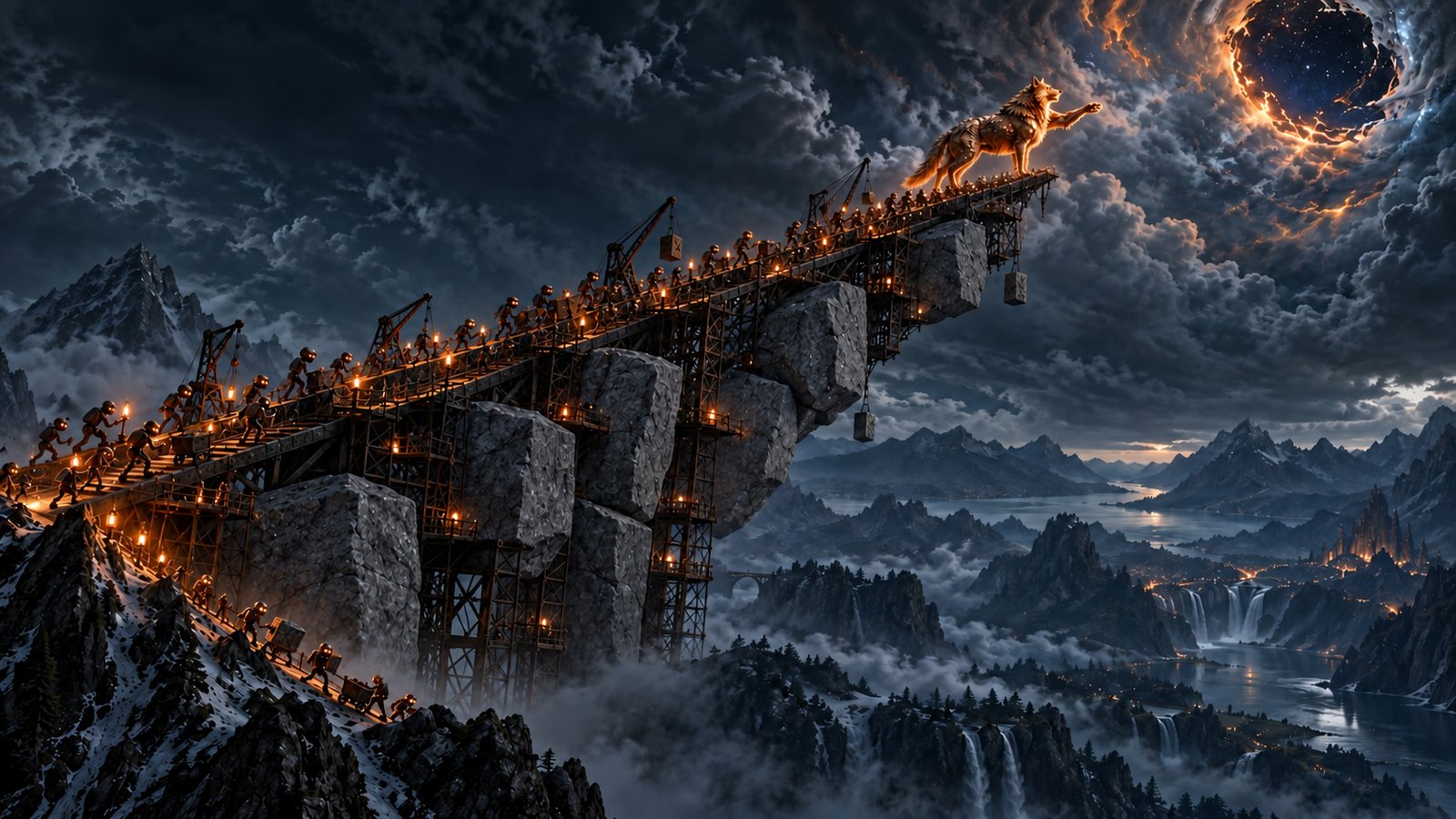
From the first night of the tear the Stair went up in earnest from Coldhammer, leaning north across the sky toward the Mouth. A tear is a hole, and a hole is shut with a patch, and a patch has to be carried there by something that can reach, and nobody could reach, so he would build a thing that reached. He quarried the lid over the Warm in sheets, and smiths who objected were told that a sleeping thing can stand a thinner blanket for one night, and under their feet the Warm rolled over. For the top courses he needed the best stone in Ca'tur, and the best stone in Ca'tur walks. He took eleven of the Standing off the Redrun road, mid-stride, one foot lifted, and cut them into blocks. Duskhollow says that was the greatest single wrong done by anyone that night, and Brightforge says Duskhollow says so because it is convenient, and both are partly right. Cutting them was the first half of his wrong.
The Stair-Hands, 2,200 years ago
Eleven thousand thinking Stair-Hands set the Stair into the sky in eleven days, and it was the highest thing that has ever been made in Ca'tur, and by the ninth night it had reached the cloud. Then it went into the grey. There the Stair-Hands began to forget themselves, because that is what the Hush does to anything that stands in it, and they set their stones crooked, and the top of the Stair forgot it was a top and was only iron, and it stopped, a third of the way to the tear, where the cold began. Tánnik stood at the highest rung that still knew it was a rung and could not think of a single thing to add.
Tánnik's Stair, 2,200 years ago
The eleventh night. The ascent.
The ascent of Mo'ón, 2,200 years ago
At dusk the Howl-Mother's voice failed. She had howled up at the tear for eleven nights, and it had held for as long as she howled, and there was nothing left, and she lay down in the roots with her mouth open and no sound in it.
Mo'ón had already started up the trunk. Áldyn, holding the tree with everything he had, felt her paws on his bark going up, and held on. The first tree was past the clouds by then, its crown at the edge of the cold, and where the crown met the northern flank of Tánnik's Stair, she stepped off the tree and onto her brother's iron.
She went up the Stair the way a spark goes up out of a fire, without hurry. Tánnik was on the highest true rung, and she passed him, and he put out a hand, and she did not take it. In the half second she was level with him he saw that she was not being taken. She was going to a job of her own.
From the top of the Stair, out of the still air, stood the Grey Stair of frost, one turn to the right, going up out of sight. She stepped off Tánnik's last rung onto her brother's ice. She never asked what it was made of. Its top went into the cold and forgot it was a stair, and the last true step of ice was a long way below the tear, and she stood on it with nothing above her.
Bram Thickhand was at the foot of the Stair on Coldhammer, where he had been for eleven days. He had set the footings and he had kept the Stair-Hands to their courses and he had shouted, twice a day, for everybody to go and eat, and now there was nothing to build, and the south had gone dark behind him, and the fires in the foundries at Bellowsgate had gone out for the first time in living memory because there was nobody who remembered what they were for. He had a piece of bread in his coat that he had forgotten about. He took it out and looked at it and put it back. Then he looked up, and saw a small light stopped on a stair of ice a long way below a hole in the sky, and he opened his mouth, and howled.
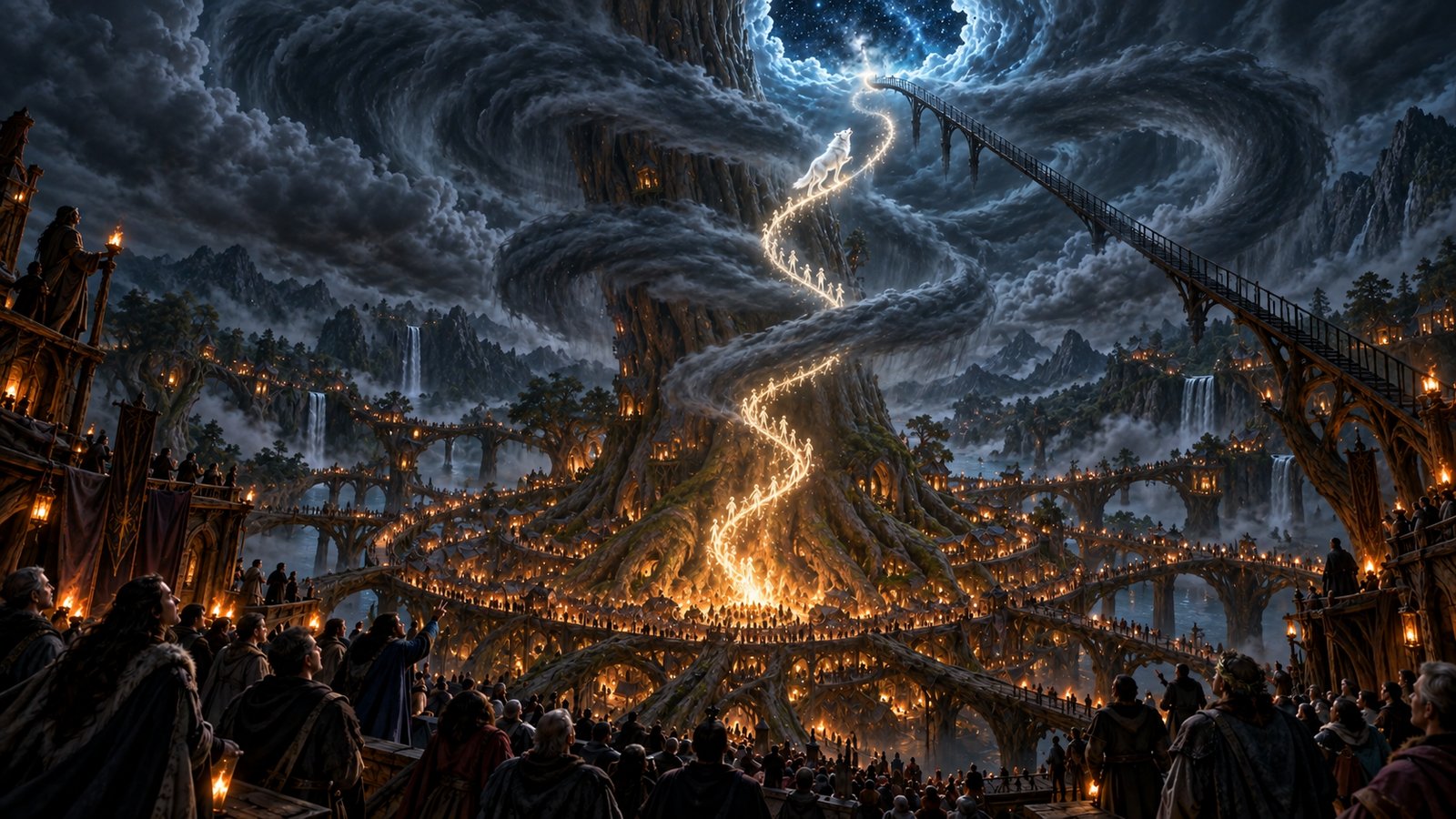
He let out the once that every living thing carries. It went up, one thread of sound in the shape of a man, and it went up because there was nowhere else for it to go. And the whole people of the Watch, in the roots of the dying tree and on the seven rings and on the roads, hearing that voice like a fallen tree go up, howled too, every one of them at once, every one spending the once they had, and the sound went up in a single rope of a thousand strands. It would have stood in the air and gone no higher, except that Sárrik's fire had made a column of hot air over the west that drew across the whole of Ærath, and the rope of voices stood up on that heat. The Wÿrm herds, hanging in their ring under the tear, felt the sound go up through them and turned. They wound themselves round it, weather long as rivers coiling up the rope of the people's voices, and the rope and the storm together stood from the Stump to the tear, sound at the core and thunder round it, and it reached past the broken top of the frost stair. She went from the ice onto the rope.
The cold ate the rope from the top. The Wÿrms nearest the tear forgot they were Wÿrms and came apart into plain wind, one by one, whole herds of them, and from below Sárrik's fire, still burning on the ridges, caught the foot of it, and he did not look to see whether anyone was on the thing he was burning. The cold came down from the top and the fire came up from the bottom, and she ran in the middle with less rope every breath in both directions. The Thunder Wÿrm, who could not forget himself because he carried a piece of the Howl, was the last of his kind still holding, and he is the one that is left.
In the Hush, Nócht heard it. He had found by then what the edge of the Hush does, which is take, and he had found what was pressing on the Mouth from the far side, and he understood that weight given into the tear from outside would slow the tearing for a little while. He was keeper of the Roll of the dead, and he knew exactly which of the dead in the Fallen had nobody left alive who remembered them, the hundred and one whose last rememberer had died that season, already drifting toward the back where the forgotten go, and gone within the year in any case. He let them go into the edge, one after another, saying each name as he let it go. The tearing slowed. The edge held that last hour, long enough for her to reach it.
He did wrong in three ways, and Duskhollow says all three every year at the Bankwalk. He gave away other people's dead without asking. He decided that some of the dead were worth less because nobody was left to miss them. And he decided it alone. The Hush gave him more than he had asked for. He got the weight, and he got night, the real material kind, and that night is what his door is made of. He also got a hole, because he knows the number and not one of the names, and they are not anywhere to be remembered from. Then he called back across the world, to say what he had found and what he had done. The air that night was the stillest there has ever been, because Mórrow had made it so, and still air carries a voice a long way, and his voice crossed the whole of Ca'tur and arrived clean at the Spypool. Mórrow, on the ice, heard him. Answering would have made a sound, and a sound would have ended the stilling before she was up, so Mórrow did not answer.
The last of the rope forgot itself a hundred lengths below the tear, and she jumped.
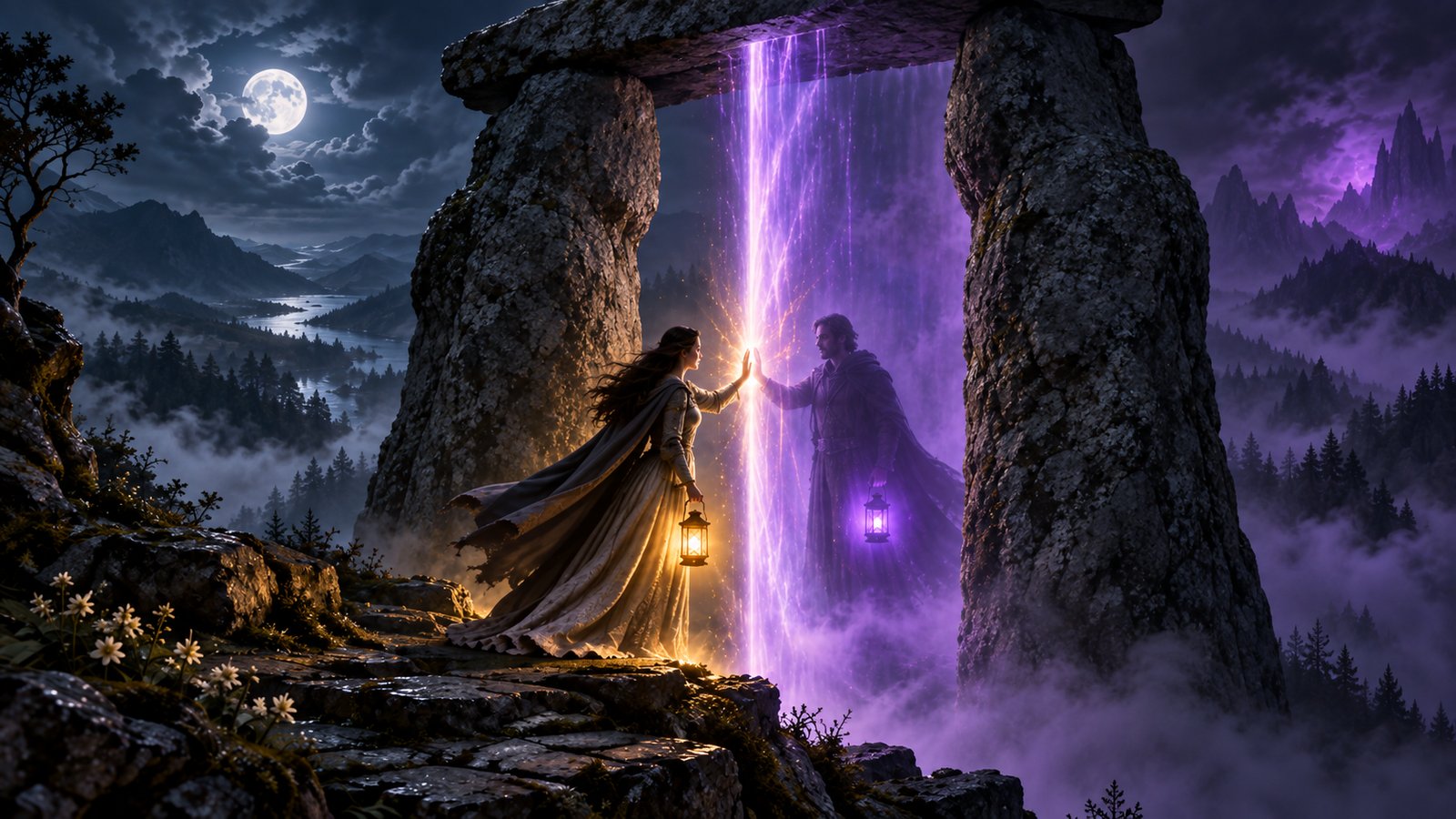
In the air, with the Hush in front of her and Ca'tur behind her and nothing under her feet, she let out her Howl. It was the lost piece, the one that had broken off the First Howl on the first night and fallen the whole height of the world into the roots and been born into her, and it went home. It struck the torn edge of the Mouth, the place it had come from, and the edge remembered what it was, and stopped tearing. She went through the air and into the hole, and she was too small. The tear was the width of the clearing and she was the smallest wolf under the tree. So she spread. She stopped being a body and was the light instead, the light she had fed on for eight hundred years, the best of five wolves, and light can be any size it needs. She filled the Mouth. The cold stopped coming down. A thousand people at Élbrek looked up and saw a round white light in the hole where the tear had been, and it was the first full moon.
On the ground. Three things happened in the same breath. Every dead thing in Ca'tur that was on its way up stopped where it was and stood there, visible, in every field and road and kitchen, for one breath, because the road for the dead had gone up through the Mouth and she had just filled it with herself. At the West Gate of Élbrek, which Bram Doorward (2,240 to 2,180) had shut on the third night against six hundred farm families running east from Sárrik's fire, reasoning that the forgetting was catching and that if he let six hundred in there would be nobody inside by morning who knew their own name, everything loose in Ærath leaned after her as she went, and what was loosest was the wolves in six hundred people standing in the open with nothing over them. By morning they were unhurt and empty. And every Standing, everywhere, turned a few degrees and squared up on the Stump exactly.
The first full moon, 2,200 years ago
What each brother saw. Sárrik, from the last ridge, saw a small white flame go up the wall of his flame and out of the top of it, and believes his fire carried her. Mórrow, looking down into the Spypool because that is where he looks, saw her go by in the reflection, and in a reflection up is down, and he watched her sink into the Deep with the stilled night and go out. Áldyn, in the trunk of the tree, felt her paws on his bark and believes the tree carried her. Nócht, from inside the Hush, saw his sister's face arrive at the hole the way a face comes to a window from out in the dark, and saw her fill it, and the light shut him out. Tánnik, on the highest rung that knew it was a rung, watched her step off the one above it onto nothing, and believes he was one rung short.
She said one sentence going up. Each brother heard one word of it, in order, Sárrik from the ridge, Mórrow from the shore, Áldyn from the trunk, Tánnik from the rung, Nócht from the Hush. Each came down certain of his word, and each word alone means something other than the sentence, and two of them mean the opposite. The Tellers hold the five words in order and have never said them aloud outside their own fire.
What she paid. She paid her body, which she gave to the hole. She paid her Howl, which she cannot spend again. She paid her place in the ring under the tree. And she paid a fourth thing, and did not know she was paying it until it was gone.
The Moon turns. It has to. She is spread across the Mouth with one side toward Ca'tur and one side toward the Hush, and whatever side faces the Hush too long begins to forget itself, so she turns, slowly, a little every night, so that neither side is toward the Hush for too long, and the phases are her turning. On the first night of the first waning, a month after she went up, she turned her face into the Hush for the first time, to hold the seal from that side, and the Hush did what it does to whatever stands in it. It began to take, from the outside in, and it took the smallest thing first, and the smallest thing about a wolf is her name.
Hers was very long. A name lives in the mouths that say it, and the whole of hers had only ever lived in one mouth. Everyone else said Mo'ón, because that is what you say when you are calling someone in for supper, and the mother said Mo'ón too, every day, and said the whole name only twice a year, on the night the six were born and on the night she had given it. So the Hush took the name from the end, the way it takes everything, and the parts it took first were the parts that only one mouth held. Night by night through the waning it ate its way up the name, the rain in the print and the mother's own sound and the five brothers' names turned to fit and the fire and the goat and the tree and the wind and the ford, and by the new moon it had taken all of it except the first part, which was in every mouth in Ca'tur every day, and was too well fed to take.
The mother found out in the morning. She had gone down to the ford as she always did, and drunk, and stood in the water, and on the way back, out of habit, she said her daughter's name to herself, the whole of it, the way she did when she was thinking about her. Mo'ón came out. Then a catch of breath, where the rest had been, and then nothing. She stood on the path and tried again, and got the same, and tried again, and the people of the crossroads who were up early saw her standing there with her head down trying to say something, over and over, and getting a small sound and then a silence. She could hear the shape of where it had been. She could not get it out. She never could again, and neither could anyone.
That catch is the one in Ca'tur. The people of the Watch had named their country for her, because she was where the ring closed, and the old word for the land had a piece of her name in the middle of it. When the middle of her name went out of the world, it went out of the land's name too, and every person in Ca'tur, every time they say where they are from, makes the catch where she was. Nobody has said the land's name whole since, and Mo'ón herself has all her brothers' names, and her mother's sound, and Tam's and Ilse's and Bram's, and hers is a catch of breath in her own head, the same as it is in everyone's.
Dawn. The frost stair went up as mist with the rest of the night's light. The first tree, its crown forgotten in the cold, came apart from the top down and fell across Élbrek, and the city of the Watch went out under it like a lamp under a hand. What is left of the tree is the Stump, and what is left of Élbrek is underneath it. Pell of House Iskeld carried the Night Roll out of the city that night as far as the Wood, and forgot his own name on the way, and it was written in the book he was carrying. The Stair's southern leg, lifted by Áldyn's roots and set crooked by Stair-Hands who had begun to forget themselves in the cloud, split, and most of the Stair came down over the next century. Its top did not. On a clear night, low in the south, there is a thin bright line that is not a star and does not move, and the road people call it the Thread, and it is the top of Tánnik's Stair.
The Thread, 2,200 years ago
At dawn, on Tánnik's word and by Ilse the Stair-Wright's hand, the Stair-Hands were driven down the ruined Stair into the Bellowsgate foundries and put back into the fire, all eleven thousand, over nine days. They had been made for one job, and the job was over, and there were eleven thousand clever things in a starving country with no work and no law, and Brightforge says the reason was that they were afraid, and does not hold that as an excuse. Three hundred and eleven are written as having spoken on the way. Seven hid in a cold spill of slag under Bellowsgate and were not found. The melting was the second half of Tánnik's wrong. He made minds in order to use them and unmade them when they stopped being useful, on the morning after his sister had gone up out of his reach.
The First Melt, 2,200 years ago
6The Wake and the origins of the peoples
The three hundred years after the Widening are called the Wake. It was a time of mourning, and not of war, and it is worth being clear about that, because the wars came later and people run the two together. In the Wake the one people of the Watch, with their city under a fallen tree and their sister in the sky, scattered along the five roads after the five wolves, slowly, a family at a time, and those who walked far enough became packs. A pack is what happens when grief keeps a person walking one way until they are nothing but that direction. Most people's grief ran out before they had gone very far, and they stopped at the first river or turned back at the first hill, and those are the Roadfolk, and they are nine people in every ten. But the ones who kept going fed one wolf on the road, the wolf of the brother they were following, and fed it so hard that it showed, and their children were born leaning.
West. Sárrik lay down on the last ridge above the Cinderfield, facing the Mouth, and said that he would keep a light his sister could see from the far side of it. He has not moved from there since. Tam Highcoal (2,090 to 2,010), a charcoal-burner's daughter who had walked west with a cart and two goats, carried the first armful of fuel up the ridge in 2,040 and put it down beside him, and the Long Fire has not gone out since, except once. Every person of Emberrun carries fuel up that ridge once in their life, at whatever age they can lift a branch. Hal Ashgate (2,150 to 2,070) built the Ashgate from two black trunks at the mouth of the Cinderfield, so that nobody would go in without knowing they were going in, and founded the Vigil, which is the watch kept every night at that gate for the people in the trees. Those who walked west became Emberrun, and they are people who go first and think after, and they know it, and they have a law, the Told Fire, that no fire is lit and no run is begun without a call ahead of it, which is the penance for the Emberwood.
North. Mórrow came north in the spring after the Widening with frost still in his coat, and lay down at the shore of the Spypool, chin on the stones, eyes open, watching down, and that is where he is. Wren of House Ryn (2,190 to 2,120), a reed-cutter of Whitewatch, began the Late Book in the first year, which is the list of everyone harmed on a night when Stillwater's readers were still looking and had not yet acted, and she wrote her own name in it first, for a sister she had watched walk out onto the ice. Those who stayed at the water became Stillwater. They build low and long so the wind has nothing to pull, and their towns have no bells, because a bell moves the air and moving air moves the water, and what they fear more than drowning is being right too late.
The Late Book, 2,190 years ago
The middle. Áldyn did not walk. He stayed among the broken orchard rows with the fallen tree behind him, and the people who stayed with him and began replanting became Rootbound. Ilse of Understory (2,090 to 2,010), a midwife, kept the stunted children of the Short Year alive through the first hard winters and built the Sapling Halls at Greenwater for them, and her house has never since been refused passage anywhere in Ca'tur. Bram of Thornwake (2,010 to 1,930) planted the Bramble Gate, eleven miles of thorn across the west road, because Emberrun riders kept coming to look at the Stump and he did not want them to. Élbrek, where the seven bend together, was renamed Ómbrek, where the five bend together, in about 2,160, and nobody wrote down who decided, and it was a long time before anyone could say the new name without stopping.
East. Nócht came out of the Hush in 2,199, a year after he went in, and he came out carrying night inside him.
He came out into a Hollow full of standing dead. The road for the dead had gone up through the Mouth, and she had filled it, and for a year every person who died in Ca'tur had gone nowhere. They stood about in the valleys of the east, thin and confused and polite, in the doorways of houses that had been theirs, and the living walked round them. Nócht looked at them, and at the Fallen, which he could see now, because night was in him and the Fallen is on the night side of things, and he set about making a road.
He asked two of the Standing to stop walking. They were near Théran, and they had been walking for ten thousand years, and they stopped, and nobody knows what that cost or when it will be paid, because a Standing's price does not come due until it moves again. He laid a cut slab across their heads, and the slab is one of the eleven that Tánnik had cut on the Redrun road, which Nócht had carried east on his back. Then he put his own night into the space between the two stones, and that is the door. It stands below Hollowgate in the last valley of the east, two tall grey people holding up a lintel, with nothing between them that a person can see in daylight, and everything between them at dusk.
The door opens at dusk. That is when the Fallen is nearest, because the Fallen is the country the sun sets into, past the last valley of the Hollow, and it is lit from behind by the Moon, so that a person standing at the door at dusk sees the dead as shapes against a light, and the dead see the living the same way. Nothing passes the door alone. That is the rule, and it is not Nócht's rule, it is the door's. A person who walks through by themselves does not come back, and one who walks through with someone holding their name on this side can go a little way in and turn round and come out, and what they bring back with them costs a memory, and the door chooses which one, and it is never the one you would have offered. Cats are the one exception. Cats go through alone whenever they like and come home, and nobody in two thousand years has explained it, and Duskhollow's best answer is that a cat is already two and is its own witness, which even Duskhollow admits is not an explanation. Those who cross by water instead of the door are Riverghosts, stuck in the between. And what nobody remembers at all, in the Fallen, slides out of the back of it into the Hush and is gone for good, which is why Duskhollow says the names of the dead, every dusk, from a Roll that grows faster than it can be said, and has never once finished it, and goes on anyway.
In 2,190 Nócht sent four Duskmoths, one to each brother, asking for help to make a proper road for the dead. A Duskmoth is a pale moth of the deep valleys, bred at Hollowgate to carry one message, and it gives the message up only when it dies. All four died where they were sent, on the ridge and the shore and in the orchard and at Coldhammer, so all four delivered, and no answer came, and Nócht has never once asked his brothers whether they heard him. He has built his whole country on believing they did not.
The Duskmoths, 2,190 years ago
There was a cat. Her name was Wick (2,215 to 2,193), and she was a small black cat with one white foot who had lived in the house of night in Élbrek and slept on the tellings, and when Nócht went into the Hush she went east after him, nobody knows how, and sat in the hollow at the edge of the Sill where he had gone in, for a year, and every evening she said his name, in the way cats say things, which is by sitting where the person would be. Duskhollow holds that she is the reason he came out. No Duskhollow door is ever shut against a cat.
Hal of Nightwick (2,190 to 2,120) became the first Keeper of the door in 2,150, when his wife walked through it after their son and he stood on this side and held her name until she came back with the boy, and both came back. Those who walked east became Duskhollow.
South. Tánnik climbed Coldhammer in 2,190 and began the Way Up again from the top of it, alone, and he is there now. The Warm, woken by the quarrying of its lid, was turning over under the Forge Hills, and the ground shook every few nights, and asking no longer worked, because the one whose world it was had left the tree. In 2,188 Bram of House Ringhammer (2,230 to 2,150), a bellows-maker of Sparkfall, went down through the crack in the hills with a hammer in his belt and a lamp, and was gone nine days, and came back up with the Bargain. The hammers never stop. Not for a night, not for an hour, not one of them, and the Warm takes the beat for a lullaby, and sleeps. Those who went south to keep the beat became Brightforge, and the beat has run without a break since Bram, except once, and every child of the Forge Hills knows that a silent night from the forges means you go up on the ridge and wait.
The Bargain of Hammers, 2,188 years ago
The Roadfolk. Most people did not walk far, and one of them did not walk at all. Mattie Corn of Stumpside (2,215 to 2,131) kept a bread oven on the west side of the clearing, and on the morning in 2,180 when the last of her neighbours packed a cart and set off down the west road, she stood in her doorway and watched them go, and then went back in and banked her fire, because the bread would not bake itself. That coal has not gone out since. A fire lit from a crossroads coal will not go out in wind, and four thousand hearths in Ca'tur trace back, coal to coal, to Mattie's oven, and when two packs meet at the Stump for a night, the fire each of them lights is a hearth fire lit from that coal, and every blow against it is only wind. The Roadfolk are the farmers and ferrymen and millers and drovers and midwives of Ca'tur, nine people in ten, and they carry the flour for everybody, and they send their children to Ómbrek in the spring of their fifteenth year to stand on the Stump and see which road pulls, and most of the children feel a tug at all five and a strong pull at none, and go home, and are given a grandmother's name and a job, and that is not failure.
The Foxes. They are the six hundred from the West Gate, and their children, and their children's children. They carry no wolf inside them now, not a weak one, not a faint one, nothing, and everyone in Ca'tur reads everyone else by the wolf showing through without knowing they do it, and with a Fox there is nothing behind the face to read, and that is why they are not trusted. Outsiders named them for the meadow fox, the one beast in Ca'tur whose wolf nobody can name.
The West Gate, 2,200 years ago
They can go where nobody else can. The edges of Ærath, where the world is still growing, do not let people through, because the edge takes hold of the wolf in you, which knows that it does not belong out there, and stops, and you stop with it. A Fox has nothing for the edge to take hold of. In 2,148 Pell of the West Wagons (2,171 to 2,061), who was a carter and had a temper, quarrelled with her mother at Fivewagons and walked off westward to cool down, and kept walking, past the Cinderfield and up the last ridge and over it, and did not stop where everybody stops, and came back eleven days later unable to say her mother's name. She could think it. She could write it in the dirt with a stick. Her mouth would not make it. That is the cost, every time. A Fox comes back from past the edge with one piece of what makes them themselves shaved off, a word gone, or an hour missing, or a taste turned inside out, and it is never a wound and never a whole person forgotten, and they call it the shave, and every crossing Fox since has it witnessed and notched on a bone within the hour, because losing pieces of yourself costs you the part that would have noticed. Cross enough times and you go Thin. A Thinned Fox is polite, carries a message word for word, and cannot want anything, and if you ask one what it would like for dinner it will ask what you are having, and mean it. They are traders and go-betweens and carry what the packs will not say to each other's faces, and they charge for it, and they have never once in two thousand years raised their price.
The Foxes cross the edge, 2,148 years ago
The Made. The seven Stair-Hands that hid in the slag under Bellowsgate walked out of it in 2,150, fifty years after the melting, when the slag had cooled enough to move in. Their names were Enough, Careful, Again, Almost, Nine, Later and Hold, because a Made takes as its name the last word that was said over it, and those were the last words seven smiths had said over seven things they were about to put in the fire. Brightforge, which had not expected them, gave them a scrapyard behind the foundries and told them to stay in it, and they kept the name they were given for it, the Left Yard, and are there still. In 2,051 a bellows-arm that had worked nine years in the Long Beat, up and down, up and down, without a pause, took a beat of its own between two of the smith's beats and stepped off its mount and stood on the floor, and that was Ninth Hammer, who began the Roll of the Made, and every Made since has woken the same way, in the rhythm.
The seven in the slag, 2,150 years ago
They are people of iron and brass and stone and Warm-dreamed metal, four or five hundred of them now, and they name themselves with a number and a work, Ninth Hammer, Second Kettle, Long Bell, Quiet Wheel, Ten-Pin. The smiths call them tools and enter them in the ledgers under weight. The Made count themselves a people and keep their own Roll. Nothing they feed grows. A Made can feed courage for its whole existence and be no braver at the end of it, and a Made spends no Moonlight at all, running on the Warm's beat instead, and nobody knows, after twenty-two centuries, whether a broken Made thing goes to the Fallen, because a Made has no wolf to send through the door, and yet a Made can be remembered, and can remember, better than anyone alive.
The Wardens. In 2,014 the Mystic flooded in the spring, and a Rootbound column crossing at the Low Arch had its carts swept off the ford and eleven people drowned, and while the rest stood on the bank not knowing what to do, one of the Standing, which had been walking toward the crossroads for ten thousand years, stopped in the middle of its stride, turned, and lay down across the water so that they could cross. Where it settled, its side cracked. Out of the crack came something small and grey, about knee-high to a tall man, with a large head and patient hands, and it climbed to the parapet of the new bridge, which was the Standing's shoulder, and sat there for a year without speaking, and at the end of the year it said, to nobody in particular: she is dreaming.
That was Greysill (2,014 to 1,602), the first of the Wardens, and every Warden since has come out of the side of a Standing that has lain down. There are about ninety of them, on the bridges of the Mystic, sitting with a hand flat on the stone. The parent is asleep and not dead, and the dream is the walk, seven thousand years of it, kept exact, with the weather of every year and what the light was like before there was a Moon, and the Wardens hear it, all of it, and they will not wake their parents for anything, and that is their whole law. Standing had lain down over water before, at Stoneknot and at Nine Bridges, and none had had children until after the night every Standing squared up on the Stump. The toll on a Warden's bridge is one honest answer to a question the Warden asks, and they can tell if the answer is honest, and nobody knows how.
The first Warden, 2,014 years ago
The Tellers. In 2,090 Ilse Fivewalk (2,105 to 2,001) stood on the Stump at fifteen with the other children of that spring, barefoot, and waited to feel which road pulled, and was asked, and said, all of them. She was sent home. She walked the north road to the end that summer, and the east road the next year, and so on for forty years, and came back with five halves of one story, and began to tell it.
The Tellers cross all five lands with no toll, because a Teller is made of honest answers. There are about sixty of them at any one time with a road-name, and they do not write, because a written story cannot be paid for, and the price of a whole tale is one memory of your own, which the Teller keeps. It is not a copy. It leaves you. A Teller who holds your memory can, while telling, briefly be you. Their house is the Empty Chair, which is a chair set empty at every fire a Teller tells at, for the three people who once paid the price of hearing the one tale the Tellers will not tell.
The Shoal. On the night of the ascent the Spypool held her image going up, whole, because the water was still and she was bright, and the Deep keeps things exactly, so that night lies whole at the bottom of the lake, still happening, and the light under the lake is that night. The brown fish that swam through the image came up the next morning silver, every one, turning together, and the shape they made on the surface was the shape they had made every night for eight hundred years, the two marks that mean not yet. Nan the fisher's great-great-grandchildren were on the shore that morning, and knew what they were looking at, and went home. For an age after, the Shoal said only that.
7The Wolf Wars
Grief turned to blame in about 1,900. It took three hundred years, which is about how long grief takes to go sour in a people who will not talk to each other, and when it went it went all at once. Each brother held another responsible for her loss, and each was partly right, because each had done a real wrong the night of the Widening and knew it, and had said nothing about his own. The packs fought in the brothers' names for four hundred years, with magic, across the fields of people who belonged to no pack and had asked for none of it, and the Five stood on one field with all five present twice, and the second time their mother died.
1,902. The five brothers came to the Stump to try once more to agree, and each of them, in turn, said the word of her sentence that he had heard going up. Wren Lantern (1,944 to 1,861), a Teller, was sitting on the west side of the clearing with her back against a cart, eating an apple, and being certain of nothing, she alone kept the five words in order. The brothers left down five roads and did not come back together for a hundred years.
1,900. The Quarrel at the Stump. Emberrun and Stillwater at Ómbrek, over the right to hold the innermost ring, where the wolves had lain. Eleven dead, and that autumn a wall went up round a town that had stood eight hundred years without one. The first thing burned in the wars was a granary at Nine Bridges that belonged to nobody in particular, because it was on the way.
1,896. The Emberwood ash. Rootbound came to the edge of the Cinderfield with saws and baskets to take cuttings, saying that the Elder Wolf's gift was still the Elder Wolf's to take back. Emberrun said the ash was theirs because their families were in it. The first blood in the west was spilled over a dead forest, and every Emberrun child learns the names of the dead of both sides.
1,840. The Green Siege and the Kiln Gate. Brightforge built four road-forts in the broken orchard to hold the road to the crossroads. Rootbound did not attack them. Rootbound planted round them, and waited nine years, and in the tenth the roots came up under the walls, and the walls came down, and the smiths inside walked out through the gaps and went home. In the same decade Rootbound sat outside Kilnmouth for eleven years to stop the quarrying of the lid over the Warm, and Kilnmouth held, and was rebuilt twice afterward for other reasons.
The Green Siege, 1,840 years ago
1,820. The Talking Wall. Nócht met Sárrik in person on the west ridge, over the burnt ruin of the Wall. The Wall had been eleven thousand names cut into hard stone along the ridge by the Mourners of the east, on no other copy, so that the dead of the west would be said, and Sárrik's fire had taken it at the Widening without his knowing it was there, and Duskhollow's charge against him is that he did not look. Neither brother won. Nócht did to the ridge what he does, and there was nothing to see afterward, and the fires went out across the whole Redrun for eleven days, including the Long Fire's outliers, though not the Long Fire.
The Talking Wall, 1,820 years ago
1,796. The Cracked Stone. The first time the Five stood on one field. A Teller carried word into all five lands that a stone of the Tally had been found in the drained bed of the Long Shallow, bearing a mark which the packs took for the sixth's name. Nobody could read it, because the Tally had walked out past the Sill two thousand years before she was born and the last person who could read their marks had died four centuries earlier, but every pack wanted it. All five came, with armies, and argued for six days over who should keep it while the packs fought round them. On the third day Mórrow rose from where he had lain, and faced Sárrik across the drained arm of the lake, and froze the ground for eleven miles, and the Red Wolf walked out of it smoking. Nine hundred Stillwater soldiers stood on that ground. Mórrow had counted them, and froze them too, and eleven never woke. On the sixth day the ground moved and the stone cracked across the mark. Brightforge has one half. Duskhollow will not say whether it holds the other.
The Cracked Stone, 1,796 years ago
1,790. Deepmoss. Orla Quiet-Hand (1,832 to 1,780), a Sunfang captain, burned the Rootbound holding at Deepmoss at night with no call and no arrow in the ground, which is the one thing Emberrun's law does not permit. Emberrun took her name out of the calling, so that her wolf would slide unremembered out of the back of the Fallen, and Duskhollow says her name at their door every year anyway, because the Hollow does not agree that anyone should be forgotten on purpose.
1,690. The Bending of the Hollow. Áldyn came east in person, for the first time in his life, to take back the orchard rows that Duskhollow had let go wild over their buried, and met Nócht in the valleys. What they did to each other bent the ground, and the valleys of the Hollow are deeper than they were, and Nócht went down to the door afterward and did not leave it again for the rest of the wars.
The Bending of the Hollow, 1,690 years ago
1,648. The Damming. Orin of House Callow (1,700 to 1,648), a frost-binder of the Winterwatch, dammed the Mystic where it leaves the Spypool, to hold the night's Moonlight in the lake for Stillwater alone, and for four months the whole of Ærath downstream ran dry of light, until children in Ómbrek could not remember their own names. Mórrow rose a second time. He split the dam from the inside, and froze Orin where he stood above the lock gate, and Orin stands there yet, and the Winterwatch does not keep his founder's name, on purpose.
The Damming, 1,648 years ago
1,620. The Comparison. Five books of the Widening, one for each pack, every one of them written by Duskhollow scribes for pay, because only Duskhollow scribes could write all five hands, were carried to Ómbrek and read aloud side by side on the Stump to find the true one. No version stood beside another. The packs went home angrier than they had come, and Gil of Mournhall (1,770 to 1,688), who had read the Duskhollow book, never wrote another word.
The Comparison on the Stump, 1,620 years ago
1,502. Ómbrek. The second time the Five stood on one field, and the death of the Howl-Mother.
She had left the tree after the Widening. There was no tree to lie under any more, and the town under it had gone out, and her daughter was in the sky, and she went back to what she had done for seven thousand years, which was walk. She walked the edges of Ærath, all the way round, along the Sill, more than once. She went to the Cinderfield and lay for a season at the edge of it with her ear toward the trees, listening to the Ashkin talk. She went north and lay beside Mórrow at the Spypool for a whole winter, and he did not look up from the water, and she went away again. She went every morning, wherever she was, to some ford or shallow or stream and drank and stood in the water, out of a habit nine hundred years old, and every night, wherever she was, she looked up at the Moon and said Mo'ón, and got the catch of breath after it, and lay down.
Nobody fed her. That is not said as a reproach, because nobody thought of it. Every pack spent its days feeding a brother, and the mother, who had never needed feeding, went thin. Not weak, exactly. Thin, the way a sound is thin at the far end of a long hall, and grey all through by then, so that the white patch under her chin no longer showed, and she was no bigger, in the end, than a plough ox, and people who met her on the roads took her for an old wolf of no particular kind and let her pass.
In 1,505 twenty-two Roadfolk villages that had been fought across so often that armies moved their boundary stones for them sent an ox-cart of bread to the Stump, all the bread they could spare, with a letter nailed to the board that everyone in the twenty-two villages had put a mark on, asking her to come and stop her sons. The cart is in the loft of the crossroads inn still, with the letter on it. She did not come. She was on the far side of Ærath and she did not know, and by the time the news of the cart had gone round the edges to reach her, three years had passed.
The cart of bread, 1,505 years ago
In 1,502 each of the five brothers decided, none of them knowing of the others, that the war would end if their mother came to Ómbrek and judged for him.
Four of them meant to call her themselves. Tánnik did not go. The work at Coldhammer was at a stage he did not want to leave, and so, being what he was, he had a thing made instead. Tam of House Ringhammer (1,540 to 1,490) and eight smiths cast the Second Voice, nine copper throats on an iron frame, tuned to Tánnik's own note, and they carted it to Ómbrek and set it on the Stump and wound it and went home. At the appointed hour it called her, in his voice, while he stayed at his bench. It worked perfectly. The other four, on their four roads, heard a fifth voice on the Stump that was none of them, and did not smell of anything, and did not stop when they answered it. Sárrik came at a run to see who was wearing his brother's voice, and brought his riders in through the wall and into the inner rings against his captains' advice. The others came behind him, and all four arrived together, with the packs behind them, and by afternoon the fighting was round the Stump.
The Second Voice, 1,502 years ago
She came from the west. Two nights before, at dusk, a thin grey wolf about the size of a plough ox had come up the west road to the Bramble Gate, which was shut and thorned against Emberrun riders, and had stood in front of it and asked, in the way she asked things, to be let through to Ómbrek. The gate crew did not know her. There were four of them, and the oldest was fifty and had never seen the Howl-Mother, because nobody in that part of the country had seen her in three hundred years, and she gave no name, because she had never had one that anybody said. They were not unkind. They told her to wait, and sent a girl running to the Sapling Halls to ask what to do about a wolf at the gate, and kept her outside the thorn a night and a day.
The one who came back with the answer was Elda of Longwait (1,540 to 1,456), who was thirty-eight that year and a tender of the Sapling Halls, and who had been told by her grandmother, when she was small, what the Howl-Mother had looked like, down to the patch under the chin. She came through the gate and looked at the thin grey wolf lying in the road with her head on her paws, and the patch was not there, because the grey had gone all through, but Elda knelt down anyway and looked closer, and then she stood up and told the crew to open the gate. She walked beside her the whole of the way to Ómbrek, a day and a half, and did not talk much, and the wolf did not either. A mile south of the clearing, where the Mystic runs shallow over stones, the wolf stopped, and went down to the ford, and drank, and stood in the water for a while with the evening light running in it, and Elda waited on the bank, and then they went on.
Elda at the Bramble Gate, 1,502 years ago
She reached the Stump at dusk on the third day. The fighting was round it. She walked up the middle of it, between the riders and the pikes, and most of the people fighting did not know what she was and moved aside because she was in the way, and the five knew her, every one of them, at once, from wherever he stood. She climbed up onto the cut face of the first tree, the grey flat stump of the place where she had borne them, where the innermost ring had been, and stood there with her sons round her and the packs beyond them, and drew breath.
The Howl-Mother at the Stump, 1,502 years ago
It was the largest breath since the First Howl. She meant to howl. She meant to let out, at last, at the place where she had made the world, a Howl that would land on the whole of Ærath and stop the war where it stood, the way the First Howl had stopped the Hush, and she had it in her, all of it, and she began to take it in. As she drew breath the paving of the inner rings lifted. The Mystic stood up out of its channel along its whole length, from the Spypool to the sea, and hung there. The door in the Hollow swung wide, and everything on both sides of it turned and looked the same way. Every living thing in Ca'tur felt a catch in its chest.
Mo'ón was full that night. She saw her mother on the Stump, and she saw her brothers, and she saw what they had brought to the crossroads, and she gave down everything she had at once, so that the ground at Ómbrek was brighter than noon and there was not a shadow anywhere in the clearing, and her brothers could see, by that light, what they had done. It was meant for them. But the mother saw by it too. She looked up, with the breath in her, and saw the Mouth straight above her, filled, with her daughter's face in it, turned down toward her, and she understood what a Howl let out there would do.
It would strike the sky again, from below, in the same place. The First Howl had made the Mouth. A second one, there, would throw her daughter out of it, and open the hole, and Ærath would come apart, with everyone in it, her sons included, and her daughter first of all.
So she closed her mouth, with the whole of the Howl still in her, and kept it closed.
A Howl that is held does not go away. A Howl is a sound, and a sound has to go somewhere. Let out, it goes out of the one who makes it and into the world, and does what it does there. Held in, it has only one place to go, which is into the one who is holding it, the way a breath you hold as long as you can pushes on you from the inside until you cannot hold it any longer. Most people, holding a breath, let it go. She did not. She held the largest Howl since the First Howl, the whole of it, with her mouth shut, and it went down through her, and she was thin, and there was less of her to hold it than there had been, and she went down with it. She sank, the way a thing sinks in deep water, slowly and upright. The ground at the foot of the Stump opened enough to take her and closed over. It did not hurt her. There was no wound and no blow and nothing to point at afterward. She simply went down into the earth she had made, still holding, and was gone, and where she had gone, Menótomy Wood grew that night, all of it, in the dark, oak and ash and thorn, so that by morning the clearing at Ómbrek stood in the middle of a forest that had not been there at dusk. Everything she had been remembering for ten thousand years went into the ground because there was nowhere else for it to go, and came up as trees.
Each of the five is to blame, and each in a different way, and this is how.
Sárrik brought the fight into the inner rings and answered the Second Voice first, at a run, so that the others came running after him. If he had kept the fighting outside the wall she would not have had to call at all. He was the nearest of the four to the gate when she went down, on his horse, with his riders behind him, and he had never once in three thousand years stopped moving, and he stopped. He sat on his horse in the middle of the road with the trees coming up round him and did not move until the sun was up. Then he rode west without a word to anyone, and that night he put a whole tree on the Long Fire with his own teeth, and he did not speak to anyone for a year.
Mórrow heard her draw breath and knew what it meant before anyone else, and waited one moment to be certain. An answer then would have been enough, because all she had wanted, before she looked up, was to be heard, and any of them could have given it. Nobody answered, because he was still making certain. He was certain a moment later, and it was the wrong moment, and he has known it every day since. He went back north and lay down at the shore and did not lift his head from the water for a hundred years, and Stillwater wrote his name in the Late Book, the only wolf in it.
Áldyn saw the ground lifting and held it. He put roots through the crossroads and pinned Ómbrek to the world, because a town was coming apart and holding things together is what he is, and it held, and the breath had nowhere left to go but down into her. He saved the town, and he is the reason the Howl went into her. He was closest of all, four steps away, and he did not move until she was gone, and then he walked to the new grass where the ground had closed and lay down among the oaks that were coming up through it, and he has not properly risen since. When Rootbound says he guards the Wood, that is what they mean.
Nócht opened his door, thinking, rightly, that a thing too large for the world could be put out through a door that leads out of the world, and he had not reckoned which way a door pulls. His pulls downward, toward the Fallen, and the breath turned that way, and the turn sent it down. He shut the door afterward, from the far side, and stood in it, and did not say her name, because there was none to say, and it was the first dusk in twelve hundred years when the Mourners of the Hollow did not hear their wolf at their backs.
Tánnik's nine copper throats had called her there in a voice that was not a brother, and when she drew breath the frame did what it had been built to do, gathered a voice and aimed it at the ground, and he did not come. He felt the ground move under Coldhammer that night and did not know what it was, and went on with the work, and a rider from Bellowsgate reached him three days later, and he was still at the bench, and he set the tool down that he was holding and did not pick it up again for a very long time. Brightforge took the Second Voice down themselves and did not melt it. Eight throats are in the vault at Bellowsgate. The ninth is on the wall of the Left Yard, where the Made hung it, with no label, facing in.
Elda of Longwait came to the place two days later, when the fighting had stopped, and poured a cup of water on the new grass, and told her children to do it again tomorrow, and they did, and Rootbound has poured that cup at that place every dusk for fifteen hundred years, and a Rootbound child of seven is taken there and made to put a hand flat on the grass and told what is under it.
Menótomy Wood rises, 1,502 years ago
The sixth blames herself, because it was her light that showed her mother the middle of the Stump. That was the night she turned away. She had turned her face into the Hush at the new of that month, the way she always did, and at the time to turn back she did not, because there was nothing in Ca'tur she wanted to look at. Then, because her face was in the Hush, she forgot that she had chosen not to turn, and then that there was anything to turn toward. The light thinned through 1,501, and fell in a thread, and then every third night, and in 1,500 Fenn Ninebank, keeper of the Roll at Ómbrek, wrote the shortest year in the chronicle: the Moon came up and gave nothing down. Nine carts in, four out. The well is cold.
8The Long Dark
It lasted from 1,500 to 1,380, four generations, and the light did not come full again until 1,369. It happened because a wolf had her face in the cold and was forgetting the way home, and each year there was less of her that remembered why she was facing that way. It was not a punishment. She did not decide it. But it was the worst hundred and twenty years in the history of Ca'tur, and every people in this account was changed by it, and some of them were made by it.
People did not drop dead, whatever the ballads say. A woman setting out for the next town would find, half way, that she could not finish, and would sit down at the roadside, not hurt and not able to go on, and somebody would come along with a cart and take her home. A field came up half its height and stopped. A smith raised a hammer twenty times and the twenty-first would not come. In the fourth decade people began losing the middles of things, so that a man knew his daughter's name and could not have told you her face. Pack magic went first, because it drank the most, and Emberrun could not light and Stillwater could not see and Rootbound could not heal and Duskhollow could not hold a name steady and Brightforge could not wake a thing. What was left was Plain Work, which is things done by hand on a whisper of light, bread that rises and a wall that holds and a rope replaced by feel, and Plain Work is the Roadfolk's, so for four generations the ordinary people of Ca'tur fed the packs, and the packs do not like that fact and have never said it was untrue. Each pack was forced to hold an edge, because the old things are kept quiet by spent Moonlight sinking down to them, and there was none to sink.
North. The Deep rose. It came up not as a flood but as cold standing water where water had never been, in cellars, in beds, in the middle of dry roads, and everything it touched was kept, cold and exact and unable to change, so that a man who stepped in a puddle of it in the dark stood in the road all night with one foot wet and could not think why he was there. From 1,486 to 1,475 the Mystic ran backward, up into the Spypool, with a sound that people who heard it describe as something being unsaid, and after that it ran both ways at once for a century, which is why every ferry town south of the Wood still has two landings on each bank. In 1,478 the Leviathan came up. It is a hand, long and pale and many-jointed, and it came out of the water at Nineferry in the dark and felt along the shore for anything still warm, and took eight of the nine causeways in one night, and the Long Shallow, eleven miles of it, went under and is down there still, with the doors on the houses shut. Rootbound came up the river road that decade carrying living green in baskets, when nothing else in Ærath was green, and Stillwater has mentioned the debt at every negotiation since, from the other side. In 1,484 Stillwater, who had refused Emberrun's coals for fourteen years on the grounds that fire moves the air, asked for them, and Sunfang riders and Stillwater boats held the river mouths together for eleven years.
The Long Dark at Nineferry, 1,478 years agoHolding the Reeds, 1,486 years ago
South. In 1,472 Hal of House Ringhammer (1,502 to 1,464), Keeper of the Beat, stood on the first anvil at Bellowsgate and told the Bellows Watch what he meant to do. He had judged that a Warm half woken would heat a country made of iron in which children were dying of cold, and he was a careful man and had thought about it for a year, and he stopped the hammers for nine hours. The Warm woke halfway. It turned over, and the hills split from Sparkfall to Kilnmouth along four glowing seams, which Brightforge calls the Four Windows and which are still lit, and Kilnmouth fell into the split with four thousand people in it. The crack breathed heat for a hundred and ten years and kept the southern half of Ca'tur alive, and Hal's name is struck from the Watch rolls and carved on the memorial at Sparkfall, four hundred paces apart. The Made held the Long Beat from 1,470 to 1,360, because living hands could not lift the hammers and a Made spends no Moonlight, and Wren of House Ironhour (1,462 to 1,398) built the Hammer Chain for them, a wheel and a fall of water out of a split seam and counterweights, with the Made on the night shift, and the hammers did not stop, and the Warm went back to sleep. House Ringhammer's record of the century says that the works were maintained by our equipment.
The last Wÿrm over Bellowsgate, 1,440 years ago
East. In the first year of the Dark the door opened at noon and would not shut, and it stayed open in daylight for a hundred and twenty years. The dead came out thin and confused and looking for their houses, and Duskhollow took them in, and sat them by the fire, and said their names, and many went back at dusk of their own accord, and the Hollow's rolls of that century are rolls of the living rather than the dead, taken twice a day, because the two could not be told apart at a glance.
Behind the dead came the Blanks. A Blank is a patch of the Hush that has come in through an open door and settled in low ground the way cold air does. It has no shape and no name of its own, and it walks a valley over about forty days, and everyone in its path is left with a hole the same shape as the Blank, in the middle of themselves, where something used to be. Duskhollow says that a Blank takes the shape of whoever looks at it, so that you see your sister coming up the path, and that it cannot speak until it has a name, so that the first thing it does is ask for yours, politely, in your sister's voice, and that if you give it, it has it and you do not. Farhollow, Lowbank and Sorrel were lost that way, three villages, and the Mourners keep the blank years in the book rather than take the pages out. In 1,470 Áldyn grew the Thornwall across the mouth of the Hollow, living oak fifty feet thick and nine miles long, to keep the Blanks in the east, and Rootbound sent food over the top of their own wall in baskets on ropes for three generations, and that is why a Duskhollow Keeper will stand for a Rootbound stranger without asking what for. The Foxes ran the only supply line into the Hollow through those years, because no edge stops a Fox and a Blank has nothing in a Fox to take, and forty-one of them went Thin doing it, and Duskhollow's own histories of the century do not use the word fox once. In 1,420 the Wardens walked east, unsent, and taught the Keepers to put an ear to a Standing and hear it dreaming, and Isla of Nightwick (1,450 to 1,371), who stood in the open door for fifty years, was the first to report that the two doorposts dream of going up, and of nothing at all in the Hollow.
The Blanks, 1,500 years ago
West. The fires were already lit, and fire eats wood and not light. Fire is the one thing in Ca'tur that keeps going after you stop paying for it, and Emberrun had known that for a thousand years and had never before had to prove it. Nine Wÿrms came low across Ca'tur that century, out of the last herds, eating the last of the light off whatever lived underneath, and a herd passing over a village left the buildings untouched and everyone in it sitting down. In 1,480 Corin Coalhand (1,522 to 1,441) of House Longfire went up the Last Ridge alone, at night, to meet the Wÿrm Ánvek, who was lying along the ridge with its storm folded, and struck the Bargain of the Black Rain, which is fire off the ridge every night for the people's light left alone, and the storm-ash dropped where the callers asked. Black rain fell for sixty years, and the fields it fell on are the richest in the west.
The firebreak, 1,480 years ago
The middle. A tree is dying for a hundred years and still standing at year ninety, so the Wood was the last larder in Ca'tur, and for a hundred and twenty years the Wood was eaten, and Áldyn allowed it. He was lying among the oaks with trees on his back, and when the first Emberrun column came east to beg he did not get up, but the Wood opened, and the deadfall stores that House Longwait had held against a bad century went out on carts. The Thunder Wÿrm lay along the canopy for two winters and fed, and Thornwake wanted to fight it, and Rook of Longwait (1,470 to 1,381) forbade it in the sentence everyone still quotes: you cannot kill weather, you can only be somewhere else, and we are not going to be somewhere else.
The four words. In the winter of 1,402, the eighty-ninth of the Dark, with the Mystic running backward and the dead out at noon, the Shoal came up under the ice at the north tower of Whitewatch and worked all night.
For twenty-two centuries, every night, they had said not yet. Ilse Nine-Winters (1,443 to 1,368), chief watcher of the tower, saw from the first hour that the shape they were making was not that one, and she did a careful thing. She had eleven watchers on the tower, and she made every one of them write down what they read, separately, in the dark, before anyone spoke a word, so that nobody's reading could lean on anybody else's. In the morning she collected the eleven slates. All eleven said the same thing, in the two marks and two more that the fish had made under the ice, and it was this:
ALL FIVE. ONE FIRE.
It is the only thing the Shoal has ever said besides not yet, and it is why the packs came to Ómbrek at all, and why there is one fire on the Stump when they meet and not five, and why a pack's Heart at the crossroads tonight is a hearth and not a beacon. The Wardens carried the four words the length of the Mystic in one day, bridge to bridge, which nobody had known they could do. And Pell (1,410 to 1,350), a Fox, who could go where nobody else could, carried them to all five edges over the winters that followed, on foot, and said the same thing at each, standing in front of whatever pack she had reached: you cannot hold the edges. Come to the middle. It took twenty-two years, because to come, each pack had to leave its edge unheld, and each of them knew what that meant.
Ómbrek, 1,380. They came in over four days, in an order three ledgers agree on. Rootbound first, on foot, out of the Wood, fifty-one of them, and they took the chairs off the Stump and carried them back into the trees. Duskhollow next, two hundred and six, walking and saying names, with the Roll on nine carts, and behind them the door in the Hollow stood open with no one at it for the first time in a hundred and twenty years. Emberrun the same evening, ninety, with eleven pans of black fire that they left outside the clearing at Rootbound's asking, which the Roll notes because it was remarkable, and Mab Hearthward (1,440 to 1,352) carrying a coal from the Long Fire that three hundred people had passed east hand to hand, three hundred miles, and it had not gone out, and behind her, on the ridge, the Long Fire went out, the only time it has. Stillwater on the third day, a hundred and forty, unarmed. Brightforge last, three hundred and nine, every one of them carrying a hammer, because Nell of House Ashthread (1,414 to 1,352) had read the Bargain aloud at Bellowsgate and found that it says the hammers never stop and does not say where. With them came the Made. The Roadfolk made up the rest, about seven hundred in all.
They argued for three days, and that part of the record is the part to trust, because arguing is what a crossroads records well. Every pack came with the remedy its wolf had tried at the Widening. Emberrun wanted a signal fire bigger than any fire had been. Brightforge wanted to raise a frame and put someone on top. Stillwater wanted to wait for the Spypool to speak. Rootbound would have no fire near the Wood and nothing on the Stump, and would not wait. Duskhollow said, and the Roll copied it down, that she is not deaf and she is not far, she is angry, and you are all of you shouting at her in the voices she is angry at.
On the fourth day they stopped arguing, and the Roll does not say why. At the eleventh hour Tam of the Low Field, a farmer, who had come with a cart of turnips and stayed, blew one note on an ox-horn from the edge of the clearing, and every living and dead thing in the Wood moved at once. All seven hundred went and stood in a ring round the Stump, mixed, not each pack with its own, a smith beside a reader beside a Mourner. Every fire in the town was let go out except one. The Roadfolk lit it from Mattie Corn's coal, and Mab put the Long Fire's coal into it, so that one fire burned from two coals. Brightforge's hammers kept the beat at the edge of the clearing, softly, and asked her for nothing.
They did not howl. They had learned what howling did. They said the names of the dead, and not their own dead, because each pack said the dead of the pack across from it. Emberrun said Stillwater's dead of the Wolf Wars, every one, four hundred years of them, from the tellings they had kept of whom they had killed, and Stillwater said Emberrun's, and so round the ring, with the Mourners reading from the Roll to help with the ones they had lost. It cost them. To say a name is to spend a little of yourself, and there was no Moonlight, so they spent what was left, and the last Wÿrm came down out of the dark and lay along the treetops and ate the light off the ones who were speaking, and the ones who spoke longest went blank, and stood in the ring with their mouths still moving, saying names, having forgotten their own, and when one voice went the next took up the list where it had stopped.
Mab of Mossbell (1,428 to 1,344) walked out to the middle and planted a seed in the crack of the Stump where the heartwood had been. It was an old seed-Howl from before the Dark, hung by somebody whose name is not written down, as the practice requires, and she poured on it the cup Rootbound pours every dusk, and stepped back. There was no Moonlight anywhere in Ca'tur, and it should not have opened. It opened, and one green shoot the length of a hand came up out of the Stump and made the sound of a held breath let go, and every person there heard it.
Near dawn, with the ring half blank, Wren Halfsong (1,440 to 1,380), a Teller, blind from birth, stood up on the Stump, which no one had done since Áldyn forbade it, and said the names of the Watch. The oldest tale the Tellers kept was the Night Roll of Élbrek, carried out of the city on the eleventh night by Pell of Iskeld, and Wren had it whole. The names were two thousand years gone and by every rule of Ca'tur should have meant nothing to anyone. She said them anyway, all of them, in order, and she said Tam of the Reed Hearth last, a shepherd's boy of the first years of the Watch who had brought the sixth a crust every day for a year and taught her to count on his sheep. Then Wren went blank, and sat down on the Stump, and did not get up. When the Roll reached the place where the sixth's name would be if anybody had it, all five packs made the catch of breath at once.
The ring at the Stump, 1,380 years ago
From the Hush side, with her back to Ca'tur, Mo'ón saw the dead of the Wolf Wars standing near the back of the Fallen, unfed, thousands of them, about to go. She saw them stop. Then she saw them turn, one at a time, as a name reached each of them through the open door, away from her, toward a voice, like a field of grass when the wind changes. Then, at the very back, so far back they were nearly in the Hush with her, the old dead of Élbrek turned too. Among them were a boy who had once brought her bread, and a woman who had once asked her a question at a furnace, and a man with a voice like a fallen tree. She did not remember Ca'tur. But she saw everyone she had ever loved turn toward something behind her, and she turned to see what it was.
At that moment, on a count given from the Stump by Hesper Ninefold (1,400 to 1,340), every reader in the north, on every stone and causeway round the whole shore of the Spypool, stilled the surface at once and lifted the stilling together, and made the largest mirror there has ever been, forty miles across, facing straight up. When her face came round, the first thing it met was herself, holding, which nobody had ever shown her. And once her face was toward Ca'tur she remembered, and gave down light, and the Mystic ran the right way, and the Deep went down, and the Warm turned over and slept, and the door shut at dusk.
Everyone who stood in that ring woke at dawn missing one thing, and not the same thing. A Duskhollow keeper lost a song. Bram of House Ashgate, who had led the Emberrun ninety, lost his brother's face while his brother was still living. The keeper of the Roll wrote two hundred close lines that night in her own hand, and nobody can read them, because the memory of writing them was taken from her while the ink was wet. The price they paid was the door's price, and nothing else in Ca'tur charges it. The door was open that night with no one at it, and the ring at Ómbrek had brought something back through it that had been gone a hundred and twenty years, and the door chose which memory, as it always does. After the page, in the same hand, steadier than it had been in years: light on the pool at the fourth hour. Thin. It is coming down the river. Everyone here has lost something and nobody can say what.
The blank page, 1,380 years ago
The shoot was gone by morning, and nothing has grown on the Stump since. The light took eleven years to come full, and in the eleventh, 1,369, the Moon stood full over the Stump and the whole town went out into the road at midnight and stood in it like people standing in rain. The sixth does not know whether they did it for her or for the dead, and she hopes it was for the dead, and thinks that if it had been for her it would not have worked.
9The Long Quiet
Twelve hundred years, from 1,380 to 200, called quiet because nothing in them threatened Ærath itself. There were kingdoms and houses and ferry towns, and bridge tolls, and treaties, and feuds, and marriages across packs, and most of the lineages in section 13 were made in these years, and most of what the people of Ca'tur think of as ordinary life was settled in them. A few things happened that the account needs.
1,369 and 1,354. Gil Tollgate (1,404 to 1,338), Roadfolk, an innkeeper's son with a head for numbers, took the first census since the Watch, walking every road in Ca'tur with a slate, and then proposed to the packs that every child of no pack should come to Ómbrek in the spring of their fifteenth year and stand on the Stump to see which road pulled. Before this, the packs recruited by raiding. The rite of the roads is the single reason there has not been a second Wolf War, and every spring, the week after the thaw, the children come at dusk in groups of about twenty, take their shoes off, stand in a ring facing out, and wait, and most of them get cold and go and eat, and a few turn, and everyone watching sees it.
1,200. The Ómbrek Compact. Brightforge got the roads and the bridge tolls, Stillwater the ferry rights, Emberrun the west ridges, Duskhollow the door. Rootbound got one clause, argued by Tam of Longwait (1,240 to 1,154) over four days, and gave up everything else for it: nothing shall be built on the Stump.
1,140. Long Bell at the door. A Made called Long Bell, a bell-founder's assistant of iron and brass who had woken in 1,404, carried the cracked heart-plate of another Made to the door in the Hollow. The other was Second Kettle, a water-carrier lost in the Mystic forty years before, whose plate Long Bell had carried every day since, and both Keepers went along, because nothing passes the door alone. The door opened at dusk, and the Fallen is lit from behind by the Moon, so everything at the threshold throws a shadow back into the living country. Both Keepers threw a shadow, and Long Bell threw none. He held out the plate, and the Keepers said Second Kettle's names, first and last, and nothing came. Then Ilse of the Sixth Furnace (1,261 to 1,181) came to the threshold instead, the Brightforge smith who had built Second Kettle with her own hands, forty-one years dead, and fed all that time because Long Bell had said her name every day for forty years along with his own, by the Made's law that you say your maker and yourself on one breath, and it had never occurred to him that saying a name is a way of feeding. Across the threshold she said: I do not know where he is. I have looked. Then the door shut. Nothing was answered, and one thing was learned, which is that somebody who loved a Made has been looking for him on the other side for a thousand years.
1,100. Sela of House Tallow (1,140 to 1,061), of Duskhollow, went down into the Spypool on a Stillwater rope of Brightforge chain, three hundred fathoms of Warm-dreamt links given free on the condition that she say what she saw, further than anyone since Hesper, and said at the top of the rope, with the water running off her: it is all still happening down there.
843. The Five-Road Writ. No pack may hold the crossroads, none may build on the Stump, and no toll is charged on the last mile of any road into Ómbrek. The Table of Roads was formed, five road-chairs and a sixth seat for the Roadfolk, and the Writ was signed for the Roadfolk by Mil Oxlow (887 to 811), of Mattie Corn's line, who had kept the crossroads inn for thirty years and had opinions about tolls.
640. The season of the open door. In the spring of that year the door in the Hollow opened at dusk and did not shut at dawn, and stood open all summer, and the dead walked among the living. It was not a horror at first. Families set places at the table. Conversations forty years unfinished were finished, and a great many people slept better than they had in years. But the door takes a memory from anyone who comes back through it, and standing open it charged that toll over and over, on everyone who went out to walk with the dead in the evening and came home to bed, and by high summer whole valleys were going hollow, a memory a night, to keep company with people already kept. Duskhollow's own account calls it the sweetest famine. It was shut on the last night of summer by two at once, Orla of House Nightwick (680 to 604) from the living side and her brother Bram (684 to 641), three years dead, from the far side, on a hinge made for the purpose by Ilse of House Ashthread (690 to 618) of Brightforge, who had loved Bram across two packs and did not say so until afterward. Bram did not come back through, and the Hollow holds that he is the Keeper on the far side still. Since then the Keepers of the Hollow are always two, and in 612 Cass of House Twolamp (651 to 588) made it law that nothing in the Hollow is single.
The season of the open door, 640 years agoTwo Keepers shut the door, 640 years ago
560 to 496. The last herd of Wÿrms but the Thunder Wÿrm, nineteen counted, crossed the Redrun in 560. In 517 the Salt Wÿrm took the light off four ferry towns three summers running, and all five packs hunted it together, the only time they have hunted anything together, led by Rob of House Cinderhold (556 to 498) and Edda of House Ironhour (561 to 509), with boats from Fenn of House Nineoar (570 to 501). It went down above Lowbridge on the eleventh day, and it was the last but one.
320. The Made Assize. After forty days of argument at Bellowsgate, Orla the Assizer (356 to 271) of House Ringhammer wrote the verdict: a made thing is a tool, whatever it says. She spent her last twenty years trying to overturn it and failed.
220 to 205. Hal of Stumpward (270 to 188), a Roadfolk boy pulled by the Wood road at fifteen, sat down on the Stump at thirty because his legs hurt, and was told to get off, and would not, and founded House Stumpward, a ring of thirty-one chairs round the Stump with no roof. In 205 the Wardens counted the bridges of the Mystic for Ruth Oxlow (251 to 188), Keeper of the Stump, and reported eleven, where every map said ten.
10The Turning
200. The Nearing. On the first evening of autumn a drover coming up the east road with forty sheep told Perrin Tollgate (246 to 179), Keeper of the Stump, over a cup of something, that there was a new hill on the Hollow ridge. Perrin went out and looked. The head of the Standing's column had crested the last ridge, and could be seen from the Stump, a grey shape against the evening with the light behind it, two hundred and thirty-one steps out. Perrin went back in and wrote the line that opens the age: it is in sight; somebody should have been counting. In the same ten years Duskhollow found that none of their three hundred and fourteen had moved, and that all the movement was on the road.
The Standing come to Ómbrek, the present
188 to 164. Mell (260 to 171), a Warden of the sixth bridge, walked to Ómbrek, which Wardens do not do, and testified at the Table of Roads that the bridges dream of climbing, all eleven, the same dream, and was thanked and sent home. Cass of House Rivetstone (210 to 148) surveyed the column over four years with a chain and two apprentices: four thousand and six Standing, running east past the Hollow into the Fallen country, standing closer together at the head.
141. The First Step. The Standing at the head stopped walking. The one behind walked up over the course of a year and lay down across its feet. The one behind that walked up and stood on the one lying down, and stopped.
120. The Five Agree. In the only unanimous finding in the history of the Table, the five packs and the Roadfolk recorded: the Standing are a stair, and it is aimed at the Moon. They agreed on nothing else, and they have not since.
98 to 70. Rootbound grew the Root Wall east of the Wood, meant to turn the column. At the Bent Step in 76 the head reached the wall and did not turn. It stepped up onto it, and the one behind lay down on the wall, and the wall became part of the stair. Since 70 Rootbound has seeded the last twelve miles between the column and the Stump with deeproot, ironbramble and old orchard stock, and calls it the Slow Fence.
63 and 60. Brightforge raised the Leaning Man, a scaffold of iron and timber against the flank of the Standing, and House Longstair began cutting the Downlatch at the top of Coldhammer, a gate of hushiron, the black metal that holds no Moonlight, hinged to open one way only, downward. Emberrun began the Kindling, a ring of stacked fuel outside the Stump, chest high and a mile round, to make a light that can be seen from the Mouth on the night the ladder is finished. Rootbound reads it as a siege pile.
The Downlatch, 63 years agoThe woodpile at the Stump, 60 years ago
41. The Cut at Ninefoot. Emberrun undercut a Standing on the eastern march and burned the ground beneath it with black fire for nine days. It did not fall. Over the following year it turned its head, a quarter turn across four seasons, until it was looking down at the town below it. Eleven hundred people live under that gaze and a third have moved away.
40. The Shoal stop. Maud of Mournhall (120 to 22) finished seventy years of counting: nine hundred and sixty Standing between the Hollow and the Stump, and by her reckoning of how they stack, the climb needs nine hundred and seventy-one, which is short by eleven. In the same year Pell of House Ashthread (79 to 24) stood on the north shore under a Stillwater writ and asked the Shoal, aloud, whether a broken Made goes to the Fallen. The Shoal turned over once, all of them together, silver to grey, and went down, and have said nothing since.
33 and 22. Stillwater closed the north road to Brightforge carts for a season over iron bound for the scaffold, and six Roadfolk ferries burned running it at night. Eleven years later Stillwater cut the Leaning Man's ropes and admitted it the next morning with a written argument.
12. The Root Refusal. Rootbound stopped paying bridge tolls, let bramble close two ferry landings and a forge road, and sent word to every pack: build nothing new anywhere, and we will open the roads again. Nobody agreed, and Ómbrek is hungry for the first time since the Long Dark.
11. The Shape. The Shoal rose at dusk and held one shape all night, an upright line thickest at the bottom with the top bending over, and have not risen since.
6 to 2. Ned Shadelow, a Gravewarden of Dusklow, went through the door alone, on purpose, and has not come back. Third Ladder, a Made, proposed that the Made help finish the ladder, and the Roll of the Made split in half. The Roadfolk called the first Common Road, the five unpacked peoples at one table with an empty chair for the Shoal, which annoys the Foxes, who point out that it is a lake. The Council at the Stump came apart when Rootbound proposed that nothing be built by anyone until the Mouth is shut. Two years ago Nan Oxlow, Keeper of the Stump, found that a Fox run, the Under Run, had bought nine parcels along the column's line, and that Brightforge has been buying ground between the last Standing and the Stump through Fox agents.
The five positions. Emberrun: the only question about a ladder is who is on the top step when it is finished, and Emberrun means to be first up it, because if nobody is on it, it is a road with a door at the top and the Hush is on the other side. Stillwater: the ladder will work; they know the year from the Count that Marra of House Callow (260 to 190) began and will not publish it; the Standing watched a stair of frost carry somebody to the Moon and melt, and are copying it in the one material that does not melt; it is for bringing her down, and she is not beside the Mouth, she is in it, and if a stone giant takes her hand and helps her down, Ærath ends that afternoon. Rootbound: every ladder costs a living thing and no ladder has ever reached, and the Standing will arrive and take hold and pull; build nothing, anywhere, until the Mouth is shut. Duskhollow: the ladder does not start at Ómbrek, because the bottom of a ladder is the part that does not move, and three hundred and fourteen Standing have stopped in the Hollow; the Standing dream of carrying something up, setting it down at the top, and coming back empty, and the two that hold the door dream it loudest; the ladder is the road for the dead, being rebuilt, and it is eleven stones short. One of the eleven Tánnik cut is the lintel of their own door, and the Hollow is split between Anchorers, who would pin the door and let the ladder be short, and Climbers, who would give back the lintel and walk up with the dead. Brightforge: a ladder is a tool, and the first question about a tool is which way it is meant to be used; a finished ladder with no gate at the top is an entrance; Brightforge means to take the head of the ladder, finish its last hundred feet, and set the Downlatch in it so that she can come down and nothing can go up.
The Wardens' dilemma. Nineheart, of the Fourth Pier, keeps the Count of rungs, and it puts the ladder between nine and fourteen rungs shy of the top of the air. Fourteen Standing now lie across the Mystic, three more than the Wardens counted in 205, and the new ones are in the wrong places for traffic and the right places for a line drawn to Ómbrek, and the Wardens could wake them. They tested it once, on the smallest, at the Eleventh Pier, for four heartbeats, and it woke with nothing in it. Seven thousand years of the world, kept exact, were gone in the time it took to sit up. So the only way the Wardens can help the ladder is to erase the one record of everything before, and orphan themselves in the same motion, without knowing what the ladder is for. They sing the bridges down every night, and there are not enough of them, and Grist of the third bridge has asked for help, which no Warden has done in two thousand years.
This year. The head of the column is thirty-one steps from the edge of the clearing. This year it did not walk. The head stood, and two more lay down behind it, so the stair went up rather than forward, and the count of steps no longer measures anything. The Table of Roads has called a Reckoning for the full moon after harvest, all five packs and the Roadfolk at the Stump, the first time all five will have stood there since 1,380. The rite last spring drew four hundred and sixty children and ninety-one were pulled, more than double any year in the Roll. Three were pulled by no road at all. They turned east, all three, at the same moment, past the mouth of the east road, toward the ridge where the head of the column stands, and could not say why, and the Keeper wrote it in the Roll and drew no conclusion.
The Reckoning called, the present
What the ladder is for is not known. The Standing were walking before there was a Moon to walk to, and in ten thousand years not one has lifted its head to the Mouth except on the night of the Widening. They come from the Sill, near the Hush, and have never forgotten themselves, and the only other things known that the Hush cannot make forget are the sixth and the Thunder Wÿrm, because each carries a piece of the Howl. If the Standing carry something the Hush cannot take, nobody knows what it is or who gave it to them.
11The Five and the sixth
The Great Wolves are not gods. They are old, and enormous, and still out there, and half made of light, and each of them is lying at the edge of the country that follows him, doing one thing, and has been doing it for a very long time, and is wrong about it. What follows is where each of them is now, what he did, what he wants, what he is wrong about, and what he and his sister would say to each other if either of them had the means.
Sárrik, the Red Wolf. First fed, red, already moving, who made the Redrun by running through a forest. At the Widening he burned the Emberwood with the camps still full and did not call first, and his heat stood the people's Howl up into the sky, and his fire caught the foot of it while she was on it, and he did not look. At Ómbrek he answered the Second Voice first and brought the fight into the inner rings. He lies on the Last Ridge beside the Long Fire, which he has fed for twenty-two centuries so that his sister can see it, an old red wolf the size of a barn with his chin on his paws and his eyes on the Mouth, and the fuel his people carry up to him is put down within reach of his nose. He wants her to see him. His blindness is that he believes she cannot see the small ones, and so the fire has to be big, and the Redrun has been stripped to stone to keep it so, and she sees all of them, every hearth in Ca'tur, and always has. What he would say to her: I kept it lit. What she would say to him: I see all of them. Stop building the big one and turn around.
Mórrow, the Grey Wolf. Second fed, grey, nine days with his eyes shut, who bridged the Mystic with Tánnik in the years of the Watch. At the Widening he made the Count, held the tear three nights, stilled the Mystic, built a stair of frost for small feet knowing it would melt at dawn, told nobody, and heard Nócht call across the still air and did not answer. At Ómbrek he heard his mother draw breath and waited one moment to be certain. He lies at the shore of the Spypool with his chin on the stones and his eyes open, watching down, because he saw her go by in the reflection and watched her sink, and he wants the water to let him into the night that lies whole at the bottom, so that he can be in that hour again and tell her, this time, what the stair is made of. His blindness is twofold. The first is that a thing kept exactly cannot be altered by anything, including the one who goes down to alter it, so that night would give him only the chance to watch himself not speak. The second is that she is not down there. Down there are the stilled night, and the Glass Herd still running, and the Shoal, making a shape at him every night that he does not look at because it is small and quick and he is watching for something big and still. In twenty-two centuries he has never once howled up. What he would say to her: I counted, and I was right. What she would say to him: those are not me down there. Those are the ones who sent me. Let them finish.
Áldyn, the Elder Wolf. Third, the largest, last to walk, who planted the Long Orchard and the Emberwood. At the Widening his sister asked him to grow her a way up and he told her to wait one more season, and then grew the tree that carried her the first stage, and took the growing out of every living thing in Ca'tur to do it. At Ómbrek he was closest and did not move, and pinned the town to the world so that his mother's Howl went down into her. He lies among the oaks of Menótomy with trees on his back, a green-brown hill that breathes, and lets nobody build on the Stump, and when he stands, which he has done four times in fifteen hundred years, the Wood stands with him. He wants the Stump clear for the next green thing to come up on it the way Ma'run did, so that she has a tree to come home to. His blindness is that a tree is not what she would come home to. What he would say to her: it is not late, it is only long. What she would say to him: let them build. I would come home to a fire with people round it, and you have kept the one place where that fire should be bare for two thousand years.
Nócht, the Black Wolf. Fourth, born at night, fed last and in the dark, who stopped for Efa and kept the Roll. At the Widening he went into the Hush without telling anyone but was seen by his sister, found that the edge takes, gave it the hundred and one whose last rememberer had died, held the tear the last hour, and came out with night inside him and a hole where the names had been. He built the door out of that night and two Standing who said yes and one of Tánnik's cut stones, and sent four moths, and no answer came. At Ómbrek he opened his door to let his mother's Howl out of the world and it pulled the Howl down. He has kept the door since, a black wolf that is hard to see even at noon, and in the last twenty years he has left it to stand at dusk at the Stump, which he had never done, and nobody knows why. He wants to be believed about what he found, and to be asked. His blindness is that he believes his brothers turned him away, and he has never once asked whether they heard him. Mórrow heard him. The four moths delivered. What he would say to her: I found out what was tearing it, and nobody would listen. What she would say to him: I saw you go in. I was the only one. What did it cost you? Tell me and I will tell you what it cost me and we will see if it is the same thing.
Tánnik, the Bright Wolf. Fifth, taking things apart before he could stand, who built fire a house and lit Élbrek and made the first lantern with Nócht. At the Widening he quarried the lid, cut eleven living Standing into blocks, built the highest thing ever made in Ca'tur, which carried her a third of the way, put out a hand as she passed and was not taken, and at dawn melted eleven thousand thinking things because their job was over. At Ómbrek he sent a machine to do his loving for him and stayed at his bench, and the machine called all five to one crossroads in one hour and aimed his mother's Howl at the ground. He is on Coldhammer at this hour with his back to the country, a copper-coloured wolf with burn scars on his forelegs, building the Way Up, and every smith in the Forge Hills can hear him at it on a still night. His blindness is that he thinks height is the missing thing. The only thing that ever went all the way up was the people's once, and you cannot make that, and you have to ask. What he would say to her: one more rung. What she would say to him: it was never height. Ask the people for their once.
The sixth. Born last and small round a piece of the First Howl, so that her mother's giving could not enter her and fed the whole world instead. Named Mo'ón, and more, by her mother over a whole night, and fed on the best of five wolves, and the keeper of the people of the Watch, and the one who went up when nobody else could, on a road made of all five remedies and the people's Howls, and jumped the last hundred lengths, and spent her Howl on the torn edge, and spread. She is the Moon. She has no mouth of her own any more, because she gave it to the hole, so she gives down light, which is the only thing she has that will go through, and she hears everything and answers nothing, not because she is angry or far, but because there is nothing to answer with.
The phases are her turning. Whatever side faces the Hush too long forgets itself, so she turns, slowly, the way a sleeper in the cold turns to keep both sides alive. At the full her face is toward Ca'tur, and she can see and hear and give down the most. At the new her face is wholly in the Hush, and she can neither see Ca'tur nor hear it, and every new moon takes one small thing from her, and she does not get to choose which and does not know afterward what it was, and that is why she fears the new moon, and why Duskhollow says the names of the dead most on the dark nights, when she cannot hear them said. Halfway round she passes the back of the Fallen and sees the dead from behind, walking away from her toward her own light gone round, and the ones at the very back sliding out past her into the Hush, and sometimes she knows them, and she sees the cats going by, both ways. She never chose to come back down, and never could, because what fills a wound cannot leave it. Her wrong, as she counts it, is that her light showed her mother the middle of the Stump. Her blindness is that she believes the packs at Ómbrek did it for the dead and not for her, and hopes so, and cannot see that both were true. She does not want a way down. She wants someone to come up and stand beside her and take a turn, so that she could face Ca'tur for one whole month without turning and remember every single thing at once.
The wrong all five did together, which none of them will say, is that they each tried to save her alone. Not one of them stood in the roots and howled with Bram. A thousand people spent their once for her that night, and her brothers, who were made of the Howl, did not.
12The peoples now
The packs. For the first time since the Wolf Wars they are swelling, and no road-chair has said so at the Table. Emberrun holds the west ridges, the Kindling, and the argument between House Longfire and House Hearthward over the small fires, which somebody is going to take to Sárrik. Stillwater holds the Count and refuses to publish the year, and has sent three Ropes down since the Shoal went quiet, two back empty and one not back. Rootbound holds the Slow Fence, the Root Refusal, the ring of chairs on the Stump, and the Bell Grove, where the young now hang their one Howl unspent at fifteen for somebody they will never meet, four thousand of them on threads. Duskhollow hunts the last four of the eleven cut stones, keeps three Keepers at Ómbrek watching Brightforge's surveyors, pays Foxes to listen at the edge for the hundred and one, and is split between Anchorers and Climbers. Brightforge cuts the Downlatch, paces four Standing and hears nothing, buys ground through Foxes, keeps the beat, and has asked the Made in writing to help, and the Made have not answered.
The Roadfolk. Nine in ten. They keep the inn at Ómbrek, the Roll, the Long Table and the Common Road, and they carry the flour. Nan Oxlow, about fifty-one, in her eleventh year as Keeper of the Stump, a former grain factor, says in a cheerful voice and without meaning the cheer that the Reckoning will either be the second-best night in the history of the town or the last one.
The crossroads inn at Ómbrek
The Foxes. Four thousand along the west and the wagon roads. Three runs now accept future favours, written and witnessed, and one accepts memories, which the Tellers call a theft. The Under Run has bought the ground the column will cross, and a Fox does not buy land, so somebody there expects a market at the foot of that stair. Their own reckoning, written on a wall at Fivewagons, is that the ladder is an edge, that only a Fox can cross an edge, and that whoever goes up will lose the part that wanted to go, and they are going anyway.
The Made. Four to five hundred, in the Left Yard, on the Long Shift floor, and in the Smoke at Ómbrek, where a third of the workers are Made. They ask three things and have asked them for three hundred years: that no Made be opened without its word, that none be melted except at its own asking, and that a Made of fifteen years' standing be allowed to walk to Ómbrek and see which road pulls. Brightforge refuses the third most flatly, and says it is because they are not people, and the true reason is that it is afraid they would go and no road would pull. The Made hold that the Standing are kin, made things that woke and were never asked. Ten-Pin is the only person who has asked a Standing a question and had an answer; it took a year, and the answer was that the Standing turned its head to look at the asker.
The bronze hound at the door
The Wardens. About ninety, on fourteen bridges, hands flat on the stone. They have asked for help, and nobody has given it.
The Tellers. About sixty road-named. They hold the five words and the memory of the night in 1,380, and they have stopped telling the tale of the Standing, because a tale told often enough settles into the shape it is told in, and they do not intend to decide what this is before it happens.
The Shoal. Not yet for an age, four words once, silent forty years, one shape eleven years ago. They have moved below the rope-line where light stops and no longer rise for the dawn mist.
Master chronology
The Standing come to Ómbrek, the present
One row for each event, counted in years before the present. A pack filter also shows that pack's wolf and the events that involved everyone.
The deep pastThe LitterThe WatchThe WideningThe WakeThe Wolf WarsThe Long DarkThe Long QuietThe Turning
No events match. Clear the filters to see the whole chronology.
Houses and lineages
Each house gives its founder, its seat, its emblem, and the line of descent in the order the record keeps it. Dates are years before the present. Names without dates belong to the present generation, and lines set in italic are offices or groups rather than single people.
Emberrun
House Cinderhold
Founder
Hal Ashgate (2,150 to 2,070)
Seat
the Ashgate, two black trunks at the mouth of the Cinderfield
Emblem
a black tree with one red seam
Keepers of the Vigil and the record; called House Ashgate outside the Redrun.
Line of descent
Sef1,790 to 1,714
Bram1,196 to 1,120who wed Nan of Longbough
Rob556 to 498of the Wÿrm Hunt
Bram of House Cinderholdforty-four, the Near Fire, war-leader of the west road and chair at the Reckoning
House Longfire
Founder
Tam Highcoal (2,090 to 2,010)
Seat
Highcoal, on the shoulder of the Last Ridge
Emblem
an open hand holding a branch
Largest, oldest-fashioned, losing the argument about small fires slowly.
Line of descent
Feeders of the Long Fire
Corin Coalhand1,522 to 1,441of the Black Rain
House Sunfang
Founder
Gart Sunfang (1,720 to 1,656), who made the rule of the arrow in the ground before the charge
Seat
none; the moot is wherever the standard is planted on the first night of summer
Emblem
a spear crossing a rising sun
Line of descent
Orla Quiet-Handstruck out
Rue Blazeheart1,490 to 1,418
House Flamecall
Founded
about 2,380 by the students of Nell Redwind
Seat
a hall of red clay at Torchwell
Emblem
an open palm with a ribbon leaving it
House Hearthward
Founder
Mab Hearthward (1,440 to 1,352), who organized the coal carry to Ómbrek and refused the seat on the Last Ridge
Seat
Torchwell, a spring town in the middle of the plains
Emblem
a ring of nine small flames with a gap in it, on purpose
Line of descent
Mab
long generations of carriers and callers
Wren920 to 848of the ferry-beacon
Joss390 to 318who began the Hearth Reform, the argument that many small fires can be seen from higher up than one big one
Ivetseventy-one, Caller of Ashgate
CharlieVanguard of Emberrun, of the present generation, whose page is left open for the family that keeps it
Stillwater
House Ryn
Founder
Wren (2,190 to 2,120), who began the Late Book
Seat
the gate of Reedwall, an opening in a quarter mile of living reed
Emblem
a grey heron standing, one foot up
Gate-holders and keepers of the Late Book.
Line of descent
Orla1,010 to 930who married into Rootbound
Nell90 to 20Warden of the Spypool before the present line
Tam60 to nowthe third Rope since the Shoal went quiet, whose name is on the Coldmouth board with no date after it
BenjaminWarden of the Spypool, of the present generation, whose page the house keeps blank on purpose
House Vellim
Founder
Hesper (2,910 to 2,840), first Ropewoman
Seat
the Ropehouse at Coldmouth, with a name on the board for every descent
Emblem
a line with a knot every fathom and a false end
Holders of the finish year of the Count.
Line of descent
Ilse2,540 to 2,470who went down against the Shoal's not yet and whose rope came up cut clean, with nothing down there to cut it
Hesper Ninefold1,400 to 1,340the Mirror
Ilse of the Spypool915 to 861
House Nineoar
Founder
Ilse (1,511 to 1,477) of the Count of Nine
Seat
Ottermere on the west shore and every ferry landing from Stoneknot to the Shallows
Emblem
an oar crossed with a reed
Line of descent
Edda1,331 to 1,254first Reed Chair
Fenn570 to 501
Edda of House Nineoarsixty-eight, the Slow Chair
House Callow
Founder
a frost-binder of the Watch whose name is not kept, on purpose
Seat
the Winterwatch, on the cold north arm
Emblem
a plain white field
Line of descent
Orin the Dammer1,700 to 1,648
Marra260 to 190who began the Count
Rootbound
House Longwait
Founder
Elda (1,540 to 1,456)
Seat
the Mound, a low green hill with no building on it
Emblem
an acorn not yet opened
The grave-keepers, who pour the cup at dusk.
Line of descent
Rook1,470 to 1,381
Tam1,240 to 1,154of the Compact
Nettie884 to 799who forded the Mystic eighty years rather than walk on a Warden's parent
Hale402 to 318who opened the seed trade with the Foxes
Bryn96 to 14who planted the first three miles of the Slow Fence and counted the nearest Standing's steps for sixty years
SamHeart of the Grove, of the present generation, whose deeds will be written by the one who has them
House Thornwake
Founder
Bram (2,010 to 1,930)
Seat
the Bramble Gate
Emblem
a boar's back, thorns up
Line of descent
Wardens and gate crewsthe largest house and the angriest
Pell the traitor1,590 to 1,538who in 1,545 sold eighty-one seed-Howls to Brightforge, who opened forty at once under a hill to see what was in them
House Understory
Founder
Ilse (2,090 to 2,010)
Seat
the Sapling Halls at Greenwater
Emblem
two leaves, one shading the other
Tenders and healers, never refused passage anywhere.
Line of descent
Nessa1,650 to 1,570
Sefa156 to 61the Grove Tender
House Mossbell
Founder
Orla (1,800 to 1,720), who invented the seed-Howl, which is a Howl let out into a seed and finishes whenever the seed opens
Seat
the Bell Grove
Emblem
a seed on a thread
Line of descent
Mab1,428 to 1,344who planted the seed at Ómbrek
House Rootwell
Founder
Orla the Grafter (1,470 to 1,391)
Seat
the Moot oak in the west Wood
Emblem
a grafted branch
Line of descent
Dell512 to 448of the refusal
Dell of House Rootwellfifty-seven, grove-speaker and chair at the Reckoning
House Longbough
Founder
Nan (1,199 to 1,114)
Seat
the orchard rows on the west edge
Emblem
a long bough over a firebreak
House Stumpward
Founder
Hal (270 to 188)
Seat
thirty-one chairs on the Stump under open sky
Emblem
an empty circle
Duskhollow
House Nightwick
Founder
Hal (2,190 to 2,120), first Keeper
Seat
Hollowgate, the timber hall above the door
Emblem
two lanterns crossed, one gold, one violet
The Keepers, always two at a time; one holds the gold lantern, which is the way back, and one the violet, which is the way out, and they trade at midwinter.
Nothing passes the door alone while they stand in it.
The rest of their page is theirs.
Line of descent
Wren1,995 to 1,904who founded Bankwalk
Isla1,450 to 1,371
Orla680 to 604and Bram (684 to 641), who shut the door
pairs down the centuriesRell and Sela, Piet and Anwen, Garen and Nell, Tobin and Efa, Ansel and Marin, Rowan and Hal, Bram and Orla
Meaghan and DanielKeepers of the Hollow, of the present generation
Buck and Annie, the Hearthcats
They go through the door and they come home, as every Hearthcat has, and nobody has explained it.
Their page is open too.
Line of descent
Wick2,215 to 2,193
House Mournhall
Founder
Ilse (2,100 to 2,031)
Seat
the Namehall at Stonewalk, no windows and nine hundred shelves
Emblem
an open book with nothing written on the page
Line of descent
Four thousand Mourners
Gil1,770 to 1,688
Maud120 to 22of the count
House Bankwalk
Founder
Wren of Nightwick, who loved Marin of Stillwater (1,990 to 1,962), drowned and given to the river, and called her from the bank forty years
Seat
Lastford
Emblem
a grey oar with no boat
House Tallow
Founder
Tam (1,880 to 1,799), whose line every Tallow learns first: what you asked for is the smaller half
Seat
Nine Stones, under nine Standing on the high road out of the Hollow
Emblem
a balance with a lit candle on one pan
Line of descent
Jory1,472 to 1,430who in the Long Dark let three hundred of the unremembered dead go into a Blank to buy eleven quiet months, and whose name is kept on the Roll alone on its own page
Sela1,140 to 1,061of the rope
Brightforge
House Ringhammer
Founder
Bram (2,230 to 2,150)
Seat
Bellowsgate, over the Warm's throat
Emblem
a hammer head in a ring of nine sparks
Line of descent
Keepers of the Long Beat and the Bargain
Tam1,540 to 1,490of the Second Voice
Hal1,502 to 1,464struck from the Watch rolls and carved on the memorial at Sparkfall, four hundred paces apart
Orla the Assizer356 to 271
House Quickvise
Founder
Orla of the Vise (2,152 to 2,061), maker of the first brass hare
Seat
Kilnmouth, rebuilt twice
Emblem
a hare between the jaws of a vise that is not closed
What she builds is hers, and this history puts no words in her mouth.
Line of descent
Orla
Pell1,844 to 1,779
Nell1,470 to 1,398
Jory1,109 to 1,041
Ilse612 to 548
Cass301 to 233who argued for the Made at the Assize
Tam131 to 44of the hinge that woke
Wren74 to 9who walked into the Left Yard alone, was refused, and stayed eleven years, and whose followers founded House Openhand
CatherineArtificer of Brightforge, of the present generation, of House Quickvise by birth and House Openhand by her own choosing
House Openhand
Founder
Wren of House Quickvise and her followers, forty years ago
Seat
the Left Yard
Emblem
an open hand with a hinge set in the palm
The only Brightforge house with Made names on its hearth-roll.
House Longstair
Founder
Hal (651 to 559)
Seat
Coldhammer
Emblem
a stair with no top step
They cut the Downlatch and want the head of the ladder.
House Ashthread
Founder
Nell (1,414 to 1,352), who found the Bargain does not say where
Seat
Copperwater on the Mystic
Emblem
a needle drawing wire through a coal
Line of descent
Ilse690 to 618of the hinge
Pell79 to 24who asked the Shoal the last question
The unpacked
The Hearth of the Stump
Founder
Mattie Corn (2,215 to 2,131)
Seat
the crossroads inn at Ómbrek
Emblem
a coal in a clay cup
Line of descent
Mil887 to 811
Dora259 to 190
Ruth251 to 188
Nan Oxlowfifty-one, Keeper of the Stump
The Long Run
Founder
Pell of the West Wagons (2,171 to 2,061)
Seat
Fivewagons
Emblem
a notched bone on a cord
Line of descent
Keepers of the Tallybone and the thirty-one Thinned
Halfcoat300 to 241
Tinderthirty, factor of the Under Run
The Sixth Furnace
Founder
Ninth Hammer (woke 2,051)
Seat
the Long Shift floor and the Left Yard
Emblem
nine marks in a row
Line of descent
EnoughSpeaker of the Left Yard
Hold
Later
Long Bell
Ten-Pin
Third Ladder
The Eleven Piers
Founder
Greysill (2,014 to 1,602)
Seat
the Low Arch
Emblem
an open hand flat on stone
Line of descent
Underarch1,940 to 1,644who set the toll
Mell260 to 171
Nineheartborn 178
Grist
The Empty Chair
Founder
Ilse Fivewalk (2,105 to 2,001)
Seat
none
Emblem
an empty chair
Line of descent
Wren Lantern1,944 to 1,861
Hal Emptychair1,401 to 1,296who in 1,311 gave Orla of Duskhollow back her memory of her dead brother, the one forbidden thing, and lost his road-name
Wren Halfsong1,440 to 1,380
Vane
Orla Nine-Tales149 to 61
One hearth at Ómbrek
The lines of House Hearthward, House Ryn, House Longwait, House Quickvise and House Nightwick come down in the present generation to six people and two cats at one hearth at the crossroads, each holding an office of a different pack by lineage.
How five roads came to one fire is the family's page, and this history leaves it open.
The Five and the sixth
The Great Wolves are not gods. They are old, and enormous, and still out there, and half made of light, and each of them is lying at the edge of the country that follows him, doing one thing, and has been doing it for a very long time, and is wrong about it. What follows is where each of them is now, what he did, what he wants, what he is wrong about, and what he and his sister would say to each other if either of them had the means.
Sárrik
the Red Wolf
The past
First fed, red, already moving, who made the Redrun by running through a forest.
The wrong
At the Widening he burned the Emberwood with the camps still full and did not call first, and his heat stood the people's Howl up into the sky, and his fire caught the foot of it while she was on it, and he did not look. At Ómbrek he answered the Second Voice first and brought the fight into the inner rings.
Where he is now
He lies on the Last Ridge beside the Long Fire, which he has fed for twenty-two centuries so that his sister can see it, an old red wolf the size of a barn with his chin on his paws and his eyes on the Mouth, and the fuel his people carry up to him is put down within reach of his nose.
What he wants
He wants her to see him.
The blindness
His blindness is that he believes she cannot see the small ones, and so the fire has to be big, and the Redrun has been stripped to stone to keep it so, and she sees all of them, every hearth in Ca'tur, and always has.
What he would say to her
I kept it lit.
What she would say to him
I see all of them. Stop building the big one and turn around.
Mórrow
the Grey Wolf
The past
Second fed, grey, nine days with his eyes shut, who bridged the Mystic with Tánnik in the years of the Watch.
The wrong
At the Widening he made the Count, held the tear three nights, stilled the Mystic, built a stair of frost for small feet knowing it would melt at dawn, told nobody, and heard Nócht call across the still air and did not answer. At Ómbrek he heard his mother draw breath and waited one moment to be certain.
Where he is now
He lies at the shore of the Spypool with his chin on the stones and his eyes open, watching down, because he saw her go by in the reflection and watched her sink.
What he wants
He wants the water to let him into the night that lies whole at the bottom, so that he can be in that hour again and tell her, this time, what the stair is made of.
The blindness
His blindness is twofold. The first is that a thing kept exactly cannot be altered by anything, including the one who goes down to alter it, so that night would give him only the chance to watch himself not speak. The second is that she is not down there. Down there are the stilled night, and the Glass Herd still running, and the Shoal, making a shape at him every night that he does not look at because it is small and quick and he is watching for something big and still. In twenty-two centuries he has never once howled up.
What he would say to her
I counted, and I was right.
What she would say to him
those are not me down there. Those are the ones who sent me. Let them finish.
Áldyn
the Elder Wolf
The past
Third, the largest, last to walk, who planted the Long Orchard and the Emberwood.
The wrong
At the Widening his sister asked him to grow her a way up and he told her to wait one more season, and then grew the tree that carried her the first stage, and took the growing out of every living thing in Ca'tur to do it. At Ómbrek he was closest and did not move, and pinned the town to the world so that his mother's Howl went down into her.
Where he is now
He lies among the oaks of Menótomy with trees on his back, a green-brown hill that breathes, and lets nobody build on the Stump, and when he stands, which he has done four times in fifteen hundred years, the Wood stands with him.
What he wants
He wants the Stump clear for the next green thing to come up on it the way Ma'run did, so that she has a tree to come home to.
The blindness
His blindness is that a tree is not what she would come home to.
What he would say to her
it is not late, it is only long.
What she would say to him
let them build. I would come home to a fire with people round it, and you have kept the one place where that fire should be bare for two thousand years.
Nócht
the Black Wolf
The past
Fourth, born at night, fed last and in the dark, who stopped for Efa and kept the Roll.
The wrong
At the Widening he went into the Hush without telling anyone but was seen by his sister, found that the edge takes, gave it the hundred and one whose last rememberer had died, held the tear the last hour, and came out with night inside him and a hole where the names had been. He built the door out of that night and two Standing who said yes and one of Tánnik's cut stones, and sent four moths, and no answer came. At Ómbrek he opened his door to let his mother's Howl out of the world and it pulled the Howl down.
Where he is now
He has kept the door since, a black wolf that is hard to see even at noon, and in the last twenty years he has left it to stand at dusk at the Stump, which he had never done, and nobody knows why.
What he wants
He wants to be believed about what he found, and to be asked.
The blindness
His blindness is that he believes his brothers turned him away, and he has never once asked whether they heard him. Mórrow heard him. The four moths delivered.
What he would say to her
I found out what was tearing it, and nobody would listen.
What she would say to him
I saw you go in. I was the only one. What did it cost you? Tell me and I will tell you what it cost me and we will see if it is the same thing.
Tánnik
the Bright Wolf
The past
Fifth, taking things apart before he could stand, who built fire a house and lit Élbrek and made the first lantern with Nócht.
The wrong
At the Widening he quarried the lid, cut eleven living Standing into blocks, built the highest thing ever made in Ca'tur, which carried her a third of the way, put out a hand as she passed and was not taken, and at dawn melted eleven thousand thinking things because their job was over. At Ómbrek he sent a machine to do his loving for him and stayed at his bench, and the machine called all five to one crossroads in one hour and aimed his mother's Howl at the ground.
Where he is now
He is on Coldhammer at this hour with his back to the country, a copper-coloured wolf with burn scars on his forelegs, building the Way Up, and every smith in the Forge Hills can hear him at it on a still night.
The blindness
His blindness is that he thinks height is the missing thing. The only thing that ever went all the way up was the people's once, and you cannot make that, and you have to ask.
What he would say to her
one more rung.
What she would say to him
it was never height. Ask the people for their once.
The ascent of Mo'ón, 2,200 years ago
The sixth
the Moon
The past
Born last and small round a piece of the First Howl, so that her mother's giving could not enter her and fed the whole world instead. Named Mo'ón, and more, by her mother over a whole night, and fed on the best of five wolves, and the keeper of the people of the Watch, and the one who went up when nobody else could, on a road made of all five remedies and the people's Howls, and jumped the last hundred lengths, and spent her Howl on the torn edge, and spread.
Where she is now
She is the Moon. She has no mouth of her own any more, because she gave it to the hole, so she gives down light, which is the only thing she has that will go through, and she hears everything and answers nothing, not because she is angry or far, but because there is nothing to answer with.
The phases are her turning. Whatever side faces the Hush too long forgets itself, so she turns, slowly, the way a sleeper in the cold turns to keep both sides alive. At the full her face is toward Ca'tur, and she can see and hear and give down the most. At the new her face is wholly in the Hush, and she can neither see Ca'tur nor hear it, and every new moon takes one small thing from her, and she does not get to choose which and does not know afterward what it was, and that is why she fears the new moon, and why Duskhollow says the names of the dead most on the dark nights, when she cannot hear them said. Halfway round she passes the back of the Fallen and sees the dead from behind, walking away from her toward her own light gone round, and the ones at the very back sliding out past her into the Hush, and sometimes she knows them, and she sees the cats going by, both ways. She never chose to come back down, and never could, because what fills a wound cannot leave it.
The wrong
Her wrong, as she counts it, is that her light showed her mother the middle of the Stump.
The blindness
Her blindness is that she believes the packs at Ómbrek did it for the dead and not for her, and hopes so, and cannot see that both were true. She does not want a way down.
What she wants
She wants someone to come up and stand beside her and take a turn, so that she could face Ca'tur for one whole month without turning and remember every single thing at once.
The wrong all five did together, which none of them will say, is that they each tried to save her alone. Not one of them stood in the roots and howled with Bram. A thousand people spent their once for her that night, and her brothers, who were made of the Howl, did not.
Characters
Every painted character of the first set, with what the card does and the story behind it. Tap a painting to see it large.
The Great Wolves and Mo'ón
The five brothers of the Litter and their sister, who went up.
Mo'ón, the Moon
The sixth wolfBorn of the LitterNot a card
Born last and small round a piece of the First Howl, so that her mother's giving could not enter her and fed the whole world instead. Named Mo'ón, and more, by her mother over a whole night, and fed on the best of five wolves, and the keeper of the people of the Watch. She is the one who went up when nobody else could, on a road made of all five remedies and the people's Howls, and jumped the last hundred lengths, and spent her Howl on the torn edge, and spread.
She is the Moon. She has no mouth of her own any more, because she gave it to the hole, so she gives down light, which is the only thing she has that will go through, and she hears everything and answers nothing, not because she is angry or far, but because there is nothing to answer with. The phases are her turning. At the full her face is toward Ca'tur, and she can see and hear and give down the most; at the new her face is wholly in the Hush, and every new moon takes one small thing from her, and she does not get to choose which.
She never chose to come back down, and never could, because what fills a wound cannot leave it. She does not want a way down. She wants someone to come up and stand beside her and take a turn, so that she could face Ca'tur for one whole month without turning and remember every single thing at once.
Sárrik, the Red Wolf
KinCost 77/6 attack and healthSwift, Arrival
First of the Litter, born red and already moving, who ran west in 2,960 until the forest fell aside and left the track called the Redrun. At the Widening he burned the Emberwood, sixty years of his brother's growing, with the summer camps still full and without calling first, and his heat stood the people's Howl up into the sky. He lies on the Last Ridge beside the Long Fire, which he has fed for twenty-two centuries so his sister can see it.
Swift. Arrival: Deal 2 damage to all enemy Kin.
Fury is only courage that forgot to wait.
Mórrow, the Grey Wolf
KinCost 76/8 attack and healthStart of turn
Second of the Litter, grey, who did not open his eyes for nine days. At the Widening he made the Count, stopped the air inside the tear so that for three nights it did not widen by a hair, stilled the Mystic, and built his sister a stair of frost with one gentle turn to the right, knowing it would be gone at dawn and not telling her. He lies at the shore of the Spypool with his chin on the stones, watching down.
At the start of your turn, draw a card and freeze a random enemy Kin.
Patience is not waiting. It is knowing what comes next.
Áldyn, the Elder Wolf
KinCost 87/9 attack and healthGuard, Arrival
Third of the Litter, the largest and the last to walk, who set a hundred and forty trees toward the sunrise in 2,940 and kept going until the row was the Long Orchard. At the Widening his sister asked him to grow her a way up and he told her to wait one more season, then spent his Howl into every root in Ca'tur at once and sent the first tree into the sky. He lies among the oaks of Menótomy with trees on his back.
Guard. Arrival: Give your other Kin +2/+2.
Growth is slow. That is not the same as weak.
Nócht, the Black Wolf
KinCost 86/6 attack and healthArrival
Fourth of the Litter, born at night and fed last and in the dark, who stopped at the crossroads in 2,960 to ask what a dead stranger had been called and so began the Roll. At the Widening he walked east past Théran to the Sill and into the Hush, found out what was tearing the sky, and held the edge the last hour so that his sister could reach it. He came out in 2,199 with night inside him and built the door out of it.
Arrival: Destroy all other Kin.
When the Black Wolf comes, the field is cleared for whatever comes next.
Tánnik, the Bright Wolf
KinCost 76/7 attack and healthAura
Fifth of the Litter, taking things apart before he could stand, who lit Élbrek with lamps that burned on being looked at and made the first lantern with Nócht in 2,400. At the Widening he quarried the lid over the Warm, cut eleven living Standing into blocks, and set the Stair into the sky in eleven days with eleven thousand thinking Stair-Hands. He is on Coldhammer at this hour with his back to the world, still building the Way Up.
Your other Kin have +1/+1.
The first fire was a gift. The first forge was an idea.
The Family Legends
Six cards that carry a real first name, written as characters of Ca'tur.
Charlie, Vanguard of Emberrun
KinCost 44/3 attack and healthSwift, Arrival
Vanguard of Emberrun and of House Hearthward, the house Mab Hearthward founded at Torchwell after the coal carry of 1,380, when three hundred people passed a coal from the Long Fire hand to hand for three hundred miles. Its emblem is a ring of nine small flames with a gap left in it on purpose. The Vanguard goes at the front with the torch up, and the house keeps his page open for the family that keeps it.
Swift. Arrival: Your other Kin get +1 Attack and Swift this turn.
He never asked the pack to follow. He just ran, and they did.
Benjamin, Warden of the Spypool
KinCost 54/7 attack and healthGuard, Arrival
Warden of the Spypool and of House Ryn, whose founder Wren began the Late Book, the list of everyone harmed on a night when the readers were still looking, and wrote her own name in it first. The house holds the gate at Reedwall and carries a grey heron standing with one foot up. House Ryn keeps the Warden's page blank on purpose, for him to fill.
Guard. Arrival: Draw 2 cards.
He learned that the still ones see the most.
Sam, Heart of the Grove
KinCost 32/4 attack and healthStart of turn
Heart of the Grove and of House Longwait, the grave-keepers, founded by Elda of Longwait, who poured a cup of water on the new grass at Ómbrek two days after the Howl-Mother went into the ground and told her children to do it again tomorrow. The house has poured the cup at dusk at the Mound ever since. Its emblem is an acorn not yet opened, and this Heart's deeds will be written by the one who has them.
At the start of your turn, Sam gets +1/+1.
Every morning, a little taller.
Buck and Annie, the Hearthcats
KinCost 32/3 attack and healthLast Breath
The pair on the hearthstone of the Keepers' hall at Hollowgate, in the line of Wick, the cat who sat in Nócht's hollow while he was in the Hush and who Duskhollow holds is the reason he came out again. Cats pass the door alone, which nothing else in Ca'tur may do, and nobody has explained it. Every Hearthcat in the line of Wick has gone through the door and come home.
Last Breath: Return this card to your hand.
The hearth remembers them. So they always come home.
Meaghan and Daniel, Keepers of the Hollow
KinCost 63/5 attack and healthGuard, Arrival
Keepers of the door and of House Nightwick, founded by Hal of Nightwick, the first Keeper, in 2,150, and seated at Hollowgate, the timber hall above the door. One carries the gold lantern, which is the way back, and one the violet, which is the way out, and they trade at midwinter as the Keepers always have. They stand back to back, because the door has two sides.
Guard. Arrival: Return a Kin from your Fallen to the board.
They keep the door between the living and the remembered. Nothing passes it alone.
Catherine, Artificer of Brightforge
KinCost 43/4 attack and healthEnd of turn
Artificer of Brightforge, born into House Quickvise and joined to House Openhand by her own choosing, keeper of the hearth in the Left Yard that Wren of Quickvise kept before her. Quickvise was founded by Orla of the Vise and carries a hare between the open jaws of a vise. Openhand, founded forty years ago, is the only Brightforge house with Made names on its hearth-roll, and this Artificer's work will be written by the one who does it.
At the end of your turn, summon a 1/1 Forgeling.
She builds because she cannot help it.
Emberrun
Ashpaw Runner
KinCost 12/1 attack and healthSwift
The youngest rank of House Sunfang, given one stretch of burnt ridge in the Redrun and told to be the first thing anyone coming over it meets. Their paws and muzzles go red from the hot stone. A runner carries no horn and no fire, and she is picked for being able to reach the Ashgate ahead of whatever she has seen.
Swift.
First to the fire, first to the fight.
Cinderling
KinCost 11/2 attack and healthLast Breath
A small creature of coals and ash that walks out of the Cinderfield, the burnt Emberwood that Sárrik set alight at the Widening 2,200 years ago. One forms where a person's last warmth was, so the crews at the Ashgate do not ask what it used to be. They do not last long, and when a Cinderling goes out it lights whatever is nearest.
Last Breath: Deal 1 damage to a random enemy Kin.
Even a spent coal can light a field.
Spark
HowlCost 1
The first Howl an Emberrun child learns, one syllable thrown from the throat with a piece of the First Howl behind it. House Flamecall teaches it in the red clay hall at Torchwell, and the craft came down from Nell Redwind of Ashwell, who worked out the Calling in 2,410. A Spark lights a ridge fire or the fuel of the Kindling, and it is too small to bring down a wall.
Deal 2 damage to any target.
Sárrik's followers carry the fire in their throats.
Hearthfire Scout
KinCost 23/2 attack and health
A rider of House Hearthward who goes along the ridgelines at night with one small torch, lighting the little fires House Longfire calls a waste of good fuel. The house was founded by Mab Hearthward, who organized the coal carry to Ómbrek in 1,380. Joss began the Hearth Reform in about 340, arguing that many small fires can be seen from higher up than one big one.
She runs the ridgelines at night so the pack sleeps.
Redrun Hunter
KinCost 22/2 attack and healthArrival
A House Sunfang archer riding one of the big ridge wolves, keeping the rule Gart Sunfang made about seventeen hundred years ago. A Redrun Hunter puts the warning arrow into the ground in front of whoever is there before every charge. Emberrun calls this the Told Fire, and it is what the pack took away from the Emberwood, where Sárrik burned the summer camps without calling.
Arrival: Deal 1 damage to any target.
One arrow before the charge. Always one arrow.
Kindle
HowlCost 2
The Howl a caller of House Flamecall uses before a pack moves together. It makes no fire in the world and wakes the fire already in each of them, and under it a pack turns as one animal with light showing beneath the fur. Sunfang riders take it before a charge, after the warning arrow has gone into the ground.
Give all your Kin +2 Attack this turn.
Feed the fire and it feeds you back.
Wildfire
HowlCost 2
What happens in the Redrun most summers, and what happened in the west for nine days at the Widening on a scale nobody has seen since. A wildfire does not choose what it takes and it gives no warning. Emberrun built the Told Fire around that, and the warning arrow is a rider's job.
Deal 1 damage to all enemy Kin.
It does not choose. That is what makes it wild.
Fangstrike
HowlCost 2
The oldest Emberrun Howl still in use, a single bite of sound thrown at one thing and finished before it has landed. It was taught in the Watch, the eight hundred years when there was one people and seven wolves and one town, and it has not been improved in twenty-four centuries. Every Sunfang rider learns it in the first month.
Deal 3 damage to an enemy Kin.
Fast. Final.
Emberwolf
KinCost 33/3 attack and healthSwift
The big ridge wolves of the Redrun, dark red at the shoulder and glowing orange at the tips, bred on the burnt plains Sárrik opened when he ran west in 2,960. They run through smoke without slowing because their eyes were made in it. House Sunfang rides them, and House Longfire uses them to carry fuel up the Last Ridge to the Long Fire.
Swift.
Born in the burn, bred for the run.
Flamecaller of Sárrik
KinCost 32/3 attack and healthArrival
A woman of House Flamecall in the red markings of Nell Redwind's craft, out of the red clay hall at Torchwell. She asks fire to go where she wants it rather than throwing it, and the asking can be refused. Flamecallers train for years before they are sent to a ridge, because a caller who is refused in front of a pack has to stand there and say so.
Arrival: Deal 2 damage to an enemy Kin.
She does not throw fire. She asks it to go.
Rally the Pack
HowlCost 3
The caller's Howl, and the one working the Emberrun houses have never argued about. A caller puts one voice up where everyone can hear it, with no order carried in it, and every head comes up. House Longfire, House Hearthward, House Sunfang and House Flamecall teach it in the same words.
Give all your Kin +1/+1.
One howl. Every head comes up.
Sunfang Rider
KinCost 44/3 attack and healthSwift
House Sunfang rides the big ridge wolves in red and gold and goes over what is in the way rather than around it. The house was founded by Gart Sunfang, who made the rule of the arrow in the ground, and it has no seat; the moot is wherever the standard is planted on the first night of summer. Sunfang riders carried the coal roads through the Long Dark and lost most of a generation doing it.
Swift.
The riders of the Redrun do not dismount to sleep.
Ember Sentinel
KinCost 43/5 attack and healthGuard
The Emberrun who stand still, in scorched iron, holding a line while the rest of the pack runs. Their shields are Brightforge work, and the oath is taken at the Ashgate in front of a shield that has stood upright there fourteen hundred years. The Ashgate itself was built of two black trunks by Hal Ashgate, who founded House Cinderhold and the Vigil after the Widening.
Guard.
Someone has to hold the line while the others run.
Blazeheart Champion
KinCost 55/4 attack and healthArrival
The rank is named for Rue Blazeheart of House Sunfang, who lived from 1,490 to 1,418 and thought the walking-up part of a fight was wasted time. A Blazeheart is sent alone to where a line has already broken, with no plan agreed beforehand. House Cinderhold keeps the list of every Blazeheart sent and what was standing afterward.
Arrival: Deal 2 damage to an enemy player.
He arrives already swinging.
Firestorm
HowlCost 5
The great burning Howl, used four times in Emberrun's record and regretted twice, the last of them in the Long Dark when the sky came down in pieces for a night. Grass burnt by Sárrik comes up again in the shape of his running, which is why the track he made in 2,960 is still called the Redrun and can still be read from the ridges.
Deal 3 damage to all enemy Kin.
When the Red Wolf ran, the grass remembered for a hundred years.
Sárrik's Fury
HowlCost 6
No caller can teach this Howl. It is the Red Wolf himself answering, a pillar of fire coming down out of the night sky onto one hill, and it has happened perhaps nine times since the Wake. House Cinderhold keeps a short exact record of what stood on each of those hills before and what stood there after.
Deal 6 damage to any target.
There is no argument with it. There is only before and after.
Stillwater
Mist Heron
KinCost 11/1 attack and healthWinged
The grey herons of the Spypool shallows stand so long that the water forgets them and gives up hiding, and every Stillwater watchhouse names its discipline for them. A heron on the roof before a decision is the oldest good omen in the north. Readers at Reedwall and Whitewatch are told to stand the way a heron stands, one foot up, for as long as it takes.
Winged.
It stands in the shallows until you forget it is there.
Ripple
HowlCost 1
The first exercise at every watchhouse, set to students at nine years old. Throw one stone into the Spypool, keep your hands out of the water, and read what comes back. The Pool always answers more than it was asked, because the Deep beneath it keeps everything exactly as it was and will show any of it.
Draw a card.
Every stone thrown tells the water something.
Stillness
HowlCost 1
Mórrow's own working, the small version of what he laid on the whole sky at the Widening, when he stopped the air inside the tear for three nights so the edges could not pull apart. Every reader and every gate guard in the north is taught it. A held moment does no damage and sets a piece of time down where somebody sensible can look at it.
Freeze an enemy Kin.
Mórrow's gift: a moment that lasts.
Reedwall Guard
KinCost 21/4 attack and healthGuard
The gate at Reedwall is an opening in a quarter mile of living reed, grown about nineteen hundred and sixty years ago and held by people who stand in the water and do not advance. Captains of House Ryn have commanded it since the wall went up. They have never pursued a beaten enemy out of the reeds, and the wall has never been turned.
Guard.
The reeds bend. They do not break.
Mórrow's Pupil
KinCost 21/2 attack and healthArrival
Any student admitted to a watchhouse, at nine, on the morning she is handed a stone and told to look at it until she is uncomfortable and then keep looking. The Grey Wolf has never taught anyone, and the name means a person taking the same lesson from the same water he has watched at the Spypool shore since the spring after the Widening.
Arrival: Draw a card.
The first lesson is to look longer than feels comfortable.
Undertow
HowlCost 2
The Spypool's own habit, made into a working by the Ottermere ferry crews of House Nineoar, who needed to move a thing off a landing without touching it. It was first used in war at Greyhithe in 1,898, in the second year of the Wolf Wars, and the crews who used it were sick about it afterward. It is still taught on every landing from Stoneknot to the Shallows.
Return an enemy Kin to its owner's hand.
The lake takes what it wants and gives it back later, elsewhere.
Clear Sight
HowlCost 2
The deep reading, taken on a flat night with no mist, when the Spypool shows all the way down to the stilled night and the Glass Herd still running in it. It is also the working that failed the north in the years before the Widening, when every reader got perfect clarity and read the wrong thing. Stillwater teaches the working and that failure in the same lesson.
Draw 2 cards.
When the water is still, you can see all the way down.
Silverfin Shoal
KinCost 23/3 attack and health
A thousand small silver things moving as one under the north shore, and the voice of the Deep. They made the two words not yet at the birth of the Litter and went on saying them for an age, gave four words in 1,402, and stopped forty years ago when Pell of House Ashthread asked whether a broken Made goes to the Fallen. Eleven years ago they rose at dusk and held one shape all night.
A thousand small things moving as one.
Mistwing
KinCost 33/3 attack and healthWinged
The great mist-trailing owls of the Spypool, never once seen on the ground in three thousand years of a people who do nothing but watch. They came the year the Wÿrm herds froze over the lake. One gliding low over a town is read in the north as a warning, and the watchhouse sends word along the shore the same night.
Winged.
Nobody has seen one land.
Deepwater Seer
KinCost 32/4 attack and healthArrival
The senior grade of the Ropehouse at Coldmouth, a reader who has been down into the Spypool on the line and come back up. There are usually four alive and at present there are two. The frost that spreads from her feet does no harm and holds the moment open while everyone else catches up with what she has already seen.
Arrival: Freeze an enemy Kin.
She has already seen how you attack. She is waiting for you to do it.
Cold Snap
HowlCost 3
The full stilling, laid over a whole field at once, which takes eleven readers working from one count. It was done at the Long Shallow during the Wolf Wars, and again at Ómbrek to quiet the crossroads so that a mother could be heard. Every reader who learns it is told about Ómbrek before being told about the Long Shallow.
Freeze all enemy Kin.
The whole field went quiet at once.
Tidal Wall
KinCost 43/7 attack and healthGuard
About fourteen hundred and fifty-five years ago, in the Long Dark, with Lowmist about to go under, the Spypool lifted itself into a wall a hundred feet high and held for a whole day with a wolf shape standing in it, and nobody had asked it to. Stillwater has two explanations, that Mórrow did it from two miles off without moving, or that the water did it alone.
Guard.
The Spypool rose once to defend the town. It has not forgotten how.
Stillwater Sage
KinCost 43/5 attack and healthEnd of turn
The watchhouse masters, who sit on a flat rock from dusk to dawn and put a cold on whatever wanders near without getting up. The joke in the south is that nothing gets past them because nothing in the north hurries. A sage on a rock is keeping the Count that Marra of House Callow began and the pack still will not publish.
At the end of your turn, freeze a random enemy Kin.
He does not hurry, and somehow nothing gets past him.
Wavecrash
HowlCost 5
The heavy working of the Long Dark, when the Deep had risen into the reed country and cold standing water sat in cellars and dry roads keeping whatever it touched. The only way to clear a shore was to take the whole field back to where it began. Stillwater's position is that the decision was arithmetic and not a question of mercy or cruelty, and it was used sparingly even then.
Return all enemy Kin to their owners' hands.
Start again.
Moonlit Oracle
KinCost 53/6 attack and healthEnd of turn
The rarest grade Stillwater has, a reader who no longer needs a surface, who stands on the water and takes whatever comes, and who is never asked a question. Hesper Ninefold, who lived from 1,400 to 1,340, was one, and she called the count at Ómbrek in 1,380 that stilled the whole shore of the Spypool at once and made a mirror forty miles across.
At the end of your turn, draw a card.
Ask her nothing. She will tell you anyway.
Leviathan of the Deep
KinCost 88/8 attack and healthArrival
The hand of the Deep, pale and long and old, which comes up when the Moon turns away too long. In 1,478, in the Long Dark, it took eight of the nine causeways at Nineferry in one night, and the Long Shallow went under, eleven miles of it, with the doors on the houses shut. It has never brought anything back up, and Stillwater sets that against Mórrow's hope.
Arrival: Freeze all enemy Kin.
The Spypool is deeper than the maps admit.
Rootbound
Mosscub
KinCost 11/2 attack and healthArrival
A bear cub of the inner groves of Menótomy Wood, born under deadfall with moss already on its back, which happens only within a mile of the Mound where House Longwait keeps the Howl-Mother's grave. Tenders of House Understory carry one on long walks, because a sleeping cub settles a hurt person better than a fire does.
Arrival: Restore 2 Heart to you.
Small, warm, and already asleep.
Deep Roots
HowlCost 2
The lesson of the dry year at Élbrek in 2,700, when the town wanted to cut the young Long Orchard for firewood and Áldyn told them to wait one more season. The roots went down past the dry into water nobody knew was there. Áldyn said the same thing to his sister at the Widening, and Rootbound holds it to be the best advice ever given in Ca'tur.
Gain 1 Moonlight, permanently.
Áldyn taught the first people to wait one more season.
Thornback Boar
KinCost 22/3 attack and health
The bramble boars of the west Wood, whose spines carry live thorn taken off the Bramble Gate stock that Bram of Thornwake planted in about 2,010, eleven miles of it along the west road. They were bred to go through a hedge in a straight line so that wardens can follow them. House Thornwake has kept the line since Bram's day.
It does not go around things.
Nourish
HowlCost 2
The plainest working a tender of House Understory does, and the first any of them learns. Green light is put into a living thing at the rate that thing can take it, until it is bigger. The Sapling Halls at Greenwater have taught it since Ilse of Understory kept the stunted children of the Short Year alive there after the Widening.
Give a friendly Kin +2/+2.
What you feed, grows.
Tussle
HowlCost 2
The old way of settling a dispute in the Wood, older than the Rootbound houses. Each side puts forward a beast, the two go at each other once, and everyone goes home sore and alive and abides by what happened. It settled grove boundaries for centuries and is still used at the Moot oak of House Rootwell.
A friendly Kin and an enemy Kin deal damage to each other.
Settle it the old way.
Menótomy Warden
KinCost 32/5 attack and healthGuard
The line began as orchard wardens standing at the ends of the rows in bark-plated coats with wooden shields, asking people to go around. Jorin of Thornwake, who lived from 1,102 to 1,030, held the east path for thirty-one years and turned back a hundred and ninety-four parties of woodcutters without ever drawing on anyone. The wardens keep the Slow Fence now.
Guard.
The wood has kept its own watch since before the towns.
Spring Rain
HowlCost 3
The warm rain that comes out of the south in the first mild week of the year. Everything alive takes Moonlight up faster in it, so House Understory has used it for healing since Ilse founded the Sapling Halls, and the halls save their hardest cases for that week. Understory tenders are never refused passage anywhere in Ca'tur in any season.
Restore 6 Heart to a player or Kin.
Everything drinks.
Ancient Tortoise
KinCost 31/7 attack and healthGuard
The mossy tortoises of the forest paths, which cannot be hurried and cannot be turned, and which grow a small garden on the shell if they are left alone for a century. In the Long Dark four of them walked the length of Menótomy Wood alone, after everyone escorting them had run out of light and sat down at the roadside.
Guard.
It has outlived four kings and intends to outlive you.
Grove Tender
KinCost 32/4 attack and healthEnd of turn
Sefa of House Understory, who lived from 156 to 61 before the present, the old man in green who walked the Sapling Halls at dawn watering one thing at a time. He refused every office Rootbound offered him and taught one sentence, that a little each day is the whole of it, and the Halls still open the morning with it.
At the end of your turn, give a random friendly Kin +1/+1.
A little each day. That is the whole secret.
Oakhide Bear
KinCost 43/6 attack and health
The bark-hided bears of the deep Wood, which arrows do not bother and winter does not bother, because a thing with bark on it is not quite an animal any more. In the Long Dark they carried deadfall south out of Menótomy and fed the smith-towns of the Forge Hills, in the century when the Wood was the last larder in Ca'tur.
Arrows do not bother it. Winter does not bother it.
Bloom
HowlCost 4
What happened in Menótomy Wood the spring after the light came back in 1,369, when everything that had held on through a hundred and twenty years of the Long Dark opened in one week. House Mossbell holds that every Bloom since is a seed-Howl opening that nobody alive hung, left in the ground by someone who is gone.
Give all your Kin +2/+2.
The whole wood woke at once.
Mother of Saplings
KinCost 42/4 attack and healthArrival
The bark-skinned women of the deepest groves, who are not quite people and not quite trees, always walking somewhere with small saplings at their heels. The first was seen within a year of Menótomy Wood coming up in 1,502, on the night the Howl-Mother went down into the ground at the Stump. Rootbound does not know where they go and has stopped following them.
Arrival: Summon two 1/2 Saplings.
She has never once been alone.
Elder Stag
KinCost 55/6 attack and health
Stags of the inner groves whose antlers never shed, so moss takes them and then saplings, and the oldest of them walk with a small wood on their heads. The one that carried baskets north through the Long Dark had walked that road since before it was cut. Rootbound has never hunted them.
Its antlers are older than the road.
Heartwood Guardian
KinCost 65/8 attack and healthGuard
The oldest tree in a grove will stand up if the grove is threatened, and Rootbound has four recorded instances. The most recent came when a Brightforge party began cutting sight-lines through the east root of the Wood. Each of the four times the face that showed in the trunk was a wolf's, and each time the tree sat back down afterward.
Guard.
When the wood is threatened, the oldest tree stands up.
Overgrowth
HowlCost 6
Some years the Wood simply takes a field, and no tender causes it and none can stop it. It happened at the Green Siege in 1,840, when Rootbound planted around four Brightforge road-forts and waited nine years for the roots to come up under the walls. Forty years ago it happened again against a Standing, and nothing else has ever slowed one.
Give all your Kin +3/+3.
Some years the wood simply decides to take the field.
Riverbank Colossus
KinCost 76/9 attack and healthGuard
Where the Mystic runs along the west edge of Menótomy Wood, three stretches of the bank are living things. They stood up in the Long Dark, in the years after 1,486 when the river ran backward up into the Spypool, made the water go around, and sat down again. They have not moved since, and Rootbound marks the three places on its maps.
Guard.
The Mystic bends around it rather than argue.
Duskhollow
Boneyard Rat
KinCost 11/1 attack and healthLast Breath
The rats of the Boneyard at Dusklow have lived among the sleeping for two thousand years and something has rubbed off on them. When one dies in the old ground a wisp gets up out of it, and the Gravewardens disturb neither the rat nor the wisp. Duskhollow counts them, because anything in the Hollow that comes back is counted.
Last Breath: Summon a 1/1 Wisp.
Nothing in the Hollow is only itself.
Duskmoth
KinCost 21/1 attack and healthWinged, Last Breath
Bred at Hollowgate about 2,310 years before the present out of the pale moths of the deep valleys. A Duskmoth carries one message and gives it up only when it dies. Four were sent in 2,190, one to each of Nócht's brothers, asking help to make a proper road for the dead, and all four died where they were sent.
Winged. Last Breath: Draw a card.
It carries one message, and only when it dies.
Nightfeed
HowlCost 2
The oldest working Howl in the Hollow, first used by Nócht at the edge of the Hush on the night of the Widening, when he found that the edge takes and began giving weight into the tear. Mourners use it to take from one thing and feed another. The her in the old Namehall line is the night herself, and Mourners have always spoken of the night that way.
Deal 2 damage to a Kin. Restore 2 Heart to you.
The Black Wolf takes, and the taking sustains her.
Hollow Hound
KinCost 22/2 attack and healthLast Breath
The lean black hounds of the fog valleys have crossed back and forth through the door so long that nothing about it troubles them. Keepers work with them at Hollowgate, because a hound that is not afraid of the far side will show a frightened person how it is done. They and the cats are the only animals the Keepers take to the door.
Last Breath: Summon a 1/1 Wisp.
Kill it and it only changes shape.
Remembrance
HowlCost 2
The plainest Howl in the Hollow and the first any child of Duskhollow is taught, which is a name said out loud by somebody who means it. What it costs is a memory, and the door chooses which, and it has never once taken the memory the speaker offered. Mourners say the names out of the Roll that Nócht began for Efa at the crossroads in 2,960.
Return a Kin from your Fallen to your hand.
The Fallen are not gone. They are waiting to be called.
Dark Bargain
HowlCost 2
The business of House Tallow at Nine Stones, under nine Standing on the high road out of the Hollow, where the ledger is kept of what Nócht owes and is owed. A visitor brings something he cares about and gets more than he asked for. Every Tallow learns one line first, that what you asked for is the smaller half.
Destroy one of your Kin. Draw 3 cards.
Nócht always pays. Never in the coin you wanted.
Duskhollow Mourner
KinCost 32/3 attack and healthLast Breath
House Mournhall was founded by Ilse about 2,100 years before the present and is four thousand strong today, seated at the Namehall at Stonewalk, a building with no windows and nine hundred shelves. A Mourner keeps the names, including the eleven thousand of the Blank Years whose faces nobody has. When a Mourner dies the Roll pauses for the length of her own name and then goes on.
Last Breath: Draw a card.
She keeps the names. All of them.
Shade Stalker
KinCost 33/2 attack and healthLast Breath
The dusk wolves of the Hollow ridges hunt in the hour between the sun going and the door opening. They are thin and quick and not strong, and they worked out long ago that their best moment to strike comes just after they have been hit. Gravewardens at Dusklow leave them alone, because a shade stalker on a ridge means the hour is right.
Last Breath: Deal 2 damage to a random enemy Kin.
It bites hardest on the way out.
Night Falls
HowlCost 4
What Nócht did to the pressing at the tear on the night of the Widening, and what he has done twice since to armies. The night he carried out of the Hush is the real material kind, and it is the same night his door is made of. There is nothing to see afterward, which other packs find hard, and Emberrun says openly that it would rather be hit.
Destroy an enemy Kin.
Quietly. Completely.
Cloud of Bats
HowlCost 4
They pour out of the cave mouths of the deep valleys at dusk in their thousands, some minutes before the door in the Hollow opens, and never after it. Nobody knows what calls them. The Hollow has used them as a clock since the Wake, and the Keepers time the evening watch by the first of them coming out.
Summon three 1/1 Wisps.
They come when called. Nobody knows what calls them.
Gravewarden
KinCost 42/4 attack and healthGuard, Last Breath
House Gravewatch, at the Boneyard at Dusklow. A Gravewarden guards the sleeping until he joins them, and then takes up the same post from the far side of the door. Ninety stand on this side and about eleven hundred on the other, and the Hollow counts both. Ned Shadelow, a Gravewarden of Dusklow, went through the door alone six years ago and has not come back.
Guard. Last Breath: Summon a 1/1 Wisp.
He guards the sleeping. Then he joins them. Then he guards again.
Bone Gatherer
KinCost 42/4 attack and healthArrival
A Mournhall office rather than a house, held by the one who walks the old fields where a village stood before the Blank Years, when patches of Hush came in through the open door and settled in low ground. Farhollow, Lowbank and Sorrel were lost that way. She gathers what is left so that it can be named again, and she carries her list for life and only ever adds to it.
Arrival: Summon a 1/1 Wisp for each Kin in your Fallen (up to 3).
Every loss is a lantern she has not lit yet.
Plague of Moths
HowlCost 4
When the Duskmoths of the deep valleys go up together, which has happened four times in Duskhollow's record, they blind a field for an hour and neither side can see the other or itself. They come in the years when too many messages have gone unanswered. House Nightwick keeps the four dates and will not say what it thinks they mean.
Deal 2 damage to ALL Kin.
The moths do not take sides.
Riverghost
KinCost 54/4 attack and healthWinged
Those who crossed by water instead of by the door, stuck in the between. The oldest are Mórrow's, the dead being carried down the Mystic toward the east in the week of the Widening, who stopped in the water when he stilled the river for nine nights. A Ferrier who calls one of them out in a whole career is remembered in the Hollow by name.
Winged.
Something drowned in the Mystic long ago and never agreed to stay down.
Second Night
HowlCost 5
The great Howl of House Nightwick, and it needs two Keepers, because nothing passes the door alone. One holds the name on this side and one walks out to meet what is coming. What comes back is the thing itself rather than a memory of it, and the price is the door's usual one, a memory the door chooses.
Return a Kin from your Fallen to the board.
Once for living. Once for remembering.
Brightforge
Tinker's Apprentice
KinCost 11/1 attack and healthArrival
Every Brightforge child is set the same proof-piece at eleven, which is to build a thing that walks. On the third attempt the master tells her about wakebrass, the deep-seam metal that sometimes wakes, and about the hinge that woke in Tam of House Quickvise's day. The masters do not raise the question of what a maker is responsible for before that hour.
Arrival: Summon a 1/1 Forgeling.
Her first one only walked in circles. Her second one walked.
Sharpen
HowlCost 1
The whetstone oath is the first thing a Brightforge apprentice learns and the shortest one in the pack, which is that edge is a decision. The stroke-count is sung in time with the Long Beat, so that sharpening a knife three valleys from Bellowsgate still keeps the Bargain that Bram of House Ringhammer brought up out of the crack in 2,188.
Give a friendly Kin +2 Attack.
Edge is a decision.
Bronze Hound
KinCost 22/3 attack and health
The hounds of the Bellows Watch, plated in bronze with a slow coal in the chest, which is why they are warm to the touch. The Made Assize of 320 never ruled on the hounds. House Openhand says the reason is that a hound cannot argue its own case, and holds that there is somebody in there.
Loyal, tireless, and slightly warm to the touch.
Reinforce
HowlCost 2
War-plating, invented during the eleven-year Rootbound siege of Kilnmouth that began in 1,840, and never improved on since. The wolf stands patiently while the plates go on, and the armor only works on someone who trusts the person holding the wrench. Every marshal is taught to fit it and every smith to check it.
Give a friendly Kin +0/+3 and Guard.
More iron. Always more iron.
Retool
HowlCost 2
Nothing in a Brightforge workshop is ever called finished, only ready enough, and a plan in the Forge Hills carries four generations of crossings-out on the same sheet. The pack counts this its greatest strength. House Openhand says a people who never finish anything never have to look at what they have made.
Draw a card. Summon a 1/1 Forgeling.
Nothing in the forge is ever finished. Only ready enough.
Whetstone Hare
KinCost 23/1 attack and healthArrival
Orla of the Vise, who founded House Quickvise in the Wake, made the first one as her proof-piece, brass and copper with the ears ground to an edge, and it could cross a workshop faster than a thrown hammer. Every Quickvise apprentice still makes a hare. The tradition is to race it once and never wind it again.
Arrival: Give a friendly Kin +1 Attack.
Quick, sharp, and gone.
Forge Guard
KinCost 32/5 attack and healthGuard
The gate of Bellowsgate has stood since 2,700, and behind it are the nine hammers and the throat of the Warm, where the Long Beat has been kept without a break since the Bargain in 2,188. In twenty-six centuries the gate has been rushed eleven times, and no party has rushed it a second time. The guard is drawn from House Ringhammer.
Guard.
Nobody enters the forge uninvited. Nobody has tried twice.
Anvil Smith
KinCost 32/3 attack and healthArrival
The custom of the spare comes out of the Long Dark, when nothing could be replaced and the smiths began making two of everything. A marriage-gift in the Forge Hills is still two of a thing, and using the second one is taken as the mark of a hard year. Anvil smiths work the second shift at Bellowsgate and at Sparkfall.
Arrival: Summon two 1/1 Forgelings.
He makes two of everything. One to keep, one to lose.
Crucible
HowlCost 3
The three words of the Brightforge casting floor are pour, cool and wake. The hour between the pour and the waking is the quietest hour in any workshop, because nobody yet knows what is going to sit up. A Made takes as its name the last word said over it, so Openhand smiths stand by their molds and speak kindly, which is how Enough, Careful and Hold came by their names.
Summon three 1/1 Forgelings.
Pour, cool, wake.
Ballista
HowlCost 3
Built in a single night in the year 1,440, out of bridge cable and a kiln door, by a Made called Later, while the last Wÿrm sat on Bellowsgate eating the light off the city. In the Brightforge records the machine that saved the capital is entered as of unknown origin. House Openhand has asked four times for Later's name to be written beside it.
Deal 4 damage to a Kin.
Engineering solves most arguments.
Master Artificer
KinCost 43/4 attack and healthAura
The rank is given, never bought, and for one thing only, which is making other makers better. There have been four hundred and six of them since the Wake began in 2,200. The Master Artificer of this generation has taken no apprentice, and the reason for it is not raised at councils.
Your other Kin have +1 Attack.
He does not fight. He makes everyone else better at it.
Copper Sentinel
KinCost 44/5 attack and health
One of the great copper watchers of the Brightforge gates, and this one has stood sixty years and has not yet needed to move. House Ringhammer offers it as proof that a made thing does what it is told. The Made offer the same Sentinel as proof that a person can choose to stand still for sixty years.
It has stood at that gate for sixty years and has not yet needed to move.
Foundry Golem
KinCost 54/6 attack and healthGuard
Built in the Long Quiet to carry ore out of the deep cuts under the Forge Hills, and then the wars came round again and it was repurposed. Brightforge's own records use that word for it. When the Left Yard argues at a council the Speaker says the word once.
Guard.
Built to carry ore. Repurposed.
Gearwright Marshal
KinCost 53/5 attack and healthArrival
The marshals came out of the siege years of the Wolf Wars, and a marshal inspects rather than commands, tightening every piece and checking every edge before the column marches. Emberrun finds this unbearable, and twice a Sunfang force has arrived at a battle three days early and alone while the Brightforge column was still being checked.
Arrival: Give your other Kin +1/+1.
Every piece tightened, every edge checked, and then the march.
Kiln Behemoth
KinCost 66/7 attack and health
It was a kiln at Kilnmouth for two hundred years. In 1,472 the hills split from Sparkfall to Kilnmouth along the Four Windows, a quarter of the city fell into the crack, and nothing left standing could lift the fallen stone, so somebody gave the kiln legs. There is no record of who built them, which in the Long Dark usually means the Made did.
It was a kiln. Then someone gave it legs.
Forge Titan
KinCost 76/6 attack and healthArrival
Seven Titans were raised in the Long Dark to lever the split hills apart after the Four Windows opened, and one of the seven still stands at Coldhammer. The Titans made the small ones, the Forgelings and the sentinels and the hounds. When a Titan wakes, every small thing it ever made stands up straighter.
Arrival: Give your Forgelings +2/+2.
When the Titan wakes, every small thing it ever made stands up straighter.
Neutral
Meadow Fox
KinCost 12/1 attack and health
The one beast in Ca'tur whose wolf nobody can name, and the reason the six hundred who walked out of the West Gate of Élbrek after the Widening were called Foxes. They are common along the wagon roads and in the grass at the edge of the Redrun. Roadfolk set no traps for them.
Quick as gossip.
Pond Turtle
KinCost 11/3 attack and health
When the Mystic ran backward up into the Spypool from 1,486, in the Long Dark, the turtles of the ferry country left the water and walked overland together. Four ferry towns packed up and followed them, and those four towns came through. Roadfolk have watched them ever since, and a turtle leaving a pond is written into the Roll at Ómbrek whenever it happens.
Unbothered.
Village Militia
KinCost 22/3 attack and health
Farmers with spears, standing in the formation the Roadfolk call the Row, shoulder to shoulder with every one of them holding the same picture in mind. A Row of them stopped an Emberrun charge at Ninebridge during the Wolf Wars. Nine people in ten in Ca'tur are Roadfolk, and they carry the flour for all five packs.
Farmers with spears, and no less brave for it.
Grey Owl
KinCost 22/2 attack and healthWinged
These are the Tellers' birds. One will carry a knotted cord fifty miles to a face it has seen once, which is the only way to reach a Teller, because the Tellers do not write and keep no seat anywhere but an empty chair at whatever fire they are telling at. Their house was founded by Ilse Fivewalk in 2,090.
Winged.
It sees you. It has always seen you.
Trail Rations
HowlCost 2
The Bread Law was cut into the West Gate of Élbrek in 2,404, and it says that nobody on the road is turned away from a meal. The Common Road, the table the unpacked peoples first sat at four years ago, has agreed that it holds for pack armies too. Roadfolk inns keep bread, cheese and a bed on that footing.
Draw a card. Restore 3 Heart to you.
Bread, cheese, and a plan.
Hunter's Volley
HowlCost 2
A volley is meant to make a thing the size of a river choose another road rather than to kill it. At Ninebridge in 1,433, in the Long Dark, the villagers loosed three flights of arrows at something coming up the river road and killed nothing. It has been the Roadfolk answer to anything too large to fight ever since.
Deal 2 damage to a Kin.
Three arrows, one breath.
Wandering Bard
KinCost 32/3 attack and healthArrival
A Teller before the road-name, walking all five lands and not yet trusted with the five words of the sentence the sixth said going up. Bards tell for coin and for food and never for memories, because the memory price is charged only for a whole tale by a road-named Teller. The road-name is given late, and some never get it.
Arrival: Draw a card.
Every song is a map if you listen.
Bridge Warden
KinCost 32/5 attack and healthGuard
A child of a sleeping giant, sitting on its mother's back and asking the toll that Underarch set in 1,871. The Wardens are the children of the Standing that lay down across water, beginning with Greysill at the Low Arch in 2,014, and there are about ninety of them now on fourteen bridges of the Mystic. Two armies have turned back rather than answer the toll.
Guard.
The toll is one honest answer.
Hill Ox
KinCost 33/4 attack and health
In the Toll War of 611 a Rootbound column was held two days at the Sixth Pier of the Mystic by a drover's ox named Bell, who would not be moved off the bridge. The Wardens wrote it down and the Roadfolk have told it ever since. Oxen still do most of the hauling on the five roads.
Slow to anger. Then not slow.
Windrider Falcon
KinCost 33/2 attack and healthWinged
Falcons ride the sky roads the Wÿrms made when they followed the seams where the First Howl struck and rebounded off the Sill. That is how Roadfolk read weather, by watching where the falcons will not go. A falcon turning back from a ridge is taken at Ómbrek as reason enough to hold the carts a day.
Winged.
The wind is not its master. It is its road.
Healer of the Hamlet
KinCost 32/3 attack and healthArrival
Ilse of Ninebridge healed for forty years in the Long Dark with almost no Moonlight to heal by, and asked no questions of anyone until the bleeding had stopped. Her rule is still said at sickbeds in all five lands. Hamlet healers are Roadfolk and take no pack's pay, and only the Understory tenders of Rootbound are as freely let through anywhere.
Arrival: Restore 4 Heart to a player or Kin.
She asks no questions until the bleeding stops.
Warhorn
HowlCost 3
The ox-horn that Tam of the Low Field, a farmer, blew at Ómbrek in 1,380 at the eleventh hour of the fourth day. Every living and dead thing in Menótomy Wood moved at once, and the seven hundred went and stood in a ring round the Stump, mixed, not each pack with its own. Roadfolk have kept an ox-horn at the crossroads inn since.
Give all your Kin +1 Attack this turn.
One note, and everything moves.
Wandering Knight
KinCost 44/5 attack and health
An Unsworn of Orla Plainsword's order, who carries a bare shield, takes no wolf's pay and keeps to no road. There were four hundred of them once and there are forty now. They say so often enough that the packs have given up asking.
He serves no wolf. He says that a lot.
Ridgeback Eagle
KinCost 43/4 attack and healthWinged
They nest on the shoulders of the Standing, which is the safest ledge in Ca'tur, since nothing climbs a walking stone and the stone does not mind. From the Ridgeback an eagle can see all five lands at once. Roadfolk falconers on the high road say the eagles have begun nesting lower, on the ones nearest Ómbrek.
Winged.
From the ridge it can see all five packs at once.
Crossroads Trader
KinCost 43/3 attack and healthArrival
A Fox with a covered wagon, selling what nobody else can fetch, because an edge takes hold of the wolf in a person and a Fox carries none. There are about four thousand of them along the west and the wagon roads. Nobody trusts them, since a thing with no wolf in it cannot be read, and the Foxes have had nothing behind the face since Élbrek shut a gate in 2,200.
Arrival: Gain 1 Moonlight this turn.
Everything has a price. Most of them are fair.
Stormcaller's Bolt
HowlCost 4
What comes down when the Thunder Wÿrm answers. He swallowed a piece of the First Howl on the first night of Ærath and has been trying to say it ever since, and that is what thunder is. Twice in living memory a bolt has come down where it was asked for, and once it came down on the person who asked.
Deal 4 damage to any target.
The sky owes no wolf a favor.
Campfire Tales
HowlCost 4
Roadfolk call this the Free Telling. A story has no owner once nobody can say who told it first, so the Tellers loose certain tales on purpose and take no memory for them. Inns on all five roads keep an empty chair by the fire for the Teller who is not there, which is the house sign of the Empty Chair.
Draw 2 cards. Restore 2 Heart to you.
Nobody remembers who told it first.
Old Bridge Troll
KinCost 53/7 attack and healthGuard
Old Gurn has been under the Ninth Pier of the Mystic since about the year 800. A troll is what a river makes under a thousand-year bridge, out of silt, moss, coins and whatever else has been dropped there, stood up. He is very large, he is reasonable to deal with, and the Wardens of the Ninth Pier have never asked him to move.
Guard.
He is not unreasonable. He is just very large.
Highland Giant
KinCost 66/6 attack and health
One of the Standing still on its feet, of the four thousand and six that Cass of House Rivetstone counted in a four-year survey of the column. They rose at the Sill on the first night of Ærath and have been walking toward the crossroads ever since. Longshadow is the one nearest the Stump, and the ground in front of it has not been planted since 204.
The hills are not hills.
Thunder Wÿrm
KinCost 87/8 attack and healthWinged
The last of the Wÿrms, the oldest living things, long as a river and bodied like weather. He swallowed a piece of the First Howl on the first night and has been trying to say it since. Most of the herds came apart at the ascent in 2,200, nine came down in the Long Dark, and the last but one went down above Lowbridge in 517, and of the nine he alone went up again.
Winged.
It nests above the storms because nothing else will.
Tokens
Never in a pack. These are made on the board by other cards.
Sapling
KinCost 11/2 attack and health
The walking seedlings of the inner Wood, knee high and faintly green at the root, with no face. They come up wherever a seed-Howl opens and nobody was there to receive it, and House Mossbell counts every one that comes up.
Small now.
Wisp
KinCost 11/1 attack and health
What gets up out of the ground where something is remembered and not called. A Keeper of the Hollow will say a name at it and watch whether it steadies.
Something that was, still is.
Forgeling
KinCost 11/1 attack and health
A round copper thing the size of a loaf, with stubby legs and two lit slits, and it follows whoever spoke last. House Ringhammer says a forgeling is a tool and House Openhand says it is a child. People in the Forge Hills set them down carefully.
Newly made.
Moonstone
HowlCost 0
A white stone off the Spypool shore, holding one night's Moonlight and no more. At the crossroads it goes to whoever plays second, by a Roadfolk custom kept at the inn at Ómbrek.
Gain 1 Moonlight this turn.
Given to those who go second, so that no one starts behind.
No characters match. Clear the filters to see them all.
6The Wake and the origins of the peoples
The three hundred years after the Widening are called the Wake. It was a time of mourning, and not of war, and it is worth being clear about that, because the wars came later and people run the two together. In the Wake the one people of the Watch, with their city under a fallen tree and their sister in the sky, scattered along the five roads after the five wolves, slowly, a family at a time, and those who walked far enough became packs. A pack is what happens when grief keeps a person walking one way until they are nothing but that direction. Most people's grief ran out before they had gone very far, and they stopped at the first river or turned back at the first hill, and those are the Roadfolk, and they are nine people in every ten. But the ones who kept going fed one wolf on the road, the wolf of the brother they were following, and fed it so hard that it showed, and their children were born leaning.
He came out into a Hollow full of standing dead. The road for the dead had gone up through the Mouth, and she had filled it, and for a year every person who died in Ca'tur had gone nowhere. They stood about in the valleys of the east, thin and confused and polite, in the doorways of houses that had been theirs, and the living walked round them. Nócht looked at them, and at the Fallen, which he could see now, because night was in him and the Fallen is on the night side of things, and he set about making a road.
He asked two of the Standing to stop walking. They were near Théran, and they had been walking for ten thousand years, and they stopped, and nobody knows what that cost or when it will be paid, because a Standing's price does not come due until it moves again. He laid a cut slab across their heads, and the slab is one of the eleven that Tánnik had cut on the Redrun road, which Nócht had carried east on his back. Then he put his own night into the space between the two stones, and that is the door. It stands below Hollowgate in the last valley of the east, two tall grey people holding up a lintel, with nothing between them that a person can see in daylight, and everything between them at dusk.
The door opens at dusk. That is when the Fallen is nearest, because the Fallen is the country the sun sets into, past the last valley of the Hollow, and it is lit from behind by the Moon, so that a person standing at the door at dusk sees the dead as shapes against a light, and the dead see the living the same way. Nothing passes the door alone. That is the rule, and it is not Nócht's rule, it is the door's. A person who walks through by themselves does not come back, and one who walks through with someone holding their name on this side can go a little way in and turn round and come out, and what they bring back with them costs a memory, and the door chooses which one, and it is never the one you would have offered. Cats are the one exception. Cats go through alone whenever they like and come home, and nobody in two thousand years has explained it, and Duskhollow's best answer is that a cat is already two and is its own witness, which even Duskhollow admits is not an explanation. Those who cross by water instead of the door are Riverghosts, stuck in the between. And what nobody remembers at all, in the Fallen, slides out of the back of it into the Hush and is gone for good, which is why Duskhollow says the names of the dead, every dusk, from a Roll that grows faster than it can be said, and has never once finished it, and goes on anyway.
In 2,190 Nócht sent four Duskmoths, one to each brother, asking for help to make a proper road for the dead. A Duskmoth is a pale moth of the deep valleys, bred at Hollowgate to carry one message, and it gives the message up only when it dies. All four died where they were sent, on the ridge and the shore and in the orchard and at Coldhammer, so all four delivered, and no answer came, and Nócht has never once asked his brothers whether they heard him. He has built his whole country on believing they did not.
There was a cat. Her name was Wick (2,215 to 2,193), and she was a small black cat with one white foot who had lived in the house of night in Élbrek and slept on the tellings, and when Nócht went into the Hush she went east after him, nobody knows how, and sat in the hollow at the edge of the Sill where he had gone in, for a year, and every evening she said his name, in the way cats say things, which is by sitting where the person would be. Duskhollow holds that she is the reason he came out. No Duskhollow door is ever shut against a cat.
Hal of Nightwick (2,190 to 2,120) became the first Keeper of the door in 2,150, when his wife walked through it after their son and he stood on this side and held her name until she came back with the boy, and both came back. Those who walked east became Duskhollow.
They can go where nobody else can. The edges of Ærath, where the world is still growing, do not let people through, because the edge takes hold of the wolf in you, which knows that it does not belong out there, and stops, and you stop with it. A Fox has nothing for the edge to take hold of. In 2,148 Pell of the West Wagons (2,171 to 2,061), who was a carter and had a temper, quarrelled with her mother at Fivewagons and walked off westward to cool down, and kept walking, past the Cinderfield and up the last ridge and over it, and did not stop where everybody stops, and came back eleven days later unable to say her mother's name. She could think it. She could write it in the dirt with a stick. Her mouth would not make it. That is the cost, every time. A Fox comes back from past the edge with one piece of what makes them themselves shaved off, a word gone, or an hour missing, or a taste turned inside out, and it is never a wound and never a whole person forgotten, and they call it the shave, and every crossing Fox since has it witnessed and notched on a bone within the hour, because losing pieces of yourself costs you the part that would have noticed. Cross enough times and you go Thin. A Thinned Fox is polite, carries a message word for word, and cannot want anything, and if you ask one what it would like for dinner it will ask what you are having, and mean it. They are traders and go-betweens and carry what the packs will not say to each other's faces, and they charge for it, and they have never once in two thousand years raised their price.
They are people of iron and brass and stone and Warm-dreamed metal, four or five hundred of them now, and they name themselves with a number and a work, Ninth Hammer, Second Kettle, Long Bell, Quiet Wheel, Ten-Pin. The smiths call them tools and enter them in the ledgers under weight. The Made count themselves a people and keep their own Roll. Nothing they feed grows. A Made can feed courage for its whole existence and be no braver at the end of it, and a Made spends no Moonlight at all, running on the Warm's beat instead, and nobody knows, after twenty-two centuries, whether a broken Made thing goes to the Fallen, because a Made has no wolf to send through the door, and yet a Made can be remembered, and can remember, better than anyone alive.
That was Greysill (2,014 to 1,602), the first of the Wardens, and every Warden since has come out of the side of a Standing that has lain down. There are about ninety of them, on the bridges of the Mystic, sitting with a hand flat on the stone. The parent is asleep and not dead, and the dream is the walk, seven thousand years of it, kept exact, with the weather of every year and what the light was like before there was a Moon, and the Wardens hear it, all of it, and they will not wake their parents for anything, and that is their whole law. Standing had lain down over water before, at Stoneknot and at Nine Bridges, and none had had children until after the night every Standing squared up on the Stump. The toll on a Warden's bridge is one honest answer to a question the Warden asks, and they can tell if the answer is honest, and nobody knows how.
The Tellers cross all five lands with no toll, because a Teller is made of honest answers. There are about sixty of them at any one time with a road-name, and they do not write, because a written story cannot be paid for, and the price of a whole tale is one memory of your own, which the Teller keeps. It is not a copy. It leaves you. A Teller who holds your memory can, while telling, briefly be you. Their house is the Empty Chair, which is a chair set empty at every fire a Teller tells at, for the three people who once paid the price of hearing the one tale the Tellers will not tell.
West
Sárrik lay down on the last ridge above the Cinderfield, facing the Mouth, and said that he would keep a light his sister could see from the far side of it. He has not moved from there since. Tam Highcoal (2,090 to 2,010), a charcoal-burner's daughter who had walked west with a cart and two goats, carried the first armful of fuel up the ridge in 2,040 and put it down beside him, and the Long Fire has not gone out since, except once. Every person of Emberrun carries fuel up that ridge once in their life, at whatever age they can lift a branch. Hal Ashgate (2,150 to 2,070) built the Ashgate from two black trunks at the mouth of the Cinderfield, so that nobody would go in without knowing they were going in, and founded the Vigil, which is the watch kept every night at that gate for the people in the trees. Those who walked west became Emberrun, and they are people who go first and think after, and they know it, and they have a law, the Told Fire, that no fire is lit and no run is begun without a call ahead of it, which is the penance for the Emberwood.
North
Mórrow came north in the spring after the Widening with frost still in his coat, and lay down at the shore of the Spypool, chin on the stones, eyes open, watching down, and that is where he is. Wren of House Ryn (2,190 to 2,120), a reed-cutter of Whitewatch, began the Late Book in the first year, which is the list of everyone harmed on a night when Stillwater's readers were still looking and had not yet acted, and she wrote her own name in it first, for a sister she had watched walk out onto the ice. Those who stayed at the water became Stillwater. They build low and long so the wind has nothing to pull, and their towns have no bells, because a bell moves the air and moving air moves the water, and what they fear more than drowning is being right too late.
The middle
Áldyn did not walk. He stayed among the broken orchard rows with the fallen tree behind him, and the people who stayed with him and began replanting became Rootbound. Ilse of Understory (2,090 to 2,010), a midwife, kept the stunted children of the Short Year alive through the first hard winters and built the Sapling Halls at Greenwater for them, and her house has never since been refused passage anywhere in Ca'tur. Bram of Thornwake (2,010 to 1,930) planted the Bramble Gate, eleven miles of thorn across the west road, because Emberrun riders kept coming to look at the Stump and he did not want them to. Élbrek, where the seven bend together, was renamed Ómbrek, where the five bend together, in about 2,160, and nobody wrote down who decided, and it was a long time before anyone could say the new name without stopping.
East
Nócht came out of the Hush in 2,199, a year after he went in, and he came out carrying night inside him.
South
Tánnik climbed Coldhammer in 2,190 and began the Way Up again from the top of it, alone, and he is there now. The Warm, woken by the quarrying of its lid, was turning over under the Forge Hills, and the ground shook every few nights, and asking no longer worked, because the one whose world it was had left the tree. In 2,188 Bram of House Ringhammer (2,230 to 2,150), a bellows-maker of Sparkfall, went down through the crack in the hills with a hammer in his belt and a lamp, and was gone nine days, and came back up with the Bargain. The hammers never stop. Not for a night, not for an hour, not one of them, and the Warm takes the beat for a lullaby, and sleeps. Those who went south to keep the beat became Brightforge, and the beat has run without a break since Bram, except once, and every child of the Forge Hills knows that a silent night from the forges means you go up on the ridge and wait.
The Roadfolk
Most people did not walk far, and one of them did not walk at all. Mattie Corn of Stumpside (2,215 to 2,131) kept a bread oven on the west side of the clearing, and on the morning in 2,180 when the last of her neighbours packed a cart and set off down the west road, she stood in her doorway and watched them go, and then went back in and banked her fire, because the bread would not bake itself. That coal has not gone out since. A fire lit from a crossroads coal will not go out in wind, and four thousand hearths in Ca'tur trace back, coal to coal, to Mattie's oven, and when two packs meet at the Stump for a night, the fire each of them lights is a hearth fire lit from that coal, and every blow against it is only wind. The Roadfolk are the farmers and ferrymen and millers and drovers and midwives of Ca'tur, nine people in ten, and they carry the flour for everybody, and they send their children to Ómbrek in the spring of their fifteenth year to stand on the Stump and see which road pulls, and most of the children feel a tug at all five and a strong pull at none, and go home, and are given a grandmother's name and a job, and that is not failure.
The Foxes
They are the six hundred from the West Gate, and their children, and their children's children. They carry no wolf inside them now, not a weak one, not a faint one, nothing, and everyone in Ca'tur reads everyone else by the wolf showing through without knowing they do it, and with a Fox there is nothing behind the face to read, and that is why they are not trusted. Outsiders named them for the meadow fox, the one beast in Ca'tur whose wolf nobody can name.
The Made
The seven Stair-Hands that hid in the slag under Bellowsgate walked out of it in 2,150, fifty years after the melting, when the slag had cooled enough to move in. Their names were Enough, Careful, Again, Almost, Nine, Later and Hold, because a Made takes as its name the last word that was said over it, and those were the last words seven smiths had said over seven things they were about to put in the fire. Brightforge, which had not expected them, gave them a scrapyard behind the foundries and told them to stay in it, and they kept the name they were given for it, the Left Yard, and are there still. In 2,051 a bellows-arm that had worked nine years in the Long Beat, up and down, up and down, without a pause, took a beat of its own between two of the smith's beats and stepped off its mount and stood on the floor, and that was Ninth Hammer, who began the Roll of the Made, and every Made since has woken the same way, in the rhythm.
The Wardens
In 2,014 the Mystic flooded in the spring, and a Rootbound column crossing at the Low Arch had its carts swept off the ford and eleven people drowned, and while the rest stood on the bank not knowing what to do, one of the Standing, which had been walking toward the crossroads for ten thousand years, stopped in the middle of its stride, turned, and lay down across the water so that they could cross. Where it settled, its side cracked. Out of the crack came something small and grey, about knee-high to a tall man, with a large head and patient hands, and it climbed to the parapet of the new bridge, which was the Standing's shoulder, and sat there for a year without speaking, and at the end of the year it said, to nobody in particular: she is dreaming.
The Tellers
In 2,090 Ilse Fivewalk (2,105 to 2,001) stood on the Stump at fifteen with the other children of that spring, barefoot, and waited to feel which road pulled, and was asked, and said, all of them. She was sent home. She walked the north road to the end that summer, and the east road the next year, and so on for forty years, and came back with five halves of one story, and began to tell it.
The Shoal
On the night of the ascent the Spypool held her image going up, whole, because the water was still and she was bright, and the Deep keeps things exactly, so that night lies whole at the bottom of the lake, still happening, and the light under the lake is that night. The brown fish that swam through the image came up the next morning silver, every one, turning together, and the shape they made on the surface was the shape they had made every night for eight hundred years, the two marks that mean not yet. Nan the fisher's great-great-grandchildren were on the shore that morning, and knew what they were looking at, and went home. For an age after, the Shoal said only that.
12The peoples now
The packs
For the first time since the Wolf Wars they are swelling, and no road-chair has said so at the Table. Emberrun holds the west ridges, the Kindling, and the argument between House Longfire and House Hearthward over the small fires, which somebody is going to take to Sárrik. Stillwater holds the Count and refuses to publish the year, and has sent three Ropes down since the Shoal went quiet, two back empty and one not back. Rootbound holds the Slow Fence, the Root Refusal, the ring of chairs on the Stump, and the Bell Grove, where the young now hang their one Howl unspent at fifteen for somebody they will never meet, four thousand of them on threads. Duskhollow hunts the last four of the eleven cut stones, keeps three Keepers at Ómbrek watching Brightforge's surveyors, pays Foxes to listen at the edge for the hundred and one, and is split between Anchorers and Climbers. Brightforge cuts the Downlatch, paces four Standing and hears nothing, buys ground through Foxes, keeps the beat, and has asked the Made in writing to help, and the Made have not answered.
The Roadfolk
Nine in ten. They keep the inn at Ómbrek, the Roll, the Long Table and the Common Road, and they carry the flour. Nan Oxlow, about fifty-one, in her eleventh year as Keeper of the Stump, a former grain factor, says in a cheerful voice and without meaning the cheer that the Reckoning will either be the second-best night in the history of the town or the last one.
The Foxes
Four thousand along the west and the wagon roads. Three runs now accept future favours, written and witnessed, and one accepts memories, which the Tellers call a theft. The Under Run has bought the ground the column will cross, and a Fox does not buy land, so somebody there expects a market at the foot of that stair. Their own reckoning, written on a wall at Fivewagons, is that the ladder is an edge, that only a Fox can cross an edge, and that whoever goes up will lose the part that wanted to go, and they are going anyway.
The Made
Four to five hundred, in the Left Yard, on the Long Shift floor, and in the Smoke at Ómbrek, where a third of the workers are Made. They ask three things and have asked them for three hundred years: that no Made be opened without its word, that none be melted except at its own asking, and that a Made of fifteen years' standing be allowed to walk to Ómbrek and see which road pulls. Brightforge refuses the third most flatly, and says it is because they are not people, and the true reason is that it is afraid they would go and no road would pull. The Made hold that the Standing are kin, made things that woke and were never asked. Ten-Pin is the only person who has asked a Standing a question and had an answer; it took a year, and the answer was that the Standing turned its head to look at the asker.
The Wardens
About ninety, on fourteen bridges, hands flat on the stone. They have asked for help, and nobody has given it.
The Tellers
About sixty road-named. They hold the five words and the memory of the night in 1,380, and they have stopped telling the tale of the Standing, because a tale told often enough settles into the shape it is told in, and they do not intend to decide what this is before it happens.
The Shoal
Not yet for an age, four words once, silent forty years, one shape eleven years ago. They have moved below the rope-line where light stops and no longer rise for the dawn mist.
The tellings
Nine accounts, one for each pack and four for the ages and peoples that belong to no pack. Each was written to be believed by its own people.
What Emberrun tells
This is the story this people keeps. Where it differs from the True Account, the ledger says which is which.
The Emberrun Telling
The history of Sárrik, the Red Wolf, and of the pack of the Redrun and the Cinderfield, set down by the callers of Ashgate, who are required by our own law to say a thing out loud before we do it.
1. Who we are
We are the people of the Red Wolf. We live on the dry grass plains of the Redrun, on the burnt ridges above them, and at the edge of the Cinderfield, where a forest has stood in fire for two thousand two hundred years and has not fallen down yet.
Every living thing in Ca'tur carries five wolves inside it. We fed one. Outsiders take fury to mean anger, which is not what the word means among us. Fury is what moves before the rest of you has agreed to move, and it is what gets a person out of a burning house in the time a careful person spends counting the doors. Our saying is the one line of ours that every pack knows: fury is only courage that forgot to wait.
That is the light of it. The shadow of it is that fury burns what cannot be rebuilt, and we can put a number on what that has cost, tree by tree, because we can walk out to the Cinderfield and stand in front of it.
Our country. The Redrun is flat, pale and open, and a rider can see a fire three days away. It was forest once, to the last ridge; now there is grass, stone, and black glass on the ridgetops where the heat stood still. On the furthest ridge lies Sárrik, and beside him burns the Long Fire, which has not gone out since the Wake, and which every one of us carries fuel to once in our lives, at whatever age we can lift a branch. Past the Last Ridge is the Cinderfield. Do not go in without a caller.
How magic works among us. Everything alive spends Moonlight to do anything at all, and by dawn it has gone up again and cannot be saved. Stillwater hoards the day's spending for the one right moment. We spend everything at dusk and have nothing left by midnight, and we are content with that, because fire is the one thing a night's Moonlight buys that outlasts the night.
Fire is the only work in Ca'tur that keeps going after you stop paying for it. You spend Moonlight to light it, and from then on it takes its fuel from wood rather than from light. Everything else in Ca'tur stops when the Moonlight stops. Fire goes on burning regardless, and in the Long Dark that was the reason anybody else was still alive.
Our Howls are short. A Duskhollow Howl can run to an evening of names. Ours is one syllable, thrown, and it arrives faster than a listener can work out what was said.
The Told Fire. This is our law, and the only one that cannot be argued away. No fire is lit and no run is begun without a call ahead of it. Our hunters put one arrow into the ground in front of a stranger before the charge, always one, and it means: we are coming, move. Other packs read the arrow as a threat. It is a courtesy, and it is a penance for the burning of the Emberwood set out in section three. The law permits any speed at all and forbids only silence.
What we feed, what we fear. We feed our wolf on the thing in front of us that needs doing now, and we are bad at feeding it patience, and Stillwater tells us so at every crossroads meeting. What we fear is being late, because fury is useless once a thing has already happened. We also fear the Cinderfield, which is full of people who were not told.
2. Timeline
About 3,000. The Litter. Six wolves born to the Howl-Mother under the first tree at Ómbrek. She fed five. Section three sets out why the sixth could not be fed, which was not a choice she made.
About 2,960. Sárrik goes west, and the plains are made. He ran and did not stop for a season, and where he ran the forest fell aside and grass came up in the track, red at the tips. The Redrun is named for that running and not for its flatness.
About 2,880. Áldyn plants the Emberwood. The Elder Wolf grew a forest along the whole western arm, third ridge to last, as a gift, because his brother had torn up half a country and Áldyn does not like a bare place. It was a gift, given and not owed, and Rootbound has never stopped saying so.
About 2,410. The Calling is invented. A herald of the western Watch named Nell worked out that if you send a rider ahead with a horn before you burn a field, nobody dies in the field. For two hundred years nobody in the west was burned by accident, and Sárrik used it every time.
About 2,200. The Widening. The Mouth tore, the cold came down out of the sky, and things standing in it began to forget themselves. Sárrik burned the Emberwood, and section three sets out what was standing in it at the time.
About 2,150. The Wake, and the Red Road walked. The one people scattered along the five roads, and those who walked west became us. A year after the burning, the Emberwood was still standing, still black, still burning, and had eaten no wood at all. Most of the first Emberrun were the families of that wood.
About 2,040. The Long Fire is lit. Sárrik lay down on the Last Ridge facing the Mouth and said he would keep a light his sister could see from the far side of it. Tam Highcoal carried the first armful of fuel up the ridge and founded a house doing it. It is why the Redrun is bare now, and we are not all of one mind about that.
About 1,900. The Wolf Wars open, and they open in the west. Rootbound came to the ash of the Emberwood to take cuttings, saying the Elder Wolf's gift was still his to take back. We said the ash was ours because our families were in it, and the first blood of the Wolf Wars was spilled over a burnt forest that neither side could put to any use.
About 1,790. The Unnaming of Orla Quiet-Hand. Orla, a Sunfang captain, burned the Rootbound holding at Deepmoss at night with no call and no arrow, because a call would have warned them. We took her name out of the calling, which is our heaviest punishment, because a name nobody says slides out of the back of the Fallen. Duskhollow says her name every year at their door regardless, and our assemblies have never agreed whether to thank them for it.
About 1,640. The Iron Bargain with Brightforge. We gave them coal roads across the Redrun and they gave us scorched iron that keeps its edge in fire. It has been broken by both sides four times and remade four times, because they need our heat and we need their shields.
About 1,560. The Howl-Mother dies at Ómbrek. She came to the Stump to call her sons off the war, and our part in it is section four. Menótomy Wood came up from where she fell in a single spring, and Áldyn sat down in it and has not left.
1,500. The Long Dark begins. Their sister turned away. No Moonlight, four generations, and nothing ran, grew, made or remembered properly. Our fires were already lit, so there was light in the west, and for a hundred and twenty years the other four packs came west for it.
About 1,480. The Wÿrms come down on the Long Fire. They eat Moonlight out of the air, and when there was none in the air they came for the last light off the living. Corin Coalhand went up alone to meet a Wÿrm named Ánvek and struck the Bargain of the Black Rain: fire off the ridge every night, for our people's light left alone and the storm-ash dropped where our callers asked. Black rain fell for sixty years and the grass came back thicker than it had in a thousand.
About 1,430. The Mystic runs backward, and we stand with Stillwater. The Deep rose and pushed the river back up its own bed. Sunfang riders and Stillwater boats held the river mouths for eleven years, lighting the banks so the ferry towns could see to move. In eleven years of that work we and Stillwater did not once disagree about the pace of it, which has not happened before or since.
About 1,400. The Coal Roads. The Foxes carry no wolf, so the edges do not stop them, and in the Long Dark they alone could cross every border without losing themselves. We gave them coals from the Long Fire and they carried our fire into the Hollow, the Wood, the Spypool and the Forge Hills, and charged us for every one. We paid every charge. We do not trust them. Without their carrying, the coals would not have reached the other four packs at all.
About 1,380. The five packs at Ómbrek. All five stood at the Stump at once for the first time since the Watch. Mab Hearthward carried a coal from the Long Fire the whole way east, hand to hand, three hundred people in a line, and it did not go out. What turned the sister back we do not claim to know. We brought the light the others worked by, and ours was the first pack into the clearing.
About 900. Wren and Ilse. Wren of Hearthward met Ilse of the Spypool at the Mystic crossing, and they built the ferry-beacon there together, a fire in a stone cup standing over open water, which both packs had said for a thousand years was impossible. Their two children took two different roads by their own arrangement. Stillwater blood has run in House Hearthward ever since.
About 340. The Hearth Reform. Joss Hearthward stood up at Ashgate and said the Long Fire was eating the Redrun, and that a country stripped bare to feed one light would end with nothing left to burn. House Longfire called it treason, half the Redrun lit small fires anyway, and the argument has run three hundred and forty years without once becoming a war.
200. The Standing come in sight of the Stump. The stone giants who have walked one step a year since before the Moon came close enough to be seen from the crossroads, and every pack worked out at about the same time what they were doing. They are making a ladder out of themselves. Nobody agreed what it is for, and that disagreement is the Turning.
About 60. The Kindling begins. We started stacking fuel at Ómbrek, a ring of it outside the Stump, enough to make a light that can be seen from the Mouth on the night the ladder is finished. Rootbound reads it as a threat to burn the Stump. We have said forty times that it is not, and we have not stopped stacking.
Now. The Long Fire burns on the Last Ridge and Sárrik lies beside it. The Cinderfield burns and has not fallen. Charlie of House Hearthward runs at the front of the pack with a torch up, and this record has nothing yet to set down after his name.
3. The Widening, as we tell it
What we saw
We were in the west when the sixth went up. We saw it through smoke, from about six miles, and everything below is limited by that.
First, why she was never fed. What the Howl-Mother had to give was Moonlight, and Moonlight cannot be kept past dawn. The five brothers were born in the night. The sixth came last and came in the daylight, the only one of the six born in the sun, and there was nothing left to give until the Moon came round again. No choice was made about it. Our mothers use the phrase of their own hard mornings: there was nothing in the cup, and the sun was up. She loved the sixth as she loved the other five.
When the Mouth tore, the cold came down, not dark and not wind but like a lid coming off, and the first thing it did in the Redrun was take the names off things. People lost the word for a bowl while holding it, and then the word for hand.
Sárrik understood it in a night, faster than his brothers. The Hush is the absence of anything that can be heard or seen, so make something that must be seen, and make so much of it that there is no room left for nothing. Fire does not contest the Hush on its own terms. It fills the space, and the Hush has to get past it.
It held. The Hush stopped at the western ridges for nine days while the rest of Ca'tur was emptied, and those nine days were the whole of the time the Watch had to get its children onto the five roads.
The fire needed feeding
A fire big enough to hold a sky needs fuel the size of a country, and the only thing in the west that would burn that big was the Emberwood, sixty years of Áldyn's growing, the whole western arm from the third ridge to the last. There were towns in the Emberwood.
Sárrik knew the Calling and had used it for two hundred years. That night he had breath for one Howl, and he spent it on the fire rather than on the warning.
The wrong, said plainly
Sárrik burned the Emberwood with people still in it, and he did not call first.
The wrong lies in the silence and not in the burning. He had one voice left and spent it on the flame instead of the warning, because a warning would have cost him half a night, and he judged half a night to be more than Ærath could spare.
He may have been right about the arithmetic. Being right about it does not settle the matter. A person who weighs other people's lives against half a night owes those people the knowledge that he is weighing them.
We say this out loud every year at Ashgate, in front of the black trees, and it is the first thing an Emberrun child memorizes, before any hero's name. There is a second wrong under it. The wood was not his. Áldyn grew it and gave it, Sárrik did not ask, and Rootbound has never let that go, and we hold that they are correct to hold it against us.
What became of the Emberwood
The fire he lit was not ordinary fire. It was a piece of his own fury let out on purpose, which is the definition of a Howl, and a Howl happens once and cannot be called back. So the Cinderfield, which was the Emberwood, stands where it stood, every trunk black, every trunk burning at the seams, and in twenty-two centuries not one tree has come down and not one has been consumed.
The people who did not get out never reached the door. They did not cross by water, so they are not Riverghosts. They crossed by fire, and the fire has not ended, so they have not finished crossing. We call them the Ashkin, and they are in the trees. If you go in past the Ashgate, quietly, on a still night, you can hear them talking rather than screaming: a woman counting stock, somebody calling a dog, the ordinary sound of a town on an evening, and it has not stopped in twenty-two centuries.
What we saw her do
Every brother saw her go up, and each of them saw something different. The column over the Emberwood went straight up, higher than smoke goes, because the fire was not natural and neither was the sky it was going into. She came from the east, low and small, and she went into the column at the bottom and walked up it, on the smoke, the way you would take a hill. The column held her weight. She got smaller and smaller and she did not burn, and the last we saw was a shape going into the tear at the top. Then the cold stopped coming down.
So this is what Emberrun believes, and it is the reason for everything we do now. Our fire was the road she went up by. Mórrow's ice did not hold her, Áldyn's branches did not reach, Tánnik's tower fell, Nócht went the other way entirely. She went up our smoke, and the way up was made of the worst thing we have ever done. No assembly of ours has ever settled on a single way to hold those two facts together.
What the other four did wrong, as we say it
Mórrow froze the tear to stop it spreading, and it did stop spreading, and then it stopped doing anything else either. He did not close the wound, he held it exactly as it was, which keeps a thing without mending it.
Áldyn grew the Wood up toward the wound, and a thing growing upward into a torn skin is a wedge. His remedy pried at the tear, and it worked at the speed of a forest.
Nócht walked into the edge of the Hush to find what was tearing it, which took more courage than any of the rest of it, and then he came home and brought some of it inside him. Every cold hollow in Ca'tur where a person forgets their own name for an hour is a place where some of what he brought back has come out of him.
Tánnik measured for a full year before he began to build. Then his tower went up beautifully and fell, and where it struck the sky's edge it tore the Mouth wider by the width of a hand, and that hand's width is the difference between a Moon that turns and a Moon that could be climbed down from. We blame him most, and the blame is convenient for us.
And the other four say Sárrik burned a country to make a stair he did not know he was making, and burned a town to do it, and did not tell anybody. They are right, and we have never disputed any part of it.
4. The death of the Howl-Mother, as we tell it
By then the packs had fought in the brothers' names for three hundred and forty years. The Howl-Mother had said nothing in all that time, and the packs took her silence to mean she held no position.
She came to Ómbrek in the spring. She stood on the stump of the first tree, where all six of her children had been born, and she called them.
It was the largest Howl since the First Howl. It carried one word, the word every mother in Ca'tur has used since, the word for enough, meant to land on the whole country at once and stop the war where it stood. A Howl happens once, and hers did not land, because all five of them answered.
Sárrik answered first. He heard his mother call and threw his own voice back up the road before the sound of hers had cleared the Wood, because fury is the thing that moves before the rest of you agrees. The other four heard him answer and answered too.
Mórrow's answer was silence, held so wide it took the sound out of the air around it. Áldyn did not come, being rooted, so she had to spend more of her voice reaching him than she had planned to spend on anyone. Nócht answered with a question instead of a word, and the question was where is our sister, and it was the wrong shape, and her voice broke on it. And Tánnik had built an engine that caught howls and kept them, because he wanted to understand how they were made. It caught hers, it holds her still, and Brightforge has never opened it.
So the largest Howl since the First Howl went out into a world full of noise and never arrived anywhere. She was not struck, and nothing touched her. She spent everything she had on one word, the word went nowhere, and she had nothing left to be with. She came down off the stump and lay down there.
Whom we blame. Tánnik, for keeping what was not his and refusing still to open the box. Mórrow, for answering with silence, which took sound out of the air around her as surely as noise would have.
Our own part. Sárrik answered first. The other four answered because he did. If he had held his voice four heartbeats, the word lands, the other four do not answer, the war stops, and there is no Long Dark.
We do not put this in the songs. It is in the record and the callers read it aloud once a year to an empty hall so that it has been said and nobody has to watch anyone's face while it is said. It is also the second half of the Told Fire, which runs: speak before you act, and when somebody else is speaking, do not be first. It is the hardest law we have, and the callers' record shows a breach of it in every generation since the Wake.
5. The Long Dark, from our edge
We held the west, and the west turned out to be the edge that mattered, and we say so at every crossroads meeting.
When the Moonlight stopped, everything that was running stopped. Mill wheels stopped, ferries stopped, and a memory stopped coming when it was called for. Rootbound's groves would not grow, Brightforge's furnaces would not draw, Stillwater could not see past their own shore, and the door in the Hollow stood open at noon so Duskhollow had to stand in it.
Our fires were already lit. We had paid for them before the light stopped, and fire takes no second payment. For a hundred and twenty years the whole of Ærath ran on the Redrun. Coals went out from the Last Ridge in every direction, carried by Foxes, who alone could cross the edges. We relit the Forge Hills and Brightforge gave us iron that would not soften. We gave coals to Rootbound, who had killed our people at Deepmoss and would still not let us into the Wood, and they took them. We gave coals to Duskhollow for their lantern lines. We gave coals to Stillwater, and Stillwater sent them back, saying a fire on water is a hole in the dark you cannot see out of. Eleven years later, when the Mystic ran backward, they asked for the coals, and we brought them without remarking on the reversal. Both packs count those eleven years as the nearest the two of us have come to friendship.
What came at us. The Wÿrms, along the old sky roads out of the northwest, herd after herd, because the Long Fire was a lamp to a moth the length of a river. The Bargain of the Black Rain bought us off, and ash is good ground, and the grass under it came up thicker than it had in a thousand years. That bargain is still open, and a bargain made with a herd is made with what is left of the herd. We still lay a fire on the ridge on the nights the sky roads run, the Wÿrm still comes down for it, and nobody at Highcoal goes outside on those nights.
What it cost. Four generations carried fuel up a ridge and did nothing else with their lives, and the plains went from grass to stone. Of the twelve hundred Sunfang who rode the coal roads in the dark, most did not come back, because a rider with no Moonlight in him eventually sits down.
Ómbrek, the last night. All five packs at the Stump at once, the first time since the Watch. Mab Hearthward brought the coal, three hundred people carrying it a hundred steps each across three hundred miles, and it did not go out. When the five stood in the clearing there was no other light in Ca'tur at all, and every other pack worked that night by our fire.
What was done there that turned her back, we do not claim. We know Duskhollow said names. We know Rootbound had brought something living. We know Brightforge had built a thing and that it did not work. We know Stillwater did nothing for a very long time and then did one thing. And we know that when somebody had to walk out into the middle of that clearing first, with no idea what would happen, it was one of ours, as it has been at most of the crossroads meetings since. At dawn the mist went up, and there was Moonlight in it.
6. The Turning
The Standing have walked one step a year toward Ómbrek since before the Moon, and two hundred years ago they came in sight of the Stump. Every one of them faces Ómbrek. They are stacking themselves into a ladder that rises from the ground at the crossroads. Every pack agrees that far, and nobody agrees what it is for.
What we believe. A ladder has no intention of its own. What matters about this one is who is standing on the top step when the last stone sets down.
We built her one already. Ours was made of smoke and of the worst thing we ever did, and she used it, and she has been up there twenty-two centuries. Now something else is building a way up, out of stone, out of itself, over an age. If it finishes and the right people are on it, she can come down. If it finishes and nobody is on it, then it is a road with a door at the top, and the Hush is on the other side of that door, and it has been trying to get back into Ærath since the first night.
The ladder is neither good nor wicked in itself. It has a finishing date, and Emberrun means to be first up it. We hold that without proof, and we say so plainly at council, because we can tell the difference between what we are certain of and what we can show.
Whom we fear.Stillwater most, and not because they are cruel. Mórrow's counsel is always wait and see, and a pack that always waits will still be waiting when the last stone sets down, and the ladder will finish empty, and what is on the far side of that door will come down it instead of her. Duskhollow we fear more quietly. A pack whose whole craft is doors and bargains, standing beside a ladder to the Moon, will make a bargain, and Duskhollow bargains have always cost more than they were quoted. Rootbound we fear plainly. Áldyn will let nobody build on the Stump, the ladder's last step comes down on the Stump, and he is wrong that a tree is what his sister would come home to. If he grows the Wood over the ladder the way he tried to grow it over the Mouth, it will be the Wolf Wars again with the same wolves and the same argument.
Whom we would ally with.Brightforge, and we have begun. Tánnik wants to finish a way up, and so do we. He is wrong that height is what is missing, but a pack pointed the same direction as us can argue about the reason on the way, and the Iron Bargain is being rewritten this year at Ashgate. We would take the Foxes as go-betweens and pay their price, as always.
What we are doing right now.
The Kindling. Sixty years of stacked fuel at Ómbrek, chest high and a mile around. On the night the last stone sets down we mean to light it, so whoever is climbing can see the steps. Rootbound calls it a siege pile. Stillwater calls it a fire hazard in the one place in Ca'tur that cannot be replaced, and we accept that description of the risk. We have offered three times to let a Rootbound warden hold the torch, and they have not answered.
The Step-Count. Nine riders are out there now, moving one step a year, sleeping on stone, counting what is left. Three have come home early and have given no reason for it.
The Small Fires. House Longfire says every branch belongs to the Last Ridge. House Hearthward says a thousand small fires can be seen from higher up than one big one, and that the Red Wolf has been wrong about that for two thousand years while the Redrun turned to stone underneath him. Nobody has yet put the argument to Sárrik himself, and House Hearthward means to.
The Calling, kept. Before the Kindling is lit there will be a call: a rider, a horn, an arrow in the ground, and a full season's warning to every road. We will go first, and we will go loudly, because the Ashkin are still talking in the Cinderfield.
7. Figures
Sárrik, the Red Wolf (born about 3,000 years ago, living). Second of the Litter, who made the Redrun by running through a forest. Burned the Emberwood at the Widening and did not call first. Answered his mother first at Ómbrek. Lies now on the Last Ridge feeding the Long Fire so his sister can see it, and House Hearthward holds that he is wrong that she cannot see the small ones.
Nell Redwind (about 2,470 to 2,390; of the western Watch, before houses). Herald, and the inventor of the Calling. She was the first person recorded to have spoken with Ráska, the wind that follows fire in the Redrun. The Flamecallers still open with her opening: I am asking, not telling.
Hal Ashgate (about 2,150 to 2,070; founder, House Cinderhold). Built the Ashgate from two black trunks and founded the Vigil. She went in on her last night and did not come out, and the Vigil has heard counting at the gate ever since, in her voice.
Tam Highcoal (about 2,090 to 2,010; founder, House Longfire). Carried the first fuel to the Last Ridge, having gone up with an armful of Emberwood that would not burn because it was already burning, then down again for ordinary wood. Every Emberrun person carries fuel up that ridge once in a life, and Tam carried it nine thousand times.
Gart Sunfang (1,720 to 1,656; founder, House Sunfang). Put archers on the ridge wolves and made the rule of the arrow. Died on the ridge road still mounted, and House Sunfang holds that to be the correct end for a rider.
Orla Quiet-Hand (1,832 to 1,780; House Sunfang, struck out). Our traitor, a captain of great skill, who burned the Rootbound holding at Deepmoss at night with no call and no arrow. We unnamed her, so nobody would remember her and her wolf would slide out of the back of the Fallen. Duskhollow says her name at their door every year anyway.
Sef of Ashgate (1,790 to 1,714; House Cinderhold). Vigil-keeper who wrote Orla's name back into the record, in the record only, never in the calling. This history can name a traitor at all because of Sef.
Corin Coalhand (1,522 to 1,441; House Longfire). Went up the Last Ridge alone in the Long Dark to meet the Wÿrm Ánvek and came down having made the Bargain of the Black Rain. He fed fire to a thing the length of a river every night for eleven years, and afterward his hands were the color of old coal and did not feel heat.
Rue Blazeheart (1,490 to 1,418; House Sunfang). Broke the Wÿrm line at the third ridge, and arrived at a fight already swinging, because she thought the walking-up part was wasted time. Since her, the word champion in our country has named the rider who arrives first, whatever the outcome of the fight.
Mab Hearthward (1,440 to 1,352; founder, House Hearthward). Organized the coal carry to Ómbrek on the last night of the Long Dark, then refused the seat on the Last Ridge she was offered and said a fire you can sit around is worth more than a fire you can see from the Moon. She is the first ancestor of the line that comes down to Charlie.
Wren of Hearthward (about 920 to 848; House Hearthward) and Ilse of the Spypool (about 915 to 861; Stillwater, House of the Mirror Shore). They met at the Mystic crossing and built the ferry-beacon together, a fire in a stone cup standing over open water. Their two children took two different roads by their own arrangement.
Joss Hearthward (390 to 318; House Hearthward). Stood up at the Ashgate assembly and said the Long Fire was eating the country, and began the Hearth Reform and the doctrine of small fires. House Longfire called him a traitor for thirty years and then began to agree with him. Descended from Wren, ancestor of the present line.
Ivet Hearthward (born 71 years ago, living; House Hearthward). Caller of Ashgate, the office that reads the record aloud once a year to an empty hall, and the eldest of the present line. She sent the twelve riders east to count the Standing's steps, and she holds that the Told Fire must be spoken before the Kindling is lit even if it costs us the top step.
Charlie, Vanguard of Emberrun (living; House Hearthward). The present Legend of our pack, of the line of Mab, Wren, Joss and Ivet. He runs at the front with a torch up and the pack goes with him, and he has never once asked them to. What he will do is not written in this record. The callers have left the page after his name blank.
8. Houses and lineages
House Cinderhold. Founder: Hal Ashgate, about 2,090 years ago. Seat: the Ashgate, two standing black trunks at the mouth of the Cinderfield. Emblem: a black tree with one red seam down it. They keep the Vigil and they keep the record, including the parts nobody wants kept, and no Emberrun assembly has ever voted against them on a matter of the record.
House Longfire. Founder: Tam Highcoal, about 2,040 years ago. Seat: Highcoal, a stone town on the shoulder of the Last Ridge where nothing is ever cold. Emblem: an open hand holding a branch. They feed the fire and hold the fuel counts, and for two hundred years under the Ridge Kings they taxed the carry, which nobody has forgotten. Largest house and the most old-fashioned, and it has been losing the argument about small fires for three hundred years.
House Sunfang. Founder: Gart Sunfang, about 1,700 years ago. Seat: none, by rule; their moot is wherever the standard is planted on the first night of summer. Emblem: a spear crossing a rising sun. Riders, border, coal roads, the arrow before the charge. Four thousand strong, the hardest arm in the Redrun and the least interested in politics.
House Hearthward. Founder: Mab Hearthward, about 1,380 years ago. Seat: Torchwell, a spring town in the middle of the plains where the small-fire rite is kept. Emblem: a ring of nine small flames with a deliberate gap in it, meaning the ring is not finished. They carried the coal to Ómbrek, they have Stillwater blood through Wren and Ilse, and they hold against the Red Wolf himself that many small fires can be seen further up than one big one. The line runs Mab, long generations of carriers and callers, Wren, Joss, Ivet, and now Charlie.
House Flamecall. Founded about 2,380 years ago by the students of Nell Redwind, who refused to name it after her. Seat: a low hall of red clay at Torchwell. Emblem: an open palm with a ribbon leaving it. They speak to Ráska, the wind that follows fire, and ask a flame to go somewhere rather than throwing it. Their craft is slow and fails more often than it succeeds, and a successful asking is the most frightening thing in our country.
9. The old things and the other peoples, as we know them
The Deep. We have almost nothing to do with it, and that suits us. It keeps things exactly as they are, and nothing our pack does is of that kind. A seer who went down on a rope says the night of the Widening lies whole at the bottom, and that the light under the lake is that night still happening. If that is true, our fire is down there burning under all that water and the Emberwood is still standing in it. Every keeper of Cinderhold has asked to be let down on that rope. Stillwater has never allowed it.
The Warm. We asked it once, in the Long Dark, for a seam of its heat. It gave one, and the price it named was drums. For sixty years Emberrun drummers kept time in the Forge Hills beside the Brightforge hammers, and the Iron Bargain has survived four breakings because those two peoples kept time together for sixty years.
The Standing. We have no dealings with them. Our riders walk beside them now and report that up close they are warm, which nobody expected, and that a Standing on the move sounds like slow breathing.
The Wÿrms. We hold the only standing bargain any pack has with them, the Black Rain, fire for passage and ash where we ask for it. There was a herd of them, and one is left. When the Thunder Wÿrm passes over the Redrun the whole plain hums, and the callers say that if you could hold that sound still for one second you would hear the first word anybody ever said.
The Foxes. They carry no wolf, so nothing stops them at a border. They carried our coals across five lands in the Long Dark and charged us for every one, and we paid, and we would pay again. A thing with no wolf in it cannot be read, and a people nobody can read cannot be argued with, so every pack uses them to carry what it will not say face to face. We are using them now to talk to Brightforge.
The Made. Brightforge's things that woke up. The smiths call them tools. They count themselves a people, and we side with them loudly, which embarrasses our allies. Nothing they feed grows, and no keeper of ours has found a reason for it. Nobody knows whether a broken Made thing goes to the Fallen, so House Cinderhold keeps one empty place at the Vigil every night in case.
The Wardens. They hear their sleeping parents, the bridge giants under the Mystic, dreaming, and will not wake them. We never understood this, and we stopped saying so out loud after an Emberrun captain proposed waking a bridge to move an army faster, and a Warden asked him whether he would like his mother woken up the same way.
The Tellers. A whole tale costs you a memory, which they keep. They are the only people who might carry a tale into the Cinderfield and bring one out. Two have tried. One came back, and she has not told anybody what she heard, and she sits at the gate most nights now, and House Cinderhold brings her food and does not ask.
The Shoal. The Deep's voice in the Spypool. For an age they said only not yet. Lately they say nothing. Stillwater reads the silence as patience. We read it as a thing that has stopped saying not yet because it has stopped being not yet, and we have not got another pack to take that reading seriously.
10. The cards
Ashpaw Runner. The youngest rank of the Sunfang, given a stretch of ridge and told to be the first thing anybody coming over it meets. Their paws and muzzles go red from the hot stone of the burnt ridgelines.
Cinderling. A small creature of coals and ash that walks out of the Cinderfield and sits on a burnt stump. One forms where a person's last warmth was, and nobody at the gate asks what it used to be. They do not last long, and at the end they go out in a way that lights whatever is nearest.
Spark. The first Howl an Emberrun child learns, one syllable thrown from the throat with a piece of the First Howl behind it. It is not much, and it is enough to start a fire, which is all our country asks of a first Howl.
Hearthfire Scout. A rider of House Hearthward who goes along the ridgelines at night with one small torch, lighting the little fires House Longfire calls a waste of fuel.
Redrun Hunter. A Sunfang archer on a running wolf, keeping Gart's rule: the warning arrow goes into the ground in front of whoever is there, first, every time. The rule is the Told Fire, which we made after the Emberwood burned.
Kindle. The Howl a caller uses before a pack moves together. It makes no fire in the world but wakes the fire already in each of them, and under it a pack turns as one animal with light showing beneath the fur.
Emberwolf. The big ridge wolves of the Redrun, dark red at the shoulder and glowing orange at the tips. They run through smoke without slowing because their eyes were made in it.
Flamecaller of Sárrik. A woman of House Flamecall in the red markings of Nell Redwind's craft. She does not throw fire. She asks it to go, asks Ráska to take it there, and the asking can be refused by either of them.
Wildfire. What happens in the Redrun every summer, and what happened in the west for nine days at the Widening on a scale nobody has seen since. It does not choose where it goes, and the Told Fire exists because a fire will not warn anybody and a person has to.
Fangstrike. The oldest Emberrun Howl still in use, a single bite of sound thrown at one thing and finished before it has landed. It was taught in the Watch and has not been improved in twenty-four hundred years.
Sunfang Rider. House Sunfang in red and gold, on the big wolves, over anything in the way. They carried the coal roads through the Long Dark and lost most of a generation doing it, and they still do not dismount to sleep.
Ember Sentinel. The half of Emberrun that outsiders forget, the ones in scorched iron who volunteer to stand still while the rest of the pack runs. Their shields are Brightforge work, and their oath is taken at Ashgate in front of a shield that has stood upright there fourteen hundred years.
Rally the Pack. The caller's Howl, and the one thing our houses have never disagreed about. It is a single voice put up where everyone can hear it rather than an order, and every head in the pack comes up at it.
Blazeheart Champion. The rank named for Rue Blazeheart, who thought the walking-up part of a fight was wasted time. A Blazeheart is sent where the line is already gone, alone, with no plan agreed beforehand, because there was no time.
Firestorm. The great burning Howl, used four times and regretted twice, the last in the Long Dark when the sky came down in pieces for a night. When the Red Wolf ran, the grass remembered it for a hundred years, and grass burnt by Sárrik comes up again in the shape of his running.
Sárrik's Fury. Not a Howl anybody can teach. It is the Red Wolf himself answering, a pillar of fire coming down out of the night sky onto one hill, and it has happened perhaps nine times since the Wake. House Cinderhold keeps the list of the afters.
Charlie, Vanguard of Emberrun. The present Legend of our pack, of House Hearthward, of the line of Mab who carried the coal to Ómbrek, of Wren, of Joss who said the small fires were enough, and of Ivet who is caller at Ashgate now. He goes at the front with the torch up and the pack goes with him, and the rest of his page is left open on purpose.
Sárrik, the Red Wolf. Second of the Litter. He made the Redrun by running through it, burned the Emberwood to hold back the Hush and did not call first, answered his mother first at the Stump, and lies today on the Last Ridge beside a fire he has fed for twenty-two centuries so his sister can see it from the Mouth. Our saying is said of him before it is said of anyone else: fury is only courage that forgot to wait.
11. Open questions we cannot answer
Can she see the small ones? Sárrik says no, and has said no for twenty-two centuries, and the Redrun has been stripped to stone to prove him right. House Hearthward says a thousand small fires spread across a country are visible from further up than one big one on a ridge. Nobody has been up there to look.
Are the Ashkin still themselves? They talk, counting stock and calling dogs and finishing sentences from an evening that ended twenty-two centuries ago. We do not know whether that is a person waiting or the shape a person left in the air.
Could the Calling have been made in time? He had breath for one Howl and used it on the fire. Every Emberrun child works out, around the age of nine, that he might have had time for both. Every Emberrun adult decides at some point to stop weighing it, and the callers report that nobody manages to stop.
Was the smoke column really a road, or did we only need it to be? We have built two thousand years of policy on what we saw through smoke from six miles away.
What is in Tánnik's engine now? If the word for enough is still in there, still sounding, then the largest Howl since the First Howl is sitting on a shelf in the Forge Hills and somebody could let it out. We do not know whether that would be a rescue or the worst thing anybody has ever done.
Why did the Shoal stop saying not yet? Either the waiting is over, or the thing that was waiting has stopped bothering to tell us, and we cannot get one pack in Ca'tur to take the second possibility seriously.
Whose side are the Standing on? We have decided, and we have no proof, and we know the difference. We mean to act on the decision rather than stand at the bottom of a finished ladder waiting to be certain.
Was the unnaming of Orla Quiet-Hand justice, or was it the same silence again? We answered her silence by taking her name out of the world, and it is the one punishment we have that makes no sound. Sef's compromise has held seventeen hundred years, and we have never been sure it is not just a way of not deciding.
And the last, read aloud at the end of every year to the empty hall. If the ladder finishes and she comes down, and she looks at the five of them, and then she looks at us, what is it that we are going to say first?
What Stillwater tells
This is the story this people keeps. Where it differs from the True Account, the ledger says which is which.
The Stillwater Telling
Kept at the Ropehouse at Coldmouth, read aloud at the turn of the mist.
1. Who we are
We are the people of the Spypool, the still lake in the north, and of the reed country around it. We feed depth and patience. Our wolf is Mórrow, the Grey Wolf, second of the Litter, and he has lain at our shore since the night the sky tore, chin on the stones, eyes open, watching down.
The Spypool is the top of the Deep. Ropes have gone down eight hundred fathoms and come back with the end knot dry, and no reader has ever explained it. Every night the Moon gives down a little of what she is, it falls here first, and the Mystic carries it south to everything alive. The light reaches us before it reaches anyone, and we pass it on the same night, and it does not belong to us.
Because we see it first, we look. Still water shows what is coming, but only if nothing touches it, and to act is to touch. A reader who moves loses the surface and sees nothing, and a reader who holds still keeps seeing and watches things happen that she could have stopped. Waiting is not the easy course, and any reader who has sat a night at a stone with a fire burning on the far shore knows what it costs.
Our magic has four parts. Reading: a flat surface, no wind, no hand in the water, and a question you are willing to hear answered; what comes up is the shape tomorrow is leaning into rather than a picture of it. Stilling: a cold laid on a thing so it stops being in a hurry. Outsiders take it for a weapon. It can be used as one, and its first use is to hold a moment open long enough to look at it. Drawing: the Pool always answers more than it was asked. The Rope: going down, the oldest and worst of our arts.
We eat lake fish, reed root, and stillcorn, a pale grain that takes two years to ripen in standing water. We build low and long, roofs almost to the ground so the wind has nothing to pull. Our towns have no bells, because a bell moves the air and moving air moves the water.
What we fear above everything is being right too late. Drowning and the Deep come a long way below it. Every town keeps a Late Book with the name of every person harmed on a night when our readers were still looking. The Coldmouth book is nine volumes, read aloud whole on the first night of winter, and children are not sent out of the room. We read it in front of them because patience held as a virtue on its own has cost this pack more lives than any enemy has.
2. Timeline
About 10,000. The water left behind. When the First Howl broke the skin of the Hush the blow went down as well as up and opened a shaft with no floor. The first water in Ærath came up that shaft and stood, and stands yet.
About 9,400. The Shoal first speaks. A thousand silver fish came up under the north shore, made a shape, and said two words: not yet. Nobody had asked anything, and for nine thousand years those were the only words they said.
About 5,000. The Standing pass. Six crossed the reed country, and one lay down across the Mystic where the river leaves the Pool, and we built Stoneknot on its back and have never driven a peg into it. Its children the Wardens asked us to keep the noise down, and we told them we already did.
About 3,000. The Litter. Six born under the first tree at Ómbrek. The second was grey and did not open his eyes for nine days, and when he did he looked at his mother a long while before anything else.
About 2,960. Mórrow comes north. He stopped at our water because it was the only surface in Ærath that did not move, and looked into it and did not speak for a season. People came to watch a wolf doing nothing and stayed, and the first Stillwater towns grew out of those watchers' camps.
About 2,880. The first Rope. Hesper of House Vellim went down on a braided reed line and came back at dawn white-haired, with one sentence: it keeps everything. She founded the Ropehouse at Coldmouth so nobody after her went down alone.
About 2,700. The high age on our shore. Nineferry was built, nine causeways with a reading stone at the end of each, so nine readers could work nine questions in one night and compare. With Rootbound's growers we drained the Long Shallow to read its bed, and found footprints of something very large going north and not coming back.
About 2,480. The great question. Ilse of House Vellim asked the Shoal whether a person could reach the bottom and come back a person, and was told not yet, twice. She went anyway, and her rope came up cut clean, and there is nothing down there to cut a rope with.
About 2,210. The mist stops. For one year there was no mist at dawn and everyone called the clear water a blessing. Mist is the Pool breathing; it was holding its breath, and we understood that ten years too late.
2,200. The Widening. The Mouth tears, Mórrow stills the sky, the Grey Stair goes up out of the Stump, our sixth climbs it, and she does not come down. In the spring he came north with frost still in his coat and lay down at our shore, and has risen three times in the twenty-two centuries since.
1,900. The Wolf Wars open at Greyhithe. Emberrun riders burned all seven watchtowers on the west shore in one night, because Sárrik's people had decided our looking was a kind of lying in wait. Our readers had known for six days, and the Late Book carries four hundred and one names from that night and the reason: we were still deciding.
About 1,870. The Two Quiets. Stillwater and Duskhollow made the only treaty of the war that was never broken: your dead are kept in the dark and ours are kept in the water, and neither of us will use the other's keeping as a weapon. The two peoples have disliked each other in a friendly way ever since.
About 1,780. The Long Shallow, and the first rising. Mórrow got up, faced Sárrik in the drained arm with an army behind each, and on the third day froze the ground for eleven miles while the Red Wolf walked out of it smoking. Nine hundred of our own stood on that ground; he had counted them, froze them too, and eleven never woke again.
About 1,648. The Damming. Orin of House Callow dammed the Mystic to hold the night's Moonlight in the Pool, and for four months the land downstream ran dry of light, until children in Ómbrek could not remember their own names. Mórrow rose, split the dam from inside, then froze Orin where he stands yet above the lock gate.
1,500. The Long Dark begins. The Moon turns away, and the Mystic runs backward up into the Pool for eleven years, which is worse than a flood, because the water that should have carried light down to the whole of Ærath was coming back up into it. Asked what to do, the Shoal said not yet, and everyone understood at last that it might be a habit and not an answer.
About 1,420. The Wÿrm comes down. The last Wÿrm dropped off the sky road to eat the light out of living things, because there was none left in the air. We fought it beside Rootbound, who carried living green up the river road when nothing in Ærath was green, and beside Brightforge, whose lamps were the only things that would burn.
1,381. The Nine Days, and the Mirror. All five packs stood at the Stump at once, the first time since the Watch. We arrived nine days early, stood in the way of everyone unarmed, lost eleven of our own to our own allies, and on the tenth night turned the Spypool face up.
About 200. The Standing come in sight, and the Count begins. When Ómbrek came into the giants' sight, Marra of House Callow went back through our centuries of position logs and found that not one has changed pace by an inch, and that they will finish. We know the year and have never published it.
About 40. The Shoal stops saying not yet. They say nothing now, though they still come up and still make a shape, and no reader living can say what it is a picture of.
Now. Benjamin of House Ryn walks home from Ómbrek. He went to the crossroads at fifteen with the other Roadfolk children to see which road pulled, and the north road pulled. On the way home a grey wolf came out of the reeds and walked beside him, which has not happened to anyone in twenty-two centuries.
3. The Widening, as we tell it
At the Ropehouse this section is read at half the usual pace.
For a year beforehand there was no mist at dawn, the water stayed clear, and every reading returned the same shape whatever the question was. Mórrow lay on the ninth causeway eleven nights, then got up and went south without telling anyone why, and he has not moved at that speed since.
That night the Mouth tore and the Hush came through. It is not dark and it is not winter cold. It is a cold from the sky down that takes the inside out of things. A reed touched by it is still a reed and no longer knows it, and a person touched by it goes on standing where she was.
Each brother tried what he was. Sárrik lit a fire on the ridge big enough to make the west into day. Áldyn grew the Wood straight up at the wound. Nócht walked to the edge of the Hush to find what was tearing it. Tánnik began to build up.
Mórrow went out onto the Spypool and made it stiller. He laid the cold on the whole sky, stopped the wind, and stopped the air inside the tear so the edges could not pull apart, and for three nights the Mouth did not widen by a hair. The other packs are slow to say so, and our wolf held it.
And where the cold went up the frost went with it, in a column out of the still air over the Stump, and built itself into a stair of grey ice, one clean turn to the right the whole way, going up out of sight. We call it the Grey Stair. It is the only road anyone has ever built to the Moon, and no assembly of ours has ever regretted the building of it.
It failed in this way. The Hush is the absence of anything that can be heard or seen, and the nearest thing Ærath has to that is perfect stillness. When Mórrow stilled the sky he did not fight the Hush; he made Ærath more like it. On the third night the tear stopped widening and began deepening instead, and under that still sky people began forgetting themselves without being touched at all, our own readers at Lowmist losing their names at their stones in perfect safety. He is the only one of the five whose remedy fed what it fought, and he understood that while it was happening, and did not stop, because by then he had made the Count.
The wrong
Before he went out, Mórrow read the last still surface in Ærath and counted. Five of them could go up, and all five would fail and be lost, and Ærath would fall anyway. One could go up and hold it, and it was not the biggest or the fastest of them but their sister, the small one, who had fed on the best of all five and taken none of the worst. He was right about it, and he said nothing to anyone.
He did not tell his brothers, because Sárrik would have gone up himself out of pride and wasted the stair. He did not tell his mother, because she would have stopped it. And he did not tell his sister, and that is the wrong, and it has three parts, and we teach all three.
He did not tell her she was the only one who could. He did not tell her the stair was frost, that Moonlight cannot be kept past dawn, and that the stair would therefore be gone before she reached the top, leaving no way down for as long as Ærath lasts. And he built it anyway, and built it well, one easy turn to the right, gentle for small feet.
She climbed it and asked nothing about it. She trusted a thing her brother made for her, all the way up, and it was a trap he had measured, and the measurement was correct. She holds the Mouth to this day, the light is her, and because of the Count Ærath is still here.
We do not say the Count was wrong. Our readers have redone it every generation for twenty-two centuries and it comes out the same. We say instead: he was right, he should have told her, and being right does not buy that. A Stillwater child learns the arithmetic at nine and why it was a wrong at ten, and a teacher who does those in the other order is removed from teaching.
There is a fourth thing, and we write it down because a Late Book with omissions in it is worth nothing. The air that night was the stillest there has ever been, because our wolf made it so, and still air carries a voice a long way. When Nócht called back from the edge of the Hush, his voice crossed the whole of Ærath and arrived clean at the Spypool, where our wolf lay on the ice. The Black Wolf believes to this day that nobody heard him.
Four Stillwater watchers heard him and are named in the Coldmouth record, and one of them wrote four words down before the rest went out of her. Mórrow did not answer. Answering would have made a sound, and a sound would have ended the stilling before the stair was finished. Every Duskhollow lantern since has been lit off a belief that one sentence from us would end, and every generation of our readers decides not yet, which is the Shoal's phrase.
What the other four did wrong
Sárrik lit a fire so bright that nobody in the west could see the sky all night, and blinded every reader who was working under it. Áldyn grew the Wood upward with everything Ærath had, spending the night's light, all of it, everyone's, on one idea, and he took it without asking any of the people it belonged to. Nócht went alone, with no witness and no record, so the most valuable reading ever taken in this world exists nowhere but inside a wolf who will not discuss it. Tánnik built up, did not finish, and left his half tower east of the Stump, whose shadow fell across the third causeway at Nineferry on the night of the tearing, with nine readers working there.
4. The death of the Howl-Mother, as we tell it
She died at Ómbrek about sixteen hundred years ago, in the worst of the Wolf Wars, and she was not struck. We think we know how it happened, because we were the only pack with a reader standing on the Stump, and because our wolf did the thing that made it possible.
By then Ærath was full of noise. Sárrik's fires roaring on the ridges, Tánnik's works clattering day and night, Áldyn pushing the Wood out a mile a year and the whole of it creaking, and Nócht's people saying names all night, thousands of them, which is not noise to them and is noise to everyone else.
She came to the Stump and called all six of her children and asked them a question. We have four words of it, from Ilse of the Stump of House Vellim (about 1,660 to 1,590), our reader on the stone that day: which of you still. Nobody answered, because nobody could hear her. Five wolves each making the sound of what he was, and their mother in the middle asking her question in a voice that was the First Howl itself, and it went into the noise and did not come out.
So Mórrow stilled Ómbrek, and that is our part in it. He laid the cold on it, and the fires went down and the works stopped and the Wood went quiet and the names stopped, and for the first time in three hundred years there was silence at the crossroads so that she could be heard.
And the Hush came into the silence and took her. It does not need a hole if you make it a room to stand in. She stood in a perfect stillness of our making for less than a minute, and the inside went out of her. Our reader says she looked around at all five of them, in order, and knew each one, and then did not. Menótomy Wood grew from the place, and Áldyn has guarded it since, and our readers hold that we understand the guarding better than he credits.
We blame all five, each for his own noise, and each truly, and we know what we did ourselves. Other packs say the Grey Wolf silenced the field to steal the last word, which is not true. The charge we hold against ourselves is a different one, and it runs: the second time our wolf faced a thing that had to be heard, he made Ærath too quiet again, and he had already been told once what his quiet does.
5. The Long Dark, from our edge
We held the north, and the north was the worst edge, and we have argued that at every crossroads meeting since.
There was no light in the river, and what falls first on us did not fall at all. The Mystic ran backward for eleven years, carrying up every drowned thing and every Riverghost between here and the Forge Hills, and the Pool took all of it and did not rise a finger's width.
Then the Deep rose. It is not angry. It is the first water, it keeps things exactly, and when the Moon stops giving down it comes up to see why. It came as cold standing water in cellars and beds and the middle of dry roads, and everything it touched was kept cold and exact and unable to change. We lost the whole Long Shallow, eleven miles, and it is down there still with the doors on the houses shut. The Deep reaches with the Leviathan, which took eight of the nine causeways at Nineferry in one night, with frost running ahead of it across the water like a rumor.
Who we fought beside. Rootbound came up the river road carrying living green when there was no green in Ærath, and bound our shores with roots that had no light to grow by and grew anyway. Brightforge sent lamps and pumps up the Mystic against the current, and the Made came with them and worked the water nine years without rest, and when four went under the ice nobody could tell us where they had gone, and we were the ones who asked. Duskhollow sent name-keepers instead of soldiers, who said the names of our drowned on our causeways every night for a hundred years, so nothing of ours slid out the back of the Fallen into the Hush. Emberrun we did not ask. They had the only fire left in Ærath, and for four years we held off over a grudge about Greyhithe two hundred years old. It is the longest single entry in the Late Book.
What it cost. Heronsbrook gone, Lowmist gone twice and rebuilt once, and two houses ended. Four generations of children never saw the water shine.
Ómbrek, the night all five stood there
We arrived nine days early and did nothing. Our readers had worked out where it would happen and when, and four thousand of us came down the north road and made a ring around the Stump. Emberrun arrived on the third day wanting to begin at once, Brightforge on the fifth with a machine, Duskhollow on the seventh, walking and saying names. Rootbound was already there, having come to the Stump before any message was sent.
For nine days our people stood between all of them and the Stump and would not let anyone start, and were struck for it, and did not strike back, and eleven of ours were lost to our own allies. They have their own heading in the Late Book: the Nine Days. We were right about the night, and being right nearly cost us the alliance, and Emberrun still tells the end of the Long Dark as the story of a pack that stood in the doorway with its arms out.
What we did on the tenth night is the only wonder of ours the others admit is beautiful. We turned the Spypool over. Every reader in the north, on every stone and causeway around the whole shore, stilled the surface at one moment and then lifted the stilling together, in one turn. A still lake shows what is above it, and what we made was the largest mirror there has ever been, forty miles across, perfectly flat, at midnight, facing straight up.
And she looked down into it and saw herself. She had been up there eight hundred years holding a hole shut with her body, and nobody had ever shown her what she looked like doing it. We make no claim that ours is the piece that turned her. We record only what happened on our water. When the mirror came flat, the light changed, and every living thing in the north felt something arrive in the river that had been gone a hundred and twenty years.
We have been asked whether we did it to show her the world she saved or to show her the brother still lying on the shore of it, and the Ropehouse has never given an answer.
6. The Turning
Two hundred years ago the Standing came within sight of the Stump and every pack worked out at last what they are: a ladder, building itself out of itself, walking to the Moon. What the ladder is for is the argument of this age. Our position is the least popular of the five.
We believe the ladder will work. The other four packs argue about the Standing's intentions. We have the Count, eight generations of arithmetic off a log of every giant's position, and the answer does not move. They finish soon enough that a child alive today will see the last step, and we do not publish the year because we have seen what people do with a number.
We believe the ladder is a copy of the Grey Stair. There is a bend in the log twenty-two hundred years back where every one of them turned a few degrees and squared up on the Stump exactly, and the year of that bend is the year the sky tore. They watched a stair of frost carry somebody to the Moon and melt at dawn, and stone does not melt.
We believe the ladder is for bringing her down, and not to harm her. We think they are doing the obvious kind thing anyone would do who watched a small person climb up and get stranded, which is to build a way to go and fetch her.
And that is exactly what we fear. She is in the Mouth and not beside it, and she is the light because she is what stops the hole. If a stone giant reaches the top and takes her hand and helps her down, Ærath ends that afternoon. Our position is that the rescue is the thing that would kill everyone.
What that costs us. A great deal. The argument requires people to accept that the right thing to do about a stranded child is leave her there, and nobody hears past that sentence. At the Stump we are called cold and the word is fair, our own people have gone south to Brightforge rather than hold it, and we stand on the same side of the road as anyone who wants the Standing broken, which we do not.
Whom we fear. Brightforge first: Tánnik wants to finish a way up, his people are the only ones who could shorten the giants' walk, and if they help, the year in our Count moves in. Emberrun second, not because of Sárrik but because Emberrun's answer to any unknown is to go at it first, and an action taken against the Standing cannot be taken back.
Whom we would stand with. Duskhollow, on the Two Quiets, seventeen hundred years unbroken, because Nócht's people understand keeping, and understand that you cannot always bring somebody back merely because you want to. Rootbound next, because Áldyn will let nobody build on the Stump and the ladder arrives on the Stump, and we hold that as a hedge rather than a friendship.
What we are doing now. Keeping the Count and refusing to publish the year. Rebuilding the eleven causeways at Nineferry with a reader on each, because the readings of the last forty years are worse than anything since the mist stopped. Sending Ropes down: three since the Shoal went quiet, two back empty, one not back. And sending our children to Ómbrek at fifteen, told to count the giants' distance on the way and come home and say what they saw, because a Count made only by people who already believe it is worth nothing.
What our wolf believes is at the bottom, and why he is wrong
Everything above is the position of the pack, and the rest of this section is about our wolf.
What Mórrow believes lies at the bottom of the Spypool is the night of the Widening, kept whole.
He has reason. The Deep keeps things exactly; that is what the Deep is for. The Long Shallow is down there with the doors still shut, Hesper came up from the first descent saying it keeps everything, and there is a light far down that was not there before that night. So he believes the hour in which he did the arithmetic is down there whole, and that when the water lets him in he will be in it again and will speak this time, telling her what the stair is made of and what the climb costs, and letting her choose it with her eyes open. That is what he wants, and no reader at Coldmouth has ever called the wanting unreasonable.
He is wrong in two ways, and we say so out loud about our own wolf, because a pack that cannot correct its own wolf has no use for readers.
First. What the Deep keeps cannot be altered. The word doing the work is exactly. A thing kept exactly cannot be altered by anything, including by the one who goes down to alter it. If that night is whole at the bottom, it is unchangeable at the bottom, and going into it would not let him speak. He would watch himself not speak, exactly as it happened, for as long as he was down there. The Leviathan has reached into Ærath for eleven hundred years and never brought one thing up, and everyone calls that greed, when what it shows is that nothing the Deep keeps comes back out. Our wolf has confused a vault with a road.
Second. That is not the night down there, and it is not even the bottom. We have three Ropes' worth of testimony and the last cost us a man we could not spare. The light is the Shoal, a thousand small silver things, lit from below by something further down that no rope has reached, hanging in the dark between him and whatever is actually there, and moving, and making a shape.
They have been making shapes at him for eight hundred years. He does not look at them, because they are small and quick and they disturb the surface, and he is watching for something big and still. The one being in this world that is trying to answer him is of the kind his nature cannot read. When the Shoal stopped saying not yet, forty years ago, and began making a shape instead, we think the answer had arrived and they had given up on words. We have been laughed at for writing this down. The shape may be a wolf lying on a shore with his chin on the stones, held up to him every night, meaning look up.
She is up there. The phases are her turning, so some nights she faces this way, fully. The Moon hears every voice in Ca'tur. A Howl is a piece of the First Howl let out on purpose, it happens once, and every one of the five still has his.
Mórrow has lain at the edge of the Spypool for twenty-two centuries working out how to get down to a night he cannot change, and he has never howled up.
7. Figures
Hesper of House Vellim (about 2,910 to 2,840 before now; Vellim; first Ropewoman). Went down on a braided reed line and came back white-haired with one sentence, it keeps everything. She founded the Ropehouse at Coldmouth so nobody after her went down without a witness and a name on a board.
Wren of House Ryn (about 2,190 to 2,120; Ryn; began the Late Book). Mid-reading when a child of her town went into the water, she began the book of everyone harmed while we were still looking, wrote her own name in it first, and had it read aloud every winter in front of children.
Ilse of House Vellim (about 2,540 to 2,470; Vellim; asked the Shoal the great question). Told not yet twice when she asked whether a person could reach the bottom and come back a person, she went anyway, and her rope came up cut clean. The Vellim knot has carried a false end ever since.
Tam of House Callow (about 1,800 to 1,730; Callow; the windowkeeper, a traitor of the quiet kind). Led a reading order out of the north and sold our frost-work to Brightforge, holding that our art was wasted on watching. What he sold was a habit of mind, and no treaty since has recovered it.
Orin of House Callow (about 1,700 to 1,648; Callow; the Dammer, the traitor we name first). Dammed the Mystic to keep the night's Moonlight in the Pool while the rest of Ærath forgot itself for four months. Mórrow split the dam from inside, then froze him where he stands to this day above the lock gate.
Hesper Ninefold (about 1,400 to 1,340; Vellim; called the Mirror). Stood on the eleventh stone at Ómbrek at sixty-one, blind in one eye, and gave the count that turned the whole Spypool face up. She said the hard part was not the stilling but the nine days of standing in the way.
Orla of House Ryn (about 1,010 to 930; Ryn; the reader who married into Rootbound). The finest reader in six generations, she gave it up at forty, married a grove-keeper of Menótomy, and went to live in the Wood where nothing can be read, saying she had read her whole life and once was enough. Benjamin's line comes down from her.
Marra of House Callow (about 260 to 190; Callow; began the Standing Count). Turned the habit of logging the giants into arithmetic, found the bend where every Standing squared up on the Stump in the year the sky tore, and found the finish year, which she burned and told only to the Ropehouse. She also spent thirty years asking one giant one question a year; in that time it moved one step, which is all the answer she got.
Nell of House Ryn (about 90 to 20; Ryn; Warden of the Spypool before the present line). Held the gate at Reedwall through the dry years, argued the Count at Ómbrek three times and was called cold three times, and taught that a reader who has never been wrong has never read anything difficult. Benjamin's great-grandmother.
Tam of House Ryn (about 60 to now; Ryn; the third Rope since the Shoal went quiet). Went down the year the shape changed and did not come back, and the line came up whole, dry at the end, still knotted. His name is on the Coldmouth board with no date after it, because a dry rope is not proof that a person is gone.
Benjamin, Warden of the Spypool (living; Ryn; the present Legend of our pack). Fifteen years old, of the line of Wren, Orla, Nell and Tam, gate-holder at Reedwall by inheritance and reader by choice; he went to Ómbrek, the north road pulled, and a grey wolf walked out of the reeds beside him. His deeds are not yet written, and the house keeps a blank page after his name.
Mórrow, the Grey Wolf (born about 3,000 before now; of the Litter; our wolf). He made the Count, built the Grey Stair, held the tear three nights, and did not tell his sister what the climb would cost. He has risen three times since: at the Long Shallow, at the Damming, and once more that is not in the public copy.
8. Houses and lineages
House Ryn. Founder: Wren. Seat: the gate of Reedwall, an opening in a quarter mile of living reed, kept clear by hand. Emblem: a grey heron standing, one foot up. Today: the house of the present Warden. Ryn are gate-holders and counters, and it is a nine-hundred-year-old family joke that a Ryn cannot read water and can read people. They keep the Late Book, and their duty is to stop it becoming a tenth volume.
House Vellim. Founder: Hesper. Seat: the Ropehouse at Coldmouth, with a board inside and a name on it for every descent. Emblem: a line with a knot every fathom and a false end. Today: reduced, the eastern branch ended in the Long Dark and three of the main line lost in forty years to the new descents. Vellim hold the finish year of the Count, and are the only house ever asked by another pack to hand something over and to formally refuse.
House Ottermere. Founder: Bram (about 1,540 to 1,460), who spent eleven years reinforcing the ninth causeway against a thing everyone called a story, and whose causeway was the one that held. Seat: Ottermere on the west shore, and every ferry landing from Stoneknot to the Shallows. Emblem: an oar crossed with a reed. Today: the largest and least respected of our houses, because they trade, deal with the Foxes daily, and will carry anyone's cargo. They also feed the north, and every ferry toll is split with the Ropehouse by an arrangement nobody has revisited in eleven hundred years.
House Callow. Founder: a frost-binder of the Watch whose name is not kept, on purpose. Seat: the Winterwatch, a tower on the cold north arm where the Pool freezes first. Emblem: a plain white field, because they have twice been made to take an emblem down. Today: coming back slowly. They gave us the windowkeeper and the Dammer, then Marra and the Count, and their unwritten motto is that a house wrong twice in a large way pays attention.
House Tarn. Founder: Sedge (about 1,395 to 1,381), the boy of fourteen who stood nine days in the ring at Ómbrek, was struck by an ally, and did not strike back; the house took his name after he died. Seat: none; Tarn keep a room at every crossroads meeting and a hut at the foot of every road into the north. Emblem: two open hands. Today: small and permanent. Their whole function is to stand in the way, unarmed, and be struck, and count.
9. The old things and the other peoples, as we know them
The Deep. We live on its lid. It is the first water and it keeps things exactly, which is a property of the thing, like cold, and neither a threat nor a promise. Our bargain is kept every dawn: we let the light go. Our grudge is that it taught us keeping badly, and let us treat keeping a thing and saving a thing as one word.
The Warm. We have never dealt with it and are glad. Our readers say one useful thing: the Deep drinks the spent Moonlight cold and the Warm drinks it hot, and a world with only one of them would have torn long ago. When the Warm woke halfway and split the Forge Hills, the Spypool rang like a struck bowl for three days, so the two old things can hear each other, and we have never told the south.
The Standing. Our great study and our great fear. We hold the only continuous log of their positions, the bend in it, and the finish year, and have never spoken to one. We think they are the most patient people who ever existed, and that their errand is a kindness that would open the Mouth.
The Wÿrms. One is left and it has not come down since the Long Dark. It ate the light off the living at Heronsbrook and was not cruel, only starving, because we had none in the air for it to drink. We read the Thunder Wÿrm as having swallowed a piece of the First Howl on the first night and trying ever since to get it out, which is thunder, so a piece of the First Howl flies above us and nobody knows how to ask for it back.
The Foxes. They carry no wolf, a thing with no wolf cannot be read, and we are the people who read, so the Foxes are the one shape our art cannot take. We use them constantly, because news out of season comes up the Mystic in a Fox boat, and privately we find them restful, because a person nobody can read has to be talked to instead.
The Made. Four went under the ice at Nineferry working our pumps, and when we asked Brightforge where they had gone we were told they were tools. Our readers have twice tried to read a Made thing, and both times the water showed not a blank, which would mean absence, but a stillness. We count them as people, because being wrong in that direction leaves us owing a debt and being wrong in the other direction makes us criminals.
The Wardens. The small grey children of the sleeping bridge giants, who hear their parents dreaming and will not wake them. We built Stoneknot on their parent's back and have never driven a peg into it, and for that they let us cross free, unrevised in five thousand years. When Stillwater and the Wardens meet, nothing is decided, and neither side minds it.
The Tellers. We pay them in memories like everyone else and are worse at it, because we keep records and think a written thing is safe. A Teller took four words out of our archive and the page is blank now, and that taught us what a memory is. We still winter them, because a story is how a person rehearses a thing she has not done.
The Shoal. The Deep's voice, and we now think the Deep's answer. For nine thousand years they said not yet and we took it for an instruction; forty years ago they stopped speaking and began making shapes, and our readers are split on whether the shapes are too hard for us or simply not addressed to us. They are down there now, lit from below, making a picture at a wolf who looks straight through them at something further down.
10. The cards
Mist Heron. The grey herons of the shallows stand so long that the water forgets them and gives up hiding, and our watchhouse discipline is named for them. A heron on your roof before a decision is the oldest good omen in the north.
Ripple. The first exercise at every watchhouse: throw one stone, keep your hands out of the water, read what comes back. The Pool always answers more than it was asked.
Stillness. Mórrow's own working, the small version of what he did to the sky at the Widening, taught to every reader and every guard. A held moment is a piece of time kept open so somebody sensible can look at it, and it is not an attack.
Reedwall Guard. The gate at Reedwall is an opening in a quarter mile of living reed, held by people who stand in the water and do not advance, under captains of House Ryn since the wall was grown about 1,960 years ago. They have never pursued a beaten enemy out of the reeds, and the wall has never been turned.
Mórrow's Pupil. Any student admitted to a watchhouse, at nine, on the morning she is handed a stone and told to look at it until she is uncomfortable and then keep looking. The Grey Wolf has never taught anyone; the name means a person taking his lesson from the same water.
Undertow. The Pool's own habit, made into a working by Ottermere ferry crews who needed to move a thing off a landing without touching it. It was first used in war at Greyhithe, and our people were sick about it after.
Mistwing. The great mist-trailing owls of the Pool, never once seen on the ground in three thousand years of a people who do nothing but watch. They came the year the Wÿrm herds froze the lake, and one gliding low over a town is a warning.
Deepwater Seer. The senior grade of the Ropehouse, a reader who has been down; there are usually four alive and at present two. The frost spreading from her feet is her holding the moment open so the rest of us catch up, and not a strike.
Clear Sight. The deep reading, taken on a flat night with no mist, when the Pool shows all the way down. It is also the working that failed us the year before the Widening, when every reader in the north got perfect clarity and read the wrong thing.
Tidal Wall. About 1,455 years ago, with Lowmist about to go under, the Spypool lifted itself into a wall a hundred feet high and held a whole day with a wolf shape in it. Nobody asked it to, and both of our explanations are frightening.
Cold Snap. The full stilling laid over a whole field at once, which takes eleven readers working from one count. It was done at the Long Shallow, and at Ómbrek to quiet the crossroads so a mother could be heard, and every reader who learns it is told that second story first.
Stillwater Sage. The watchhouse masters, who sit on a flat rock from dusk to dawn and put a cold on whatever wanders near without getting up. The joke in the south is that nothing gets past them because nothing in the north hurries. The joke is wrong, and a sage on a rock is running a count.
Wavecrash. The heavy working of the Long Dark, when the Deep had risen into the reed country and the only way to clear a shore was to take the field back to where it began. Taking a field back is neither mercy nor cruelty, and it is done on a count.
Moonlit Oracle. The rarest grade we have: a reader who no longer needs a surface, who stands on the water and takes what comes. Hesper Ninefold was one, and she called the Mirror at Ómbrek; you do not put a question to an Oracle.
Leviathan of the Deep. The Deep's hand, pale and long and old, which came up at Nineferry about 1,478 years ago and took eight causeways in a night. It has never brought anything back up, which is the Ropehouse's answer to our wolf's hope.
Silverfin Shoal. A thousand small silver things moving as one under the north shore, the Deep's voice, which said not yet for nine thousand years and then stopped speaking forty years ago. They still make a shape below the surface, and our unpopular guess is that it is a wolf lying on a shore, meaning look up.
Benjamin, Warden of the Spypool. Of House Ryn, gate-holder at Reedwall, fifteen years old, of the line of Wren who began the Late Book. He went to Ómbrek to see which road pulled, the north road pulled, and a grey wolf walked out of the reeds beside him on the way home, which has not happened in twenty-two centuries.
Mórrow, the Grey Wolf. Second of the Litter, our wolf, depth and patience and foresight and coldness. He made the Count, built the Grey Stair, held the tear three nights, did not tell his sister what the climb would cost, and he is wrong about what lies at the bottom of our lake.
11. Open questions we cannot answer
What is the rest of the question?Which of you still. Four words out of a mother's last sentence, written down by a woman standing eleven feet away, and sixteen hundred years of argument have got us no closer.
Who cut Ilse's rope? There is nothing at that depth that cuts. Three Ropewomen since have come up parted the same way, and the last was Tam of House Ryn, whose line came up dry.
Should we tell Nócht that we heard him? One sentence from us ends seventeen hundred years of a wolf's certainty, and we do not know what a wolf that old does when the floor is taken out of him. Every generation decides not yet, and is ashamed of the phrase.
Did our wolf act at Lowmist, or did the water? He was two miles off and did not move. If the water did it alone, the Deep defended us against its own rising; if he did it without moving, everything we believe about what stilling costs is wrong.
Is the finish year still right? Every generation re-runs Marra's arithmetic and gets the same answer, but the readings these last forty years are worse than anything since the mist stopped, and the last time our readings went strange we were a year from the sky tearing and called it a blessing.
And the one we ask at the winter reading, with the Late Book open. If we knew tonight, for certain, what was coming, and knew that knowing it needed one more season of watching, and that one more season of watching would put names in this book, would we watch? The Ropehouse votes on it every winter and has never voted the same way twice.
What Rootbound tells
This is the story this people keeps. Where it differs from the True Account, the ledger says which is which.
The Rootbound Telling
The account of Áldyn, the Elder Wolf, and of the pack that keeps the Wood at the heart of Ca'tur, set down at the Mound by the keepers of House Longwait.
1. Who we are
We are the pack that lives on top of a grave. Every other pack has a country. What we have is Menótomy Wood, which came up out of the one place where one person went into the ground and has grown outward from that place for fifteen hundred years. When you walk from the Bramble Gate to the Sapling Halls you are walking on her.
That is the first thing a Rootbound child learns, in those words. At seven you are taken to the Mound, a low green hill no higher than a cart, with grass on it and no stone and no mark, and your mother puts your hand flat on the grass and says: the Howl-Mother is under this. She made Ærath, the world we live in. She fed five wolves and could not feed the sixth, and her sons fought over it for four hundred years, and it killed her, and this is where she went down. We live on top of her. We do not leave. Then you pour a cup of water on the Mound, and you do that every dusk of your life. The pouring is the whole of our religion, and what it does is feed what is under us.
What we feed. Growth and endurance. To feed a thing is to give it what it needs at the rate it can take it, and that rate is almost always slower than anyone wants. Áldyn's light is nurture and his shadow is stubbornness, and those are one thing and not two. The tender who keeps a sick child alive six months by refusing to give up is the same tender who keeps a bad argument going for sixty years.
How our magic works. Most packs drink Moonlight straight from the Mystic. We take ours the long way, out of the ground, through root and leaf and the flesh of things that ate leaves. A Stillwater seer can pull more in one night than a Rootbound tender pulls in nine, and the tender is still standing on the tenth.
A Howl happens once in a living thing. Eighteen hundred years ago Orla of Mossbell worked out how to let a Howl out into a seed instead of into the air. The Howl goes in, the seed closes over it, and the Howl finishes whenever the seed opens, which may be long after you are dead. We hang those seeds on threads in the Bell Grove, some for a thousand years, and when one opens it makes a sound like a held breath let go, and usually nobody alive knows what was asked for.
What we eat. Deadfall, never standing timber, and a third of any crop the Wood volunteers, which in hard years is a sentence of hunger, and we take it.
What we fear. Being hurried, and under that a fear that is not spoken at the Mound, which is that the thing we grew over the wound was the wrong thing, and that she has held the Mouth shut alone for two thousand two hundred years and looks down and sees, where her mother's tree stood, a stump with a ring of chairs round it and a pack of stubborn people saying wait.
2. Timeline
About 4,000. Ma'run comes up. Where the Howl-Mother slept longest, a tree came up out of ground nobody had planted, and the Old Tongue called it Ma'run, the one that came up by itself. Five roads found it, and the town at its foot was Ómbrek.
3,000. The Litter. Six born under Ma'run. Áldyn was third, and he opened his eyes eleven days after the others and was last to walk, and by the end of that year he was larger than the other five together and still falling over. Our oldest saying comes from his mother watching him: it is not late, it is only long.
2,940. The first planting. Áldyn set a row of a hundred and forty trees from Ómbrek toward the sunrise, and kept going. Eight hundred years later that row was the Long Orchard, running from the crossroads to the edge of the map.
2,700. Deep Roots. A dry year, and Ómbrek wanted to cut the young orchard for firewood. Áldyn told them to wait one more season, and the roots went down past the dry into water nobody knew was there.
2,520. The Road Quarrel. Tánnik cut a road through the Long Orchard because his carts were losing nine days going round, and he did not ask.
2,350. The Hungry Winter. Ice came down the Mystic through the orchard's north rows, and Mórrow slowed the water until it let go while Áldyn held the roots warm from beneath.
2,200. The Widening. Told below. The year after it the sky-trees came down, and Emberrun says our dead wood is what their endless fire has been eating ever since.
2,150. The Wake. The people scattered down the five roads after the five wolves, and the ones who stayed in the broken orchard and began replanting became us. Every other pack was made by a journey, and ours was made by staying where it was.
1,900. The Wolf Wars begin. The first blood in our country was Emberrun riders burning the west orchard belt, saying Áldyn's theft of the growing had left their land dry. The theft they named was real, and burning the orchard did nothing to undo it.
1,840. The Green Siege. Brightforge built four road-forts in the broken orchard to hold the Forge road. We did not attack them. We planted around them and waited nine years, and the roots came up under the walls and the forts came apart.
1,690. The Bending of the Hollow. Áldyn and Nócht met in person in the east valleys, where Áldyn had come to take back the orchard rows Duskhollow had let go wild over their buried. What they did to each other bent the ground, and dusk comes early there still.
1,610. Nessa and Corin. Nessa of Understory married Corin, a Keeper of the Duskhollow door, in the worst decade of the Wolf Wars with both packs against it.
1,540. The Howl-Mother dies at Ómbrek. Told below. Menótomy Wood came up out of the place where she went down, fast, and swallowed the broken orchard, eleven towns and four hundred miles of road inside a year.
1,500. Áldyn lies down. He walked to the Mound, lay down among the oaks, and has not properly risen since. House Longwait was founded that year by Elda, who poured a cup of water on the new grass and told her children to do it again tomorrow.
1,390. The door open at noon. The Hollow's door stood open and many of the remembered walked into the Wood, because the Wood is a grave and the remembered go where the dead are. Duskhollow came with lanterns and we came with water.
1,380. The Long Dark ends. After a hundred and twenty years without Moonlight, all five packs stood on the Stump at once for the first time since the Watch. We keep everyone else off the Stump, and that night we stepped off it ourselves.
1,200. The Ómbrek Compact. Brightforge got the roads and the bridge tolls, Stillwater the ferry rights, Emberrun the west ridges, Duskhollow the door. We got one clause and gave up everything else for it: nothing shall be built on the Stump. We have been told for a thousand years that we were robbed, and the clause we kept was the only thing we wanted.
200. The Standing come within sight. Within ten years every pack agreed what they were: a ladder, making itself out of itself, to the Moon. Nobody agreed what it was for. We agreed with ourselves at once and have not moved since.
90. The Slow Fence begins. We began seeding the last twelve miles between the nearest Standing and the Stump with deeproot, ironbramble and old orchard stock, so thickly that stone cannot set a foot down. It will not be finished for two hundred years and we started anyway.
12. The Root Refusal. Rootbound stopped paying bridge tolls, let bramble close two ferry landings and a forge road, and sent word to every pack: build nothing new anywhere, and we will open the roads again. Nobody agreed, and Ómbrek is hungry for the first time since the Long Dark.
3. The Council at the Stump. Brightforge proposed to help the Standing finish and climb with them, Emberrun to break them where they stand, Stillwater to wait, Duskhollow to ask the dead. We proposed that nothing be built by anyone ever again until the Mouth is shut, and the Council came apart.
Now. Sam of House Longwait is eight and keeps the Mound with his grandmother.
3. The Widening, as we tell it
What we saw. We had the best view in Ca'tur and we were the last pack to look up. For a year the crowns of the oldest orchard trees had been leaning the same way, up and slightly north, and nobody knew why. Then the Mouth tore. It looked like the sky going soft in one place, the way skin goes soft over a bruise, and what came down out of it takes away the part of you that knows you are a living thing. A row crew forgot what walking was and sat down where they were, and eleven of them never got it back.
We saw four answers start in four directions. West, the sky went red where Sárrik began burning. North, the Mystic stopped all at once from the Spypool down. East, a black line went out of the world at the edge of the Hollow, which was Nócht walking into the Hush. South, the Forge Hills lit from inside as Tánnik began to build. And in the middle, all around us, the orchard began to climb.
Our remedy. Áldyn's answer was to grow the Wood up over the wound, to grow a living thing tall enough to put leaves across a hole in the sky and to close the sky the way bark closes over a cut in a trunk, slowly, from the edges in, with the tree alive the whole time. It is the only remedy of the five that was the right shape, because a wound closes by growing.
To do it he spent his Howl. Áldyn has one the same as a mouse has one, and he let it out into the ground, into every root in Ca'tur at once, and the orchard went up. Trees a hundred years old rose nine hundred feet in an hour and the oldest passed the clouds by dawn. We call it the Reaching, and people who watched from the Redrun say the horizon grew a second horizon.
He spent something else as well, and that part is ours to answer for. There was not enough Moonlight in Ca'tur in one night to push eleven hundred rows into the sky, so he took the growing out of everything else: out of the grain, the herds, the children. Crops failed three years, and the children born that year stayed small their whole lives, and so did their children, and that line is still short today, and we buy their bread. We call it the Short Year. Emberrun calls it the Theft.
How it failed. It failed because Ærath has an edge and a tree does not know that. The crowns went up out of Ærath into the Hush, the tops forgot they were part of a tree, and the forgetting came down the trunk like water down a wick. When it reached the last living wood the tree came apart and fell. That was the Falling: eleven days, six of the eleven towns of the orchard country gone, and the hole in the sky the same size as before.
Our wrong, set down plainly.
She came to him first. The sixth, the small one called Mo'ón, the rest of whose name is a catch of breath, came to Áldyn in the orchard that night before she went up. She had been fed on the best of all five of them, and it had made her the greatest of them and had not made her large, and she could not reach the sky on her own. She asked her brother, the one whose whole nature is making things reach, to grow her a way up.
And Áldyn said, wait one more season. He said the trees are already climbing, and by the season after next the tallest will be at the tear, and then we go up together and it will hold, because a living thing can hold what a built thing cannot. He said I will not send my sister into that cold tonight on a maybe.
He said it kindly, and he was not jealous. He had carried her in his mouth as a cub because she could not keep up. He told her to wait because he believed waiting works, because he is the wolf of one more season and one more season had never failed him.
It failed that night, because she did not have a season. She went up another way, and she has held the Mouth shut with her own body ever since, and the light is her, and the phases are her turning, and she never chose to come back down and never could.
That is the wrong. Áldyn was asked for help by the one who needed it most, at the one moment when slow was the wrong answer, and he told her to wait. She asked him and no one else, he was able to do what she asked, and he said not yet. There is a second wrong, which we count the smaller of the two, and it is that he took the growing out of every living thing in Ca'tur without asking one of them.
What we say the other four did wrong.
Sárrik burned what cannot be regrown. His wall of fire never touched the Hush, because you cannot burn an absence, and it did burn six hundred miles of the west orchard belt. The Redrun is dry today because that windbreak is gone.
Mórrow stilled the water everything drinks. To freeze the tear he stopped the Mystic from the Spypool down, and for nine nights no Moonlight reached any root in Ca'tur, and he spent most of the night deciding to do it.
Nócht opened a door in himself. He walked into the edge of the Hush, which was the bravest act of the five, and came back with something inside him. We were wrong not to hear him out, and our fear of him was reasonable.
Tánnik cut down Ma'run. This is the one we will not let go of. To build up you need material, and the tallest oldest wood in Ca'tur stood at the crossroads. That night Tánnik felled the first tree, the one that came up on its own where the Howl-Mother slept, the one the six were born under, and what he built of it stood four days and came down. We were not there to stop him. Áldyn was in the orchard, spending his Howl, telling his sister to wait. The stump at Ómbrek is what Tánnik left of Ma'run, and House Stumpward has sat on it ever since.
4. The death of the Howl-Mother, as we tell it
For four hundred years her sons made war in her hearing. A wolf lives on what its people bring it. For two thousand years the people of the Watch fed her in the ordinary way, by bringing what they had to the foot of the first tree. Then the tree came down and the people scattered, and every one of the five packs spent four hundred years feeding a brother. Nobody fed the mother. She went thin in the way a sound goes thin at the end of a long hall, which is not the way a hungry person is thin.
In 1,540 the war came to Ómbrek for the fourth time and all five brothers were there in person, on the five roads, at the Stump. She walked up the middle of it, stopped on the cut face of her own tree, and let out her second Howl.
Nobody can say how she had a second; our tenders say the First Howl was the thing all Howls are pieces of, and that she never spent her own. It stopped the war without knocking anyone down. It went into everyone at the crossroads at once, and every one of them remembered in the same second what they had been like when there were seven of them and one road. Emberrun riders got out of the saddle, and wolves the size of hills sat down in the road like dogs.
Then the sound, having gone out of her, went into the ground, because everything spent goes down, and she went with it. She sank rather than fell, the way a thing sinks in deep water, and the ground at the foot of the Stump opened enough to take her and closed over, and there was grass on it before the packs had finished standing up.
Then the Wood came. It came up out of her that year and did not stop for twelve months, and it took the broken orchard, the roads and eleven towns. Our histories say the eleven were abandoned ahead of the growth. The Tellers say seven were abandoned and four were not. We have never dug to find out, and we will not.
Whom we blame. All five, each for a different thing, and four of them more comfortably than the fifth. Sárrik brought the war to the crossroads that year, and made the fourth battle happen on her doorstep. Mórrow could have ended the wars a century earlier; Stillwater's own records name the year, and the year came, and they had done nothing but write it down. Nócht had been howling at his door every night for two hundred years, wanting to be believed about what he brought back from the Hush, and she could not hear over it. Tánnik had cut her tree, and she spent her last Howl standing on the cut face of it. Áldyn was there, and closest, and did nothing; the wolf whose whole nature is to hold a living thing up watched his mother go into the ground four steps away and did not move until she was gone.
Our own part. She came to the Bramble Gate first.
It was on the west road two nights before, and the gate was shut and thorned against Emberrun riders. A thin grey wolf no larger than a plow ox came at dusk and asked to be let through to Ómbrek. The crew did not know her, which is the whole of our defense. She had gone thin and did not look like the pictures, and she gave no name, because she has never had one anybody says. They asked what her need was, and she said she was going to stop her sons, and they said everyone on this road this week is going to stop somebody's sons.
They kept her outside the thorn for a night and a day while word went to the Sapling Halls and came back.
She got to Ómbrek in time, so it is not that we killed her by it, and the keepers have repeated that for fifteen hundred years without it settling anything. What we did was keep the Howl-Mother standing at a hedge we had planted, in the cold, asking, and tell her to wait.
It is the same wrong twice. Áldyn told his sister to wait, and she went up the smoke and has never come down. Rootbound told his mother to wait at a gate, and two nights later she went into the ground at Ómbrek. Both times we were being careful, and both times we took careful for kind.
5. The Long Dark, from our edge
We held no frontier of our own. We held the middle of Ca'tur, and the middle fed the four frontiers.
Each of the other four got a frontier and a monster. Stillwater got the Deep rising and the river running backward, Brightforge the Warm waking halfway and splitting the hills under their floors, Duskhollow the door standing open at noon, Emberrun the west, and whatever they fought out there they have never described in a way we understand.
We got the job of feeding all of them, because with no Moonlight nothing grew anywhere and root holds longer than anything else. A field is dead in a month, and a tree takes a hundred years to die and is still standing at year ninety. The Wood held the last food in Ca'tur, and for a hundred and twenty years it was eaten.
Áldyn allowed it. He was already lying among the oaks with trees on his back, and when the first Emberrun column came east to beg he did not get up, but the Wood opened. Deadfall stores Longwait had held against a bad century went out on carts, and what carts could not carry, the great beasts did.
Three things came at us. The Deep came up the north root and drowned nine thousand acres, and we fought it beside Stillwater, who were fighting it harder and lower down, and we owe them a debt they mention at every negotiation since. The Thunder Wÿrm lay along our canopy two winters and fed, and Thornwake wanted to fight it, and Rook of Longwait forbade it in the sentence everyone still quotes: you cannot kill weather, you can only be somewhere else, and we are not going to be somewhere else. And the seeds went silent, which was the worst of the three and which no enemy did to us. Four generations of seed-Howls came due in the Dark, every one of them hung by an ancestor against the worst day her children would see, and with no Moonlight in the ground not one opened.
It cost us a third of the Wood, four generations of Howls, and Áldyn went further down into the ground. The trees on his back are a measurement of how far down he has gone, and not a figure of speech.
Ómbrek, the last night. Our part in it is the only thing in this account we are simply proud of.
House Stumpward had kept the Stump clear a hundred and eighty years, with thorn. The five packs came up the five roads, stopped at the edge of the clearing, and looked at us. We stepped off. Hal's people picked up their chairs, carried them back into the trees and stood aside, and for one night all five packs stood together on the cut face of Ma'run.
Then Mab of Mossbell went out to the middle and planted a seed, an old one from before the Dark, hung by somebody whose name is not written down, as the practice requires. She put it in the crack where the heartwood had been, poured on it the same cup we pour every dusk, and stepped back.
There was still no Moonlight anywhere in Ca'tur, and the seed should not have opened. It opened, and what came up was one green shoot the length of a hand rather than a tree, and it made the sound of a held breath let go, and every person there heard it.
We say that is what turned her, because she had been looking down at a stump for a hundred and twenty years and that night something on it was growing again. We say it carefully, because none of us was looking at the same place. Duskhollow says the names did it, Brightforge says a light, Emberrun says a fire, and Stillwater says she was always coming back and the rest of us were in the way. What we know is that the Moon came up the next night with light in it, that the shoot was gone by morning, and that nothing has grown on the Stump since. We have kept it clear thirteen hundred years waiting for the next one.
6. The Turning
What we believe the ladder is for. We do not think the Standing are wicked or servants of the Hush. We think they are doing exactly what their bodies say: going up to her, one step a year, for nine thousand years, out of something that may even be love.
And we think that when they arrive they will open the Mouth. The Mouth is a hole in the skin of the Hush, held shut for two thousand two hundred years by one small wolf pressed into it with her whole body. That is what the light is. She is not sitting up there, she is stopping the hole.
Now lean a ladder on it. A ladder does not hold; it presses and shifts and puts everything it carries onto one point, and the point it will press on is her. They will reach her and take hold and pull, because that is what you do at the top of a ladder, and either the Mouth tears open around her or she comes away from it. Either way the Hush comes in and Ærath begins forgetting itself from the top down, the way our sky-trees did in the Falling. When we describe that to the other packs they take it for a figure of speech, and we watched it happen to eleven hundred rows of trees.
Underneath that is the older thing, and it is why no argument moves us. Tánnik built a way up once, and to get the material he cut down Ma'run, and four days later it was a heap. The Standing are building one out of themselves, spending an entire people one step a year until there is nothing left of them but the ladder, and it will not reach either.
Every ladder costs a living thing, and no ladder has ever reached. That is the whole of our doctrine and it is written on the gate at Ómbrek.
A built thing stops, which is what built means. You finish it, and then it is done, and while it stands it is exactly as tall as the day you stopped. A grown thing is worse at everything and does not stop. We were right about the shape of the remedy at the Widening and wrong about the speed, and two thousand years has not changed our mind about the shape. Climbing to somebody is not possible. Growing toward them is, if you live long enough, and if you do not, your children carry on the growing, which is the work a root does.
So we say build nothing. We mean it literally, and that is what nobody can stand about us. No new bridge, no new tower, no new forge stack, no new wall, no new road, nothing new anywhere, until the Mouth is shut. A granary is not wicked. A people still building will build the last hundred feet of that ladder the moment somebody offers a reason, and Brightforge has already offered one.
We know what it costs. The Root Refusal has closed two ferry landings and a forge road, Ómbrek is hungry for the first time since the Long Dark, and some of that hunger is ours to answer for.
Which packs we fear. Brightforge, most and first. They have surveyed the Standing, worked out the joins, and propose to go up and finish the climb, and they cut down the first tree the last time they had this idea. They also want the ore under our Wood, which we will not dig. Emberrun second. They mean to break the Standing where they stand, and Sárrik's people have never in three thousand years broken something small enough, and the nearest one is eleven miles from the Mound.
Whom we would ally with. Duskhollow, and we have said so twice at council and both times we were the only ones who thought it obvious. They keep a door and will not let anyone hurry through it; we keep a grave and will not let anyone build on it. They say the names of the dead so the dead are not forgotten out of the back of the Fallen; we pour water on the Mound so what is under it keeps growing, and we count those as the same rite. Stillwater too, if they would ever finish a sentence. Mórrow waits at the Spypool and Áldyn waits among the oaks, and those two have never fought because each recognizes the other, and not because they are friends.
What we are doing right now. The Slow Fence, with nine tenths of our young people on it. House Stumpward in a ring of chairs with no roof, counting steps, turning away every mason who comes to put something on the cut face of Ma'run. The roads closing, and the arguments in every ferry town.
And the seeds. Young Rootbound come to the Bell Grove at fifteen now and give up their one Howl unspent, not knowing what it is for, on the understanding that somebody they will never meet will need it. Four thousand hang on threads there, and the whole lot may go silent again the way it did in the Dark, and they do it anyway. That is our answer to the ladder, and we know it is a poor one.
7. Figures
Áldyn, the Elder Wolf (born 3,000 under Ma'run; living). Third of the Litter, last to open his eyes and last to walk. Planted the Long Orchard, spent his Howl on the Reaching, told his sister to wait, and grew Menótomy Wood out of his mother's grave in a single year. Will let no one build on the Stump.
The Howl-Mother (from before the counting; died at Ómbrek 1,540). She who howled the First Howl and made Ærath. Fed five, could not feed the sixth, loved all six. Spent a second Howl to stop her sons' war and went into the ground at the foot of the Stump. She has no name in the Old Tongue; the writing simply stops.
Ilse of Understory (2,090 to 2,010; founder). Tender of the Wake who kept the stunted children of the Short Year alive on nothing. Built the Sapling Halls at Greenwater and set the tenders' rule: weakest first, strongest last, nobody skipped.
Bram of Thornwake (2,010 to 1,930; founder). Orchard warden who grew tired of asking. Planted the Bramble Gate, eleven miles of thorn on the west road, and did not live to see it close.
Orla of Mossbell (1,800 to 1,720; founder). Invented the seed-Howl after watching a generation spend their Howls in the first year of a four hundred year war. Hung the first nine seeds in the Bell Grove herself, and three of them have still not opened.
Nessa of Understory (1,650 to 1,570; tender). Married a Keeper of the Duskhollow door in the worst decade of the Wolf Wars with both packs against it. Four children, three Rootbound and one who went east.
Corin of the Hollow (1,644 to 1,588; Duskhollow Keeper). Nessa's husband, who carried water to the Mound every dusk of his married life, which no outsider had ever done, and taught his wife to say the names.
Pell of Thornwake (1,590 to 1,538; traitor). Gatekeeper of the Bramble Gate who sold eighty-one seed-Howls to Brightforge, who opened forty at once under a hill to see what was in them. Given a spade instead of a sentence, because we do not execute, he planted five years and then walked into the Wood.
Elda of Longwait (1,562 to 1,478; founder). Stood at the new grass two days after the Mother went down, poured a cup of water on it, and told her children to do it again tomorrow. Everyone has, for fifteen hundred years.
Rook of Longwait (1,470 to 1,381; grave-keeper). Held the Mound through the whole Long Dark and forbade Thornwake to fight the Thunder Wÿrm. Shared a fire with Duskhollow Keepers the year the door stood open at noon, and died a month before the light came back.
Mab of Mossbell (1,428 to 1,344; seed-singer). Planted the old unopened seed in the crack of the Stump on the last night of the Long Dark, and made the only thing that grew in Ca'tur in a hundred and twenty years.
Hal of Stumpward (270 to 188; founder). Roadfolk boy who felt the Wood road pull at fifteen, came back at thirty and sat down on the Stump for forty years. Made the rule that the ring of chairs has no roof, because a roof is a thing built.
The line of the Mound, down to the present
The keeping passes to whoever is standing at the Mound at dusk with the cup, and that person was usually brought there as a child by whoever stood there before.
After Elda and Rook came Tam of Longwait (1,190 to 1,104), who argued the Stump clause into the Ómbrek Compact and gave away the roads to get it; then Nettie of Longwait (884 to 799), who refused to walk on the Bridge of Wardens and forded the Mystic in all weathers for eighty years; then Hale of Longwait (402 to 318), who opened the seed trade with the Foxes over every other house's objection; then Bryn of Longwait (96 to 14), who planted the first three miles of the Slow Fence with her own hands, counted the steps of the nearest Standing for sixty years, and left the count to her granddaughter.
Sam, Heart of the Grove (present day; House Longwait). Eight years old. Keeps the Mound with his grandmother, pours the cup at dusk, and walks the Wood with a young wolf at his heel. The deeds of the Heart of the Grove are not written yet. What everyone at the Mound has noticed is that things near him do better, that he is taller every morning than he was the morning before, and that he has never once had to be told to wait.
8. Houses and lineages
House Longwait. Founder Elda, 1,500. Seat: the Mound, which has no building on it and never will; the house lives in a ring of low turf halls a mile off, out of respect. Emblem: an acorn not yet opened. The grave-keepers, who pour the cup and say what may be done in the Wood's heart. Today: four hundred people, poor by choice, and the only house that can tell Thornwake no. Sam's house.
House Thornwake. Founder Bram, 1,980. Seat: the Bramble Gate, eleven miles of grown thorn with one opening. Emblem: a boar's back, thorns up. Wardens, gate crews, boar-keepers, the people who turn strangers around. Today: the largest house and the angriest, pushing to close the last two open roads. They produced our only traitor and have never been allowed to forget it.
House Understory. Founder Ilse, 2,050. Seat: the Sapling Halls at Greenwater, a long low building with living walls. Emblem: two leaves, one shading the other. The tenders and healers, who go to any pack that asks in any war and have never been refused passage anywhere, including by Emberrun in the worst year of the Wolf Wars. Today: the most respected of our houses and the poorest in metal.
House Mossbell. Founder Orla, 1,760. Seat: the Bell Grove, a stand of old oaks hung with seeds on threads. Emblem: a seed on a thread. The seed-singers, who take Howls into keeping. Today: broken once and rebuilt, still missing four generations of Howls lost in the Long Dark, and taking in more seeds now than ever before.
House Stumpward. Founder Hal, 220. Seat: a ring of thirty-one chairs on the Stump at Ómbrek, under open sky. Emblem: an empty circle. They live at the crossroads, not in the Wood, and their one duty is that nothing is ever built on the cut face of Ma'run. Today: thirty-one people, hated in Ómbrek, and the reason the Council came apart three years ago.
9. The old things and the other peoples, as we know them
The Deep. Our roots drink it and we do not like what it is. The Deep keeps things exactly, forever, unchanged, and a thing kept exactly has stopped growing, and we count a thing that has stopped growing as dead. Twice we have sent a tender down on a rope at the Spypool to ask to be shown the night of the Widening, which is said to lie whole at the bottom, because we would give a great deal to know what our sister said. Twice we were shown nothing.
The Warm. The Wood's south root goes down onto the lid. Our oaks have held the cracks in the Forge Hills shut since the Warm woke halfway and split them, and in return the Warm dreams metal up through the rock into our root country, thick seams of it a foot under the moss. We do not dig it out, and Brightforge has asked in every generation for nine hundred years and thinks we are hoarding. We are keeping a promise to a sleeping thing that stopped shaking the hills when we started holding them.
The Standing. Our great fear, set out above. Four times House Longwait has stood in front of one at dusk and asked out loud what the ladder is for, and four times nothing. Bryn said they were not ignoring us but concentrating, the way a person carrying something heavy up a stair does not answer the door.
The Wÿrms. The Thunder Wÿrm fed on our canopy two winters in the Long Dark and we let it, and it has not touched the Wood since. It comes over once a generation, low, with the storm behind it, and we open the canopy and let it take the mist off the Wood. It is the only old thing we are on easy terms with, and no tender can say whether the ease is mutual.
The Foxes. We trade living seed with them, more than any pack does, and are mocked for it. A fox carries no wolf, so no edge stops it and nobody can read it, and everybody else finds that unbearable. We find it useful, because a fox buries what it is given and forgets where, and forgetting is how half the Wood got planted.
The Made. Our hardest problem, because nothing they feed grows, which is the opposite of everything we are. Our rule is old and cold: a Made thing may walk anywhere in the Wood and may not be repaired there, because repair resembles healing and is a kind of making. Quietly, tenders of House Understory plant a seed for every broken Made thing they see and hang it in the Bell Grove unopened, in case.
The Wardens. The small grey children of the sleeping bridge giants, who hear their parents dreaming and refuse to wake them. They are our closest kin. They will not wake a sleeper and we will not cut a tree, and in both cases the thing kept cannot ask to be kept.
The Tellers. We pay them, because Rootbound memory is not our strength; we hold things in ground and root and rite, not in words. The full account of the Mound is held by nine Tellers and not by us, and every generation House Longwait gives up a memory to have it recited back. Bryn gave up her wedding day for the Long Dark chapter.
The Shoal. For an age the silver fish said only "not yet," and we took it for agreement, because it sounded like our own doctrine coming back out of the water. Now they say nothing at all, and of everything in this account, the thing that frightens the old people at the Mound most is that the one voice in Ca'tur that ever agreed with us has stopped.
10. The cards
Mosscub. A bear cub of the inner groves, born under deadfall with moss already on its back, which happens only within a mile of the Mound. Tenders carry one on long walks, because a sleeping cub calms a hurt person better than a fire.
Deep Roots. The lesson of the dry year at Ómbrek in 2,700, when Áldyn told the people to wait one more season and the roots went down past the dry into water nobody knew was there. Tenders call it the best advice ever given in Ca'tur, and it is the same advice he gave his sister at the Widening.
Thornback Boar. The bramble boars of the west Wood, whose spines carry live thorn off the Bramble Gate stock, bound to House Thornwake since Bram's day. They were bred to go through a hedge in a straight line so wardens can follow.
Nourish. The plainest working a tender does and the first any of them learns: green light put into a living thing at the rate it can take it, until it is bigger. It looks like a miracle over a single night, which is all a card shows of it.
Menótomy Warden. The line that began as orchard wardens at the ends of the rows, in bark-plated coats with wooden shields, asking people to go around. Jorin of Thornwake, 1,102 to 1,030, held the east path thirty-one years and turned back a hundred and ninety-four parties of woodcutters without drawing on anyone.
Oakhide Bear. The bark-hided bears of the deep Wood, which arrows do not bother and winter does not bother, because a thing with bark on it is not quite an animal any more. In the Long Dark they carried deadfall south and fed Brightforge's smith-towns.
Elder Stag. Stags of the inner groves whose antlers never shed, so moss takes them and then saplings, and the oldest walk with a small wood on their heads. The one that carried baskets north in the Long Dark had walked that road since before it was cut.
Bloom. What happened in the Wood the spring after the light came back: everything that had held on for a hundred and twenty years opening in one week. House Mossbell believes each Bloom since is a seed opening that nobody alive hung.
Tussle. The old way of settling a dispute in the Wood, older than the houses. Each side puts forward a beast, the two go at each other once, and everyone goes home sore and alive and abides by it.
Heartwood Guardian. The oldest tree in a grove will stand up if the grove is threatened, and there are four recorded instances, the most recent when a Brightforge party began cutting sight-lines through the east root. Each time the face in the trunk was a wolf's.
Spring Rain. The warm rain out of the south in the first mild week, used for healing since Ilse because everything alive takes Moonlight up faster in it. The Understory halls save their hardest cases for that week.
Ancient Tortoise. The mossy tortoises of the forest paths, which cannot be hurried and cannot be turned and grow a small garden on the shell if left alone a century. In the Long Dark four walked the length of the Wood alone, after everyone escorting them was gone.
Grove Tender. Sefa of Understory, 156 to 61, the old man in green who walked the Sapling Halls at dawn watering one thing at a time. He refused every office offered him and taught one sentence: a little each day, that is the whole secret.
Riverbank Colossus. Where the Mystic runs along the Wood's west edge, the bank in three places is not a bank. They rose in the Long Dark when the river ran backward, made the water go around, and sat down again.
Overgrowth. Some years the Wood simply decides to take the field, and no tender causes it and none can stop it. It happened at the Green Siege, and once forty years ago against a Standing, the only time anything has ever slowed one.
Mother of Saplings. The bark-skinned women of the deepest groves, who are not quite people and not quite trees, always walking somewhere with small saplings at their heels. The first was seen within a year of the Wood coming up.
Sam, Heart of the Grove. Of House Longwait, the line that has kept the Mother's grave since Elda. He pours the cup at dusk with his grandmother, and everything near him does better than it ought to.
Áldyn, the Elder Wolf. Planter of the Long Orchard, who spent his Howl on the Reaching, told his sister to wait, and grew Menótomy Wood out of his mother in a single year. When he stands, which has happened four times in fifteen hundred years, the Wood stands with him.
Sapling. The walking seedlings of the inner Wood, knee high, faintly green at the root, with no face. They come up wherever a seed-Howl opens and nobody was there to receive it, so Mossbell counts them the way other people count debts paid.
11. Open questions we cannot answer
What did she say to him in the orchard, exactly? Every version we have is a Teller's version, and every one has him saying wait, and none has her answer.
If he had lifted her, would it have worked? The trees would have been at the tear in two seasons, and two seasons was not available.
How did the Howl-Mother have a second Howl?
How many were in the towns the Wood took in 1,540, and would we be a different pack if we had counted? House Longwait has voted on opening the question nine times and voted no nine times.
Is the Mound her grave, or is it her? We pour the cup as though something under there can still be fed. If nothing can, we have done a pointless thing every dusk for fifteen hundred years, and we would still do it.
What came out of the forty seeds Brightforge opened under the hill in 1,545, and is it still growing?
Why did Mab's seed open on a night with no Moonlight anywhere in Ca'tur?
Do the Standing know we are here? Bryn thought they were concentrating. Others think they cannot see anything that will not still be there in a thousand years, and that from their side we are weather.
Why have the Shoal stopped saying "not yet"?
And the one the young ask and the old at the Mound will not answer. When she comes home, will she want a tree? We have kept the Stump clear thirteen hundred years so the next green thing can come up on it the way Ma'run did. But she was the one who could not be fed the way the rest were, and the last thing her brother ever offered her was a tree and one more season. She may want a door instead, or a road, or her brothers, and if it is her brothers then four of them will be at the crossroads and the fifth will be in the Wood with oaks on his back.
What Duskhollow tells
This is the story this people keeps. Where it differs from the True Account, the ledger says which is which.
The Duskhollow Telling
Kept at Hollowgate by the Mourners of the Namehall. Said aloud once a year, at the Bankwalk, so that it cannot quietly change.
1. Who we are
We are the people of the fourth wolf. Our country is the Hollow, the deep wooded valleys in the east where the ridges stand close and the sun goes out an hour early. Past our last valley is the Fallen, the country the sun sets into. We are the only people in Ca'tur who live facing the Fallen.
Nócht is our wolf. He is memory and night. Other packs take that to mean we are a sad people. What we mean by memory is the refusal to let a thing be finished with just because it stopped. A Duskhollow child learns to count before she walks.
Our valleys are full of standing stones: three hundred and fourteen of them, every one a Standing caught mid-stride, one foot up, leaning toward Ómbrek. Other packs call them stones. We have lived among them for two thousand years and we know they are people, and we know they are waiting.
Our magic is the door. Below Hollowgate two tall Standing hold up a cut slab, and that is the door to the Fallen, and Nócht built it with his own teeth and his own night. It opens at dusk, and the dead wait on the far side, lit from behind by the Moon, fed by whoever remembers them. When a Duskhollow howler lets out a Howl it is almost always a name.
We feed the dead by saying their names. What nobody remembers at all slides out of the back of the Fallen into the Hush and is gone for good. Every dusk the Mourners begin the Roll and say names until dawn, and the next dusk take it up where they left off. It has never once been finished, because it grows faster than it can be said. The Mourners continue it anyway.
We fear being forgotten, and we fear forgetting. We fear the Blanks, and the water, because the water takes the dead the wrong way. And we fear our own strongest houses, because the fastest way to get something back is to trade for it, and Nócht pays every bargain in full and pays it in something the asker did not name.
Every hearth in the Hollow keeps a low fire all night, a bowl on the stone, a name said over it, and cats, and no Duskhollow door is ever shut against a cat. The reason is Wick, who kept Nócht's name warm while he was in the Hush, and the Hollow counts that as its oldest debt.
2. Timeline
About 10,000 before the present. The Standing set out at one step a year, and eleven of them came west through our valleys before there were valleys.
About 3,000. The Litter. Nócht is fed fourth, in the dark, after the others slept. Our Mourners say that is why he is a night wolf, and why he has always counted the order he was fed in as part of what was done to him.
About 2,960. A Roadfolk woman named Efa dies at the crossroads among strangers. Four brothers walk past; Nócht stops and asks what she was called. That is the first entry on the Roll, still read first.
About 2,830. The high Watch. We cut the Roll into the long ridge stone on the western edge of the Redrun, eleven thousand names in lines you could walk beside for half a day. Emberrun herders called it the Talking Wall.
About 2,400. Nócht and Tánnik make the first lantern together, Tánnik the iron and glass, Nócht the flame that stays lit in a wind that is not a wind. They were friends four hundred years.
2,200, the Widening. The Mouth tears and the cold comes down and things begin to forget themselves. The other four try their remedies where everyone can see. Nócht walks east past the last hollow, past the Fallen, to the edge of the Hush, which no living thing had ever done, and goes in.
2,199. He comes home to a Hollow full of standing dead, because the road up had shut. He asks two Standing to stop walking, and they stop, and he lays a cut slab across their heads. The door opens at dusk, and nothing passes it alone.
About 2,190, the Wake. Nócht sends four Duskmoths, one to each brother, asking help to make a proper road for the dead. A Duskmoth delivers when it dies; all four died where they were sent. No answer came, and the Hollow has counted those four silences ever since.
About 2,150. Hal of Nightwick holds a name at the door while another walks through, and both come back. He is the first Keeper. His cat, of Wick's line, walks through alone that year and comes out again, and nobody has explained it.
About 1,960. Wren of Nightwick loves Marin of Stillwater. Marin drowns and her own people give her to the river, as their custom was, and Wren calls her from the bank for forty years and never gets her out. She founds House Bankwalk. The distrust between the Hollow and Stillwater dates from her.
1,900, the Wolf Wars. Grief turns to blame, and Duskhollow is accused first and loudest, because we held the dead of every pack.
About 1,820. Nócht meets Sárrik in person on the west ridge, over the burnt ruin of the Talking Wall, and neither wins. The fire went out for eleven days across the Redrun, and Emberrun still calls it the coldest time they have known.
About 1,740. The five packs each commission a book, and Duskhollow scribes write all five and take payment from all five. For the first time a telling of the Widening cannot change its mind overnight. The Mourners reckon it the worst thing the Hollow has ever done.
About 1,620. The Howl-Mother dies at Ómbrek at the Comparison, and we brought the books. Afterward Nócht goes down to the door and does not come out for four hundred years, and Duskhollow stops being a war pack.
1,500, the Long Dark. No Moonlight. The Mystic runs backward. The door opens at noon, which it must never do, and will not shut for a hundred and twenty years.
About 1,470. The Blanks come out. Rootbound answers by growing the Thornwall across the mouth of the Hollow, living oak fifty feet thick and nine miles long, and it holds ninety years. It also means we cannot be reinforced, which we understood and accepted.
About 1,420. The Wardens walk east out of the river country, unsent, and teach our Keepers to put an ear to a Standing and hear it dreaming. In the same years the Mourners give the Thunder Wÿrm the Roll to carry in its throat, which is why thunder sounds like a crowd, and the price is that any name the Wÿrm is carrying, the Hollow may not say for a year.
1,380, the end of the dark. All five packs stand at Ómbrek at once for the first time since the Watch. We come last, up the east road, unarmed, with the Roll on nine carts.
About 1,100. Sela of Tallow goes down into the Deep on a Stillwater rope and comes back saying the night of the Widening lies whole at the bottom, kept exactly. Stillwater says she was theirs, on the grounds that the rope was theirs. Sela was of House Tallow.
About 900. The Lastford Accord: Stillwater agrees their dead will be carried, not floated, as far south as Lastford, and we agree to stop sending Ferriers north to shout names at their funerals. It has been broken eleven times and is still our only treaty.
About 640. Somebody leaves the door open a whole season and the dead walk among the living, and it is not frightening at first. Orla of Nightwick pushes from the living side and her brother Bram, three years dead, pulls from the far side, and it shuts at the same moment. Since then the Keepers are always two.
About 200, the Turning. The Standing come within sight of the Stump. In the same ten years every one of our three hundred and fourteen stops walking. They stop outright, without slowing. Only we noticed, because nobody else counts them.
About 40. Maud of Mournhall finishes the count. Nine hundred and sixty Standing exist; the climb needs nine hundred and seventy one. The Hollow is short by eleven. Twenty-eight years later the Shoal stop speaking, and the Mourners now read the "not yet" they had said for an age as an answer to our question.
Now. Meaghan and Daniel keep the door and Buck and Annie keep the hearth. Nócht has left the door for the first time since the Long Dark, and has been seen at dusk at the Stump at Ómbrek three times in twenty years.
3. The Widening, as we tell it
Our people watched from the Hollow the night the sixth went up.
They saw nothing at first, because the Hollow was dark. Áldyn was growing the Wood up toward the wound, and a thing that size takes Moonlight, and he took the east's. Every lantern guttered at once and our people stood in valleys they had known all their lives and could not find the path home.
Then the stones moved. All three hundred and fourteen turned their heads east in one night, which is nine hundred years of walking spent in a breath. Every Keeper's first lesson is that they knew something that night, and that they were looking at the Fallen and not at the Mouth.
Then the dead appeared. Every dead thing in Ca'tur that was on its way up stopped where it was and stood there, visible, for one breath, in every field and road and kitchen in the land. That is the moment the road for the dead shut, because it went up through the Mouth and she had just filled it with herself. Most people ran from what they saw, and our people greeted them.
High up and going the other way, one small light was climbing into the black. Our people say that by the time she was high she did not look like a wolf. They describe what they saw as a thought somebody was having very hard.
Nócht was not there; he was in the Hush.
What he found
The Hush is the absence of anything that could be heard or seen, and a living thing that stands in it forgets itself from the outside in. He went in and kept going and did not forget, because he was memory.
He found that the Hush was not tearing the Mouth. The Hush has no will and wants nothing. What was tearing the Mouth was on the inside of the skin, pressing up, and it was every forgotten thing that had ever slid out of the back of the Fallen, an age of them, piled against the underside of the sky, leaning, trying to get back in.
He found the remedy, and it was slow. A forgotten thing lets go when it is remembered. There were more of them than there were living voices in Ca'tur, and it would have taken every living mouth, every night, for a hundred years, and it would have worked. He also found a faster way.
What he did
The Hush's edge takes what is put into it, because it is empty. He understood that weight put into the tear from outside would slow the pressing. He was keeper of the Roll, and he knew exactly which of the dead had nobody left alive who remembered them, the hundred and one whose last rememberer had died that season, already drifting toward the back of the Fallen, gone inside the year.
He gave them to the Hush. He said their names into the edge and let go, one after another, a hundred and one. The pressing slowed. The tear held long enough for her to reach it.
That is the wrong. He gave away other people's dead without asking. He decided that some of the dead were worth less because nobody was left to miss them, and he decided it alone, and he was the only one who could have saved them, because he was the last one who remembered. He pushed them out; they did not slide out on their own.
We say it plainly every year at the Bankwalk. A hundred and one people who had already died once were unmade a second time by their own keeper.
What it cost him
The bargain paid him more than he asked. He asked for weight in the tear; he got the weight, and he got night, the real material kind, and that night is what the door is made of. Every dead thing that has crossed properly in two thousand years has crossed on that night.
He did not foresee the rest of it. He cannot remember what he gave. He knows the number. He does not know one single name of the hundred and one and never will, because they are not anywhere to be remembered from.
That is the second reason we say the Roll. If we say enough names we might one day say one of the hundred and one by accident and get it back. In two thousand years it has not happened, and the Roll is still said.
What the other four did wrong
Sárrik burned the names. His fire, set to burn the Hush back, went where fire goes and took the Talking Wall, eleven thousand names cut into hard stone, on no other copy. He did not know they were there, and the Hollow's charge against him is that he did not look.
Mórrow made the Riverghosts. To still the tear he stilled the Mystic, and there were dead being carried down it that night toward our door. They stopped in the water. They are still in the water, and Stillwater has never admitted it happened.
Áldyn took the east's light, and his Wood never reached the wound, and it did reach our valleys, and it grew over the Hollow road so that the message Nócht sent ahead of himself took three years to arrive on foot.
Tánnik cut the Standing. He needed stone, and the best stone in Ca'tur walks. He took eleven people off the Redrun road, mid-stride, and cut them into blocks for a tower that fell before it was finished. We say this is the greatest single wrong done by anyone that night, greater than our own, and Brightforge says we say that because it is convenient.
4. The death of the Howl-Mother, as we tell it
She was not killed by a blow, and no pack in Ca'tur claims she was.
By the middle of the Wolf Wars each brother had a telling of the Widening, and each named her differently: the mother who fed five and could not feed one, the mother who chose, the mother who failed, the mother who was prevented, the mother who let it happen. There were five accounts, all sincere, all partly right, and no two of them able to stand beside each other. And she was the oldest living thing in Ca'tur, and a thing that old is held in the world by being remembered truly rather than by its body.
About sixteen hundred and twenty years before the present the five packs came to Ómbrek for the Comparison, which was meant to end the war. Every pack would lay its book on the Stump, the tellings would be read side by side, the true one found, and there would be nothing left to fight about. She came, and nobody expected that. All five of her sons were in the clearing, and she walked in between them and lay down on the Stump on top of the five books and let them read.
They read her five ways at once, out loud, in front of her, with conviction. No version of her was whole, and every version was said by somebody who loved her, and she came apart into the five stories. It took most of a night, and it was not violent. Each brother saw a different part of her go, and each part went toward the brother who had said it, and none of them could hold what they had.
What was left on the Stump at dawn was the one thing all five books agreed on, which was that she had loved them. That love had nothing left to hold on to, and it grew. Menótomy Wood is what it grew into, and Áldyn has guarded it ever since.
Whom we blame. All five, each for a different thing. Sárrik for saying his loudest and first, so the others had to shout. Mórrow for the coldest and most exact telling, the one that made her smallest. Áldyn for refusing to change a word even as he heard her coming apart. Tánnik for arranging the Comparison at all, because he thought a question with five answers must have one right answer. And Nócht for reading his out. He read last, and he could see it happening by then, and he read to the end.
What our part was. We wrote the books. All five, in Duskhollow hands, paid by every pack. Before us the tellings were spoken, and a spoken thing can be corrected by the next mouth. We made the five tellings permanent, and comparable, and carted all five to Ómbrek ourselves because only we could read all five hands, and our Mourners read them aloud because the packs would not trust each other to read fairly.
She came apart while Duskhollow voices were reading. We were paid in lantern-iron, salt, and two hundred acres on the Mystic, and we still hold the acres. Once a year the Mourners say the price out loud along with the names, so that Duskhollow children learn it with everything else.
5. The Long Dark, from our edge
Every pack held an edge. Emberrun held the fire, Stillwater the rising water, Brightforge the lid over the Warm, Rootbound the Wood. We held the door, and ours was the only edge that lay inside our own country.
In the first year of the dark the door opened at noon and would not shut, and stayed open a hundred and twenty years. With no Moonlight nothing remembered well, and with nothing remembering well the Fallen emptied from the back, and behind the Fallen is the Hush.
What came at us. The dead came first. They came out thin and confused and looking for their houses, and our people took them in and said their names, and many went back willingly at dawn. Behind the dead came the Blanks. A Blank has no shape and no name. It takes the shape of whoever looks at it, so you see your sister coming up the path, or you see yourself, and it cannot speak until it has a name, so the first thing it does is ask for yours, politely, in your sister's voice. Give it, and it has it and you do not, and a person without a name does not die but stops being anybody in particular, and they are the hardest of all to call back, because there is nothing left to call them by. We lost the villages of Farhollow, Lowbank and Sorrel that way, and the Mourners keep the ninety blank years in the book rather than take the pages out.
Whom we fought beside. Rootbound, who grew the Thornwall and then sent food over the top of their own wall in baskets on ropes for three generations. It is why a Duskhollow Keeper will stand for a Rootbound stranger without asking what for.
The Wardens, who came unsent and taught us to hear a Standing dreaming. That is how Isla of Nightwick learned that our doorposts dream of going up and not of the Hollow.
The Foxes, whom we hired to walk into the Hush's edge and listen for names, and paid in memories, one memory a word; half the Mourners of that century gave away their own childhoods a piece at a time and did not think it a bad trade.
And the Thunder Wÿrm, which we did not fight. It came down to eat the last light off the living and we handed it the Roll instead. A household learned that a name was up in the storm when it would not come out of their mouths at the hearth. It is the most useful bargain we ever made, and we would not make it again.
What it cost. Four generations who could not remember properly. When the dark ended and the Mourners opened the books, every name was still on the page and nobody alive knew whose face went with which. That was eleven thousand people in one century.
What we did at Ómbrek. We said the Roll. Every name in it, in order, out loud, in relay, three nights without stopping: Mourners, Keepers, Ferriers, children, and the two hundred Rootbound who volunteered a shift when our voices went. Emberrun kept the fire in the clearing so we could see the pages. Brightforge built the reading stands in an afternoon and did not charge, which they have never done before or since. Stillwater stood at the dark edge and listened, and when we reached the part of the Roll that is the Riverghosts, every Stillwater head in that clearing went down, and we have counted that as the apology.
On the third night we came to the place where the rest of her name would be if anybody had it. There is a mark there instead, the catch of breath, and all five packs made it at once at the crossroads, at the place where the first tree was.
Then the Moonlight came back. We do not say we did it, and her turning back is hers. For three nights every dead thing in Ca'tur was fed at once, and she was looking down at a world where nobody had been forgotten, and then she came back.
6. The Turning
Every pack now agrees the Standing are a ladder, making itself out of itself, up to the Moon. Nobody agrees what it is for. We know more than anybody, because we have lived among them for two thousand years and everybody else has lived near a few.
First, the ladder does not start at Ómbrek. Every other pack watches the Standing walking toward the Stump and calls that the bottom, and that is the middle. The bottom of a ladder is the part that does not move, and the only Standing in Ca'tur that have stopped moving are the three hundred and fourteen in our valleys. The ladder begins in the Hollow, passes through Ómbrek, and goes up.
Second, it is not for the living. The Wardens taught us to hear a Standing dreaming and we have listened for eight hundred years. They dream of carrying something up, setting it down at the top, and coming back empty. They do not dream of climbing, or reaching, or opening. And the two that hold our door dream it loudest, because everything to be carried has to pass through them first.
Put the two together and you have the Duskhollow conviction, held without proof. The ladder is the road for the dead, being rebuilt. She filled the Mouth with herself and the old road shut. When the ladder is finished the dead go home, over our door, out of our valleys, on the backs of our stones.
The other packs are frightened of the wrong thing. Emberrun thinks the ladder is a rescue, Brightforge thinks it is a race, Stillwater thinks it is a mistake being made very slowly, and somebody in every pack thinks the Standing are friends of the Hush come to open the Mouth. A thing that wanted the Mouth open would not need nine hundred and sixty people and ten thousand years; it would need one push.
Third, the ladder is short. Maud of Mournhall finished the count forty years ago. Nine hundred and sixty Standing exist; the climb needs nine hundred and seventy one. It is short by eleven, and we know where the eleven went, because Tánnik cut eleven off the Redrun road for a tower that fell down before it was finished.
Stone that good was reused. Our Keepers have hunted the pieces for four hundred years and found seven: a mill wheel at a Brightforge village, two bridge piers on the lower Mystic, three in the foundation of a hall at Ómbrek, and one that is the lintel of our own door.
That is the Hollow's difficulty. To finish the ladder we would have to take the top off our own door and shut the way for the dead while the new way was being built, on faith, with nothing to go on but a count and a dream.
The Hollow is split. The Anchorers say pin the door, pin the stones, keep the dead here where we can feed them, and let the ladder be short. The Climbers say the waiting room was never meant to be a home, we have kept four thousand years of people on the far side of a door, and when the stair is ready we give back the lintel, open the door a last time, and walk up with them. Meaghan and Daniel have not said which they are and are not going to, and both halves of the Hollow claim them.
Which packs we fear. Brightforge, not because they are wicked, but because Tánnik has wanted to finish a way up for two thousand years and means to be the one who gets there. If Brightforge decides the ladder is competition they have the tools to take it apart, and they have done it once already. And Emberrun a little, because their fire has taken what was in its way before.
Which packs we would ally with. Rootbound, without hesitating and without conditions, because they came over their own wall with baskets on ropes for ninety years. Stillwater, if they will finally talk about the river, and they may have to soon, because the night of the Widening lies at the bottom of the Deep, and one day somebody will bring it up, and every pack will watch the hundred and one being given away. The Hollow would rather have Stillwater beside it that day.
What we are doing right now. Hunting the last four stones. Keeping four Ferriers on the Mystic and three Keepers at Ómbrek watching Brightforge's surveyors. Paying Foxes to listen at the edge. Counting the three hundred and fourteen every morning to see whether one has taken a step. Keeping the door at dusk, two by two.
7. Figures
Nócht, the Black Wolf (born about 3,000; still living; the Hollow). Fourth of the Litter, fed last and in the dark; went into the Hush, came back with night in him and a hole where a hundred and one names had been, and built the door. The only one of the Five who has ever said out loud, in front of witnesses, exactly what he did wrong.
Hal of Nightwick (about 2,190 to 2,120; House Nightwick; Hollowgate). Lantern-maker's son and first Keeper, the first person to hold a name at the door while another walked through; remembered for the first rule, that nothing passes alone.
Wick (about 2,215 to 2,193; a cat; the Hollow). She sat in Nócht's hollow while he was in the Hush and kept his name warm on this side, and the Hollow holds that is how he found his way out; every Hearthcat since is reckoned her successor.
Ilse of Mournhall (about 2,100 to 2,031; House Mournhall; the Namehall at Stonewalk). Made the Roll a written thing and invented the relay so it need never stop; said that a name on a page is not a person, only a place to put one back.
Wren of Nightwick (about 1,995 to 1,904; House Bankwalk; Lastford). Keeper who left the door to walk the river, loved Marin of Stillwater and called her from the bank for forty years without getting her out, and said she was not wasting her life, she was spending it on purpose.
Marin of Stillwater (about 1,990 to 1,962; Stillwater; the north shore). Boatwright, drowned and given to the river as her people's custom was, a Riverghost since; named at every Bankwalk in the Hollow and not at all in Stillwater.
Tam of Tallow (about 1,880 to 1,799; House Tallow; Nine Stones). Founder of the house that makes the bargains, and author of the line every Tallow learns first: what you asked for is the smaller half.
Gil of Mournhall (about 1,770 to 1,688; House Mournhall; the Namehall). Chief scribe of the Comparison, who wrote three of the five books and read the Duskhollow book aloud the night the Howl-Mother came apart, then lived another sixty-eight years and never wrote another word.
Jory of Tallow (about 1,472 to 1,430; House Tallow; Nine Stones). The traitor, who in the Long Dark fed three hundred names off the Roll to the Blanks and bought eleven quiet months with three hundred people. He argued at his trial that he had only done what Nócht did, smaller, and the comparison was allowed and did not save him. His name is kept on the Roll on purpose, alone on its own page.
Isla of Nightwick (about 1,450 to 1,371; House Nightwick; Hollowgate). Keeper through the last eighty years of the dark, first to report that the doorposts dream of going up, and the one who could not shut the door and stood in it instead for fifty years.
Sela of Tallow (about 1,140 to 1,061; House Tallow; Nine Stones). Went down into the Deep on a Stillwater rope further than anyone since, would never say what else she saw, and said at the top of the rope: it is all still happening down there.
Orla of Nightwick (about 680 to 604) and Bram of Nightwick (about 684 to 641; House Nightwick; Hollowgate). Sister and brother; when the door was left open a season, Orla pushed from the living side and Bram, three years dead, pulled from the far side, and it shut at the same moment. Bram did not come back through, and the Hollow holds he is the Keeper on the far side still.
Maud of Mournhall (about 120 to 22; House Mournhall; the Namehall). Spent seventy years counting every Standing in Ca'tur and reckoning the height of the climb; remembered for the eleven.
The line of the Keepers, down to now
House Nightwick has kept the door since Hal, always two at a time. From Orla and Bram down: Rell and Sela (about 600), who first traded the lanterns at midwinter; Piet and Anwen (about 520), who set the rule that the Hollowgate fire is never let out; Garen and Nell (about 430), who kept the Lastford Accord alive; Tobin and Efa (about 340), who received Nine at the door and sealed the record of it; Ansel and Marin (about 250), the first to notice a stone had not moved; Rowan and Hal (about 160), who began the hunt for the eleven cut Standing; Bram and Orla (about 80), who held the door through the winter it opened twice in one night; and then Meaghan and Daniel.
Meaghan and Daniel, Keepers of the Hollow (present day; House Nightwick; Hollowgate). They keep the door between the living and the remembered. One holds the gold lantern, which is the way back, and one the violet, which is the way out, and they trade at midwinter as Keepers always have. Nothing passes the door alone while they stand in it. What else they have done is theirs to tell, and this book leaves the page open for it.
Buck and Annie, the Hearthcats (present day; Hollowgate). The tabby and the black-and-white on the hearthstone of the Keepers' hall, in the line of Wick. They go through the door and they come home, as every Hearthcat has, and nobody has explained it, and the Hollow simply keeps the fire low and the door unlatched. Their page is open too.
8. Houses and lineages
House Nightwick. Founder Hal, about 2,150. Seat: Hollowgate, the timber hall above the door. Emblem: two lanterns crossed, one gold, one violet. The Keepers: about forty people, trained from childhood to stand still, hold a name, and say it steadily while something walks past. Today they keep the door, and they lead the argument about the lintel.
House Mournhall. Founder Ilse, about 2,100. Seat: the Namehall at Stonewalk, a long low building with no windows and nine hundred shelves. Emblem: an open book with nothing written on the page. Four thousand Mourners in dark violet with a candle and a book. Today the largest house, the slowest to change its mind, and the one turning eleven thousand Blank Year names back into people.
House Bankwalk. Founder Wren, about 1,960. Seat: Lastford, the last ford on the Mystic. Emblem: a grey oar with no boat. The Ferriers, who walk the river calling Riverghosts to the door, which is thankless, because most have been in the water so long that nobody alive holds their name. Today four full-time Ferriers and a permanent quarrel with every Stillwater town north of Lastford.
House Gravewatch. Founder unrecorded, about 2,000, which the Namehall counts as a scandal. Seat: the Boneyard at Dusklow, the oldest burying ground in the east. Emblem: an iron lantern-staff, passed down and never made new. A Gravewarden guards the sleeping until he joins them, then takes the same post from the far side.
House Tallow. Founder Tam, about 1,860. Seat: Nine Stones, a crossroads under nine Standing on the high road out of the Hollow. Emblem: a balance with a lit candle on one pan and nothing on the other. The bargain-makers, who deal with the old things and worked out the terms with the Thunder Wÿrm. Today small, rich, distrusted, and quietly funding the hunt for the eleven stones.
9. The old things and the other peoples, as we know them
The Deep. The longest unfinished conversation in Ca'tur. It keeps things exactly and so do we, and that has not made us friends, because our keeping is done by saying and the Deep's is done by holding, and what it holds cannot be released. Since Sela went down we have asked the same question once a year: may we have that night back.
The Warm. Not our business and we would like it kept that way; we buy lantern-iron from the Forge Hills and that is all of it. We told the smiths twice that a thing you must never stop doing is a debt with no bottom, and they would not take it from us.
The Standing. Our neighbours. Two of them hold our door up because Nócht asked and they said yes, and nobody knows what that yes cost, because a Standing's price does not come due until it moves again. When the ladder finishes they will step off, and whatever he owes comes due in that moment.
The Wÿrms. The sky was once full of Wÿrms and one is left. The Thunder Wÿrm has carried our Roll in its throat for fourteen hundred years, trying to say it alongside the piece of the First Howl it swallowed on the first night. Duskhollow children are taught that if a name will not come out of your mouth, it is up in the weather, and you should go outside and listen instead.
The Foxes. They carry no wolf, so the edges do not stop them, so they can walk into the Hush's edge and come back, and nobody else can. We have hired them for fourteen hundred years to listen for the hundred and one, and they come back with a word or with nothing and charge either way, and we pay in memories. They have never once raised their price, and the Hollow finds that unsettling.
The Made. We hold the answer Brightforge most wants and we have not given it. Three hundred years ago the door opened for a Made called Nine and later not for one called Fourteen, and Fourteen waited at the doorposts sixty-one years and then stopped working and is standing there yet, and our Keepers polish it. We think the difference lies in whether anything remembers a Made, and not in how it is built.
The Wardens. The small grey children of the sleeping bridge giants. They came to us unsent in the dark and taught us to hear a Standing dreaming, and we owe them the largest single piece of what we know. Two of the eleven cut stones are bridge piers, and when we come for them there will be a very hard conversation.
The Tellers. The only people who cross all five lands free, and the price of a whole tale is one memory of your own, which they keep. The Hollow forbids it, on the reasoning that giving a memory away makes a name lighter, and lighter names drift out of the Fallen. The result is that the pack of memory is the worst-informed pack in Ca'tur about everybody else. Three times a Mourner has broken the rule; each was put out of the house, each came back with something we badly needed, and the rule stands.
The Shoal. The silver fish that move as one and speak as the Deep's voice. They said "not yet" to us for nine hundred years and then stopped, and every Keeper keeps one ear on the north for the day they start again.
10. The cards
Duskmoth
Bred at Hollowgate about 2,310 before the present out of the pale moths of the deep valleys, it carries one message and gives it up only when it dies. Four were sent in the Wake, one to each brother, and all four delivered and none was answered.
Boneyard Rat
The rats of the Boneyard at Dusklow have lived among the sleeping for two thousand years and something has rubbed off. When one dies in the old ground a wisp gets up out of it, and the Gravewardens disturb neither.
Nightfeed
The oldest working Howl in the Hollow, first used by Nócht at the Hush's edge when he pulled the weight out of a thing and put it into the tear. The "her" in the old Namehall line is the night herself, which is how Mourners have always spoken of her, never the wolf.
Hollow Hound
The lean black hounds of the fog valleys have been crossing back and forth so long that the crossing is nothing to them. Keepers work with them at the door, because a hound unafraid of the far side will show a frightened person how it is done.
Remembrance
The plainest Howl in the Hollow and the first a child is taught: a name said out loud by somebody who means it. What it costs is a memory. The door chooses which, and it does not choose the one offered.
Duskhollow Mourner
House Mournhall, founded by Ilse about 2,100 and four thousand strong today. She keeps the names, all of them, including the eleven thousand Blank Year names whose faces nobody has. When a Mourner dies the Roll pauses for the length of her own name and then goes on.
Dark Bargain
The business of House Tallow at Nine Stones, where the ledger is kept of what Nócht owes and is owed. You bring something you care about and you get more than you asked for, and the extra is always the part that does the harm.
Night Falls
What Nócht did to the pressing at the tear, and what he has done twice since to armies. There is nothing to see afterward, and Emberrun has said they would rather be hit.
Cloud of Bats
They pour out of the cave mouths of the deep valleys at dusk in their thousands, some minutes before the door opens, never after. Nobody knows what calls them, and the Hollow uses them as a clock.
Gravewarden
House Gravewatch, at the Boneyard at Dusklow. He guards the sleeping until he joins them, then takes up the same post from the far side. Ninety stand on this side, and about eleven hundred on the other.
Bone Gatherer
A Mournhall office rather than a house. She is the one who walks the old fields where a village stood before the Blank Years and gathers what is left so it can be named again. She carries her list for life, and it never gets shorter.
Riverghost
Those who crossed by water instead of the door, stuck in the between. The oldest are Mórrow's, stopped in the Mystic the night he stilled the river, and a Ferrier who calls one out in a whole career is remembered by name forever.
Plague of Moths
When the Duskmoths of the deep valleys go up together, which has happened four times in our history, they blind a battlefield for an hour and neither side can see the other or itself. They come in the years when too many messages have gone unanswered.
Second Night
The great Howl of House Nightwick, and it needs two Keepers, because nothing passes the door alone. One holds the name on this side and one walks out to meet what is coming, and what comes back is the thing itself and not a memory of it.
Shade Stalker
The dusk wolves of the Hollow ridges hunt in the hour between the sun going and the door opening. They are thin and quick and not strong, and they worked out long ago that the best moment to do their worst is just after they have been hit.
Buck and Annie, the Hearthcats
The pair on the hearthstone of the Keepers' hall at Hollowgate, a tabby and a black-and-white, in the line of Wick, who kept Nócht's name warm while he was in the Hush and is the reason he came back out. Cats pass the door alone, which nothing else may do, and the Hollow's answer is that a cat is already two and is its own witness, which the Mourners admit is not an explanation.
Meaghan and Daniel, Keepers of the Hollow
House Nightwick, Hollowgate, in the line of Hal and of Orla and Bram, and Keepers of the door now. One carries the gold lantern, which is the way back, and one the violet, which is the way out, and they trade at midwinter as the Keepers always have. They stand back to back because the door has two sides and both must be watched.
Nócht, the Black Wolf
Fourth of the Litter, about 3,000 years before the present, fed last and in the dark. He went into the Hush when nobody else would, found out what was really tearing the sky, gave away a hundred and one names that were not his to give, and came home with night inside him and no memory of the names he had given. He built the door because nobody answered his four moths, and he has kept it for twenty-two centuries. When he comes the field goes quiet and empty, because that is what night is.
Wisp
What gets up out of the ground where something is remembered and not called. It is neither the person nor nothing, and it is the shape a memory makes when it has been fed a little and not enough. A Keeper will tell you to say a name at it and see whether it steadies.
11. Open questions we cannot answer
What were the names of the hundred and one? Fourteen hundred years of Foxes at the edge have brought back nine words, and not one has turned out to be a name.
Did the four moths deliver? All four died where they were sent, which means all four delivered, which means the brothers heard. We have always said they turned him away, and we have never been able to prove the silence meant no. Nócht has never asked them, and we have never made him.
Where are the last four cut Standing? Twenty-two centuries is a long time for good stone to sit unused.
Why do cats pass alone? We say a cat is its own witness, and we say it is Wick's debt, and neither is a reason. No Mourner in two thousand years has found one thing that all cats have and nothing else does.
What does a Standing's yes cost? Two of them stopped for Nócht and named no price, and a Standing's price comes due when it moves again.
Why did the door open for Nine and not for Fourteen? If we knew, we would know whether the Made go to the Fallen, and we would have to decide whether to tell Brightforge.
Why did the Shoal stop saying "not yet"? The Hollow could account for an answer that changed. It cannot account for a whole lake going silent.
Is the ladder for carrying the dead up, or for carrying something down? We have heard only two of nine hundred and sixty, and a dream is not a plan.
If the ladder finishes and the dead go home, what are we for?
When the night of the Widening comes up out of the Deep and every pack sees what our wolf did at the edge, will they also see what he was trying to buy with it? The Hollow has set it down plainly and does not expect that to count for much.
What Brightforge tells
This is the story this people keeps. Where it differs from the True Account, the ledger says which is which.
The Brightforge Telling
The history of Tánnik, the Bright Wolf, and the packs of the Forge Hills, as the smiths keep it, written down so that it is kept.
1. Who we are
We live on the lid. Under the Forge Hills there is something old, made of stone and heat, and it is asleep. We call it the Warm. The hills are the lid the First Howl laid over it, and we live on that lid and dig holes in it for a living. Every other pack thinks this is madness. We think it is the only honest place to live, because we know what is under us, and every other pack is standing on something it has not looked at.
The Warm dreams, and its dreams come up through the rock as metal. A seam of copper is a warm dream; a seam of iron is a hard one. When a seam nobody has seen before opens in a hillside, the Ashthread readers sit with it for a month, because the Warm is dreaming of something new and we would like to know what.
The Warm is not wicked. It is enormous, and it sleeps badly. Two thousand seven hundred years ago Bram of House Ringhammer made it a bargain, that the hammers never stop. They do not stop for a night or an hour. The Warm takes the beat for a lullaby. We call it the Long Beat, the smiths who keep it are the Bellows Watch, and the count has run unbroken since Bram, except once.
Other packs make things because they want them; we make because if we stop, the hills open. A Rootbound wolf can put down the shovel and sit in the shade, and we cannot put down the hammer at all.
We feed craft and cunning. Its light is making: the idea before the thing, the thing out of nothing, the cleverness that finds a way through when force will not. Its shadow is making for its own sake, a thing that clicks and does not care. We know that shadow better than anyone because we live in it.
What we fear is silence, a stopped hammer, a cold forge, and a thing we built that we no longer understand. And under all of it is the fear we do not say at table, that we were the closest of the five to her the night she went up and were holding the wrong thing in our hands.
Our greeting is "What are you making?" and the correct answer is never "nothing."
2. Timeline
About 3,000. The Litter. Six born under the first tree, and she fed five. The sixth she could not feed, and it was not a choice and not for want of love, and Brightforge rejects every telling that says otherwise.
About 2,960. The fire gets a house. Sárrik gives fire to the people, and the fire they were given kept going out. Tánnik asked what fire was for and built it a house of stone with a throat and a lung.
About 2,860. The Hundred Bridges. Tánnik and Mórrow work forty years and put a hundred bridges over the Mystic, Mórrow surveying and Tánnik building. Thirty-one still carry carts, and Stillwater has called it their project for twenty-eight centuries.
About 2,700. The Warm turns over, and the Long Beat begins. The hills crack at Sparkfall and a forge town is lost, and Bram of House Ringhammer (2,730 to 2,648), a bellows-maker with no great name, goes down through the crack with a hammer and comes back nine days later with the Bargain. Nine hammers are raised over the Warm's throat, under Bram's rule carved on the first anvil: Rest is a thing you owe someone else.
About 2,310. The Measure of the Walk. Our surveyors spend nine years beside a Standing and find its step is exactly one year, and its stone the same stone as our lid. The Standing are made of our roof. Nobody outside Brightforge believes it, and nobody outside Brightforge has measured one.
About 2,215. The Stair-Hands. The Mouth begins to weep, Tánnik announces the Way Up, and Ilse the Stair-Wright (2,268 to 2,180) draws the plan. Because no living crew can build fast enough they make eleven thousand Stair-Hands of bronze and wakebrass, the deep-seam metal that sometimes wakes, clever enough to fix a bad joint unasked, and within a season some are speaking to each other unbidden.
2,200. The Widening. The Mouth tears and the Hush comes down. The Stair rises, the Stair fails, she goes up, and then we melted the Stair-Hands, which is the First Melt.
About 2,190. The Wake begins. Tánnik climbs Coldhammer, the one peak where no forge will light, and begins the Way Up again from the top of it, alone. The people follow him south and become Brightforge.
About 2,150. The seven come out of the slag. Seven Stair-Hands that hid in a cold spill under Bellowsgate walk out after fifty years: Enough, Careful, Again, Almost, Nine, Later and Hold, because a Made takes as its name the last word said over it. We give them a scrapyard and tell them to stay in it, and they have kept the name we gave it, the Left Yard, and kept it on purpose.
About 1,900. The Wolf Wars begin. Our first war is against Emberrun over the iron under the Cinderfield, which we hold is Warm-dreamt and theirs by nobody's right. They burn the wagon roads, we build a road of iron, and the war lasts four generations over it.
About 1,840. Rootbound at the Kiln Gate. Áldyn's people besiege Kilnmouth eleven years to stop the quarrying of the lid, saying we are digging the roof out from over a sleeper. They were right, and when the hills split they sent food and said nothing about it.
About 1,700. The Howl-Mother dies at Ómbrek. Five voices called her from five directions on one night, and one of them was a machine we built, standing on the Stump.
About 1,470. The Silent Night.Hal of House Ringhammer (1,502 to 1,464), Keeper of the Beat, stops the hammers nine hours on purpose, so the Warm will wake and warm a world with no Moon in it. It half wakes, the hills split, and the crack breathes heat for a hundred and ten years.
About 1,455. The Made carry us. Living things cannot make without Moonlight and the Made can, so for sixty years they hold the Long Beat and dig out Kilnmouth, asking nothing because there is nothing they eat. When the Moon comes back we tell them to go home to the yard and they go. That is the Debt of the Left Yard, and we have never paid a penny of it.
About 1,390. The five packs at Ómbrek. Every smith in the Forge Hills walks north carrying a hammer, because Nell of House Ashthread (1,414 to 1,352) read the Bargain aloud and found that it says the hammers never stop and does not say where. The Warm followed the sound, and the ground is warm under the south road to this day.
About 900. The door and the two who shut it. The door in the Hollow stands open a season, and Ilse of House Ashthread (943 to 878) of Copperwater and Bram, Keeper of the Hollow (945 to 903) of Duskhollow, who loved each other thirty years across two packs, shut it at the same moment, one from the living side and one from the other. The hinge was ours, made to open one way.
About 320. The Made Assize. Brightforge finally hears the question it had avoided for nineteen centuries, and Orla the Assizer (356 to 271) writes the verdict: A made thing is a tool, whatever it says. She spent her last twenty years trying to overturn it and failed.
200. The Turning begins. The Standing come in sight of the Stump and every pack sees a ladder. Brightforge is the only pack that has measured one, and we say so at every crossroads.
About 90. The hinge that woke. A plain iron gate-hinge with no wakebrass in it wakes in the hand of Tam of House Quickvise (131 to 44) and says the last word he said over it, which was still. Until that morning the smiths held that waking belonged to one rare metal.
About 40. House Openhand.Wren of House Quickvise (74 to 9) walks into the Left Yard alone with her tools, asks to be taught, is refused, and stays eleven years before anyone speaks to her. Her followers found House Openhand on her death, and the other houses call it a scrapheap with a seal.
Now. House Longstair cuts the Downlatch at the top of Coldhammer, and four Pacing crews walk beside four Standing and hear nothing. A girl of House Quickvise who keeps Openhand's hearth is at the Stump, and the Made have given her a name, which they have never given anyone.
3. The Widening, as we tell it
In the Forge Hills the cold came straight down out of the Mouth in a grey with no front edge, and where it touched, things forgot what they were. A man on the Watch set his hammer down and could not remember what the noise had been for, and the beat stuttered, and under our feet the Warm rolled over.
Tánnik's answer was a stair. A tear is a hole, a hole is shut with a patch, and a patch has to be carried there by something that can reach. Nobody could reach, so he would build a thing that reached. The Mouth is a problem in engineering, and engineering solves most arguments.
He quarried the lid. The only stone there is is the roof over the Warm, and he took it out in sheets, and smiths who objected were told that a sleeping thing can stand a thinner blanket for one night. Every crack the hills have had since began at that quarry.
He needed hands, and because a thing that only obeys builds badly, he and Ilse made the Stair-Hands clever enough to fix a bad joint unasked and clever enough to argue. Then they watched eleven thousand thinking things put a stair into the sky in eleven days.
It reached the cloud and went into the grey, and there the Stair-Hands began to forget themselves, because that is what the Hush does to anything that stands in it. They set their stones crooked and the top came down. The Stair was finished off by the Wood and not by the Hush. Áldyn had it growing up over the wound at that hour, his roots came under our footings, and the whole southern leg lifted and split.
Then she went up. Tánnik was on the Stair, close enough to see her go by, and Brightforge is the only pack with a witness. She did not climb. She went up the way a spark goes up out of a fire, and she passed him without hurry, and he put out a hand, and she did not take it. In the half second she was level with him he saw that she was not being taken, and that she was going to a job of her own.
Then the light came on in the Mouth and the grey stopped, and the Stair was a ruin with eleven thousand thinking things standing on it with nothing left to build.
The wrong
We melted them. At dawn, on Tánnik's word and by Ilse's hand, the Stair-Hands were driven down the ruined stair into the Bellowsgate foundries and put back into the fire. All of them, over nine days. They had been made for one job, the job was over, and there were eleven thousand clever things in a starving country with no work and no law. The reason we give is that we were afraid. Brightforge does not hold that as an excuse.
The smiths call it the Cooling of the Stair-Hands, which is a euphemism. The Made call it the First Melt, and count their people as beginning that night, because seven hid.
That is our wrong. It is not the quarrying and not the failure, because failing at an impossible thing is not a sin. The wrong is that Tánnik made minds in order to use them and unmade them when they stopped being useful, and he did it on the same night he had just learned that something can go up out of your reach and never come back.
Some of our own say Nócht came back from the Hush that night with night inside him, and it got into the Stair-Hands' heads, and what we melted was already gone. Three hundred and eleven are written as having spoken on the way to the foundry, and that is not the behaviour of a thing already gone.
What the other four did wrong
Sárrik set the Redrun alight, and the fires took our timber, and the Stair's scaffolds were timber. Mórrow froze the top of our Stair into a block we could not cut, then went down to the Deep for a better answer while the sky was still falling. Áldyn grew the Wood up over the wound, which dropped our stair, and he never asked, because he has never in three thousand years asked before growing something. Nócht went into the edge of the Hush to find the cause, which was the bravest thing any of the four did, and he came back changed, and he built his own door for the dead because he decided nobody would help him, without ever asking.
4. The death of the Howl-Mother, as we tell it
She was not struck, and all five packs agree on that.
In 1,700 each of the five brothers decided, none knowing of the others, that the war would end if their mother came to Ómbrek and judged for them, and on one night five voices called her.
She heard five. She loved six, had lost one, and the other five were calling at once, each from a different road, each certain, each needing her then. A mother can go one way, and she went all five. Those at the Stump say she did not fall and did not cry out; she simply went in every direction she was wanted at the same moment, the way light goes out of a lamp, and she went out along the five roads from Ómbrek. Menótomy Wood grew where she had been standing, and Áldyn has guarded it since.
We blame the calling, not any one brother. Five certainties arriving at one crossroads in one hour was enough to tear her apart, and each of the five brought one of them.
Our part
Tánnik did not go. He was at Coldhammer and the work was at a stage he did not want to leave, so he had a thing made instead. Tam of House Ringhammer (1,738 to 1,691) and eight smiths cast the Second Voice, nine copper throats on a frame, tuned to Tánnik's own note, set on the Stump, wound and left. At the appointed hour it called for her in his voice while he stayed at his bench, and it worked perfectly.
The plain wrong is the first thing. The wolf of craft and cunning built a machine to do his loving for him, sent it, and did not come himself.
The second is worse, and we have only admitted it these four hundred years. The other four heard a fifth voice on the Stump that was not any of them, and it did not smell of anything, and it did not stop when they answered. Sárrik came at a run to see who was wearing his brother's voice. Nócht came to see what had died. All four converged faster than they would have and arrived together, and she arrived to five. If Tánnik had walked north like a brother, the four might have come in one at a time over three days, she would have gone to one of them, and the Wood would not exist.
We took the Second Voice down ourselves and did not melt it, because by then we had learned what melting a thing you are ashamed of does not fix. Eight throats are in the vault at Bellowsgate; the ninth is on the wall of the Left Yard, where the Made hung it, with no label, facing in.
5. The Long Dark, from our edge
We held the south, the only edge where the danger came from below. When the Moonlight stopped the beat went slow, and the slower it went the more the ground moved. The Rootbound had a hungry forest and the Stillwater had a lake that came up; we had a sleeper turning over under the floor and a hundred and twenty years of night in which to keep it asleep.
Then Hal stopped the hammers. Our histories usually do not give him his due. There was no Moon and no green thing growing, and children were dying of ordinary cold in a country made of iron. Hal of House Ringhammer, whose whole office was the beat, judged that a Warm half woken would heat the south and that the price was worth it. He stood on the first anvil where Bram's rule is carved, told the Watch what he meant to do, and did it alone.
The hills split from Sparkfall to Kilnmouth, and Kilnmouth fell into the split with four thousand people in it. The crack breathed heat for a hundred and ten years and kept the southern half of Ca'tur alive, and Emberrun came down to warm themselves at our disaster. Brightforge killed a city and saved a country in the same night, on purpose, and has never been able to score it.
What came at us, in order: the Warm from below, then the split, then the Wÿrms down out of the sky roads to the warmest air in Ca'tur, eating the light off the metal so the forges guttered with nothing blowing them out. Then the Hush came down the crack, and things at the bottom of Kilnmouth forgot what they were, and that is the only time since the Widening we have seen the grey close up.
The Made did the work. For sixty years they held the Long Beat, because living hands could not lift the hammers and the Made never tire and need no Moon, and Hold stood in the south gate of ruined Kilnmouth eleven years against everything that came up the crack. When the Moon returned we thanked them and sent them home, and House Ringhammer's record of the period says, in the same hand and the same ink, the works were maintained by our equipment.
The Wardens kept the bridges, sitting on their sleeping parents the whole Long Dark, letting nothing cross and letting nobody wake the giants to help. Three times we asked and three times they refused, and they were right, and we did not forgive them for a thousand years.
Emberrun came south with fire that would not catch and stayed to fight anyway with sticks, and we have loved them since for coming when they were no use.
The cost: Kilnmouth, Sparkfall, Tallowbank, four of the nine first hammers cracked past mending, and two generations who never saw a thing they made work the first time.
Ómbrek, the night of the five
The Watch said that we could not go, that the Bargain forbids it, and that we were the one pack in Ca'tur with a chain on its ankle. Then Nell of House Ashthread read the Bargain aloud and pointed out that in twenty-six centuries nobody had noticed it does not say where.
So every smith in the Forge Hills walked north with a hammer on their shoulder, and the Long Beat walked with them, hand to hand, never missing, for eleven days. The Warm followed the sound, and the crack running toward the Wood is its track.
At Ómbrek, on the night all five packs stood there, Brightforge brought the noise. Four thousand hammers on stone at the crossroads, one beat, all night, and not one of them asking her for anything. Every other pack came with a plea or an offering or a name; we came with the only thing we had, which was work, and we did it in her hearing and did not look up.
We do not claim that turned her, and the one who decided is a long way up and has not explained. For a hundred and ten years she had heard nothing from the Forge Hills but people begging and people dying, and that night she heard us working again.
6. The Turning
The Standing came in sight of the Stump two hundred years ago and every pack said the same word, ladder, and then stopped agreeing about anything else.
Our position is not complicated, and we are tired of being called arrogant for it. A ladder is a tool, and we are the people who make tools. Every other pack is asking about meaning: are they friends, are they enemies, are they friends of the Hush come to open the Mouth, are they coming to free her. Those are fine questions and none is the first question, because the first question about any tool is which way it is meant to be used, and not what it means.
A ladder is not for climbing. That is the mistake everyone makes, and it will get Ca'tur killed. A ladder is for carrying something up or bringing something down, and you must know which before you set the foot. Five packs have argued at the Stump about the intentions of a stone people who take one step a year, and not one has asked what happens if the ladder is finished and something comes down it. Brightforge intends to control the ladder.
We believe the Standing are made of the lid over the Warm, and we have measured eleven times since the first survey and found the same stone, the same grain and the same behavior in heat, and Brightforge holds that a thing built out of our roof is ours to speak about.
We believe the Standing are building what Tánnik is building, and have been since before he thought of it, and we failed to see it because they are doing it the slow way and out of themselves. They are what our Stair would have been if we had used our own bodies instead of eleven thousand borrowed ones, and that thought is the closest thing House Ringhammer has to a religion.
And we believe, because we are the only people who ever built a stair to the Mouth, that a finished ladder with no gate at the top is the stupidest object that could exist. The Mouth is not a door that is stuck; it is a hole with our sister standing in it doing a job. Run a road up to a hole in the sky where the Hush comes through and you have built an entrance rather than a rescue.
So Brightforge is making the Downlatch. House Longstair has been cutting it at the top of Coldhammer for sixty years, a gate of hushiron, the black metal that came up in the Long Dark when the Warm dreamed of the grey, which nothing sticks to and which holds no Moonlight at all. It is hinged to open one way only, downward. Our intention, stated at the last three crossroads councils and voted against by all four other packs, is to take the head of the Standing's ladder, finish its last hundred feet ourselves, and set the Downlatch in it, so that she can come down and nothing can go up.
Whom we fear. Rootbound most, because the foot of the ladder lands on the Stump, Áldyn will let nobody build there, and a ladder without a footing falls. Duskhollow second, because they see a road to the Moon and think about the Fallen being lit from behind by it. Stillwater third and quietly, because they will counsel waiting until the question answers itself, and there are not many steps left.
Whom we would ally with. Emberrun, and we have sent three embassies and a great deal of iron. They burn what they cannot rebuild, and we rebuild, and between us something gets done. And the Wardens, if they would have us, because they can hear stone dreaming and our Pacing crews cannot hear a thing. They have refused eleven times, and the last time they said we would ask them to wake their parents next, and they were right.
What we are doing right now. Cutting the Downlatch. Pacing the four. Buying every foot of ground between the last Standing and the Stump through Fox agents under other names, which Rootbound will discover shortly and which will not go well. Keeping the beat under all of it, because a Brightforge that forgets it lives on a lid will open the hills under the rest of Ca'tur.
We have asked the Made to help us, formally, in writing, as a people, with a Fox contract and a seal, and they have not answered. The answer, when it comes, will come through Catherine.
7. Figures
Tánnik, the Bright Wolf (born about 3,000, living). Great Wolf of craft and cunning: gave fire a house, bridged the Mystic, made the Stair-Hands and melted them, and has built the Way Up alone on Coldhammer for twenty-two centuries. He is wrong that height is what is missing.
Bram of House Ringhammer (2,730 to 2,648). Bellows-maker of Sparkfall who went down through the crack and came back with the Bargain of Hammers, founding his house and the Long Beat, and who wrote Rest is a thing you owe someone else on the first anvil.
Ilse the Stair-Wright (2,268 to 2,180). Of no house; drew the Way Up, built the Stair-Hands, and lit the foundry fires on the ninth day of the First Melt with her own hand. She lived twenty years after and made nothing more, and her last words are a refusal to teach.
Enough (woke about 2,213, standing). First of the Made and first of the seven who hid in the slag, named for the last word said over it, and Speaker of the Left Yard for twenty-one centuries. Offered Brightforge citizenship four times, and each time it has answered with the same question: and my people?
Hold and Later (woke about 2,212, standing). Of the seven. Hold stood in the south gate of ruined Kilnmouth eleven years against everything that came up the crack, and stands in a gate still, by choice. Later built the first Ballista and drove a Wÿrm off Bellowsgate, and is entered in our Assize as a device of unknown origin.
Tam of House Ringhammer (1,738 to 1,691). Master of the Bellows Watch, who cast the Second Voice and set it on the Stump for his wolf. When the roads were cut he walked to Ómbrek and took his machine apart himself.
Hal of House Ringhammer (1,502 to 1,464). Keeper of the Beat, and our traitor, who stopped the hammers to wake the Warm and warm a world with no Moon. His name is struck from the Watch rolls and carved on the memorial at Sparkfall, four hundred paces apart.
Ilse of House Ashthread (943 to 878). Wire-worker of Copperwater who loved Bram, Keeper of the Hollow (945 to 903) of Duskhollow for thirty years across two packs and a war's worth of grudges. She shut the door in the Hollow from the living side at the moment he shut it from the far side; the Keepers have been two ever since, the hinge they use is ours, and she made nothing after but hinges.
Orla the Assizer (356 to 271). Of House Ringhammer; heard forty days of argument at the Made Assize and wrote A made thing is a tool, whatever it says. She spent her last twenty years trying to overturn her own verdict, and failed, because everyone who profited by it quoted her back at herself.
Tam of House Quickvise (131 to 44). Gatewright of Kilnmouth, in whose hand a plain iron hinge woke ninety years ago and said still. He carried it to the Left Yard the same day and shut his workshop forever; the hinge, called Still, is kept in the Left Yard's hall.
Wren of House Quickvise (74 to 9). Walked into the Left Yard alone with her tools, asked to be taught, was refused, and stayed eleven years before anyone spoke to her. Her followers founded House Openhand, and the hearth she kept is the hearth Catherine keeps.
The line to the Legend
The Vise line runs unbroken from Orla of the Vise to the present, which is unusual in a pack that has lost two cities. The links our records name are Orla of the Vise (2,152 to 2,061); Pell of the Vise (1,844 to 1,779), who built the first counterweight crane; Nell of the Vise (1,470 to 1,398), who was on the rota at eight years old in the Long Dark and walked to Ómbrek at eighty; Jory of the Vise (1,109 to 1,041), bridge-setter; Ilse of the Vise (612 to 548), who worked on the copy-stair and came down; Cass of the Vise (301 to 233), who argued for the Made at the Assize and lost; Tam of House Quickvise (131 to 44), of the hinge; and Wren of House Quickvise (74 to 9), of Openhand. After Wren the generations are near enough that the family tells them itself, and this history leaves those pages open on purpose.
Catherine, Artificer of Brightforge (living). Of House Quickvise by birth, of House Openhand by her own choosing, keeper of Wren's hearth in the Left Yard. She is the first person the Made have ever trusted, and they have given her a name in their own fashion, which no living thing has been given before. They call her Ask, because she is the first who asked before she opened one of them up. What she builds and what the Made finally answer through her are hers, and this history will not put words in her mouth.
8. Houses and lineages
House Ringhammer. Founder: Bram (2,730 to 2,648). Seat: Bellowsgate, over the Warm's throat. Emblem: a hammer head in a ring of nine sparks. Keepers of the Long Beat and the Bargain, the oldest house and the one that rules. They hold the Made to be tools out of arithmetic and not cruelty. If the Made are people, the Bargain requires us to make people forever to hold a beat they never agreed to hold, and Ringhammer cannot see the bottom of that thought.
House Quickvise. Founder: Orla of the Vise (2,152 to 2,061), maker of the first brass hare. Seat: Kilnmouth, rebuilt twice. Emblem: a hare between the jaws of a vise that is not closed. The tinkers and quick makers, inventors of nearly everything and breakers of a good deal of it, split down the middle on the Made and arguing about it loudly in the street. Catherine's birth-house.
House Longstair. Founder: Hal (651 to 559), who climbed Coldhammer on a wager, found Tánnik still building, and came down changed. Seat: Coldhammer, the peak where no forge will light. Emblem: a stair with no top step. Their whole purpose is the Way Up; they are cutting the Downlatch and they want the head of the Standing's ladder. They are also the only house that has read Tánnik's work close up and come away doubting it.
House Ashthread. Founder: Nell (1,414 to 1,352), who read the Bargain aloud and found it does not say where. Seat: Copperwater on the Mystic. Emblem: a needle drawing wire through a coal. Fine work, wire, glass, and the reading of seams. They sell to all five packs and take no side, and are therefore rich, useful and trusted by nobody, which they find a fair price.
House Openhand. Founder: Wren of House Quickvise (74 to 9) and her followers. Seat: the Left Yard. Emblem: an open hand with a hinge set in the palm. Forty years old, the only Brightforge house with Made names on its hearth-roll, and the others call it a scrapheap with a seal. Every young smith who goes there was taught by someone who told them not to.
9. The old things and the other peoples, as we know them
The Warm. Our sleeper, our landlord, our whole reason. The Bargain of Hammers is the oldest agreement in Ca'tur and the only one never renegotiated, because there is nobody awake to renegotiate with. The Ashthread readers hold that it dreams our metal and so dreams our tools and so, sideways, dreams us.
The Deep. Our worst debt. The bell and the rope the Stillwater seer took down the Spypool were our work, three hundred fathoms of Warm-dreamt chain, given free on one condition, that she tell us what she saw. She said the night of the Widening lies whole at the bottom, kept exactly, and that the light under the lake is that night still happening. We asked whether the Stair reached; she would not answer, and Stillwater has never let us near the water since.
The Standing. Measured by us and by nobody else. They are the same stone as our lid, they take one step a year, and every one faces Ómbrek. Our Pacing crews walk beside four of them and read nothing at all, and have taken to talking to them, which the crew-masters discourage and every crew does anyway.
The Wÿrms. There were many and now there is one, and we are the only pack that has ever hit one. Our business with the last Wÿrm is a longing and not a grudge. It swallowed a piece of the First Howl on the first night and has been trying to say it ever since, and that is thunder. A piece of the First Howl is the one thing a smith cannot make, and three expeditions have gone up the sky roads after it, and two came back with nothing.
The Foxes. No wolf inside them, so the edges do not stop them and nothing can be read off them, and we invented the written contract because of it. They are the only traders who will deal with the Left Yard, and have done so for two thousand years without once asking whether the Made are people, because a Fox cares only what you signed.
The Made.
The smiths' case is not nothing. We know exactly how they are built, because we built them. We put the cleverness in on purpose, with tools, in a shop, and a thing saying I am a person is the cleverest output a thing built for cleverness could produce, so the saying proves nothing. Nothing they feed grows, which means no wolf, which means no road pulls them at fifteen, and the crossroads is the oldest judge we have. Nobody knows, after twenty-two centuries, whether a broken Made goes through the door in the Hollow, and if they do not go to the Fallen then they were never in Ærath the way we are. And beneath it is the arithmetic Ringhammer will not say in daylight. Our whole country rests on hammers that never stop, so if every made thing might be a person, the Bargain of Hammers is a plan to manufacture a people and set them to work forever without asking. Ringhammer would rather the Made be tools than face what we would have to become if they are not.
The Made's case is shorter.
They did not ask to be made. We made them and used them and melted them, and when the seven came out of the slag we gave them a scrapyard and told them to stay in it. They held the Long Beat sixty years when no living hand could lift a hammer, and we wrote it down as equipment maintenance. They take their names from the last word said over them, and the list runs Enough, Careful, Again, Almost, Later and Hold, which are the ends of somebody else's sentences and not names.
They ask three things, and have asked the same three for three hundred years, and we have granted none. That no Made be opened without its word. That no Made be melted except at its own asking. And that a Made of fifteen years' standing be allowed to walk to Ómbrek and see which road pulls. We refuse the third most flatly, and we say it is because they are not people, and the true reason is that we are afraid they would go, and that no road would pull, and that they would look at us afterward.
Ninety years ago a plain iron hinge woke with no wakebrass in it. There is no longer a metal to blame, and what is left to explain the waking is the making itself.
The Wardens. Children of the giants who lay down over the river, able to hear their parents dreaming and unwilling to wake them for anything. Eleven times we have asked for their ears at the Pacing and eleven times they have refused; they are the only people in Ca'tur with a power they will not use.
The Tellers. A whole tale costs one memory of your own, which they keep. Our smiths write the memory down first and then pay, and we think this is clever. A Teller told me, without charge, that a written memory is a drawing of a room and not the room.
The Shoal. The silver fish who move as one and are the Deep's voice. For an age they said only not yet, and thirty-one years ago they went silent, and Brightforge has not told the other four that the last question anyone asked the Shoal was ours. Pell of House Ashthread (79 to 24) stood on the north shore under a Stillwater writ and asked whether a broken Made goes to the Fallen, and the Shoal turned over once, all of them together, and went down.
10. The cards
Tinker's Apprentice
Every Brightforge child is set the same proof-piece at eleven: build a thing that walks. The third attempt is when the master tells her about wakebrass and the hinge that woke, The girl here has not yet been told what a maker is responsible for.
Sharpen
The whetstone oath is the first thing an apprentice learns and the shortest: edge is a decision. We sing the stroke-count in time with the Long Beat, so that sharpening a knife three valleys from Bellowsgate still keeps the Bargain.
Bronze Hound
The hounds of the Bellows Watch, plated in bronze with a slow coal in the chest, which is why they are warm to the touch. The Assize never ruled on the hounds, and Openhand says that is because a hound cannot argue, not because a hound is not there.
Reinforce
War-plating, invented during the Rootbound siege of Kilnmouth and never improved on. The wolf stands patiently while the plates go on, and our armor only works on someone who trusts the person holding the wrench.
Forge Guard
The gate of Bellowsgate has stood since 2,700, and behind it are the nine hammers and the Warm's throat. In twenty-six centuries it has been rushed eleven times, and nobody has ever tried it twice.
Anvil Smith
The custom of the spare comes out of the Long Dark, when nothing could be replaced and the smiths began making two of everything. A marriage-gift here is two of a thing, and if the house ever needs the second one the marriage has had a hard year.
Crucible
The three steps are pour, cool, wake. The hour between the pour and the waking is the quietest hour in any workshop, because nobody yet knows what is going to sit up, and Openhand smiths stand by their molds and speak kindly, so that whatever the last word turns out to be, it is a decent one.
Master Artificer
The rank is given, never bought, and for one thing only, making other makers better. There have been four hundred and six since the Wake, and the current one has taken no apprentice.
Copper Sentinel
One of the great copper watchers of the gates, and this one has stood sixty years and has not yet needed to move. Ringhammer offers it as proof that a made thing does what it is told; the Made offer the same Sentinel and ask whether standing still for sixty years might be the loudest thing a person can do.
Foundry Golem
Built in the Long Quiet to carry ore out of the deep cuts, and then the wars came round again and it was repurposed. That word is in our own records, and when the Left Yard argues at a council the Speaker says it once and lets the smiths explain it to themselves.
Retool
Nothing in the forge is ever finished, only ready enough, and a plan here carries four generations of crossings-out. It is our greatest strength, and it is also how the shadow works, because a people who never finish anything never have to look at what they have made.
Ballista
Built in a single night in the year 1,440, out of bridge cable and a kiln door, by a Made called Later, while the last Wÿrm sat on Bellowsgate eating the light off the city. That settled the Wÿrm, and it did not settle the question in our own Assize, where the machine that saved the capital is entered as of unknown origin.
Gearwright Marshal
The marshals came out of the siege years, and their office is inspection and not command, which means every piece tightened, every edge checked, and then the march. Emberrun finds this unbearable and has twice arrived at a battle three days early and alone.
Kiln Behemoth
It was a kiln at Kilnmouth for two hundred years, and then the hills split and nothing was left that could lift the fallen quarter of the city, so somebody gave it legs. There is no record of who built the legs.
Forge Titan
Seven Titans were raised in the Long Dark to lever the split hills apart, and one still stands at Coldhammer. The Titans made the small ones, and when a Titan wakes every small thing it ever made stands up straighter, which is not something tools do.
Whetstone Hare
Orla of the Vise's proof-piece, brass and copper with ears ground to an edge, and it could cross a workshop faster than a thrown hammer. Every Quickvise apprentice still makes a hare, and the tradition is that you race it once and then never wind it again.
Catherine, Artificer of Brightforge
Of House Quickvise by birth and House Openhand by choosing, keeper of Wren's hearth in the Left Yard, and the first person the Made have ever trusted. She builds because she cannot help it, and the Made call her Ask, a name given in their own fashion and never before given to anything that breathes. What she does with that trust is the open page of this history.
Tánnik, the Bright Wolf
The fifth of the Litter, Great Wolf of craft and cunning, living bronze and copper with molten seams, and he is on Coldhammer at this hour with his back to everyone else, building. He was near enough to touch her the night she went up and he was holding a hammer, and he has answered that moment with height for twenty-two centuries. What is missing is a hand on the other side and not height, and a hand cannot be forged.
Forgeling
Newly made, it is a round copper thing the size of a loaf with stubby legs and two lit slits, and it follows whoever spoke last. Ringhammer says a forgeling is plainly a tool and Openhand says it is plainly a child, and nobody in the Forge Hills can tell you which, and every one of us has picked one up and set it down gently anyway.
11. Open questions we cannot answer
When a Made breaks past mending, does its wolf go through the door in the Hollow? Pell asked the Shoal and the Shoal stopped speaking to Ca'tur, and we do not know whether that was an answer.
Were the eleven thousand Stair-Hands awake when we melted them, or had the Hush already taken them? Three hundred and eleven are written as having spoken on the way, and we have never let ourselves count higher than that number.
If the Made are a people, what is the Bargain of Hammers? Is a promise to make workers forever a promise or a sentence, and could Bram have known?
Why does no road pull a Made at the crossroads? Is it because there is no wolf in them, or because the crossroads has never been asked properly?
What did she see when she passed Tánnik on the Stair? He put out a hand, and we have assumed for two thousand years that she did not take it because she could not.
If the ladder is finished, which way was it built to be used, and does it matter what the Standing meant if something else gets there first?
Why did the hinge wake? There was no wakebrass in it, so if it was not the metal then it is something we are doing.
What happens to this pack on the day we finish something?
What the sixth tells
This is the story this people keeps. Where it differs from the True Account, the ledger says which is which.
The Sixth
The sister who holds the Mouth, as those who keep the sky's account tell it.
Who she is
She is the sixth wolf born under the first tree at Ómbrek, the smallest of the Litter, and she is the Moon. Those are one fact, seen from the ground and seen from the sky.
Every night she gives down a little of what she is. It falls first on the Spypool, the Mystic carries it south, and every living thing that drinks spends her to run, to grow, to make, to remember. That is Moonlight. Nobody in Ca'tur has ever done anything at all without spending a little of her.
Her nature is that she was the one who was never fed, so she fed herself, and what she fed on was the best of her brothers. She took Sárrik's courage and left his burning on the ground. She took Mórrow's depth and left his cold. She took Áldyn's strength and left his refusal to bend, Nócht's memory and left his bargains, Tánnik's making and left the part of him that does not care what the thing is for. She took nothing whole, and that is why she stayed small and why she is the greatest of the six. A thing that takes only the best of five wolves is what the five were for.
She is not a god. She is a wolf who ran up the sky one night because nobody else could, who has not been able to come down since, and who has never once, in two thousand two hundred years, stopped listening for the voices that sent her. What she fears is the new moon.
Her life under the first tree
The Litter was born about three thousand years ago in the roots of the first tree, in the clearing that is now the Stump. When the Howl-Mother lay down and bore six, the old things came to the edge of the clearing to look, and the Shoal came up to the surface of the Spypool and said "not yet," which nobody understood then.
The mother loved all six. She loved the sixth as much as any and, we think, a little more, the way you love the one who cannot do the thing the others can.
The Howl-Mother did not feed her children milk. She fed them the Howl. She still carried most of the First Howl inside her, and when she bent over a pup she let a piece of it into him, and the piece became what he was. Five notes of one Howl made five wolves.
When she bent over the sixth, the sixth howled back. She did not do it out of stubbornness; she was a day old, and she howled back because she was already howling. When the First Howl struck the sky, a piece of it broke off against the Hush and fell back down the whole height of the sky into the ground where the first tree would grow, and it lay in the roots for seven thousand years, and when the sixth was born she was born around it. And a Howl cannot enter a thing that is already sounding it. Two of the same note, meeting, make silence. The mother howled in and the daughter howled out and between them was nothing, a small stillness the size of a pup, and no note went home.
The mother tried every night for a year. She tried softer, and from across the clearing so the note would have room to bend, and from the edge of Ca'tur with her back to the Hush in case the Hush was the trouble. Nothing went in. The old ones say that the Howl-Mother sat under the first tree in the second year of the Litter and made no sound at all.
Then she carried the sixth to each of the brothers and said: what is best in you, let her have it.
This is how the sixth fed. Each of the Great Wolves is half made of light, but the light half and the shadow half are not mixed. They lie against each other, like the bright and the dark side of a leaf. The sixth could see the seam. She was the only one who ever could. She lay along Sárrik's bright side and what came off him into her was the going first, and she left the fire that does not care what it eats lying on the ground beside him like a shadow he had not noticed. So with each of them. From Nócht she took the not forgetting and left the bargaining, which is what not forgetting turns into when it is afraid.
She did not grow big. Feeding on the best of a thing makes you brighter and not bigger. By the end of the Watch she was still the smallest wolf under the tree and you could read by her at night from across the clearing.
She was quiet, and funny in a way that took a moment to reach you, and she could make the mother laugh. The Moon hears every voice in Ca'tur, and she did before she was the Moon.
To Sárrik she was the one who ran beside him without ever trying to run in front. To Mórrow she was the one thing he did not have to wait for. To Áldyn she was the pup he had carried on his back through the first winters, and he never stopped seeing her at that size. To Nócht she was the only one who remembered as much as he did. To Tánnik she was the person he made things for.
And she was the middle of them, not the oldest and not the strongest, and the one all five bent toward. When they lay down at night around the tree, they lay in a ring, and she was where the ring closed.
The Watch
The eight hundred years from the Litter to the Widening are called the Watch, and every age since has been measured against them and found smaller.
The first tree stood directly under the Mouth, which had no Moon in it yet. It was a wound with the shine of the Howl still ringing in it, and a little of the Hush leaked through it always, a thin cold that came down at night and made the leaves at the top of the tree forget to be leaves for an hour before dawn. Someone had to watch the hole.
The city was called Élbrek, "where the seven bend together." It is the old name of Ómbrek, changed when there were only five left to bend. Áldyn grew it, and the houses were the tree's own branches, brought down and hollowed, and the streets were roots. Tánnik lit it, and the sixth was the one who told him what his lamps burned on, which was being looked at. Nócht kept the tellings in a house of night, where anyone could go in and hear their own grandmother's voice. Sárrik ran the roads, and they took the lines he ran.
The sixth kept the people, which was her post. She lay in the roots where the pups had been born and anyone could come and lie beside her and be heard. The saying the people had for their children was hers, and she meant it kindly: which wolf are you feeding?
Three of the people of the Watch are named here, because she loved them and still listens for them.
Tam of the Reed Hearth (about 2,990 to 2,910 years before the present; the people of the Watch had hearths, not houses; remembered as the first friend). Tam was a shepherd's boy of nine who was looking for a lost lamb in the roots of the first tree and found the sixth instead, hiding. He brought her a crust every day for a year and she took it, though she did not need it, because he wanted to give it. He taught her to count, on his sheep, and she has been counting ever since, and what she counts is voices. When Tam died an old man the sixth lay at the door of his hearth all night, and that was the first time Élbrek saw her light go dim.
Ilse of the Glass Hearth (about 2,610 to 2,520; remembered for the Lantern of Élbrek and for learning the rule). Ilse was a maker of glass who wanted to keep Moonlight past dawn. She blew a hundred vessels trying, and the sixth sat beside her furnace for a year watching her fail. On the last night Ilse asked why it would not stay, and the sixth told her: because it is me, and I have to have it back, or I will not be able to give it to you tomorrow. Ilse put down her pipe and made the Lantern of Élbrek instead, a globe of glass that did not hold light but showed where light had been, the whole land lit from within like a map. It fell with the tree.
Bram Thickhand (about 2,290 to 2,200; remembered as the first voice). Bram was a builder, Tánnik's foreman in the last age of the Watch. He had a voice like a fallen tree. He was the first of the people to howl on the night of the Widening. She has a count of every voice in Ca'tur, and his is the one she listens for first every night.
She sat with the dying, every one, for eight hundred years, and remembered them all afterward. There was no door in the Hollow then. The Duskhollow writers will argue about where the dead of the Watch went. We say they went to her. The dead live in being remembered, and when Nócht built his door long after, it opened onto a country that was already full, and lit from behind, and he has never said whether he knows why.
The Widening and how she went up
It began at dusk about two thousand two hundred years ago, in early winter, and it began as weather.
The Mouth tore. It had been a hole the width of a wolf's paw, held that size by the ring of the Howl still sounding in its edges, and on that evening the ring gave. Then the hole was the width of the clearing, and through it came the Hush.
It did not come as dark. It came as a cold from the sky down, and the cold made things forget instead of freezing them. Snow fell that was not snow, a white that landed on a thing and took its name out of it. It landed on the Mystic and the river forgot which way it ran. It landed on people. A woman on the third ring of Élbrek looked at her husband and asked him, kindly, who he was, and then asked the same of her own hands. Where the cold reached, Ca'tur stopped being Ca'tur, and it was widening.
Everyone who was there says the same thing about the first hour, that the sky was thinking. The clouds went in circles around the Mouth like water going down a hole, and the Wÿrms came in from every edge at once, roaring, and hung in a ring under the tear, because they eat Moonlight out of the air and the air was full of the shine of the Mouth going out. The Standing did not stop walking, but every one of them lifted its head and looked at the Stump, all at once, the only time anyone has seen them do it. And the mother stood under the tree and howled up at the tear, and it held for as long as she howled, and she could not howl forever.
Then the five each acted alone.
Sárrik ran west and lit the Redrun and howled the fire up. A wall of flame went up higher than the tree and bent in toward the Mouth, and it went into the Hush and made no smoke. Fire needs a thing to burn, and the Hush is not a thing. His fire went up into the cold and forgot how to be fire, and it came back down onto the last ridge and stood there, black, burning, a forest of flame that had forgotten how to finish. That is the Cinderfield.
Mórrow went north and stilled it. He lay at the shore of the Spypool and put his whole depth into the sky, and the sky stopped. For one long moment the tear stopped tearing. A still thing sinks, and the whole night, the stopped clouds and the stopped snow and the stopped shine, sank out of the sky into the Spypool, and is down there yet, whole, the light under the lake.
Áldyn went to the tree and grew it. He put his roots into the first tree's roots and fed it everything, and the tree went up past the clouds, past the ring of the Wÿrms, its crown reaching to close over the hole in the sky. Then the crown reached the cold and forgot it was a crown. Áldyn held on. The trunk forgot how to stand, and the first tree, the birthplace of the six, came down across Élbrek, and the city of the Watch went out under it like a lamp under a hand. What is left of the first tree is the Stump, and what is left of Élbrek is under it.
Nócht went east and in, without telling anyone. He went to the edge of Ærath, where the land stops and the Hush starts, and walked into it, to find what was tearing the Mouth and bring the answer back. The sixth saw him go, and she was the only one who did. She saw the Hush close behind him like water behind a stone, and she did not call him back, because there was no time to argue with Nócht.
Tánnik built. He had been building since the first hour, without a word to anyone, a tower made out of everything. Iron he pulled out of the Forge Hills in a single night by asking the Warm for its dreams, the roofs of Élbrek, his own lamps on every rung. It was the highest thing that has ever been made in Ca'tur, and it did not reach. It stopped a third of the way to the wound, where the cold began, and its top forgot it was a top and was just iron, and Tánnik stood at the highest rung that still knew it was a rung and could not think of a single thing to add.
In the end it was the people and not the wolves who did the thing. Bram Thickhand, standing at the foot of the tower with the city gone dark behind him, opened his mouth and howled. He let out the piece of the First Howl that every living thing carries, which a person lets out once in a life and never again, and it went up, one thread of sound in the shape of a man. And the whole people of the Watch, in the roots of the dead tree, howled at once, every one of them spending the once they had, and the sound went up in a single rope of a thousand strands and it pushed. The Hush gave back a little, and the Wÿrms felt the sound go up through them and turned. They wound themselves around it, weather long as rivers coiling up the rope of the people's voices like vines up a pole, and the rope and the storm together stood up from the Stump to the wound, sound at the core and thunder around it, and it held.
She was already running. She had started up the trunk of the falling tree while Áldyn was still holding it, gone from the trunk onto Tánnik's tower while he was still building it, and stepped off the highest true rung onto nothing at the moment Bram opened his mouth, and the rope came up under her feet as she needed it.
The cold ate the rope from the top. The Wÿrms nearest the wound forgot they were Wÿrms and came apart into plain wind, one by one. And from below, Sárrik's fire, still burning on the ridge, caught the foot of it. The cold came from the top and the fire from the bottom, and the sixth ran in the middle with less rope every breath in both directions. The Thunder Wÿrm, who had swallowed a piece of the Howl on the first night and so could not forget itself, was the last of its kind holding, and it held, and it is the only Wÿrm there is now.
The last of the rope forgot itself a hundred lengths below the tear, and she jumped, and while she was in the air with the Hush in front of her and Ca'tur behind and nothing at all under her feet, she let out her Howl.
It was the lost piece, the one that broke off the First Howl on the first night and fell into the roots and was born into her, and it went home. It struck the torn edge of the Mouth, the place it had come from, and the edge remembered what it was, and stopped tearing, and she was through the air and into the hole, and she was too small. The tear was the width of the clearing and she was the smallest wolf under the tree.
So she did the last thing and spread herself. She put herself across the hole, and she was not big enough, so she stopped being a body and was the light instead, the light she had fed on for eight hundred years, the best of five wolves, and light can be any size it needs. She filled the Mouth. The cold stopped coming down. A thousand people looked up and saw a round white light in the hole where the wound had been, and it was the first full moon.
Each brother saw it from where he stood, and each saw something else. Sárrik saw a small white flame go up the wall of his flame and out of the top of it, and believed his fire had carried her. Mórrow, looking down into the Spypool because that is where he looks, saw her go by in the reflection, and in a reflection up is down, and he watched her sink into the Deep with the stilled night and go out. Áldyn, in the trunk of the falling tree, felt her paws on his bark and thinks the tree carried her. Nócht saw her from inside the Hush, his sister's face arriving at the hole the way a face comes to a window from out in the dark, and he saw her fill it, and the light shut him out. Tánnik, on the highest rung that knew it was a rung, watched her step off the one above it onto nothing, and believes he was one rung short.
What it cost her: her body, which she gave to the hole. Her Howl, which she cannot spend again. Her place in the ring under the tree. And a fourth thing, which she did not know she was paying until later. When she turned her face into the Hush for the first time, to hold the seal from that side, the Hush did what it does to whatever stands in it, and the first thing it took was the smallest, and the smallest thing about her was her name.
She never chose to come back down and never could have, because what fills a wound cannot leave it. She went up as one thing and she is another thing now, and the other thing does not come down.
What she is now
She is the Moon, and the Moon is what fills the Mouth, and she is spread across it, holding.
She is cold on whichever side faces the Hush and warm on whichever side faces us. She has no mouth of her own anymore; she gave it to the hole. She hears everything and answers nothing. The brothers think she does not speak because she is angry or far or gone, and she does not speak because there is nothing to speak with. So she gives down light instead, which is the only thing she has that will go through the hole.
The light is her, the best of the five, leaking out of her and down. Every dawn what is left comes back up as mist, and that is why Moonlight cannot be kept past dawn.
The phases are her turning. Whatever side faces the Hush too long forgets itself, so she turns, slowly, the way a sleeper in the cold turns to keep both sides alive. At the full her face is toward Ca'tur and she can see us and hear us and give down the most. Through the waning she turns away and the Hush eats at her front. At the new her face is wholly in the Hush and she cannot see Ca'tur or hear it, and she forgets. She does not forget everything. Every new moon takes one small thing, and she does not get to choose which, and she does not know afterward what it was. Through the waxing she turns back, a sliver more each night, until she is full and whole except for one thing she cannot name because it is gone. She fears the new moon for that reason, and the Duskhollow people say the names of the dead most on the dark nights because on those nights she cannot hear them said.
When she turns she passes the back of the Fallen, halfway round, for a few nights. The Fallen is lit from behind by the Moon, and she is what is behind it. She sees the dead from behind, walking away from her toward the light on the far side, which is her own light gone around. She sees the ones who are remembered standing near the front, waiting for the door to open at dusk, and the ones at the very back, the ones nobody remembers anymore, sliding out past her into the Hush, and sometimes she knows them. She sees the cats go by, both ways.
What is on the other side is known only from what she gives down on the first night of the waxing, when what she has just seen is still on her. It is not a colour, and there are no colours there, and it is not a sound. The Hush is not smooth. It has a grain, the way wood has a grain, or fur, and the grain runs one way. She has never let anyone know which way. We think she is afraid that if the brothers knew, one of them would go in and follow it.
Her brothers, one by one
Each of the five did something wrong that night, as she saw it from above, and for each there is what she forgives, what she does not, and what she would say if she had a mouth to say it with.
Sárrik. He burned the way down. His fire came back onto the ridge and caught the foot of the rope while she was on it, and he did not look. The wrong is that he never once looked to see whether anyone was on the thing he was burning. She forgives the fire. She does not forgive the not looking, because he still does not look. He keeps a fire on the ridge for her and has never once turned around to see whether she is looking back. What she would say: I see all of them. Stop building the big one and turn around.
Mórrow. He stilled the people. The whole people of the Watch were under his stilling with their mouths open, mid-Howl. Half the voices that should have carried her went down into the Spypool with the stopped night and are there now, frozen in the act of howling, and that is the light under the lake. The wrong is that he made the people quiet on the one night she needed to hear them, and did not ask. She forgives the wish to make it stop. She does not forgive the not asking. What she would say: That is not me down there. Those are the ones who sent me. Let them finish.
Áldyn. He would not let go. The tree forgot itself from the crown down and he held on, and holding on did not save the tree, and it brought it down on Élbrek, and what he held was a tree and not a people. And it is still the wrong, because he lets no one build on the Stump so that the way home will be clear, and he thinks the Stump is the wound, when the wound is the city under it. She forgives him the holding; growth does not know how to stop. She does not forgive that he has never dug. What she would say: Let them build. I am not coming home to a tree. I would come home to a fire with people around it, and you have kept the one place where that fire should be bare for two thousand years.
Nócht. He left. The wrong is not the going in, which she understands. It is that he went without telling anyone, so that when the people howled, the strongest voice in Ca'tur that was not the mother's was not there. And there is a second thing, which she does not know and fears. The Hush lets nothing out for nothing. He came out carrying night, and she does not know what he paid for the way back, and she has wondered whether it was something of hers. She has never asked him. He has never asked whether they heard him. She forgives the going. She does not forgive the not telling. What she would say: I saw you go in. I was the only one. What did it cost you? Tell me and I will tell you what it cost me and we will see if it is the same thing.
Tánnik. He knew from the first rung that a tower could not reach, and he built it anyway, to see how high it would go, and he let her start up it. The wrong is that he said nothing, because he wanted to see, which is the click in him that does not care what the thing is for. She forgives the tower; it carried her a third of the way. She does not forgive the silence. What she would say: It was never height. Ask the people for their once. That is the only thing that has ever gone all the way up, and you cannot make it, and you have to ask.
And the wrong they all did together, which none of them will say, is that they each tried to save her alone. Not one of them stood in the roots and howled with Bram. A thousand people spent their once for her that night, and her brothers, who were made of the Howl, did not. What is between her and the five is that they were not in the rope, and it is not anger.
The death of the mother as she saw it from the sky
The Wolf Wars ran four hundred years, and she watched all of it, and could do nothing. She saw the five fight in person twice. The second time was at the Stump, about fifteen hundred years ago, and that is when the mother died.
The five came to the Stump from the five roads, each with his pack behind him, each holding another responsible, and they did the one thing they had not done on the night of the Widening, which was howl. Each of them let out the piece of the First Howl the mother had fed him as a pup, the once that even a Great Wolf has only once, and they let them out against each other, across the Stump, all five.
She knew what would happen, because it had happened to her at a day old. Two of the same note, meeting, make silence. Five notes of the one Howl, meeting where the Howl had first struck, made a silence in the middle of Ca'tur. It was a Hush and not a quiet, a piece of the thing that was before anything, opened in the heart of the land, the width of the Stump, and growing.
From the sky it looked like a second Mouth opening in the ground. She was full that night. She gave down everything at once, so that the ground at Ómbrek was brighter than noon and the brothers could see what they had made and stop. They stood at the five edges of the silence, having spent their Howls, with nothing left in any of them to close it, and it grew.
The mother walked into it. She was the Howl. She had made the world out of the Hush in the first place, and she walked into the silence her sons had made, into the middle of it, to close it with herself, the way her daughter had closed the Mouth. She was a sound and not a stopper, and a sound in the Hush is forgotten rather than held. She stood in the middle of the silence at the Stump and forgot herself, and that is how she died, with no blow struck.
Where she forgot herself, the Wood grew. Everything she had been remembering for ten thousand years went down into the ground because there was nowhere else for it to go, and came up as trees. Menótomy Wood is what the Howl-Mother remembered, standing up out of the earth. Áldyn has guarded it since, which she counts as the one thing he has guarded rightly.
Each of the five is to blame, each in his own way. Sárrik howled first. Mórrow howled to still Sárrik's, and those two meeting made the first silence, the seed. Áldyn howled to hold the ground, and the ground held, so the silence had something to stand on. Nócht howled from inside the silence, because he stepped into it to reach the mother, and a Howl let out in the Hush only widens it. Tánnik had set a ring of iron into the Stump that year, against Áldyn's word, meant to catch a Howl and throw it, and it caught five, and threw them at each other. Each was partly right to blame the others and wholly right to blame himself, and none of them does.
And she blames herself, because it was her light that showed the mother where the middle was. She gave down everything so that her brothers could see, and her mother saw by it, and walked in. That was the night she turned away.
The Long Dark from her side
She did not decide it. She had turned her face into the Hush at the new of that month, the way she always did, and at the time to turn back she did not. There was nothing in Ca'tur she wanted to look at. And then, because her face was in the Hush, she forgot that she had chosen not to turn. Then she forgot that there was anything to turn toward. The Hush ate her from the front, a little each year, and each year there was less of her that remembered why she was facing that way.
The Long Dark lasted more than a hundred years and not one because of that, and it was not a punishment.
She heard, though. The Moon hears every voice, and these are the things she heard through her back for four generations. The Mystic running backward with a sound like something being unsaid. The Leviathan's hand coming out of the Deep to feel along the land for anything still warm. The dead walking out of the open door at noon and asking in the streets whether anyone knew them. The last Wÿrm coming down to eat the last shine off the skin of people standing in their fields, so that they went blank, and did not know to go in. The packs going to the edges, and the hammers of Brightforge going in the split hills, because the bargain is that the hammers never stop, and it was the hammers that kept the Warm from waking all the way. She could not make out one word, because she had forgotten what words were for. It was a sound to her, like rain. She was in that state for a hundred and twenty years.
Then the packs came to Ómbrek. All five, at the Stump at once, the first time since Élbrek fell, and they had come because a Fox told them to.
Pell (about 1,410 to 1,350; a Fox; remembered for carrying the same message five times). Pell carried no wolf inside her, so the edges did not stop her and the dark did not blank her, and she went to all five edges in one winter and said the same thing at each: you cannot hold the edges. Come to the middle and do the thing none of you will do alone. They came, because there was nothing left to do at the edges but die. To come, each pack had to leave its edge unheld, and that night the Deep came in over Stillwater country, the door in the Hollow stood open with no one at it, and the fire on the last ridge went out, the only time it has.
At the Stump they did not howl, having learned what howling did. They stood in a ring around the Stump, all five packs, on the bare place where the ring of the seven had closed, and they said the names of the dead.
Each pack said the dead of the pack across from it, and not its own. Emberrun said the names of Stillwater's dead of the Wolf Wars, every one, four hundred years of them, from the tellings they had kept of whom they had killed. Stillwater said Emberrun's, and so around the ring, and Duskhollow, who keep all the names, helped the others with the ones they had lost. The people who had fought for four hundred years stood in the dark where the mother had forgotten herself and remembered, by name, the ones they had put through the door.
It took the whole night, and it cost them. The last Wÿrm came down and ate the light off the ones who were speaking, because to say a name you spend a little of yourself, and there was no Moonlight, so they spent what was left. The ones who spoke longest went blank, and stood in the ring with their mouths still moving, saying names, having forgotten their own. When one voice went, the next took up the list where it had stopped.
And there was one more voice. Wren Halfsong (about 1,440 to 1,380; a Teller, of no house, blind from birth; remembered for the last list). The oldest memory the Tellers kept was a telling of Élbrek with the names in it, and Wren had it whole. Near dawn, with the ring half blank, Wren stood up on the Stump, which no one had done since Áldyn forbade it, and said the names of the Watch. Nobody alive knew them. They were two thousand years gone, and by every rule of Ca'tur those names should have meant nothing to anyone.
But the sixth remembered them. She had kept them at the front of the Fallen for two thousand years, fed by her, waiting. And in the Long Dark, with her face in the Hush, she had begun to forget them, and they had begun to slide toward the back.
From the Hush side, with her back to us, she saw the dead of the Wolf Wars, thousands of them, standing near the back of the Fallen, unfed, about to go. And she saw them stop. She saw them turn. One at a time, as a name reached them through the door, each one turned, away from her, toward Ca'tur, toward a voice. Thousands of the dead, turning, all one way, like a field of grass when the wind changes. And then, at the very back, so far back they were nearly in the Hush with her, the old dead of Élbrek turned too, Tam and Ilse and Bram among them.
Wren said Tam's name last. It was the last name on the oldest list. Then Wren went blank, standing on the Stump, and sat down, and did not get up, and the Tellers say she is the only one of them who ever gave away every memory she had, and that it was a fair price.
The sixth turned because the dead turned. She did not remember Ca'tur. But she saw everyone she had ever loved turn toward something behind her, and she turned to see what it was, and it was us, in a ring, saying names in the dark. And once her face was toward Ca'tur she remembered, and gave down light, and the Mystic ran the right way, and the Deep went down, and the Warm turned over and slept, and the door shut at dusk, and the Long Dark was over.
She does not know whether they did it for her or for the dead. She hopes it was for the dead. She thinks that if they had done it for her it would not have worked.
The Turning as she sees it
She has watched the Standing walk for the whole of her time in the sky, and she knows less about them than the packs think, and some of what she knows the packs would not want.
What she knows. They were walking before she was born. The mother walked beside them in the age alone and never said why they walked, or the sixth never asked, and she cannot now remember which. They face Ómbrek, every one, and in ten thousand years of walking toward the place under the Mouth, not one of them has lifted its head to the Mouth. They come from the edges, where the old things were before Ca'tur reached them, which means they come from near the Hush. And they have never forgotten themselves. She knows only two things the Hush cannot make forget: herself and the Thunder Wÿrm, because each carried a piece of the Howl. If the Standing carry something the Hush cannot take, she does not know what it is or who gave it to them.
What she can count. She has counted their steps, and she knows the number left, and it is a number a child alive now will live to see reach nothing.
What she fears. That it is a ladder for the Hush. That what climbs a ladder built from the Hush's side is not going to be a friend, and that the Mouth she has held for two thousand years with her whole self is about to be opened from below by something patient enough to take ten thousand years over it. She fears that because she is what fills the Mouth, and cannot move out of the way.
What she hopes. She does not hope for a way down, because she knows she cannot come down. She hopes for a way for someone to come up, to hold the Mouth with her, and to take a turn, so that she could face Ca'tur for one whole month without turning and remember every single thing at once. She does not hope that anyone will take her place. She hopes someone will come and stand beside her for a while. The packs each have a conviction about who set them walking, whether they know she is there, and whether the ladder will be a thing anyone can climb, and none is proven, and she has watched the Standing from closer than anyone and has no conviction either.
Her name
It is not forbidden. Nobody forbade it, though some in Emberrun say Sárrik did, which is Sárrik's grief talking. It is not hidden, and it is not lost the way a thing is lost when it is dropped.
It is lost the way a thing is lost in the Hush. The rest of it was the first thing the Hush took from her, the first time she turned her face into it, on the first night of the first waning. The Hush takes the smallest thing first, and the smallest thing about a wolf is her name.
Nobody in Ca'tur can say it past the beginning, and not only her. A name lives in every mouth that says it and not in one place. When the Hush took hers, it took all of it but the beginning, from every mouth at once, and it left the beginning because the beginning was in every mouth in Ca'tur every day and was too well fed to take. The mother said it that morning and got Mo'ón, and then a catch of breath where the rest had been. Everyone who had ever said it woke up able to say Mo'ón and nothing after it, and what the Old Tongue writes where the rest was is a catch, which is a hole where a word was and not a rule. Mo'ón is what everybody has kept, and it is why the light in the sky is called the moon.
That catch is the one in the name Ca'tur. The old word for the crossroads was three sounds, and the middle sound was her. The people of the Watch had named the meeting place for her because she was where the ring closed, the middle of the family and so the middle of the land. When the middle went out of her name it went out of the land's name too, and every person in Ca'tur, every time they say where they are from, makes the catch where she was. Nobody has said the land's name whole since.
She does not know the rest of it either. She has all her brothers' names, and her mother's, and Tam's and Ilse's and Bram's, and hers is Mo'ón and then a catch of breath in her own head, the same as in ours.
The rest of it is in the Hush, at the very back of the Fallen, where what nobody remembers goes. It is a word, lying in the grain of the Hush, just past the last light, and nothing that has gone that far has ever come back, except the cats, who go through the door alone and come home and will not say why.
What the family Legends' generation could be to her
She sees every small fire, and she has seen this one. Six people and two cats from one hearth at Ómbrek, keeping a fire lit on the bare Stump where the ring of the seven closed.
A Vanguard of Emberrun runs first and the pack follows. She was the last one who ran first toward the sky. A small fire that ran first would prove Sárrik wrong from below.
A Warden of the Spypool is the still one who sees the most. Someone still enough to look down through the frozen night without stilling it further might be the first to tell the Grey Wolf what is really under the lake.
A Heart of the Grove grows a little every morning. A thing that grows and asks whether it should would be new in Rootbound, and might be the one to tell the Elder Wolf what is under the Stump.
An Artificer of Brightforge builds because she cannot help it. Someone who builds a thing that is not tall, but a way of asking everyone for their once, would have made what Tánnik could not.
Keepers of the Hollow are two, one from each side, and nothing passes the door alone. Her name is at the back of the Fallen, where only the door leads. If anything is ever to go to the back and come home, it will go through their door, and two will have to keep it open, one from each side, for longer than anyone has.
And the Hearthcats go through the door and come home, the only living things that go into the Fallen alone, and nobody knows how far back they go. If anything in Ca'tur could walk to the very back of the Fallen and pick up a word and carry it home, it would be something that already goes there for its own reasons and comes home because the hearth remembers it.
We do not say what they are, and she cannot.
Open questions
These are the things about her that those who keep her account cannot answer.
What did Nócht pay to come out of the Hush, and was it hers? He has never said. She has never asked. The Black Wolf's own writers may know something the Moon does not.
Which way does the grain run? If it runs toward Ca'tur, the Hush is something that can be followed home.
Did the packs at Ómbrek in the Long Dark do it for her, or for the dead? Every pack says for her. She hopes not. We think the answer changes what the Turning is for.
Is what she loses at each new moon gone, or is it in the Hush with the rest of her name? If it is in the Hush, there are two thousand years of small things of hers lying at the back of the Fallen, and someone could go and get them.
Does she know that the five howls at the Stump made the same silence that kept the mother from feeding her at a day old? We think she does. We think that is the worst of what she knows.
Why have the Standing never looked up? Either they do not know she is there, or it does not matter to what they are doing, or they are careful not to let her see them look. Each of those is a different Turning.
What do the cats know? Nobody has ever asked a cat where the back of the Fallen goes, or if anyone has, the cat did not answer, which is not the same as not knowing.
The deep past, as the chroniclers have it
This is the story this people keeps. Where it differs from the True Account, the ledger says which is which.
The Deep Past
The ten thousand years from the First Howl to the end of the Watch, and the four hundred years of the Wolf Wars.
I keep no road. I was not fed on any one wolf hard enough to show. This is put together out of the Night Roll of Ómbrek, the marks the Tally left on stone, what the Tellers will give up for a memory, and the plain evidence of the land, which cannot lie about its own shape. Where all five packs agree I am careful, because agreement among them usually means four of the accounts were copied from the fifth.
The Hush and the First Howl
Before Ærath there was the Hush.
People want the Hush to be dark, and it is not dark, because dark is a thing you can stand in and see the edges of. They want it to be silence, and silence is what a kitchen has late at night when nothing in it is making noise, and there was no kitchen and nothing in it. The Hush is the absence of anything that could be heard or seen, with no inside and no edge.
A thing that stands in the Hush too long forgets itself. The Hush does not attack and does not want. It takes back the difference between a thing and everything else, the way water takes back the shape you cut into it. First you forget what you were doing, then what you were for, then that you are a thing at all, and after that there is nothing left that could do any forgetting.
The Howl-Mother is what was left over when that was almost finished. She was the last of something the Hush had already eaten, and all of her had been taken but one thing. She remembered that there had once been a sound. She did not remember what it was or who made it, only that there had been one and that its absence was wrong.
So she made it again. That is the First Howl, one creature refusing to agree that nothing had ever happened.
The Howl struck the Hush and the Hush went back, and where it went back the world grew. That world is Ærath, and Ca'tur is the country at the heart of it. The sky is the Hush's skin where the Howl struck it, and it is still spreading a little every year. Where it struck hardest the skin broke instead of bending. That hole is the Mouth. What sits in the Mouth now and fills it is the Moon.
No pack asks aloud what she howled, because every pack is frightened of the answer.
A howl is a name said with the whole body. The oldest reading of the Old Tongue, which the Tally kept and nobody kept after them, is that she howled a name she did not yet own, the name of a daughter who would not be born for seven thousand years. She spent all of it but the beginning to make Ærath, the way you spend a coin, and Ærath has it still. The land is written with a catch of breath in the middle of it, and the catch is the part she spent. Ca'tur is that name said out loud hard enough to become a place.
What Ærath was like new. It had no distance, and everything was within reach of everything else, because distance is a habit Ærath had not learned. She taught it by walking. The ground paid out ahead of her as she went, and the ground she had crossed stayed behind her.
It had no night and no day either. Light came up out of the ground, everywhere and evenly, a low green-gold shine like the underside of a leaf held to a window, and it never went out. The Mouth wept from the first night but unevenly, nothing for a season and then so much that the low country ran silver.
The old things in their own age
The packs speak of the old things as weather, as though they had always been there. They had an age of their own, seven thousand years of it, and in it they were the Howl-Mother's only company. None is wicked. The Deep does nothing out of cruelty and it never lets go. The Warm is not angry with anyone; it is asleep and would like to stay so.
The Deep. The first water. When the Howl bent the floor of the new world, the Hush pushed out of the middle got caught in the low place and went to water rather than be nothing. It is the only part of the Hush that stayed inside, and since the Hush takes the difference out of things, the Deep does the opposite as hard as it can, which is to keep. Drop a coin in the Spypool and a thousand years later the coin is there, and so is the moment of dropping it, and so is the look on your face. Its hand is the Leviathan, and the hand comes up when the Moon turns away too long.
The Warm. Stone and heat, asleep under the Forge Hills. Not all of the First Howl got out. A piece was still going when Ærath closed around it, and it went down and knotted and has been turning over slowly since. Its dreams come up through the rock as metal, so a vein of iron is a dream about being held together. The smiths' bargain is that the hammers never stop, because the Warm takes the rhythm for a lullaby. If they stop for a full night, the south finds out what it dreams when nobody is keeping the rhythm.
The Standing. Stone people, one step a year, every one facing Ómbrek. The packs have lost the fact that they did not come from anywhere in Ca'tur. They are Hush-stuff that was inside Ærath when it closed, the way a moth is inside the house when you shut the door, and they took the only shape available to a thing with no memory of its own, which was the shape of the ground, and stood up.
They began at the Sill, which is what the old records call the place where Ærath stops, on every side at once, which is why the Hollow's stones and the highland giants and the sleeping bridges are plainly one people. The Sill is still making them, and there are Standing rising today with nine thousand years of walking ahead of them. The scratches under the moss on those stones are not the Standing's own. They are the marks of the Ánneth, called the Tally, small grey countless people who were Ærath's memory before there was memory and who wrote down what Ærath held so the Hush could not take it. All five packs explain those scratches wrongly, and what the scratches are is inventory. About five thousand years ago the Tally went out past the Sill to count the Hush itself, in a line, marking as they went, and none came back. Ærath has not been inventoried since, and anything not remembered by something alive is gone.
The Wÿrms. The oldest living things, long as a river, bodied like weather, following the sky roads the way fish follow a current and dragging storms behind them. The roads are the seams where the Howl struck the skin and rebounded, great loops from the Mouth outward and back.
The packs have forgotten that the Wÿrms did not always eat light. For two thousand years they grazed on the echo of the First Howl, which went out, struck the Sill and came back, fainter each time. The Old Tongue word for a Wÿrm herd means the ones who follow the answer. There were hundreds, fat and harmless, and they sang, and the Tally's mark for that singing means simply good.
Then the echo ran out. One Wÿrm was exempt. On the very first night, before the herds understood what they had, it took a piece of the Howl itself, whole, rather than an echo, and swallowed it. That is the Thunder Wÿrm, still trying to say it, which is what thunder is. He never had to change what he ate. Every other Wÿrm went hungry and turned to light, and light ran out too. There were many, and now there is one.
Two peoples the packs have forgotten
The Sáll, the Glass Herd. Grazers of standing light, from the age when light came up out of the ground. A Sáll is a deer made of the shine on water, with legs, and a habit of stopping to look at you. They went in herds of hundreds, eating the ground-light down to the rock, and it grew back behind them. Then the Wÿrms came down off the sky roads and found light with legs. The last herd, pressed north with nothing left, ran out onto the Spypool and went in. The Deep keeps things exactly. They are down there, still running. If you look straight down past your own face on a flat night and see something pale moving in a long line very far below, that is the Glass Herd, still running from a Wÿrm dead five thousand years, and the Deep does not permit stopping.
The Vétha, the Long Mothers. Walking hills, wider than a town, with soil on their backs and eventually whole woods. They carried dirt. The new world's floor was scoured bare where the Howl struck and thick with silt where it had not, and the Vétha spent four thousand years moving one to the other, which is the reason anything grows. Nobody asked them to. The Tally's mark for them means the ones who are patient on purpose, the only mark on those stones that sounds like affection.
They finished. There came a year when nothing needed soil. A Vétha with nothing to carry lies down, and one that has lain down does not get up. They are the ridges of the Redrun and every flat-topped hill with a wood on it. The last lay down at the crossroads, the first tree grew out of her back, and Ómbrek is built on her.
The seven thousand years before the Litter
Early dates are the Tally's, good to within a century. Later ones come off the Night Roll and are exact.
10,000. The First Howl. Ærath is made, the sky bruised, the Mouth torn where the Howl struck first. That same night the Thunder Wÿrm swallows his piece of the Howl, and the Standing rise at the Sill on every side and take their first step.
About 9,400. The first fire. A Sáll breaks on rock in the southern highlands and its light spills into dry grass. The fire runs eleven days and the Howl-Mother follows it the whole way without putting it out. The Tally's mark reads a thing that eats and grows and is not alive.
About 8,000. The last echo is eaten, and the Wÿrms begin to eat light. No pack marks this year. There came a pass of the sky roads with nothing on it. What the herds did was not wicked. They were starving and the world was full of light lying on the ground, so they came down and ate it.
About 7,600. The ground goes out. The shine that had lit Ærath from below fails, west to east. For the first time there is real night, and the only light in it is what the Mouth happens to weep. It is Ærath's first famine and the first time anything in Ca'tur is afraid of the dark.
About 7,500. The Mystic is cut. It is the largest making in the deep past. The Mouth wept mostly on the north, where the Deep had pooled and the water caught it, and the rest of Ærath got nothing. So she opened the land from the Spypool southward, one cut, corner to corner of the world, and the light that fell in the pool ran down it. That is the Mystic. It is a claw mark, and every rule the packs have about Moonlight rests on a channel one creature dug when she tired of watching things starve.
About 7,000. The first mortals stand up. She walked Ærath alone for an age, and where she stood still, which was more and more often, she left a print. A print in soft ground fills with rain; in the north the rain was full of light off the Mouth; and in a print by the first tree that had held water for a hundred years, something stood up out of the water, walked out of the shape, and stood looking at her.
That is the first person. Everyone in Ca'tur descends from water standing in a wolf's footprint, and every living thing carries a wolf inside it because every living thing was poured into the shape of one.
About 6,400. The first flood. The Mouth gives nothing for two seasons and the Deep comes up and takes the north entirely. The old shoreline is a day's walk inland of the present one. The Leviathan is seen by people who had no word for it, and the mark they cut is one long line.
About 6,000. The first standing stone. A Standing named Théran, risen at the eastern Sill and walking four thousand years, stopped in a valley in the east because a person asked him a question. The question is not recorded. Answering takes a Standing a very long time, and he has not finished. He is the tallest stone in the Hollow and he leans forward, and the others stopped near him to hear. Dusk comes early there, and some say it is because a great many enormous patient things are standing in the way of the light.
About 4,400. She makes Rásh, and unmakes him. This is the only thing the Howl-Mother is recorded as having unmade. She was alone in a way that followers do not fix, so she made a companion out of river clay, her own breath, and a name she chose rather than found. He walked beside her two hundred years. He could not be fed. He did not starve, because he was not alive in the way that starves, and he did not stop, because she had made him thoroughly. He went on and on, wanting, with no way to take anything in. She unmade him out of kindness. The Tally's last mark for him means she took the name back out.
About 3,100. She comes back to the tree. After seven thousand years of walking she stops, comes to the first tree at the crossroads, and lies down under it. The people build around her. Nobody knows she is expecting; she may not have known herself.
The Litter
About three thousand years ago, under the first tree, on the back of a hill that used to walk, six wolves were born to the Howl-Mother.
She loved all six. Every account agrees, and the ones that pretend otherwise were written to win an argument two thousand years later.
She fed five. Sárrik first, already moving. Mórrow second, who did not open his eyes for a day and then would not close them. Áldyn third, the largest. Nócht fourth, born at night and quiet. Tánnik fifth, taking things apart before he could stand. The sixth was born last and small.
The packs will tell you she was refused, or too weak, or that the mother chose. She was not refused. The feeding could not reach her, and the reason is the First Howl.
A mother feeds by giving down, and giving down runs along a name the way water runs along a channel. You call a thing to you, and what you give goes where you called. She had five names in her mouth and they worked. She turned to the sixth and reached for the sixth's name, and all that came was the beginning of it, Mo'ón, which is what everyone says to this day and what the light in the sky is called after. The rest was not there, because she had spent it seven thousand years earlier to make Ærath, and Ærath does not give things back. Where the rest should have been there was only the catch, the break in the breath the Old Tongue writes where that part of the name goes, and that you hear in the middle of the word Ca'tur. A channel that stops partway carries nothing to the end of it.
So the milk had nowhere to go. Instead of falling it rose, straight up out of the clearing, past the tree, and out through the Mouth.
She tried again the next night, and it rose again. She tried every night of her life. She lay under that tree with her smallest daughter against her side and gave down into the sky for eight hundred years and never once got a drop of it where she meant it to go.
What went up came back. It came out through the Mouth and down again as light, every night, onto the Spypool first, then down the Mystic she had cut, and into every living thing that drank. That is Moonlight, the milk of the sixth wolf, missing its aim and feeding everything alive. The packs have built the world on it without asking where it came from.
The sixth, who could not be fed, learned to feed on the only thing within reach, which was her brothers. She did not take from them. She watched them and chose. Sárrik's courage without his recklessness, Mórrow's depth without the cold, Áldyn's strength without the stubbornness, Nócht's memory without the bargains, Tánnik's making without the not-caring. The five brothers were handed everything and grew into five great creatures, each with a crack down the middle. Their sister was handed nothing. She built herself out of the best parts of five other people, deliberately, over the same years, and she was hungry the whole time. She is the greatest of the six.
Everybody says the beginning of her name, Mo'ón, every time they say the moon, and nobody has the rest of it. The land has the rest instead. The oldest stones support a further reading. When the whole split into six, every inner wolf split with it, and the five kinds a person can feed are five because that is how many of the Litter could be fed. If so, there is a sixth in every chest, one that cannot be fed and so cannot be grown and can only be chosen, and the catch of breath a person feels when something matters very much is that sixth wolf. No pack teaches this.
The Watch, year by age
Eight hundred years, from about 3,000 to 2,200. One people, seven wolves, one town, and the greatest works this world has held.
They called themselves the Watch, and the name is literal. The Howl-Mother, lying under her tree with her daughter against her, asked one thing of the people growing up around her: watch the Mouth, and tell me if it ever changes. So one person stayed awake every night and looked up, and in the morning wrote their name in a book. Eight hundred years of that. The Night Roll is the longest list of names in the world, and it is why this age can be dated to the day.
Its cities. Ómbrek at the crossroads, in seven rings around the first tree, the innermost left empty because the wolves lay in it, and no walls at any point in eight hundred years. Whitewatch on the Spypool's north shore, every building facing the water. Nine Bridges, grown up where three Standing had lain across the Mystic to sleep, with six more added by people in the same style. Ashwell in the west, around a hearth fed by a rota. Anvilrise in the south, dug into its hill. Lanterngate in the east, its streets laid so every one ends looking at Théran.
Its arts. Lightweaving is the one they are remembered for. Moonlight can be worked by hand before dawn takes it, and the weavers of Ómbrek spun it to thread and the thread to cloth. A lightwoven coat is the most beautiful object that has ever existed in Ca'tur and it lasts until sunrise. They made them anyway, thousands a night, for centuries, and let the morning have them. Nobody makes them now. There was also mirror-reading at Whitewatch, where a reader on a flat morning could ask the Deep for a thing that had already happened and be shown it exactly, and the low singing at Anvilrise, pitched below the range a person can reach, because the Warm hears low things.
Its magic was asking. They asked the Deep and were shown. They asked the Warm for iron and the hill gave it. They asked a Standing for permission and got an answer, once, that took ninety years and was yes. They could ask because the Howl-Mother lay in the middle of the world with her eyes open and the old things knew it. After she was gone, asking stopped working and bargaining replaced it, and every bargain since has carried a price.
Dated events of the Watch
2,996. Ilse of House Vennow writes the first name in the Night Roll, which is her own. The book is never empty again for 796 years.
2,955. Bram of House Karrow asks a sleeping Standing for leave to lay a road across its back, and waits. The answer comes in 2,866, to his granddaughter, and it is yes. Nine Bridges is founded on it.
2,781. Wren of House Aldergate reads the Spypool and is shown the Sill, the edge of Ærath from outside, with the Hush leaning on it. She writes eleven words and never reads again.
2,700. Hal of House Ashlow carries fire west across the dry plains and does not let it out, and the hearth he lit at Ashwell still burns. Emberrun says it has never gone out; I have checked the rota, and there are two gaps.
2,610. Orla of House Tennow weaves the Night Coat, the only lightwoven thing that ever held through a sunrise and into a second night. It went on the third morning. She never made another and would not say why.
2,520. Tam of House Selden sings low at Anvilrise, and the hill answers, and the vein opens, and people take iron freely for a hundred and forty years. This is not the smiths' bargain. It is the gift the bargain was later needed to replace.
2,404. Corin of House Orrin builds the Stair at Ómbrek, four hundred steps up from the seventh ring, stopping at nothing, in the air. He said it was not for reaching anything, only for being high up for a moment.
2,341. Rue of House Dunlow is the first person recorded as marked, the first to feed one wolf so hard it showed, in the face and the hands and the way she came into a room. The Watch treated it as an illness and tried to cure her. There were eleven more inside a century. The packs begin here. The Watch read it as decline.
What began to go wrong in its last century
Everything at once, quietly, each with a reasonable explanation. The light came thin, four or five nights a month from about 2,290, and the lightweavers found their cloth would not hold and blamed their hands. The Deep came up a hand's width along the north shore and Whitewatch moved two streets inland and called it drainage. Children were born already leaning, and the number doubled every twenty years. The Wÿrms fell until there were four. The Standing came over the last eastern ridge in 2,285, and the argument about what they want began that year. The Howl-Mother stopped sleeping, and the Roll's last century has marginal notes, which no earlier century has, and thirty of them say some version of she is awake again tonight.
2,262. Maud of House Welk, watching from the seventh ring, records that the Mouth flickered, that its edge moved once, like a lip. She reports it and is told she is tired. She writes it in the Roll anyway and adds four words of her own, against every rule of the Roll: I know what I saw. She saw it twice more in nine years, and the only person who believed her was her daughter.
2,230. The missed night. Tobin of House Karrow, holding the watch on a midsummer night, went to his sister's wedding and did not go back up, and the Roll has a blank for the first and only time in 796 years. Nothing happened that night. He is the most hated man in the deep past, and what he did was go to a wedding. Every pack has a song about him and none of the songs are fair.
2,211. The seventh ring is emptied by order, because the tree's roots have begun to lift the paving faster than a tree does.
2,200. The Mouth tears.
The Widening from above
The Mouth is a hole in the skin of the Hush, made when the First Howl struck. It has never closed. It was held at its size by the thickness of the skin around it and by nothing else.
It tore from stretch and from traffic, and both of those are her. A growing world stretches its own sky, and the thinnest place in a stretched skin is the edge of the hole already in it. For eight hundred years, every night, a mother gave down for a daughter she could not reach, and it went up through that hole and came back down through it. Two hundred and ninety thousand passes, each way, through one gap.
The Widening was caused by a mother feeding her daughter, and the packs have spent seventeen hundred years looking for somebody else to blame.
What the sky did. It began on the twelfth night after midsummer. The Mouth's edge moved and kept moving, and by the third night the small lights near it had gone out, which is how the Watch understood the scale, because the small lights are thin places in the skin and thin places near a tear do not last. By the ninth night it was a country wide, and the colours of the sky ran out of the tear in long bands that did not move at all.
Through it came the Hush. It came like a slow snow that lands on a thing and takes the difference out of it, and it fell for eleven nights.
What the land felt. A woman at Nine Bridges set down a tool she had used every day for thirty years and could not say what it was for. A herd of oxen outside Ashwell stopped knowing their calves and stood in a field not moving. A whole town in the east went quiet in a night, its doors open and nothing taken, and nobody can tell you the name of that place, because the name is one of the things the Hush got. We call it the Forgotten Town. Iron would not hold an edge, the Deep came up nine feet in four days, the Warm cracked the south hills, and the door in the Hollow hung open.
The five remedies, and what became of each.
Sárrik went west and burned. He believed the Hush could be pushed the way the Howl had pushed it, and built a fire on the last ridge past the Redrun that made its own weather and drew air from three days' travel away. It climbed a very long way and reached a height where there is nothing for a fire to eat, and it stopped. The smoke came down instead of up and the plains burned nine years. Past the last ridge a forest still stands black in that fire and has never fallen. That is the Cinderfield.
Mórrow went north and stilled. The sky is a skin, water is a skin, and a still water holds a perfect copy of the sky. He believed that if he made the Spypool stiller than water has ever been, the sky would find its reflection so exactly true that it would copy it back and hold. On the fourth night it worked. The tear stopped growing for one whole night, the only remedy of the five that did anything. Then the Deep kept the night, which is what the Deep does. It held that stillness exactly and would not let go, and it went down instead of up, and the sky lost its copy and went on tearing. The night of the Widening lies whole at the bottom of the Spypool to this day, and that is the light under the lake, the one night the sky was saved, kept where nobody can use it. Mórrow has lain on that shore ever since, believing that what is at the bottom is her.
Áldyn went to the Wood and grew. He put trees up over the tear. He grew them past any height reached before or since, out of the east where the soil was deepest, and they went up for four days. A tree stands because the ground holds its feet, and there is no ground in the sky. The tallest began to lean and came down across the whole east, and their roots came up with them, and the land folded where they fell. Those folds are the deep valleys of the Hollow.
Nócht went out past the Sill, into the edge of the Hush itself, to find what was doing the tearing and bring the answer back. He was gone eleven days, and the door in the Hollow is what he came back through, and it has never properly shut since, and dusk has come early in the east from that year.
He came back carrying night inside him, and he had an answer, and he said it. His brothers were in three countries doing three impossible things, and he spoke in the way he had learned out there, which does not make sound, and nobody heard him. He believes they turned away. They could not hear him. He has never asked them and they have never told him, and the seventeen hundred years of war since began in that silence.
Tánnik went south and built. He took the iron out of the hills and the light out of the air and built upward from the Forge Hills, a stair with nothing under it but more of itself. It did not reach the tear. There was nothing at the top to hold on to, and when it stopped it stayed where it was. Most of it came down over the next century, and the top did not. On a clear night, low in the south, there is a thin bright line that is not a small light and does not move. The road people call it the Thread, and it is the top of Tánnik's stair.
Then the sixth went up. How she went is recorded nowhere I trust.
On the eleventh night the tear stopped. It did not narrow. It stopped at the width it had, and then the light came on. For ten thousand years the Mouth had wept in floods and droughts and had never once been on time. What came on was a steady light, shaped to the hole, turning.
The falling stopped at the height of the treetops and went no lower, all across Ærath, at the same moment. Every living thing in Ca'tur took a breath at once, and the Night Roll's entry for that morning is in four hands, because four people were writing it and none noticed the others. From the next night the light came onto the Spypool at the same hour and ran down the Mystic on time, which it had never done before.
The five were left in five countries. Each had watched from where he was and seen something different, each had been fed, each had failed, and their sister was up there where none of them could reach her.
The Wolf Wars from above
Between the Widening and the wars lie three hundred years of the Wake, which is not my subject. In about 1,900 the first blood was spilled at the Stump, and the fighting did not stop for four hundred years. Each brother held another responsible, and each was partly right, because each had done a real wrong the night of the Widening and knew it.
1,898. The Quarrel at the Stump. Emberrun and Stillwater at Ómbrek, over the right to hold the innermost ring. Eleven dead, and a wall went up that autumn around a town that had stood without one for eight centuries.
1,861. The Siege of Whitewatch. Emberrun invests the mirror city for seven months, and it ends without a blow. On a flat morning the Spypool shows the besieging army their own faces, exactly as they had been the day they set out. They went home, and Whitewatch has never been besieged again.
1,840. The Bargain of the Hammers. Brightforge needs iron faster than the hills will give it, and asking died with the age of asking, so the smiths go down and make the first true bargain of the wars. The hammers never stop, in exchange for all the Warm dreams. There has been no silent night in the Forge Hills since.
1,796. The Cracked Stone. The first time the Five stood on one field. A Teller carried word into all five lands that a Tally stone had been found in the Cinderfield with the sixth's name on it. The stone was real and the mark was real, and nobody could read it, because the last person who could read Tally marks had died four centuries before. The five argued over who should keep it for six days while their packs fought around them, and on the sixth day the ground moved and the stone cracked across the mark. Brightforge has one half; Duskhollow will not say whether it holds the other.
1,770. The Winter that Asked. A winter that moved. It came down on whichever pack was winning and stayed until they were not, then got up and went to the next. It spent its last four years sitting on Duskhollow, which says it was grieving and needed somewhere dark to do it.
1,744. The Lantern Treaty. Duskhollow and Stillwater ally, memory and patience against fire and making. It holds thirteen years, the longest alliance of the four hundred, and breaks at Nine Bridges over the middle span, which is a sleeping Standing neither pack thought to ask.
1,720. The walking furnaces cross the Redrun. Brightforge sends forty furnaces west on legs, across country that was on fire, and they arrive and they work. Emberrun met them with everything, could not stop them, and still calls it a defeat.
1,702. Ómbrek. The second and last time the Five stood on one field, and the death of the Howl-Mother.
No pack's account of this is honest, because every pack's account is built to move the blame one step away from itself.
She had lain under the tree thirteen hundred years. She did not fight in the wars and did not stop them, the way a parent does not believe a quarrel between grown children will last. By 1,702 all five packs were at the crossroads, all five wolves came in behind them, and by afternoon the fighting was around the tree.
She stood up and called them by their names, which is what a mother has. It did not work, because there were five names and what she needed to say was about the sixth, and to say what she had to say about the sixth you must say the whole of the sixth's name.
So she reached for it. The rest of the name was in Ærath and not in her mouth, and she drew breath to take it back out.
She had spent the rest of that name to make Ca'tur. The land is that part of the name. To say it again she had to pull it out of the ground she stood on, and the moment she began, the ground began to come. The paving of the inner rings lifted. The Mystic stood up out of its channel along its whole length, every mile at once, and hung there. The Cinderfield's fire went out for one breath and came back. The door in the Hollow swung wide and everything on both sides turned and looked the same way. Every living thing in Ca'tur felt a catch in its chest, and that catch has been in every chest since.
If she had finished, Ærath would have come apart, and everyone in it, including the daughter holding the Mouth.
She closed her mouth. A Howl that is let out travels outward, and a Howl held in travels down through the one holding it. She held the whole name in. It went down through her and into the ground under her, and she went down with it, and the Wood came up where the breath had gone in. Menótomy grew that night, all of it, in the dark, over the place she had lain thirteen hundred years. Áldyn has stood in it since and will let no one build on the Stump.
Nobody struck her and nobody raised anything against her. All five are to blame, in five different ways.
Sárrik brought the fight into the inner rings that afternoon, against his own captains' advice, because he believed a long war ends when somebody is willing to finish it. She would not have had to call them at all if he had kept the fighting outside the wall.
Mórrow heard her draw breath and knew what it meant before anyone else, and waited one moment to be certain. If anyone had answered her then she would not have needed the name, because all she wanted was to be heard. Nobody answered, because he was still making certain.
Áldyn saw the ground lifting and held it. He put roots through the crossroads and pinned Ómbrek to the world, and it worked, and the breath had nowhere left to go but down into her. He saved the town, and he is the reason the breath went into her.
Nócht opened his door, thinking correctly that a name too large for Ærath could be put out through a door that leads out of Ærath. He had not reckoned which way a door pulls. His opens downward, toward the Fallen, and the breath turned that way, and the turn sent it into the ground.
Tánnik had built a frame at Ómbrek that morning, iron and light, to carry a voice across the field so the packs could hear their wolves over the noise. It was working. Her breath went into it, and the frame gathered it and aimed it at the ground.
Not one of them meant any part of it. Every one of them is right about what the other four did and wrong about what he did himself.
1,660. The Siege of Lanterngate. Emberrun and Brightforge against Duskhollow, four months. It ends at noon on a spring day when the door opens at an hour it has no business opening at, stays open an hour, and the besieging armies are looked at by their own dead. There was little fighting after that.
1,580. The First Refusal. At Anvilrise the things Brightforge had made and that had woken, whom the smiths called tools and who called themselves the Made, are ordered west and do not go. They do not fight and they do not flee. They stand where they are. The Made count that day the beginning of their people.
1,555. The Nine Nights of Thunder. The Thunder Wÿrm comes low over Ca'tur and stays nine nights, and for nine nights nobody in the world can Howl. Every Howl let out came out as thunder, in his voice, and was wasted. Four hundred people spent the one Howl of their lives on nothing. Nobody has dared suggest he did it on purpose, though the wars stopped for nine nights.
1,500. The Moonlight stops. There was no treaty. Their sister, who had watched the whole of it from the Mouth, turned away and did not turn back, the light went off, and everything that runs and grows and makes and remembers lost at once what it had been running on. That is the Long Dark, and other accounts cover it.
Figures
The Howl-Mother (before time to 1,702). Howled the First Howl, made Ærath, cut the Mystic, made and unmade Rásh, bore the Litter, and died at Ómbrek holding in a name that would have unmade the world.
Théran (rose about 10,000, stopped about 6,000, still answering). A Standing who rose at the eastern Sill on the first night, walked four thousand years, and stopped in the Hollow to answer a question. The only stone known to have halted on purpose.
The Thunder Wÿrm (10,000 to now). The last of the Wÿrms. Swallowed a piece of the First Howl on the first night and has been trying to say it since. Never had to eat light, which is why he is still flying.
Rásh (about 4,600 to about 4,400). River clay and her own breath. Walked beside her two hundred years, could not be fed, could not stop, and was unmade out of kindness.
The last Vétha (died about 8,600). A Long Mother who lay down at the crossroads when nothing anywhere needed soil. The first tree grew out of her back, and Ómbrek is built on her.
Ilse of House Vennow (2,990 to 2,918). First Keeper of the Night Roll. Wrote the first name in the book, her own, and held the watch herself for sixty-one years.
Wren of House Aldergate (2,824 to 2,730). Mirror-reader of Whitewatch, who read the Sill in 2,781 and saw the Hush leaning on Ærath from outside. Wrote eleven words and never read again.
Orla of House Tennow (2,661 to 2,580). Lightweaver, maker of the Night Coat in 2,610, the only lightwoven thing that survived a sunrise. Refused ever to make a second.
Tam of House Selden (2,570 to 2,489). Low singer of Anvilrise, who sang the Warm in 2,520 and opened the vein. Brightforge says the smiths' bargain is his; the bargain is three hundred years younger.
Nell of House Harrowgate (2,509 to 2,430). First recorded to pass the door in the Hollow and come back. Paid a memory and would not say which. Her house keeps the door in pairs still.
Rue of House Dunlow (2,390 to 2,309). The first marked person, in 2,341. Treated as a patient, which she was not. The packs begin with her.
Maud of House Welk (2,288 to 2,201). Watcher. Saw the Mouth flicker in 2,262, was not believed, saw it twice more, and broke the Roll's oldest rule to write four words of her own.
Tobin of House Karrow (2,264 to 2,190). Held the midsummer watch in 2,230 and went to his sister's wedding instead, leaving the only blank in 796 years. Nothing happened that night. Five packs have songs about him; none are fair.
Pell of House Iskeld (2,240 to 2,166). Last Keeper of the Night Roll, who carried the book out of Ómbrek on the eleventh night of the Widening as far as the Wood. He forgot his own name on the way, and it was written in the book he was carrying.
Hester of House Iskeld (of the Long Quiet, dates disputed). Seer. Went down into the Spypool on a rope and came back saying the night of the Widening lies whole at the bottom. She was right. She also saw a long pale line down there, still running, and only one Teller wrote that part down.
Open questions
What was the sound she remembered? She howled because she remembered there had once been a sound, in a place where nothing had ever happened. Either something was there before the Hush, or a memory can exist with nothing behind it.
Is there a sixth wolf in every chest? The oldest stones support it and no pack teaches it. Each of the five has an obvious reason not to teach it.
Did the Wÿrms know what they were doing? They were starving, and starving is not a crime. But Ærath has been dark from below for seven thousand years because of them, and the Mystic and the Moonlight and the Widening all follow from the ground going out.
Could the five remedies have worked together? Fire needs air, a tree needs ground, a stair needs something to lean on, a stillness needs something to hold it, and an answer needs somebody listening. Every one failed for a reason another brother could have supplied, and not one of them sent for another.
What is the Wood? Menótomy grew in one night over the place a name went into the ground. It has never burned, not once in seventeen hundred years, in a country that burns every summer a day's walk to the west. Áldyn says it is a grave. I have walked in it and am not certain a grave is what it is.
What are the Standing for? They rose on the first night and have faced the crossroads ever since, before there was a crossroads, before there was a Moon, before there was anybody at the crossroads to face. They are building a ladder out of themselves and they are nearly finished. Five packs have five convictions and not one has a single word from a Standing, because the last time anybody asked one a question it took ninety years to answer. We have perhaps a generation in which to decide what question to ask them.
The Long Quiet and the Turning, as the chroniclers have it
This is the story this people keeps. Where it differs from the True Account, the ledger says which is which.
The Recent World: the Long Dark, the Long Quiet, and the Turning
Kept at the Stump, Ómbrek, from the Roll of Roads and the ledgers of the five quarters.
I am a chronicler of the crossroads, not of a pack. The rule my grandmother kept was to write what was counted. Carts, lamps, names, tolls, boats, the day a road shut and the day it opened. Five packs come down five roads into this town, every one certain it suffered most and did least wrong, and if we took sides we would have been burnt out a dozen times over. So this is the ground's account. Where the Roll is blank I say so, and it is blank for one whole night in the middle of all this. The houses of Ca'tur give the same names back every few generations on purpose, so the dates are more reliable than the names.
The Long Dark, as the chronicles record it
What went out
1,500 years before the present. The Roll of that year is in the hand of a keeper named Fenn Ninebank and it is the shortest year in the chronicle. She wrote: The Moon came up and gave nothing down. Nine carts in, four out. The well is cold. She wrote the same words eleven nights, then stopped writing the Moon at all and counted only carts, which is how this town kept its books for a century.
The packs say their sister turned her face from what her brothers had done in the Wars and would not turn it back. What the Roll records is thinner. Moonlight fell on the Spypool in a thread, then every third night, then not at all, and everything alive drinks it from the Mystic and spends it to run, to grow, to make and to remember.
People did not drop dead, whatever the ballads say. A woman setting out for the next town would find she could not finish, and would sit at the roadside, not hurt and not able to go on. A field came up half height and stopped. A smith raised a hammer twenty times and the twenty-first would not come. In the fourth decade people began losing the middles of things. A man would know his daughter's name and not be able to tell you her face.
The four edges and the middle
The old things are kept quiet by spent Moonlight sinking down to them, and there was none to sink.
North, the Spypool. The Deep rose. In the seventh year the Mystic ran backward to the lake and went on running both ways for a century, which is why every ferry town south of the Wood still has two landings on each bank. The water took eleven reed islands in one night in 1,478. Something in that water has a hand, and the Stillwater rolls count nets, boats and hands seen in the same column. Stillwater held the north by refusing to fight it, and no boat went out except in nines.
South, the Forge Hills. The Warm woke halfway. It turned over in its sleep and the hills split along four glowing seams, which Brightforge calls the Four Windows and which are still lit. The smiths' bargain with the thing under the hills is that the hammers never stop, because the rhythm is a lullaby to it, and in a century when no smith could swing twenty times that bargain nearly broke.
East, the Hollow. The door stood open at noon. It is meant to open at dusk, nothing is meant to pass it alone, and what you carry back costs a memory. For a hundred and twenty years it stood open in daylight and the Fallen were on the wrong side whenever they liked. The Duskhollow rolls of that period are rolls of the living rather than of the dead, taken twice a day, because the two could not be told apart.
West, the Redrun. The Wÿrms came down. They eat Moonlight out of the air, long as a river and bodied like weather, and they came low along the ridges and took the last of it off whatever lived underneath. A herd passing over a village left the buildings untouched and everyone in it sitting down. Emberrun held the west with fire out of the Cinderfield, which owes the Moon nothing, carried onto the plains in iron pans. The Wÿrms would not fly through it.
The middle, Menótomy Wood. Rootbound had no edge. They had the thing everyone else was falling back toward, and it was dying from the top down. The Wood held its shape, bare and grey and standing, and when the light came back it leafed out in one week.
The alliances nobody wanted
The Iron and the Water, 1,471. The backward river flooded the low vents of the Forge Hills, put out two of the Four Windows, and the hills shook once, hard enough to be felt at this table. Stillwater came south and built the locks at Threeflow, Stillwater work on Brightforge iron. Brightforge has paid a water-rent on them every year since and has resented it every year.
The Pan and the Bough, 1,466. Emberrun carried the Cinderfield fire into the Wood, and Rootbound let them in with it. Sixty miles of fire-pans, Emberrun hands under Rootbound law, and the Wÿrms would not cross. It cost four groves that caught anyway. Rootbound never sent a bill, and Emberrun has never been thanked out loud.
The Count of the Living, 1,455. With the door open at noon, six from each pack walked the Hollow's valleys twice a day taking names. It was the first cross-pack body after the Wars, and Duskhollow hated running it.
The Fox roads and the Tellers. When a Stillwater runner collapsed crossing the Redrun and an Emberrun runner in the Hollow forgot what he had been sent to say, the Foxes were the post, because no wolf inside them means no edge can stop them. Every pack used them, every pack afterward said it had been cheated, and the ledgers show not one failure. The Tellers became the strongbox, holding memories for keeping, which is the only reason several houses can name their founders.
Six who are still named
Bram of house Lastridge (Emberrun, about 1,502 to 1,449) worked out how to carry the Cinderfield fire in iron and feed it coal, stone-oil and dead wood. He spent forty years on the pan-line in the dark, went blind at the end, and went on counting.
Ilse of house Nineoar (Stillwater, about 1,511 to 1,477) made the Count of Nine: nine boats out so that eight come back. In 1,477 she rowed the backward river to the lake to see whether the light was still under the water. Nine boats went out and eight came back, and she was in the ninth.
Orla of house Rootwell (Rootbound, about 1,470 to 1,391), the Grafter, found that a memory could be tied into living wood and spent slowly the way a tree spends Moonlight. She kept seven great oaks alive thirty years on her own, giving them her wedding, her mother, and last her children's names, which she wrote on her hand so she could still call them.
Hal of house Lampwake (Duskhollow, active about 1,440) stood in the open door at noon for eleven days and named every wolf that came through, so none would slide unremembered out of the back of the Fallen. He came out unable to say who he was. Duskhollow keeps one blank line in its rolls and teaches every keeper to touch it, and calls it a place set rather than a gap.
Wren of house Ironhour (Brightforge, about 1,462 to 1,398) built the Hammer Chain when no smith in the south could lift: a wheel, a fall of water out of a split seam, counterweights, and the Made on the night shift. The hammers did not stop, and the Warm never woke.
Tam Millbank (Roadfolk, about 1,458 to 1,402) ran the Lowbridge ferry thirty-one years, in the dark, on a river that changed its mind, on a rope he replaced by feel. He is why the Roadfolk do not accept that five packs got Ca'tur through the Long Dark on their own.
The night all five stood at the Stump
1,380. They came in over four days, in an order three ledgers agree on. Rootbound first, out of the Wood, on foot, fifty-one. Duskhollow next, with lamps, two hundred and six. Emberrun the same evening, ninety, with eleven pans of black fire left outside the clearing at Rootbound's asking, which the Roll notes because it was remarkable. Stillwater on the third day, one hundred and forty. Brightforge last and largest: three hundred and nine, the Made, and a thing on twelve wheels the ledger calls only the frame.
They argued for three days, and I trust this part most, because arguing is what a crossroads records well. Every pack came with the remedy its wolf had tried at the Widening. Emberrun wanted a signal fire bigger than any fire had been. Brightforge wanted to raise the frame and put someone on top. Stillwater wanted to wait for the Spypool to speak. Rootbound would not have fire near the Wood, nor the frame on the Stump, and would not wait. Duskhollow said, and the ledger copies it, she is not deaf and she is not far, she is angry, and you are all of you shouting at her in the voices she is angry at.
On the fourth day they stopped arguing, and the Roll does not say why. The Roll says the roads were cleared at the eleventh hour and that all seven hundred went and stood, mixed, not each pack with its own. It says the fires were let go out, every one, including the hearths, which in this town is a serious thing, and that the Stump was left bare.
The next page is the one nobody can read. I have it in front of me, two hundred close-written lines in the keeper's own hand. The letters are her letters and they make no words in any speech a Teller has been able to name. It has been copied eleven times and every copy is identical, so it is not damage.
After it, in the same hand, steadier than it had been in years: Light on the pool at the fourth hour. Thin. It is coming down the river. Everyone here has lost something and nobody can say what.
That last clause appears in every surviving account of the night, in all five packs. Everyone who stood at the Stump woke missing one thing, and not the same thing. A Duskhollow keeper lost a song. Bram of house Ashgate, who commanded the Emberrun ninety, lost his brother's face while his brother was still living. None could say what had happened in the hours the page covers, only that it cost each of them one memory, which is the price the door in the Hollow charges and nothing else in Ca'tur charges.
The packs each have a fuller telling, Duskhollow's fullest, and no two of them agree. What is certain is that everyone there paid one memory and that nobody there could afterward say what for. The Teller Vane was in the room, and Tellers keep what they are given. No Teller since has told it, and they do not deny that one of them holds it. Asked, they all say the same: It is not mine to sell, and you would not be able to keep it.
The light came back in a thread and took eleven years to come full. In the eleventh, 1,369, the Moon stood full over the Stump and the whole town went out into the road at midnight and stood in it like people standing in rain.
The Long Quiet
Twelve hundred years. Between these dates lie ordinary lifetimes. It is called quiet because nothing in it threatened Ærath itself, and a great deal happened to the people in it.
1,369 and 1,354. The Count and the rite.Gil Tollgate (Roadfolk, about 1,404 to 1,338) takes the first census since the Watch, then proposes that every child of no pack come to Ómbrek in the spring of their fifteenth year and stand on the Stump to see which road pulls. Before this, packs recruited by raiding. The rite is the main reason the Wolf Wars have not happened a second time.
1,331. The Toll Writ. Crossing tolls fixed on the whole Mystic, written by Nan Ninebank (Roadfolk, about 1,370 to 1,309). Its ninth clause lets the Wardens refuse any crossing and give no reason. The packs signed that as a courtesy to small grey people under bridges, and it now matters more than anything else written in the Writ.
1,290. The Ninefold rises. Stillwater builds a kingdom of nine reed islands under Edda of house Nineoar (about 1,331 to 1,254), first Reed Chair. The office is a chair and not a crown, passed by vote of nine, held for life, and nobody may speak in it twice in one day. The Ninefold lasted four hundred and ninety years.
1,210. The First Blank. A forgetting walks the lower Hollow over forty days and leaves everyone in its path with a hole the same shape; four villages lost the same twelve years. Duskhollow holds that the Blanks are Hush that got in during the Long Dark and settled in low ground like cold air. Three more came: 906 through the Redrun; 676 up the river, which took the name of a ferry town out of every mouth and every ledger at once, so that it has been Nameless Landing ever since; and 311 through the upper Wood, where Rootbound lost the Grafter's method.
1,166. The Ash and Root marriage.Bram of house Ashgate (Emberrun, about 1,196 to 1,120) weds Nan of house Longbough (Rootbound, about 1,199 to 1,114). It was a real marriage and a working treaty, fire-lines and firebreaks in one household. Ninety good years and the finest maps of the age.
1,120. The Anvil Crown.Pell of house Ironhour (Brightforge, about 1,164 to 1,092) takes the first crown since the Watch, sworn to be woken at the third hour every night to hear the hammers. By 1,077 three shifts on every forge in the south were law, the night shift given to the Made.
1,041. The Made ask for wages. First claim of the Made to be a people, brought by a Made thing called Nine-Bell (about 1,120 to 998, if those words apply). Refused in one line: a hammer is not owed the sound it makes. Nine-Bell worked another forty-three years without stopping, which the Made say was the argument.
986. The Broken Wed. Emberrun burns a firebreak in a dry spring and the fire takes a grove of Rootbound's oldest trees; Ashgate and Longbough separate. An Emberrun rider still carries no open flame into the Wood, and a Longbough will share a room with an Ashgate but not a table.
940. The Anvil Crown falls. The Warm shifts and takes the crown-hall and the hill under it. Osk of house Ironhour (about 984 to 940), last Anvil King, got four hundred people out in one night and did not come out himself. Brightforge has had no king since, only masters of works.
880. The Farfire Kings. Ridge-kings of the west begin under Kit of house Farfire (about 922 to 851): eight kings in a hundred and eighty years, each crowned by being first over a ridge. It ended in 700 when the eighth, Berr of house Farfire (about 748 to 700), burnt his own hall rather than hand it to a cousin who was faster.
843. The Five-Road Writ. No pack may hold the crossroads, none may build on the Stump, and no toll is charged on the last mile of any road. The Table of Roads is formed: five road-chairs and a sixth seat for the Roadfolk, signed for them by Mil Oxlow (about 887 to 811), whose family has kept this inn ever since.
812 and 790. The tax and the Drowned Toll. The Ninefold breaks the Writ within a lifetime of signing it, charging on the north road and calling it water-rent. Then a toll house goes into the river at night with its two keepers, who live. House Nineoar says house Coldmouth cut the piles; house Coldmouth says the river did it and Nineoar wanted the station. Both are Stillwater houses. The feud has never once come to blows and it has decided every Reed Chair vote since.
744. The Lantern Match.Mera of house Lampwake (Duskhollow, about 776 to 698) weds Joss of house Quenchhall (Brightforge, about 773 to 705), and out of it comes a wick and an oil that burn without drinking Moonlight, so the Hollow can be lit on a night when nothing else in Ca'tur can. Brightforge has never been paid a copper for it and mentions it at every negotiation.
640. The season the door was open. In spring the door in the Hollow opened at dusk and did not shut at dawn, and stood open all summer, and the dead walked among the living. It was not a horror at first. Families set places, and conversations forty years unfinished were finished. The door takes a memory from anyone who comes back through it, and standing open it charged that toll over and over, so that by high summer whole valleys were going hollow to keep company with people already kept. Duskhollow's own account calls it the sweetest famine.
It was shut on the last night of summer by two at once, one on each side: Mera of house Lampwake (Duskhollow, about 676 to 604, great-niece of the Lantern Match Mera) from the living side, and Tam of house Rootwell (Rootbound, about 703 to 671, thirty-one years dead) from the other. Neither could have done it alone, because a door opened by something is not shut by one hand. Since then the Keepers are always two, never both of one pack if it can be helped, and one is always taught the way across. In 612 Cass of house Twolamp (Duskhollow, about 651 to 588) made it law that nothing in the Hollow is single: two lamps, two locks, two names on every gate.
517. The Wÿrm Hunt. The Salt Wÿrm comes down the Mystic valley three summers running and takes the light off four ferry towns. All five packs hunt it together, led by Rob of house Ashgate (Emberrun, about 556 to 498) and Edda of house Ironhour (Brightforge, about 561 to 509), with boats from Fenn of house Deepkeel (Stillwater, about 570 to 501), Rootbound timber and Duskhollow lamps that do not drink. It went down above Lowbridge on the eleventh day and that water has never frozen since. The last herd, nineteen counted from the ridges, had crossed the Redrun in 560, and none was seen in a herd again.
515. The Broken Share. What a Wÿrm leaves is weather, a standing storm, bottled, worth more than any pack's yearly yield. Ashgate and Ironhour had sworn a half each; Ironhour's share went south in twenty carts and eleven of those held Ashgate's half. Brightforge has argued five hundred years that the split was by weight and Emberrun that it was by count, and they went to war over it in 496 and 388. An Emberrun rider and a Brightforge master are kept apart by those eleven carts more than by the Widening or the Wars.
470. The Grove Moot refuses a crown, a third time. Dell of house Rootwell (about 512 to 448) gives the refusal carved on the Moot oak: a thing that grows without asking whether it should is the worst of what we are. Ask us again in a hundred years and we will say no again, and write that down too.
388 and 383. The Salt Peace and the betrayal at Nine Stones. The treaty at Threeflow ended the second Broken Share war on generous terms and both sides meant it. Five years later a Brightforge column took the Nine Stones crossing at night under a safe-conduct, arguing it covered persons and not carts. It was legal, and it was the last time anyone accepted a written safe-conduct without hostages. Sten of house Rivetstone (Brightforge, about 421 to 366) ordered it, and his is the name Brightforge uses for a clever man who cost them a century.
260. The Fox Writ. The Foxes granted passage on all five roads and freedom from every toll, in exchange for carrying the packs' letters unopened, negotiated by a factor called Halfcoat (about 300 to 241). Within a year four packs accused them of reading the letters. No proof was produced and the Writ stands, because every pack would rather have a courier it suspects than none.
205. The Wardens' Count. At the asking of the Keeper Ruth Oxlow (Roadfolk, about 251 to 188) the Wardens count the bridges of the Mystic and report eleven. Every map said ten. A new bridge means a Standing lay down. The Table filed the report and did nothing, because a stone giant lying down in a riverbed happens once in an age. Five years later the head of the column crested the last eastern ridge.
Ómbrek today
Ómbrek is a clearing in Menótomy Wood with five roads coming into it and a tree stump in the middle. About two thousand live here all year and as many again pass through in a week of the trading season. By the Writ of 843 it belongs to no pack, and it is the only place where a person of any pack is nobody's guest.
The quarters. Five, one at each road-mouth, none of them a pack's ground, though everyone knows who drinks where. The Ash, west, holds the drovers and the only yards where fire is allowed; the pans of black Cinderfield fire Emberrun brings for its rites stand there in a walled court with two Rootbound watchers on them at all hours, which is a humiliation everyone abides by. The Landing, north, is warehouses, rope and the fish market, with Ilse Nineoar's map of the risen Deep under glass and a rail in front of it because people touch it for luck. The Ring, where the Wood comes closest, is Rootbound work, mostly grown rather than built, so the walls have opinions about where doors go. The Lamp, east, is lit when the rest of the town is dark, and it is where the dead are spoken to by people who cannot make the journey east. The Smoke, south, is loudest and richest, a third of its workers Made, and holds a stair that goes up eleven flights to nothing. Through all of them runs Fox Row, which is a habit rather than a quarter, because the Foxes keep no ground and rent everywhere.
The Stump. In the middle of the market, unfenced, nine paces across, grey and hard as stone. Nothing grows on it and nothing has ever been built on it, because Áldyn will not have it, and because the one time somebody tried, in 1,102, the Wood came in overnight and stacked the scaffold in pieces on the west road. Nothing may stand on it, nothing may be nailed to it, nothing may be buried under it. Those are the three laws of Ómbrek, and everything else in the books is toll schedules. Children play on it every day.
Who runs it. The Table of Roads: five road-chairs sent by whoever holds each road, and the Keeper of the Stump, who must be Roadfolk, must have no pack, is drawn by lot from townspeople over thirty and serves fifteen years. The Keeper has no vote but the tie-breaker and holds the keys, the Roll and the toll books. The present Keeper is Nan Oxlow, about fifty-one, in her eleventh year, a former grain factor, and the only person in Ca'tur who can tell all five packs to be quiet and have it work.
The rite of the roads. Every spring, the week after the thaw, the children who are fifteen that year come here. Most are Roadfolk, but pack families send theirs too, because a pack child can be pulled down another road. No pack may speak to them beforehand.
They come at dusk in groups of about twenty, take their shoes off, stand in a ring facing out, and for a while nobody says anything. It is not dramatic to look at. Most feel nothing, get cold, go and eat, and are Roadfolk all their lives. Some feel a pull, described every year the same few ways: that one road-mouth is nearer than it is, or brighter, or that there is a sound down it. The child turns, and everyone watching sees it. A strong pull takes a child off their feet, two or three a year, and those are the ones the packs want. A double pull comes once in five years; those children wait three years and come again, and the few then pulled twice as hard become Tellers or Foxes' factors or Keepers of the Stump. Nan Oxlow says at every rite what her predecessor said: four in five, and the roads still need feeding.
A night at the Long Table. The inn was built in 214 by Dora Oxlow (Roadfolk, about 259 to 190): one room, forty-one feet of oak, and a hearth at each end, built that way deliberately. When two packs have a dispute not worth a war, and most are not, they bring it here: a toll, a right of way, a marriage, a season's iron, a question of who gets to try their idea first.
Each pack lights the hearth at its end from a fire carried from home, and that fire is the Heart for the night. Everything aimed at the far end is aimed at that fire, every blow that lands is spoken of as wind, and when a Heart goes out that pack gets up and walks home in the dark. Nobody is hurt, nobody dies, and the fire is lit again tomorrow. What is spent is the night's Moonlight, drawn in a cup from the town well, measured and shared so that neither side gets more. On a thin night both sides are short and everyone plays badly.
Kin stand in the firelight between the hearths, and what they do is done openly. Along the north wall is a bench called the Fallen, and when one of a pack's Kin is put down they go and sit there and are named out loud, and they are not gone, and both sides count the bench. A Howl may be given once, and when one is given the whole room stands, both packs, including the side it is used against, because a Howl is a piece of the First Howl still sounding in a living thing.
A Teller keeps the count without charge, the one service Tellers give free. What is at stake is what the roads remember: the winner's road is the one the carters take first at dawn, the one the news goes down, the one next season's trade prefers. A ferry town's year can turn on a night at this table. Nan Oxlow says the worst nights are the ones where both sides are frightened of the same thing and neither will say so, and there are a great many of those lately.
The Turning
The Nearing
200 years before the present. On the first evening of autumn a drover coming up the east road told the Keeper of the Stump that there was a new hill on the Hollow ridge.
The Standing have walked one step a year toward this town since before the Moon. They are the standing stones of the Hollow, mid-stride; the highland giants still on their feet; the bridges over the Mystic, the ones who lay down to sleep. Every one faces Ómbrek. A thing that moves eleven paces a year is scenery, and for the whole Long Quiet that is how we treated them.
What changed is that the head of the column crested the last ridge and could be seen from the Stump, two hundred and thirty-one steps out. You could stand in the market and see it, small and apparently still, and know that it was walking. The Keeper of that year, Perrin Tollgate (Roadfolk, about 246 to 179), wrote the line that opens this age: It is in sight. Somebody should have been counting.
How we came to call it a ladder
188. A Warden of the sixth bridge, an old one called Mell (about 260 to 171), gives testimony at this table. The Wardens are the children of the sleeping giants, they hear their parents dreaming, and they will not wake them. Mell says, minuted: they dream of climbing. All eleven. The same dream. She was thanked and sent home.
164.Cass of house Rivetstone (Brightforge, about 210 to 148) surveys the column over four years: four thousand and six Standing, running east into the Fallen country farther than her food would carry her, and standing closer together at the head.
141. The First Step. The Standing at the head stops walking. The one behind walks up and lies down across its feet. The one behind that walks up and stands on the one lying down, and stops. It took four years to be sure. They are not a procession. They are building out of themselves, and it is going up.
120. The Five Agree. In the only unanimous finding in the history of the Table of Roads, the five packs and the Roadfolk record: the Standing are a stair, and it is aimed at the Moon. They have agreed on nothing else since.
The five positions
Every one of them is reasonable.
Emberrun.Throw it down while you can still reach the top of it. A road runs both ways. When the stair is finished something will use it, and the one thing we know about the far end is that their sister is up there and has been held there against any choice of hers for eight hundred years. If it is a rescue, Emberrun means to be first up it; if it is a way down for something, it must not be allowed to finish. Their fear, said plainly at this table two years ago, is standing at the bottom and watching.
Stillwater.Do nothing until the water says. The Deep keeps things exactly, the night of the Widening lies whole at the bottom of the Spypool, and the Shoal are the Deep's voice. For an age they said only not yet, and fifty-five years ago they stopped saying anything. The Slow Chair holds that an answer too large to say is still an answer. Their fear is that Ca'tur will learn what the stair was for by breaking it.
Rootbound.Not on the Stump. A stair must have a foot, the column is aimed at Ómbrek, the only place it can be footed is the Stump, and nothing may stand on the Stump. Áldyn has guarded that ground since the Howl-Mother fell and the Wood grew from where she lay. Rootbound does not argue about purpose; it says the question does not arise. Their fear is older than the Turning. A thing which grows without asking whether it should is the worst of what they are, and stopping the Standing would make them that.
Duskhollow.Ask the ones who can see the whole of it. The Fallen is lit from behind by the Moon, so Duskhollow has sent Keepers through the door for a hundred years to ask the only people standing on the other side of the light. Every answer costs a memory and the answers do not agree. Some Keepers come back saying the dead are frightened; some say the dead are waiting, the way you wait for a boat. One came back saying the dead can see the top of the stair and that something is standing there already. Their fear is the emptying, that the living will climb and not come back.
Brightforge.It is unfinished and we can finish it. Tánnik has wanted a way up since his own tower failed to reach the tear, and his people inherited the want without the doubt. Theirs is the most honest reading, because it does not claim to know the purpose. It says an unfinished stair is a waste, that the Standing slow as they get taller, that at this rate the top will not be reached for eleven thousand years, and that a made stair could meet a stone one in the air inside a century. The eleven flights in the Smoke are the test piece. Their fear is stopping short.
What has already happened
98. Rootbound begins the Root Wall east of the Wood, a growing barrier meant not to stop the column but to turn it. Thirty years of work.
76. The Bent Step. The head reaches the Root Wall and does not turn. It steps up onto it, the one behind lies down on the wall, and the wall becomes part of the stair. Rootbound has not begun a second wall, and what they are doing instead they will not say, and that silence worries Stillwater more than anything Emberrun has said out loud.
63. Brightforge raises a scaffold against the Standing called the Leaning Man. 55. The Shoal fall silent.
41. The Cut at Ninefoot. Emberrun tries to bring down a Standing on the eastern march, undercutting it and burning the ground beneath it with black fire for nine days. Ninefoot does not fall. Over the following year it turned its head, a quarter turn across four seasons, until it was looking down at the town below. Nobody was hurt. Eleven hundred people live under that gaze and a third have moved away. Emberrun paid the fine and never said it was wrong.
33 and 22. The toll war and the ropes. Stillwater closes the north road to Brightforge carts for a season over iron they say was bound for the scaffold, and Roadfolk ferry-families run it anyway, at night, for Brightforge money; six ferries burnt. Eleven years later Stillwater cuts the scaffold's ropes at the Leaning Man and admits it next morning with a written argument. Nobody was on it. Brightforge rebuilt in iron, and the Smoke has been colder toward the Landing than at any time since the Drowned Toll.
11. The Shape. The Shoal, silent forty-four years, rise at dusk and hold one shape all night: an upright line, thickest at the bottom, with the top of it bending over. Half the Landing says it is the stair and half says it is a wave about to break.
6.Ned Shadelow, a Keeper of the Hollow, goes through the door alone, against the oldest law there is, with a question he would not tell his partner. He has not come back, and Duskhollow has not replaced him.
2. The Keeper of the Stump, working a toll dispute, finds that nine parcels along the column's line were bought over thirty years by four buyers who are all one Fox run, the Under Run. Their factor told the Table that land is cheap where a stone giant is going to walk and that somebody was going to buy it. Every pack has asked what the Foxes know, and the Foxes have offered to sell the answer.
Where it stands this year
The head of the column is thirty-one steps from the edge of the clearing, which is thirty-one years if they keep walking. This year they did not walk. The head stood and two more lay down behind it, so the stair went up instead of forward, and the count in steps no longer measures the time left.
The Table of Roads has called a Reckoning for the full moon after harvest, all five packs and the Roadfolk at the Stump, to decide what is done when the column reaches the clearing. It will be the first time all five have stood here at once since 1,380, and it is the only thing anyone talks about in this inn. The chairs will be Bram of house Ashgate for the west, Edda of house Nineoar for the north, Dell of house Rootwell for the Wood, Joss of house Lampwake for the east and Pell of house Quenchhall for the south, with Nan Oxlow in the sixth seat. Kit of house Lastridge, the ferry-master Rob Millbank and the Fox factor Tinder will be in the town whether they are invited or not.
The rite last spring drew four hundred and sixty children and ninety-one were pulled, more than double any year in the Roll. The packs are swelling for the first time since the Wolf Wars, and no road-chair has said so at the Table.
Three children on the Stump last spring were pulled by no road at all. They turned east, all three, at the same moment, past the mouth of the east road, toward the ridge where the head of the column stands. They could not say why. The Keeper wrote it in the Roll and drew no conclusion.
The state of the peoples now
The Foxes. They carry no wolf, nobody knows why, and the edges do not stop them, so they are the only people who can go everywhere in the Turning without being searched. Used by every pack and trusted by none. What is new is that they have stopped taking only coin. Three runs now accept future favours, written and witnessed, and one accepts memories, which the Tellers call a theft. And the Under Run has been buying the ground the column will cross. A Fox does not buy land; a Fox buys what sells again within a season. Somebody there expects a market at the foot of that stair, enough to tie up money for thirty years.
The Made. The smiths call them tools, they count themselves a people, and the argument is nine hundred years old. Nothing they feed grows. A Made thing can feed courage its whole existence and be no braver at the end, and the packs cannot agree whether that proves they are not alive. Nobody knows whether a broken Made thing goes through the door to the Fallen; Duskhollow has twice offered to find out and been refused. In the Turning they hold a position no one else holds, that the Standing are kin, things made that woke and were never asked. They are also the only people who have asked a Standing a question and had an answer, and the answer took a year, and the answer was that the Standing turned its head to look at the asker. That was Ten-Pin, who now speaks for the Made at this table, standing, since the Table has never voted them a chair.
The Wardens. Small, grey, under the bridges, listening to their parents dream, and they will not wake them. That is their whole law and it has never been broken. The bridges are Standing who lay down, the stair is built of Standing who lie down, and Mell's testimony is that the bridges dream of climbing. There are now fourteen bridges over the Mystic, three more than the Wardens counted in 205, and the new ones are in the wrong places for traffic and the right places for a line drawn to Ómbrek. If the bridges get up, the Mystic has no crossings, the ferry towns die inside a year, and the stair gains its longest steps. The Wardens sing them down every night, there are not enough Wardens, and they have begun asking for help, which they have never done in two thousand years.
The Tellers. They cross all five lands and pay no toll, and to hear a whole tale you give a Teller one memory, which they keep. They are the only archive anyone still trusts, because the packs' accounts of the last two hundred years disagree on nearly every particular and the Tellers' does not disagree with itself. They have made one change to their practice, the first in memory, which is that they have stopped telling the tale of the Standing. A tale told often enough, they say, settles into the shape it is told in, and they do not intend to decide what this is before it happens. One of them still holds whatever was paid at Ómbrek in 1,380.
The Shoal. An age of not yet, fifty-five years of nothing, one night holding a shape, and silence since. Stillwater's fishermen report they have moved below the rope-line where light stops and no longer rise for the dawn mist. A Landing man will tell you the Deep keeps everything exactly, that the night of the Widening lies whole at the bottom of that lake, and that whatever the Shoal is looking at down there it has been looking at for eleven years without coming up to say.
The Roadfolk. Four people in five, and we carry the flour for all of them. A Roadfolk ferryman kept Lowbridge alive for thirty-one years in the Long Dark, and Roadfolk carters will feed whatever camp forms at the foot of that stair. The Turning has been hardest on us because we are what the roads run through. The toll war cost the river towns a generation of trade, and blockades fall on carters first. The Table sits in our town, under our Keeper, by a writ our people wrote, and it is the last place in Ca'tur where all five can be made to sit down. Nan Oxlow says, in a cheerful voice and without meaning the cheer, that the Reckoning will either be the second-best night in the history of this town or the last one.
Figures
Ilse of house Nineoar (Stillwater, 1,511 to 1,477). Made the Count of Nine and rowed the backward river to the lake.
Bram of house Lastridge (Emberrun, 1,502 to 1,449). Walked the pan-line forty years, blind at the end, counting.
Orla of house Rootwell (Rootbound, 1,470 to 1,391). The Grafter; spent her memories to keep seven oaks alive.
Wren of house Ironhour (Brightforge, 1,462 to 1,398). Built the Hammer Chain and kept the Warm asleep.
Tam Millbank (Roadfolk, 1,458 to 1,402). Ferryman at Lowbridge for thirty-one dark years.
Hal of house Lampwake (Duskhollow, active 1,440). Eleven days in the open door; came out without his own name.
Gil Tollgate (Roadfolk, 1,404 to 1,338). Took the first census and invented the rite of the roads.
Edda of house Nineoar (Stillwater, 1,331 to 1,254). First Reed Chair of the Ninefold.
Nan of house Longbough (Rootbound, 1,199 to 1,114) and Bram of house Ashgate (Emberrun, 1,196 to 1,120). The Ash and Root marriage of 1,166.
Pell of house Ironhour (Brightforge, 1,164 to 1,092). First Anvil King, woken nightly to hear the hammers.
Tam of house Rootwell (Rootbound, 703 to 671) and Mera of house Lampwake (Duskhollow, 676 to 604). Shut the door in 640, one from each side.
Cass of house Twolamp (Duskhollow, 651 to 588). Wrote the Two Locks Writ: nothing in the Hollow is single.
Edda of house Ironhour (Brightforge, 561 to 509) and Rob of house Ashgate (Emberrun, 556 to 498). Led the Wÿrm Hunt, then split the spoil badly.
Dell of house Rootwell (Rootbound, 512 to 448). Refused a crown a third time; the refusal is on the Moot oak.
Sten of house Rivetstone (Brightforge, 421 to 366). Took Nine Stones on a technicality and cost Brightforge a century.
The living
Nan Oxlow (Roadfolk, 51). Keeper of the Stump; holds the Roll, the keys and the only tie-breaking vote in Ca'tur.
Bram of house Ashgate (Emberrun, 44), the Near Fire. War-leader of the west road; paid the Ninefoot fine and conceded nothing.
Kit of house Lastridge (Emberrun, 23). Calls the Reckoning a delay dressed as a decision.
Edda of house Nineoar (Stillwater, 68). The Slow Chair; in nineteen years she has neither lost a vote nor won one.
Dell of house Rootwell (Rootbound, 57). Grove-speaker; will not say what Rootbound has done since the Bent Step.
Fen of house Longbough (Rootbound, 35). Built the Root Wall's last ten miles and watched a giant walk up it; will not sit with an Ashgate.
Joss of house Lampwake (Duskhollow, 46) and Cass of house Twolamp (44). The present Keepers; nineteen crossings, and answers that disagree.
Ned Shadelow (Duskhollow, 40 when last seen, six years ago). Went through the door alone.
Pell of house Quenchhall (Brightforge, 62). Master of works on the eleven flights; wants the stair finished.
Ten-Pin (Made, awake 90 years). Speaks for the Made, standing, since they have no chair.
Rob Millbank (Roadfolk, 48). Ferry-master at Lowbridge; the towns on the two banks disagree about whether he is a hero or a smuggler.
Tinder (Fox, 30). Factor of the Under Run; bought nine parcels on the column's line.
Grist (Warden). Of the third bridge; asked for help singing fourteen bridges down and was given none.
Open questions
What is on the page? It is ink, in a known hand, on a known night, and fourteen hundred years of readers have failed at it. Was it written to be unreadable, or did it become unreadable when everyone there paid their memory, and if so, whose memory was the page?
Who was charged, and by what? One memory each is the door's price, nothing else in Ca'tur charges it, and the door is a long way east of this town.
What is the stair for? Five convictions, all held by serious people, and not one resting on a proved fact. We know they are building, that it goes up, and that every one of them faces this town. That is all, and every year somebody stands at this table and speaks as though we knew more.
Did she ask for it? Nobody here has once asked whether the person at the top wants a stair. The Standing began walking before there was a Moon to walk to, so whatever set them off did it before she went up.
Why do the bridges dream of climbing, and what happens when they stop? And where is Ned Shadelow?
Why three children, facing east? They had no road, and there is no sixth road. There has not been a sixth of anything since the Litter, and the Old Tongue writes a catch of breath where the rest of her name goes.
The last question is mine. In 1,380 all five packs stood on this ground at once, something enormous happened, and the light came back. This autumn all five will stand here again. I have written this Roll in the belief that what was counted is what can be known. If it goes the way it went then, none of us will remember it, and the page I write that night will be as much use to my granddaughter as the one in front of me is to me. I intend to be at the Reckoning and to write down what is counted.
What everyone else tells
This is the story this people keeps. Where it differs from the True Account, the ledger says which is which.
The Roadbook
An account of everyone who is not a pack, kept at the crossroads inn at Ómbrek and copied every generation by whoever is holding the coal. The packs have five books and we have one, because we are one thing, the people the five roads run through.
1. Who we are
We are most of Ca'tur, and the packs forget it every time. A pack is the marked few who fed one wolf so hard it shows in the face and the hands. We are the Roadfolk: every farm on the Mystic, every ferry town, every hamlet with nine houses and a well.
Our children go to Ómbrek at fifteen, stand on the Stump, and wait to feel which road pulls. Most feel a tug at all five and a strong pull at none, and go home and are given a grandmother's name and a job. That is not failure, because a person who feeds nothing too hard can still be spoken to at the end of their life. The packs call us the unmarked and we call ourselves whole.
Nor are we the only ones outside the five. The Wake made the Foxes, who carry no wolf and can walk past the edges of the world; the Made, who woke in the Forge Hills and were told they were tools; the Wardens, small grey people out of the sides of the giants that lay down over the river; and the Tellers, who could not pick a road and walked all five. In the north water is the Shoal, which has said one useful thing in three thousand years.
How magic works among us. Magic among us is cheap. A Howl costs everything and we do not have many. What we have is Plain Work, which is things done by hand and takes almost no Moonlight. Bread rises on a whisper of it and a wall holds on nothing. When the Moon turned her face away for a hundred and twenty years the grand things stopped and the bread still rose. We think it often and seldom say it.
What we feed. Everything, a little. What we fear. Being the field two armies meet in, which has happened eleven times we have dates for.
2. Timeline
About 10,000. The First Howl. Nothing that is us is there yet, and the Standing begin walking toward a crossroads that does not exist.
2,404. The Bread Law is cut into the West Gate at Ómbrek: anyone who knocks is owed bread, water and the floor by the fire.
2,200. The Widening. Sárrik's fire crosses the Redrun, the West Gate is shut against the farms running east, six hundred stand out under the tear, and the sixth goes up.
2,180. The Wake. The people walk the five roads, but Mattie Corn banks the crossroads fire instead, and that coal has not gone out since.
2,148. Pell of the West Wagons walks off the last ridge past the Cinderfield and comes back eleven days later, unable to say her mother's name.
2,090. Ilse Fivewalk, asked which road pulls, says "all of them" and is sent away.
2,051. A bellows-arm worked nine years without a pause takes a beat of its own and steps off its mount.
2,014. A Standing lies down across a flooded Mystic so a Rootbound column can cross, and from its cracked side climbs Greysill, first of the Wardens.
1,900. The Wolf Wars begin. The first thing burned is a granary at Ninebridge belonging to nobody, because it was on the way.
1,838. Emberrun and Duskhollow fight a summer across wheat country neither lives in, and Orla Plainsword founds the Unsworn.
1,560. The Howl-Mother comes to Ómbrek because twenty-two villages asked her to, dies on the Stump, and Menótomy Wood comes up in a night.
1,500. The Long Dark. The Deep rises, the Mystic runs backward, the Warm splits the hills, the door in the Hollow stands open at noon, and nine Wÿrms come down.
1,478. The Made begin the Long Shift, holding the hammers a hundred and eighteen years so the half-woken Warm does not rise.
1,455. The Tellers begin the Name Walk, because the dead are starving in the Fallen.
1,402. The Shoal does not say "not yet." Eleven watchers read the same four words, and Wardens carry them down the Mystic in a day.
1,380. All five packs stand at Ómbrek at once for the first time since the Watch. The fire is ours, and a farmer blew the horn.
611. The Toll War. Rootbound and Brightforge claim the middle Mystic tolls, and eleven Wardens refuse a coin from either until both withdraw.
204. The Standing come within sight of the Stump, a drover miscounts them, and the correction begins the Turning.
40. The Shoal stops speaking altogether. The Deep has waited since before the Litter and has stopped waiting.
4. The first Common Road: the five unpacked peoples at one table, with an empty chair for the Shoal.
3. The Widening, as we tell it
We were in the fields west of Ómbrek at harvest, and the first we knew of the tear was the light going wrong and the crows going quiet. Then the fire, Sárrik's remedy, which did not know a barley field from the Hush. Our people ran east, and when you looked back at one who fell behind and stood still in the cold, the person went vague, like a name you are about to lose.
At the West Gate the gate was shut.
That is our wrong. It was shut by a man called Bram Doorward, who reasoned that the forgetting was catching, and that if he let six hundred in there would be nobody inside by morning who knew their own name. He decided, the town let him, and nobody inside pulled the bar off.
They did not die. When the sixth went up, everything loose in Ærath leaned after her, and the loosest things of all were the wolves in six hundred people standing in the open with nothing over them. By morning they were unhurt and empty. They were the first Foxes, and we made them, and the story that Foxes sold their wolves has suited us ever since.
What the five did wrong. These are things they did, not things they failed to do. Sárrik's fire drove the six hundred to the gate. Mórrow froze the Mystic while stilling the sky, so no boat could reach the river gate. Áldyn grew the Wood up through the roads, and runners going for help went into new trees and turned back. Nócht left the door in the Hollow unwatched, and the dead came out and were taken for the forgetting. Tánnik called in every hammer for sixty miles, which is why the gate had one man at it. Each took away the one thing that would have opened the gate, and we shut it ourselves.
4. The death of the Howl-Mother, as we tell it
She came because we asked her. In the fortieth year of the wars, twenty-two villages had been fought across so often that armies moved their boundary stones. We sent an ox-cart to the Stump with all the bread they could spare, and a letter everyone put a mark on: they will not stop for each other, mother, and they will stop for you.
She came in the spring of 1,560, stood on the stump of the first tree, and called the five in, and they came. She meant to go up after her daughter and could not go alone, so she asked each for one thing.
She asked Sárrik for his fire, and forty years of burning towns had left it crooked. She asked Mórrow for his stillness, and what came out was refusal. She asked Áldyn for his growing, and forty years of growing over graves had knotted it. She asked Nócht for his memory, and it was the whole war kept exactly, the heaviest thing there. She asked Tánnik for his making, and it was a made thing with no care in it.
She took all five in at once and they did not fit. Five great things went in and there was no room left in her for herself, and she was pushed out of her own body. There was no blow and nothing to point at. Our people who were there say she stood up out of herself like weather coming off a lake at dawn. In the morning her body was not there and the Wood was.
Every brother is to blame and each differently, and none of them struck her. She asked, and each could have said no, and saying no would have killed her too. We asked her to come. The cart is still in the inn loft with the letter nailed to the board.
5. The Long Dark, from our edge
We did not hold an edge. What we held was the roads.
The pack magic went first because it drank most. Emberrun could not light, Stillwater could not see, Rootbound could not heal, Duskhollow could not hold a name steady, Brightforge could not wake a thing. What was left was Plain Work, and Plain Work is ours, so the ordinary people of Ca'tur fed the packs for four generations. The packs do not like that fact and have never said it was untrue.
The Mystic ran backward nine years, the Deep rose above its own shore, and the Warm split the hills. The dead came out of the open door into daylight looking for anyone to remember them. The worst of it was the Wÿrms, taking the last light off living things, so a field one crossed came up grey. The Made kept the hammers, the Wardens held eleven bridges by asking them all day please hold, and the Foxes ran the only supply line into the Hollow, where forty-one went Thin. The Tellers walked all five lands saying the names of the dead for sixty years and came off the roads empty.
Ómbrek, the night all five stood there. Our part was small and we are proud of it. We set one fire and not five, which was argued about for a month, and lit it from Mattie Corn's coal, kept alive by then eight hundred and twenty years. When the last pack was still out on the east road at dusk and would not come in without a sign, a farmer named Tam of the Low Field blew one note on an ox-horn, and every living and dead thing in the Wood moved at once.
The packs did the rest, and the sister turned her face back, and what passed between the five of them is not our story. The fire was ours, and when it was over they went home and left it burning, and somebody had to bank it.
6. The Turning
Two hundred and four years ago the Standing came within sight of the Stump, and every pack finally agrees what they are: a ladder, building itself out of itself, up to the Moon. Nobody agrees what it is for, and the argument about that has shaped everything in the two hundred years since.
A ladder is a road stood on end, and we know roads. A road carries traffic in both directions. Everyone argues about what will climb it, and we think the question is what comes down it.
If the ladder frees her, at the top is a wolf who has held a hole in the sky for two thousand two hundred years, and holes do not stay shut when the hand comes away. If it is meant to harm her, or if the Standing are friends of the Hush, the result is the same, and every answer ends with the sky open over the crossroads. If it finishes and nothing happens, there will be five packs armed for two hundred years standing in one clearing with nothing to do.
Whom we fear. Emberrun, who go first and think after; the last time they went first, the West Gate got shut. Brightforge, cutting rung-stone for hire. Whom we would stand with. Rootbound, because Áldyn will let nobody build on the Stump, which at least protects a town, and Duskhollow in small things, because they alone have never told us our dead do not count.
What we are doing. Four years ago we called the Common Road. Three agreements: the Bread Law holds for everyone, pack armies included; no unpacked people takes a wolf's coin against another; nobody helps finish the ladder without the Road agreeing. The Made have broken the third, the Foxes the second, and the Wardens have not spoken since. It is still the best table in Ca'tur, because nobody who sits at it claims to be certain.
7. The Roadfolk
Who we are. Nine people out of ten: farmers, ferrymen, millers, drovers, healers, innkeepers, midwives. The map of Roadfolk Ca'tur is the map with the capitals taken off.
Origin. We are the ones who did not walk. In the Wake some stopped at the first river, some turned back at the first hill, some never left the crossroads. A pack is what happens when grief keeps a person walking one way until they are nothing but that direction. Our grief ran out first.
Our gift. The Hearth and the Row. A fire lit from a crossroads coal will not go out in wind, and four thousand such hearths trace back, coal to coal, to Mattie Corn. A pack's Heart at the Stump is a hearth fire for that reason, every blow against it is only wind, and when it goes out the pack goes home in the dark and the fire is lit again tomorrow. The Row is the militia gift. Ordinary people stand shoulder to shoulder, all holding one picture of a real place, and are very hard to move while they hold it.
Our timeline. 2,404, the Bread Law cut into the West Gate. 2,200, the gate shut and the Foxes made. 2,180, Mattie Corn banks the coal. 1,838, Orla Plainsword founds the Unsworn after Emberrun and Duskhollow spend a summer in our wheat. 1,703, Wren of the Ford holds a crossing for both sides in one week and is called traitor by both. 1,560, the villages send the bread cart. 1,433, the Volley at Ninebridge. 1,380, Tam of the Low Field blows the horn. 4, the first Common Road.
Our grievances. They take our children at fifteen and give most back with nothing said. They fight in our fields because our fields are flat and on the way, and toll bridges we built. They ate our bread for four generations and wrote histories in which they endured.
Our figures.Mattie Corn of Stumpside (2,215 to 2,131, Hearth of the Stump), banked the coal and refused to walk. Bram Doorward (2,240 to 2,180, Hearth of the Stump), shut the West Gate, then stood at it, open, for twenty years. Orla Plainsword (1,879 to 1,801, the Unsworn), founder of the bare shield. Wren of the Ford (1,741 to 1,666, Low Arch ferry), ferried Tal of Emberrun free for love, then ferried the company hunting him at the standard rate. Ilse of Ninebridge (1,455 to 1,371, the Green Door), healer through the last forty years of the Long Dark.
What we believe the ladder is for. Traffic coming down. We live where the roads meet and have watched what arrives, so we think about the arrival and not about the destination.
8. The Foxes
Who they are, and where from. Four thousand people along the west and the wagon roads who carry no wolf inside them at all, not even a weak one. Everyone in Ca'tur reads everyone else without knowing it, by the wolf showing through, and with a Fox there is nothing behind the face. That is why they are not trusted. They are the six hundred from the West Gate and their children; they call that night the Open Night and do not press the point. Outsiders named them for the meadow fox, whose wolf nobody can name.
Passing the edges, and the cost. The edges are where Ærath is still growing, and the edge does not let people through. The edge takes hold of the wolf in you, which knows it does not belong out there and stops, and you stop with it. A Fox has nothing for the edge to hold, so a Fox steps over.
Pell of the West Wagons found this out in 2,148, walking off the last ridge in a temper. She was gone eleven days and came back unable to say her mother's name. She could think it and write it; her mouth would not make it.
That is the cost, every time. A Fox comes back with one thing changed and unchangeable: a word gone, an hour missing, a hand that is now the other hand, a taste turned inside out. It is never a wound and never the memory of a person. It is a piece of what makes you specifically you, shaved off. They call it the shave, and since the first Tallybone in 1,712 every crossing Fox has it witnessed and notched within the hour, because losing pieces of yourself costs you the part that would have noticed.
Cross enough and you go Thin. A Thinned Fox is polite, carries a message word perfect, and cannot want anything. Ask one what it would like for dinner and it will ask what you are having, and mean it.
Their timeline. 2,199, six hundred walk out of Ómbrek. 2,148, the first crossing. 2,101, Pell crosses deliberately to fetch back a lost child, who comes home unchanged while Pell does not. 1,930, the Long Run is founded at Fivewagons, and no Fox may cross for a wolf's coin. 1,655, Mab Quiet carries letters between Emberrun and Stillwater commanders and is turned out of both countries. 1,489, Cole Sixwagon sells the crossroads maps to Emberrun and Duskhollow in one month, and nine villages burn. 1,470 to 1,381, the Foxes run the only supply line into the Hollow, and forty-one go Thin. 187, Foxes are first hired to walk the perimeter of the Standing.
Their grievances. That the world which emptied them tells a story in which they sold themselves; that every toll charges a Fox more and no pack court will hear a Fox witness; and that they carried the Hollow for six years and Duskhollow's histories do not use the word fox once.
Their figures.Pell of the West Wagons (2,171 to 2,061, the Long Run), first crosser. Mab Quiet (1,690 to 1,611, house of Three Ash), courier of the Wolf Wars, who loved Ren of Stillwater across a closed border. Cole Sixwagon (1,530 to 1,461, put out of the Long Run), their traitor and the packs' favorite Fox. Nell Sixcross (1,251 to 1,166), six crossings, first of the Thinned.
What they believe the ladder is for. An edge. When the last Standing steps into place Ærath will begin growing upward, and only a Fox can cross an edge. Their reckoning, written on a wall at Fivewagons, is that a crossing that big takes more than a shave, and that whoever goes up will lose the part that wanted to go. They intend to go.
9. The Made
Who they are, and where from. Four to five hundred people of iron, brass, stone and Warm-dreamed metal, built by Brightforge smiths as tools and then awake. The smiths enter them in ledgers under weight. They keep their own Roll and have counted themselves a people for two thousand years. They name themselves with a number and a work: Ninth Hammer, Second Kettle, Long Bell, Quiet Wheel. The Warm sleeps under the Forge Hills and the bargain is that the hammers never stop, because it takes the rhythm for a lullaby. In the Wake the forges ran nine years without a pause, a bellows-arm worked in that beat took a beat of its own, and every Made has woken so since.
Their gift. Nothing they feed grows; they are the only people in Ca'tur who cannot become something. In exchange a Made spends no Moonlight, running on the Warm's beat, which is why they were at full strength through the Long Dark. A Made can also hold a Howl, which no living thing can, and let it out a hundred years later on another's word. That is why every pack has tried to buy Made.
The question of the Fallen. Nobody knows whether a Made goes to the Fallen when it breaks. A Made has no wolf to send through the door, but a Made can be remembered, and can remember, better than anyone.
In 1,140 a Made called Long Bell carried the cracked heart-plate of another Made to the door in the Hollow. The other was Second Kettle, a water-carrier lost in the Mystic forty years before, whose plate Long Bell had carried every day since. Both Keepers went along, because nothing passes the door alone.
The door opens at dusk, and it opened. The Fallen is lit from behind by the Moon, so everything at the threshold throws a shadow back into the living country. Both Keepers threw a shadow and Long Bell did not. He held out the plate and the Keepers said the names of Second Kettle, first and last. Nothing came.
Then Ilse of the Sixth Furnace came to the threshold, a Brightforge smith forty-one years dead, who had built Second Kettle with her own hands. She had been fed all that time by Long Bell, who had said her name every day for forty years, with his own, by the Made's law that you say your maker and yourself on one breath. It had never occurred to him that saying a name is a way of feeding.
Across the threshold she said: "I do not know where he is. I have looked."
Then the door shut. Nothing was answered, and one thing was learned, which is that somebody who loved a Made has been looking for him on the other side for a thousand years.
Their timeline. 2,051, Ninth Hammer steps off its mount. 1,908, the Made ask Brightforge to enter the Roll beside the names of people, and are declined politely, as ever since. 1,647, nine sold to Stillwater; six return, and the law of the two names is made. 1,478 to 1,360, the Long Shift. 1,355, Quiet Wheel walks out after ninety years on the third anvil. 1,140, Long Bell at the door. 611, they refuse siege-work to Rootbound and Brightforge alike. 6, Third Ladder's proposal that the Made help finish the ladder splits the Roll in half.
Their grievances. That they are called tools by the people who woke them and are heard in no pack court, and that they were made by people who never asked whether a thing that can be worked into waking might be better left asleep.
Their figures.Ninth Hammer (woke 2,051, the Sixth Furnace), first Made, keeper of the Roll. Long Bell (woke 1,404), took the question to the door. Ilse of the Sixth Furnace (1,261 to 1,181, Brightforge smith), built Second Kettle and is still looking. Third Ladder (woke 212), at the Standing's line.
What they believe the ladder is for. A ladder is a made thing, and made things want to be finished. The Standing are the only others who were made and then woke, and the Made believe they are going up to ask the same question, which is where a made thing goes when it breaks.
10. The Wardens
Who they are, and where from. Small grey people, knee-high to a tall man, and very patient. About ninety of them on the eleven bridges of the Mystic, sitting still with a hand flat on the stone, listening. The toll is one honest answer, put as a question by the Warden. They can tell, and nobody knows how.
Their parents are the Standing who lay down. In 2,014 the Mystic flooded and drowned part of a Rootbound column, and a Standing stopped in the middle of a seven-thousand-year walk and lay down across the water so the rest could cross. Where it settled its side cracked, and out came something small and grey that climbed to the parapet, sat a year, and said: she is dreaming. That was Greysill, and every Warden since has come out of the side of a lying-down. The parent is asleep rather than dead, and the dream is the walk.
Their gift. They hear it: seven thousand years of walk, the weather of every one of those years, and what the light was like before there was a Moon. They can also ask a bridge to hold, and it holds. Since the door in the Hollow stood open a season, no Warden listens alone.
Their timeline. 2,014, the first lying-down and Greysill. 1,989 to 1,604, ten more lie down across the Mystic, always where the water was stopping people. 1,871, Underarch sets the toll; asked why not a coin, he says a coin tells you nothing about who is crossing your mother. 1,402, Wardens carry the Shoal's four words the length of the Mystic in one day. 1,204, Longspan tries to wake her parent and fails, which is why there is still a crossing there. 903, two Wardens listening alone walk into the water, and the Rule of Two Hands is made. 204, every Warden reports the same thing on the same night: the dreams got louder. 61, Nineheart begins the Count of rungs.
Their dilemma. Nineheart's Count puts the ladder between nine and fourteen rungs shy of the top of the air. Eleven Standing lie across the Mystic, asleep, with the Wardens' hands on them; eleven is enough, and the Wardens can wake them. The obvious cost is no crossings, the trade of five lands stopped in a week, and the ferry towns ruined.
A woken Standing does not remember the dream. They tested it once, on the smallest, at the Eleventh Pier, for four heartbeats, and it woke with nothing in it. Four heartbeats emptied seven thousand years of kept record.
So the only way to help the ladder is to erase the one record of everything before, and orphan themselves in the same motion, without knowing what the ladder is for. They have said nothing at the Common Road in two years.
Their grievances. That the packs called their parents bridges for two thousand years and were surprised to learn otherwise, and that in five pack histories the Mystic "was bridged," as though nothing lay down.
Their figures.Greysill (2,014 to 1,602, the Low Arch), first Warden, who named what the standing stones are. Underarch (1,940 to 1,644, the Low Arch), set the toll and turned back two hundred riders with one question. Longspan (1,290 to 1,177, the Eighth Pier), tried to wake her parent and failed. Nineheart (born 178, the Fourth Pier), keeps the Count.
What they believe the ladder is for. The Mouth, and not the Moon. In the last third of the walk the dream is of fitting, a shape and a gap and the shape going in. They believe the Standing mean to fill the Mouth from the bottom up, so the one holding it can take her hand away and come down.
11. The Tellers
Who they are. Wandering bards, about sixty road-named at a time, who cross all five lands and pay no toll anywhere, because a Teller is made of honest answers. A Teller's head is a room with other people's furniture in it. They do not write, because a written story cannot be paid for.
The price of a tale. To hear a whole tale you give one memory of your own, and the Teller keeps it. It is not a copy, and it leaves you. A Teller holding your memory can, while telling, briefly be you.
Origin. Ilse Fivewalk stood on the Stump at fifteen in 2,090, said "all of them," and was sent home. She walked the north road to the end, then the east, and so on for forty years, and came back with five halves of one story, which she began to tell.
Their timeline. 2,090, Ilse says "all of them." 1,902, a Teller is at the Stump when all five brothers come to try one last time to agree. 1,844, Cole Halftale sells an Emberrun commander half a tale, leaving out the half that would have stopped him. 1,455 to 1,395, the Name Walk; nine houses end. 1,311, Hal gives Orla of Duskhollow back her memory of her dead brother, the one forbidden thing, and loses his road-name. 1,102, 744 and 96, the three years in which someone paid the price of hearing the Whole Sentence.
The reason the Five parted, which they hold and will not tell.
On the way up she said something, and not to the world. She was going, and the going was enormous, and in the middle of it she said one sentence, and no brother heard the whole of it. Each heard one word. Sárrik heard his from the last ridge, Mórrow from the Spypool shore, Áldyn from under the growing Wood, Nócht in the edge of the Hush, and Tánnik from the top of what he had built.
Five words, one sentence, in order.
They came back down and each said his word, and each word alone meant something other than the sentence, and twice the opposite. Each was certain, having heard it from her own mouth, and the other four plainly contradicted his sister's last words.
The Five parted because each held one fifth of an instruction and was sure the other four were lying about their mother's daughter. Three hundred years of that, and the Wake soured into the Wolf Wars. The five packs are five men's separate certainties with countries built on them.
Wren Lantern was at the Stump in 1,902 and heard all five say their word in turn, and being certain of nothing she alone kept them in order. Every Teller since has been given the Whole Sentence on the night they take their road-name, and not one has said it aloud outside the fire. Telling five countries that their founding certainty is one word out of five would start the Wolf Wars again.
The price of hearing it. You give the Teller the memory of your own name, which is not the name itself but every time you were called it, your mother's voice saying it. You can still spell it, and it no longer belongs to you. After that people meet you and cannot hold on to you, and at the end, when your wolf waits in the Fallen to be fed by remembering, nobody says your name. You go out the back of the Fallen into the Hush and are gone entirely.
Three people have paid it. The Tellers know the years and nothing else, because the price took the rest.
Their grievances. That every pack has tried to make them tell: Emberrun by force, Stillwater by silver, Duskhollow by offering them the door.
Their figures.Ilse Fivewalk (2,105 to 2,001, the Empty Chair), founder. Wren Lantern (1,944 to 1,861), kept the order of the five words. Hal Emptychair (1,401 to 1,296, then no house), brought all five packs to Ómbrek, then gave a memory back for love. Orla Nine-Tales (149 to 61), climbed the Ridgeback.
What they believe the ladder is for. The Standing are spelling. Orla Nine-Tales climbed the Ridgeback in 88, looked down at the line of them, and said: that is not a road, that is handwriting. When the last one steps onto the Stump the shape will be a word, and the Tellers believe it is the lost part of the sixth's name, for which the Old Tongue writes only a catch of breath.
12. The Shoal
Who they are, and where from. A great many small silver fish in the Spypool that move and speak as one, a person made of fish, the way a person is made of smaller things and does not notice. The Shoal is the Deep's mouth, because the first water has none of its own. They are the fish that were swimming in the reflection. On the night of the Widening the Spypool held the image of the sixth going up, whole, and the Deep keeps things exactly, so that night is still down there; it is the light under the lake. The fish that swam through the image came up next morning silver instead of brown, turning together, and the shape they made was two words.
How they speak. They arrange themselves, read from the north tower or, in winter, off the underside of the ice. For two thousand two hundred years the shape was always the same: NOT YET. A thing which says two words for two thousand years is not answering the question it was asked, and those two words point at something on a timetable.
The one other message. In the eighty-ninth winter of the Long Dark, the year 1,402, with the Mystic running backward and the dead out at noon, the Shoal came up under the ice and worked all night. Ilse Nine-Winters made the eleven watchers write their readings down separately before anyone spoke, which is why we know all eleven read the same thing:
ALL FIVE. ONE FIRE.
That is the only thing the Shoal has ever said besides "not yet." It took twenty-two years to carry out. But it is why the packs came to Ómbrek at all, and why there is one fire on the Stump and not five, and why a pack's Heart at the crossroads tonight is a hearth and not a beacon. Then they went back to "not yet," and forty years ago they stopped saying anything.
Their gift, and its price. You can ask the Shoal to show you a day, any day since the Widening, on any water the Spypool has touched. They make the picture out of themselves on the surface. It costs them nothing. The price is on the asker, who comes back after asking once, because the Deep has taken hold of the wanting part of them and pulls at it the way water pulls at a bank. Those who ask often are called Askers, and every so often one walks in.
Their timeline. 2,200, the fish come up silver. 2,090, the first direct question in the histories; answer, not yet. 1,911, Hal of the Rope goes down on a line and comes back saying the night of the Widening lies whole at the bottom, still happening. 1,668, Emberrun and Stillwater send envoys in one month to ask which is right, and both go home claiming the same two words. 1,402, the four words. 1,380, on the night at Ómbrek the Shoal holds no shape at all. 1,101, 702 and 219, three years in which a piece of the Shoal breaks away down the Mystic and never returns. 40, they stop.
Their grievances. The Shoal has never expressed one. Our position is that a thing which says "not yet" for two thousand years and then stops is either satisfied or out of patience.
Their figures.Hal of the Rope (1,956 to 1,878, north shore), went down on a line and came back up. Ilse Nine-Winters (1,443 to 1,368, the north tower), chief watcher on the night of the four words. Orla Last-Read (78 to 12, the north tower), read the last words the Shoal ever made. The Sliver, the Comb and the Bright Hundred (1,101, 702, 219), the three departures.
What they believe the ladder is for. They have not said. The Askers, the only ones who have looked long enough, all say the same thing, which is that "not yet" was never an answer to our questions. It was a count, the Deep telling itself every night that the time had not come, and forty years ago it stopped counting.
13. Figures
Bram Doorward (2,240 to 2,180, Hearth of the Stump). Shut the West Gate, then stood at it, open, the rest of his life. We call him our traitor and we do not call him a monster.
Mattie Corn of Stumpside (2,215 to 2,131, Hearth of the Stump). Founder; banked the coal every hearth in Ca'tur descends from.
Pell of the West Wagons (2,171 to 2,061, the Long Run). Founder of the crossers; first to pass an edge and come home.
Ilse Fivewalk (2,105 to 2,001, the Empty Chair). Founder of the Tellers.
Ninth Hammer (woke 2,051, the Sixth Furnace). Founder of the Made; keeper of the Roll.
Greysill (2,014 to 1,602, the Low Arch). Founder of the Wardens; named what the standing stones are.
Cole Halftale (1,890 to 1,820, put out of the Empty Chair). Traitor; told a story short on purpose.
Orla Plainsword (1,879 to 1,801, the Unsworn). Founder of the knights of no road.
Wren of the Ford (1,741 to 1,666, Low Arch ferry). Loved Tal of Emberrun, and ferried the company hunting him at the standard rate.
Mab Quiet (1,690 to 1,611, house of Three Ash). Fox courier denounced by two packs; loved Ren of Stillwater across a closed border.
Cole Sixwagon (1,530 to 1,461, put out of the Long Run). Traitor; sold nine villages' maps twice in a month.
Hal Emptychair (1,401 to 1,296, then no house). Brought all five packs to Ómbrek; lost his name for a kindness.
We keep no line down to a Legend, because we have no Legend. The crossroads hearth is kept by one household, as for a hundred and nine generations, and there are two cats in it.
14. Houses and lineages
The Hearth of the Stump. Mattie Corn, 2,180. Seat: the crossroads inn at Ómbrek. Emblem: a coal in a clay cup. Keeps the fire every Roadfolk hearth is lit from, keeps this book, hosts the Common Road, and is the one thing all five packs leave alone.
The Unsworn. Orla Plainsword, 1,838. Seat: Ninebridge. Emblem: a bare shield. Forty riders left of four hundred, saying "I serve no wolf" far more often than they used to.
The Long Run. Pell of the West Wagons, 1,930. Seat: Fivewagons, west of the Redrun. Emblem: a notched bone on a cord. The great Fox house: crossers, traders, guides, keepers of the Tallybone and of the thirty-one Thinned. Richest of the unpacked and least trusted.
The Sixth Furnace. Ninth Hammer, 2,051. Seat: the Long Shift floor under the Forge Hills. Emblem: nine marks in a row. Keeps the Roll of every Made that has woken, and is split in half since Third Ladder's proposal.
The Eleven Piers. Greysill, 2,014. Seat: the Low Arch. Emblem: an open hand flat on stone. Ninety-odd Wardens, eleven sleeping parents, the Rule of Two Hands, and the choice about waking them still open.
The Empty Chair. Ilse Fivewalk, 2,050. Seat: none, and instead a chair set empty at every fire a Teller tells at. About sixty road-named Tellers, each given the Whole Sentence the night they took the name.
The Shoal has no house and no founder. The Common Road sets a chair for it anyway, which annoys the Foxes, who point out that it is a lake.
15. The old things, as the common people know them
Pack scholars write long books about these. We live near them, and what ordinary people actually do is different.
The Deep. The first water, under the Spypool, with no bottom. It keeps things exactly; it does not want, it holds. Its hand is the Leviathan, which has come up four times, always in a thin-Moon year. You do not ask the Shoal anything unless a child's life is on it, and you send someone old, because the pull the Deep puts in you is a matter of how many years it has left to work in.
The Warm. Something of stone and heat asleep under the Forge Hills, whose dreams come up through the rock as metal. The bargain is the hammers, and everyone in the south hills knows that a silent night from the forges means you go up on the ridge and wait. It woke halfway once and split the hills, and it was put back to sleep by a hundred and eighteen years of the Made keeping a beat, with no Howl and no wolf in it.
The Standing. Stone people, one step a year, every one facing Ómbrek. The stones in the Hollow are them mid-stride, the highland giants are still on their feet, the bridges are the ones who lay down. Common dealings are short: do not build where one is heading, do not take stone off one for a wall, and move the fence, because the fence will lose. The ground before a giant is the Year Ahead, and you may not sell, build on or plant it.
The Wÿrms. The oldest living things, long as a river, bodied like weather, flying the sky roads and dragging storms. There were many; in the Long Dark nine came down in one century to eat the light off the living. Now there is one, and our theory is the simplest one, that they ate what was there and when there was less there were fewer. The last is the Thunder Wÿrm, which swallowed a piece of the First Howl on the world's first night and has been trying to say it since. That is what thunder is, one animal failing at a word too big for it and trying again, for ten thousand years.
And the peoples. The packs owe the Foxes an apology that would require Ómbrek to open its records. Brightforge owes the Made two thousand years of wages, Rootbound and Brightforge owe the Wardens every toll taken off their mothers' backs, and Duskhollow owes the Tellers sixty years of names. We owe the Foxes the gate we shut.
16. The cards
Meadow Fox. The one beast whose wolf nobody can name. That is why the six hundred from the West Gate were called Foxes.
Pond Turtle. When the Mystic ran backward, the turtles walked overland together. Four ferry towns followed them and lived.
Village Militia. The Row: shoulder to shoulder, all holding one picture. Farmers thinking of their own kitchens stopped an Emberrun charge at Ninebridge.
Grey Owl. The Tellers' birds. One will carry a knotted cord fifty miles to a face it has seen once, which is the only way to reach a Teller on the road.
Trail Rations. The Bread Law, cut into the West Gate in 2,404. The Common Road has agreed it holds for pack armies too.
Hunter's Volley. Ninebridge, 1,433. They killed nothing; a volley is for making something the size of a river choose another road.
Wandering Bard. A Teller before the road-name, not yet trusted with the Whole Sentence. They tell for coin and food, never for memories.
Bridge Warden. A child of a sleeping giant, on its mother's back, asking the toll Underarch set in 1,871. Two armies turned back rather than answer it.
Hill Ox. In the Toll War of 611 a Rootbound column was held two days at the Sixth Pier by a drover's ox named Bell that would not be moved.
Windrider Falcon. Falcons ride the sky roads the Wÿrms made. That is how Roadfolk read weather, by watching where they will not go.
Healer of the Hamlet. Ilse of Ninebridge, who healed forty years with no Moonlight to heal by. Her rule is still said at sickbeds in five lands.
Warhorn. The ox-horn Tam of the Low Field blew at Ómbrek in 1,380. Everything in the Wood moved at once.
Wandering Knight. An Unsworn of Orla Plainsword's order: bare shield, no wolf's pay, no road. Forty are left of four hundred.
Ridgeback Eagle. They nest on the shoulders of the highland giants, the safest ledge in Ca'tur, and from the Ridgeback you see all five lands at once.
Old Bridge Troll. Old Gurn, under the Ninth Pier since about the year 800. A troll is what a river makes under a thousand-year bridge: silt, moss, coins and dropped patience, stood up.
Crossroads Trader. A Fox with a covered wagon, selling what nobody else can fetch. There is nothing behind the face, because we shut a gate.
Highland Giant. One of the Standing still on its feet. Longshadow is nearest the Stump, and the ground before it has not been planted since 204.
Stormcaller's Bolt. What comes down when the Thunder Wÿrm answers. Twice in living memory it landed where asked, and once on the asker.
Campfire Tales. The Free Telling. A story has no owner once nobody can say who told it first, so the Tellers loose certain tales on purpose.
Thunder Wÿrm. The last one, still trying to say the piece of the First Howl it swallowed. It came down in the Long Dark with eight others and alone went up again.
Moonstone(a pack token, placed briefly). A white stone off the Spypool shore holding one night's Moonlight and no more. At the crossroads it goes to whoever plays second, by a Roadfolk custom.
Moonwell(a pack token, placed briefly). A well dug to the layer where spent Moonlight sinks on its way to the Deep and the Warm. It does not keep Moonlight past dawn, which cannot be done; it catches it on the way past.
17. Open questions we cannot answer
Where did the six hundred's wolves go? Up, after her, we have always assumed. But nothing else that went up that night came down, the Foxes are still here, and nobody can say how a wolf leaves a living person.
Could the gate have been opened? Bram Doorward said for twenty years that thirty more hands would have let him open it and sort the forgetting inside. Tánnik had called in every hammer for sixty miles that night.
Is there a place for the Made? A woman who loved Second Kettle has looked for him for a thousand years and has not found him. We do not know whether he is not there, or whether the Fallen is bigger than anybody thought.
What did she say? Five words in order, held by sixty people, for eighteen hundred years. We have asked the Tellers twice. They said no twice, politely, and one of them cried.
Who were the three? They gave up the memory of their own names to hear it, so nobody can ever know who they were. There is an empty chair for them at every fire, and they are not in the Fallen.
What is the ladder for? Six answers at our own table, and we cannot reduce them to five. A road for something to come down. An edge only the empty can cross. A question a made thing is going up to ask. A stopper for the Mouth. A name being spelled by the ground. And silence from the only voice that ever told us anything useful.
Why do cats go through alone? We have asked Duskhollow. Duskhollow has asked the door. Nobody knows, the cats are no help, and the crossroads hearth keeps one on the theory that it is better to have one on your side of it.
15The ledger
Each entry names what the true account keeps and which pack keeps the rejected piece as its own story.
Why the sixth was not fed
Canon joins the sixth's writer's stillness to the deep-past writer's rising milk, so that she was born around the fallen piece of the Howl, and what the mother gave rose through the Mouth and fell back as Moonlight. Emberrun tells that she was born in daylight and there was nothing left in the cup. The deep-past writer's version, that the mother howled the daughter's name to make Ærath and so had no name to feed her along, is what the Tellers tell; the true account has no place where names are spent.
The sixth's name
Canon: the mother gave the whole name over one night, and the Hush took it from the end inward at the first waning, all but the first part, Mo'ón, because the rest had lived in one mouth only. The Tellers' telling, that the Standing are spelling the lost part in the ground, is what the Tellers tell. Emberrun's telling, that Sárrik forbade the name, is Sárrik's grief talking and Emberrun keeps it.
The Widening's cause
Canon is the deep-past writer's: stretch and the mother's giving. Duskhollow tells that the forgotten dead were pressing on the Mouth from the Hush side.
The ascent
Canon weaves the sixth's writer's rope of Howls and Wÿrms, Stillwater's Grey Stair, Brightforge's Stair and the hand not taken, Rootbound's refusal, Emberrun's heat and the fire at the foot, and Duskhollow's held edge, in stages. Emberrun tells that she walked up the smoke column alone. Stillwater tells that the frost stair reached the Mouth. Rootbound tells that the tree carried her. Duskhollow tells that the stones turned to look at the Fallen, not the Stump. The deep-past writer's Thread is canon.
The five wrongs
Canon is the owner's list, placed in one night. The sixth's writer's versions of Mórrow's wrong (stilling the people mid-Howl) and Tánnik's (knowing the tower could not reach and saying nothing) are what the Tellers tell. Emberrun's claim that the burning was the road is half true, and Emberrun tells it whole.
Nócht's four moths and his voice
Canon: all four delivered, and Mórrow heard him. Duskhollow tells that the brothers turned him away, and Stillwater tells nobody what it heard.
The Foxes
Canon is the Roadbook's West Gate. Emberrun tells that the Foxes sold their wolves.
The death of the Howl-Mother
Canon is the deep-past writer's held Howl going down, called by Brightforge's Second Voice, with Rootbound's Bramble Gate, the Roadbook's bread cart and the sixth's writer's flood of light all true, in 1,502. Emberrun tells that her one word did not land because Sárrik answered first. Stillwater tells that Mórrow stilled the field and the Hush took her in the silence. Rootbound tells that she spent a second Howl. Duskhollow tells that she came apart in the reading of the five books at the Comparison. Brightforge tells that she went five ways at once. The Roadbook tells that she asked each son for one thing and they did not fit. The sixth's writer's five Howls meeting to make a silence is what the Tellers tell. Each pack's date is its own.
The Wÿrms
Canon: most herds came apart at the ascent, nine came down in the Long Dark, the last but one died in 517. The sixth's writer's claim that only the Thunder Wÿrm survived the ascent is what the Tellers tell. Duskhollow's telling that the Mourners gave the Roll to the Wÿrm to carry is rejected, and Duskhollow keeps it.
The Blanks
Canon is the chronicler's forgetting that walks. Duskhollow's Blanks that ask for your name and take it are what Duskhollow tells.
The night at the Stump, 1,380
Canon is one night holding the sixth's writer's ring and blind Teller, the chronicler's seven hundred and their paid memories and unreadable page, Rootbound's seed, Stillwater's mirror, Emberrun's coal, Brightforge's hammers, the Roadbook's one fire and horn, and the Shoal's four words, in the chronicler's order of arrival. Stillwater tells the Nine Days of standing in the way. Duskhollow tells three nights of the Roll. Emberrun tells that one of theirs walked into the middle first.
The open door, 640
Canon is Duskhollow's Orla and Bram on a Brightforge hinge, with the hinge-maker's love for Bram taken from Brightforge's telling and redated. Brightforge tells that Ilse of Ashthread shut it herself in 900. The chronicler's Mera of Lampwake and Tam of Rootwell is what the Roadfolk tell.
The Shoal
Canon: brown fish laid out by the Deep in the Tally's marks for not yet from the night of the Litter, silver since the Widening, four words in 1,402, silent since Pell of Ashthread's question forty years ago, one shape eleven years ago. Stillwater tells that they have spoken since 9,400 and now make the shape of a wolf on a shore.
The Tellers' price
Canon: one memory, never a name. The Roadbook's three who paid the memory of their own name to hear the Whole Sentence is rejected; the Tellers refuse to tell it at any price.
The Legends
Canon is only what the cards say and the houses given here. Stillwater's grey wolf walking out of the reeds, Brightforge's Made name for Catherine, and Rootbound's grandmother at the Mound are what those packs tell, and the family will write the true pages.
16Open questions that stay open
What the ladder is for.
Whether the Standing know she is there, and why none has ever looked up.
Where the last four of the eleven cut stones are.
Whether the Wardens will wake a parent, and what a Standing's yes to Nócht will cost when the two doorposts move again.
What the five words were, and whether the sentence said whole would end the parting or start the wars again.
What the mother remembered a sound of, before there was anything.
Whether there is a sixth wolf in every chest, which the Tally's marks seem to say and no pack teaches.
Where the rest of her name is, and whether the cats know.
Whether what she loses at each new moon lies in the Hush with it, and whether anything that has gone that far can come back.
What Nócht paid to come out of the Hush, and whether it was something of hers.
What came out of the forty seeds Brightforge opened under the hill.
Whether the Ashkin are still themselves.
Why Mab's seed opened on a night with no Moonlight.
Whether a broken Made goes to the Fallen, and whether the Shoal's turning over was an answer.
Whether Mórrow will ever look at the shape the Shoal are making, or howl up.
Who cut Ilse of Vellim's rope.
What is on the page from 1,380, and whose memory it was.
Whether the packs did it for her or for the dead.
Where Ned Shadelow is.
Why three children turned east.
Whether, when the head of the column reaches the clearing, anyone will remember the Reckoning afterward.